
Game review
Shelves and Sorcery: Tidy Up the Enchanted Shop Review
6.8 / 10
- Developer
- Teddy Bear Games LLC
- Publisher
- Teddy Bear Games LLC
- Released
- 11 August 2026
- Platforms
- ["Windows"]
- Genre
- Simulation
A Pile on the Floor, a Wall of Empty Shelves
Ever since Librarian: Tidy Up the Arcane Library turned the simple act of putting things where they belong into its own small genre, a wave of imitators has tried to bottle the same feeling. Shelves and Sorcery: Tidy Up the Enchanted Shop is one of the more polished attempts, and it wears its inspiration openly: a ransacked fantasy shop, a mountain of items dumped in a heap, and a wall of labeled shelves waiting to be filled correctly. There's no combat, no dialogue, no real story beyond the light premise that someone has trashed your store and you're the one who has to put it back together, item by item, until the floor is bare and every shelf matches its sign.
The setup is disarmingly simple and that's exactly the point. You walk into a cluttered fantasy shop, first-person, and start picking things up. Each item belongs on a specific shelf, usually marked by category or by a small icon showing what goes where. You grab, you carry, you place, and you repeat that loop for as long as it takes to clear the pile. It's the videogame equivalent of restocking a stripped shelf at a hardware store, except the stock is potions, spellbooks, dragon eggs, and enchanted vegetables instead of screws and paint cans. For the right kind of player, that repetitive, low-stakes sorting is genuinely relaxing, and Shelves and Sorcery leans hard into that mood with a quiet, uncluttered soundtrack and a soft color palette that never asks anything more demanding of you than "where does this go."
Three Shops, Four Modes, and a Spellbook Full of Shortcuts
Shelves and Sorcery ships with three shop layouts of escalating size: a small starting shop with a little over a thousand items to place, a mid-sized shop pushing past three thousand, and a sprawling grand shop with roughly four thousand items scattered across its floor. Each one is playable in four separate modes: a Casual mode with no timer for players who just want to putter around, a Timed mode that posts your clear time to global leaderboards, an Out of Mana mode that strips away your magic entirely, and an Archmage mode that leans all the way into the spellcasting toolkit. Reviewers who chase full completion note that hitting every achievement means clearing each of the three shops across all four modes, which stretches total playtime well past what the base loop alone would suggest, with the biggest shop in particular becoming a genuine slog on repeat visits.
That spellcasting toolkit is the game's real point of differentiation from its inspirations. As you work, you earn points to spend on two kinds of upgrades: enchantments that boost your character (bigger carrying capacity, longer reach, faster movement, higher jumps) and three actual spells. Arcane Sight highlights the item you're currently holding along with the shelf it belongs on, which is the one upgrade almost everyone agrees is worth investing in early. Gathering Gale sweeps up every remaining item of the same type into your bag at once, and Homeward automatically files your held inventory onto its shelves for you. Both spells run on a cooldown that shortens as you upgrade them, and both are clearly aimed at letting you skip past the more tedious stretches of a shop instead of manually schlepping one item at a time. It's a smart concession for a game built around a genuinely repetitive task, even if it does raise the obvious question of whether automating away the core loop undercuts the reason you picked the genre up in the first place.
When Every Potion Looks the Same
The sorting itself is where Shelves and Sorcery earns its keep and where it also draws its sharpest criticism, and both reactions come from the same source: the sheer density and similarity of its item pool. There is real craft in a lot of the wares on offer, with plenty of items sporting genuinely funny names and small sight gags scattered through the shelves for players who slow down to read labels. But once you're deep into the mid-size or largest shop, that same density turns into a genuine strain. Potions distinguished only by faint shifts in a red-to-orange gradient, berries in half a dozen barely-different shades of brown, and book series with near-identical covers and titles like "Book of Magic," "Book of Magic (Revised)," and "Book of Magic (Revised Again)" show up constantly, and sorting them accurately means squinting at labels rather than reading the room the way the best games in this genre encourage you to. Colorblind players in particular report the color-coded sorting becoming close to unplayable in the busiest sections, and the game currently offers no dedicated accessibility options to compensate.
There's also a thinness to what the shop itself communicates. Nothing about the mess you're clearing tells a story the way a "shop after an earthquake" or "shop after a break-in" premise might; the items are simply piled on the floor with no physics interaction, no visible cause, and no sense of before-and-after transformation beyond the shelves filling up. Reviewers who came in expecting the satisfaction of restoring something damaged instead describe it as closer to sorting a messy folder on a computer than tidying a physical space, and the three shop layouts, while different in scale, share enough of a visual identity that the variety between them is mostly a matter of size rather than atmosphere.
A Cheap, Chill Way to Spend an Evening (or Several)
None of that undercuts what Shelves and Sorcery does well, and at $5.99 it's priced to make that easy to forgive. The core loop is legitimately soothing when you're not fighting to tell two potions apart, the upgrade path gives you a real sense of growing capability as your bag gets bigger and your reach gets longer, and the leaderboard-chasing Timed mode gives the sorting a competitive edge for players who want one. The developer has also stayed unusually active post-launch, shipping quality-of-life patches that raised the starting backpack cap, added a way to recover items lost outside the play space, and refined how the highlight spell targets shelves, which suggests a studio still paying attention rather than one that shipped and walked away. Performance is a mixed bag, with some players reporting stutters and lag when a shop's full item count is rendered and physics-adjacent effects kick in, so expectations should be set modestly if you're not running fairly current hardware.
Measured against its clearest influence, Shelves and Sorcery doesn't quite have the charm or the sense of place that made the genre take off in the first place; the shops feel more like item-sorting arenas than lived-in spaces, and there isn't much here for players who've already spent dozens of hours in a similar game and are looking for a reason to feel differently about the format. But taken on its own terms, as a cheap, unhurried way to zone out for an evening or three, it delivers a competent and occasionally clever version of the loop, with just enough spellcasting flavor and structural variety across its three shops and four modes to keep the repetition from curdling too quickly for most players.
Verdict
Shelves and Sorcery: Tidy Up the Enchanted Shop is a solid, unambitious entry in the tidying-sim boom, offering three shops' worth of genuinely relaxing sorting for the price of a coffee. Its biggest strength, an enormous and detailed item pool, doubles as its biggest weakness once near-identical potions and books turn careful sorting into guesswork, and it never quite finds the sense of place or narrative hook that made its most obvious inspiration a genre-definer in its own right. Fans of the format who've already burned through the bigger names will find a competent, low-stakes way to spend a few more evenings here; newcomers looking for the single best introduction to tidying games should probably look elsewhere first.
Pros:
- Three shops of meaningfully different scale, plus four distinct modes, give the core sorting loop real structural variety
- The spell and upgrade system offers genuine, well-considered shortcuts through the loop's more tedious stretches
- Very inexpensive for the amount of content on offer, with an actively patching developer improving it post-launch
- A relaxing, low-pressure pace with a pleasant soundtrack that suits background or wind-down play
Cons:
- Dense, similarly colored, and similarly named items make accurate sorting a genuine visual strain in the larger shops
- No accessibility options for colorblind or low-vision players despite color-coded sorting being central to the game
- The shops share too much visual identity with each other, and the mess itself communicates little sense of place or story
- Full achievement completion requires replaying all three shops across all four modes, which drags by the final stretch
Screenshots
-
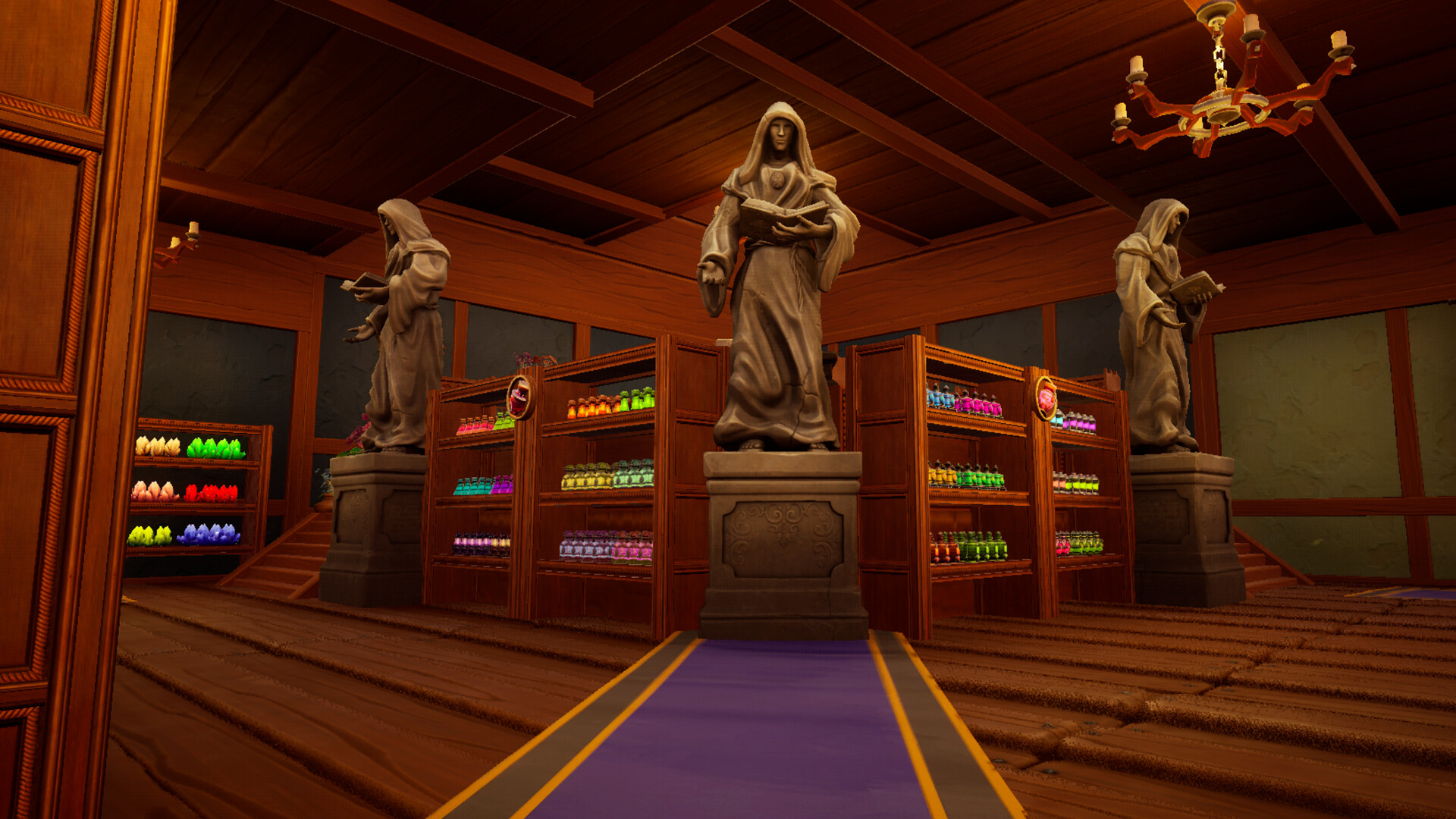
Rows of near-identical potion bottles line the shelves, a running source of both praise and complaintImage: Teddy Bear Games LLC -
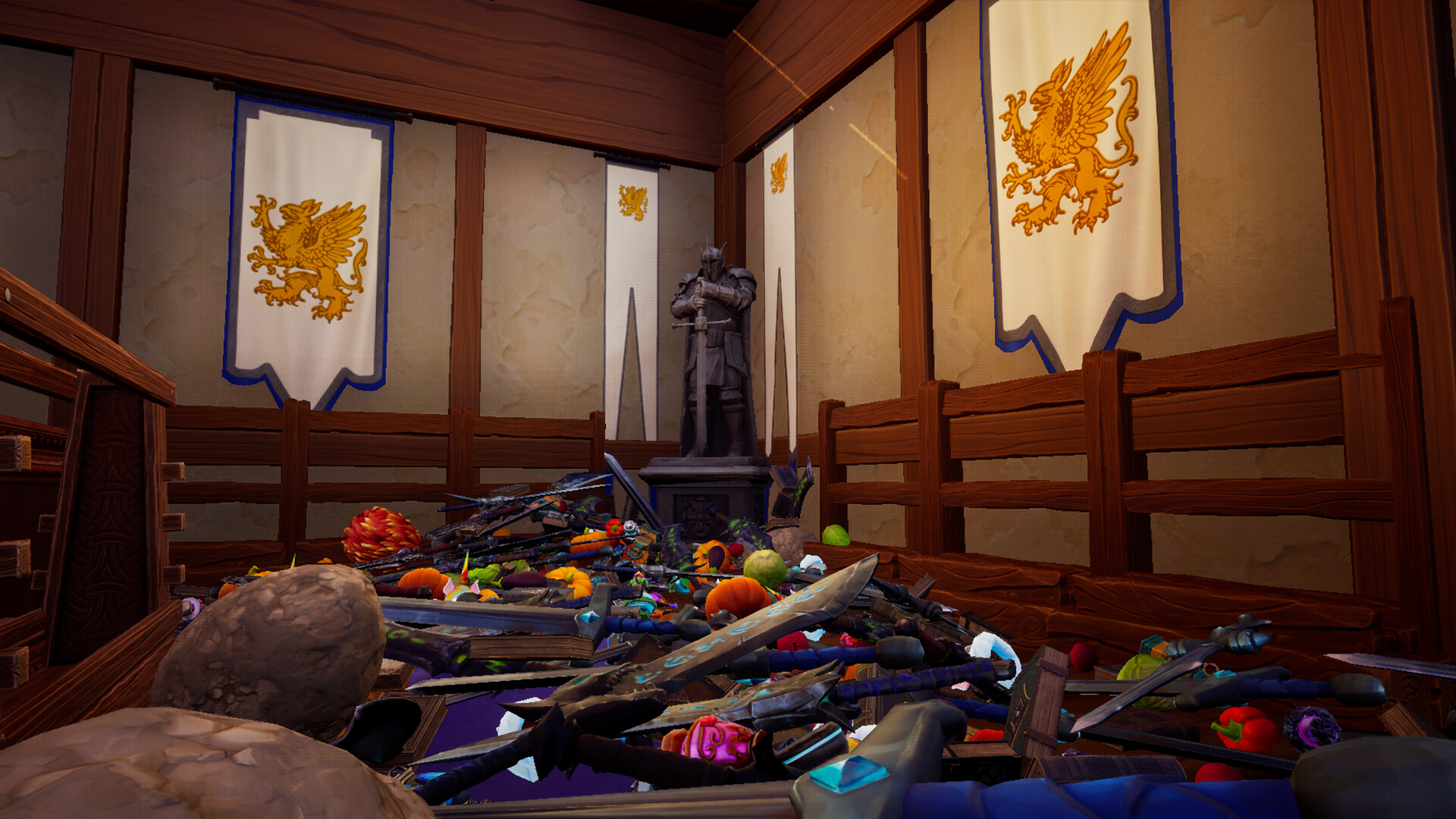
A fresh pile of unsorted stock awaits sorting beneath a knight's statue and heraldic bannersImage: Teddy Bear Games LLC -

Weapon racks demand precise sorting by blade type once the matching sets are broken up in the pileImage: Teddy Bear Games LLC -
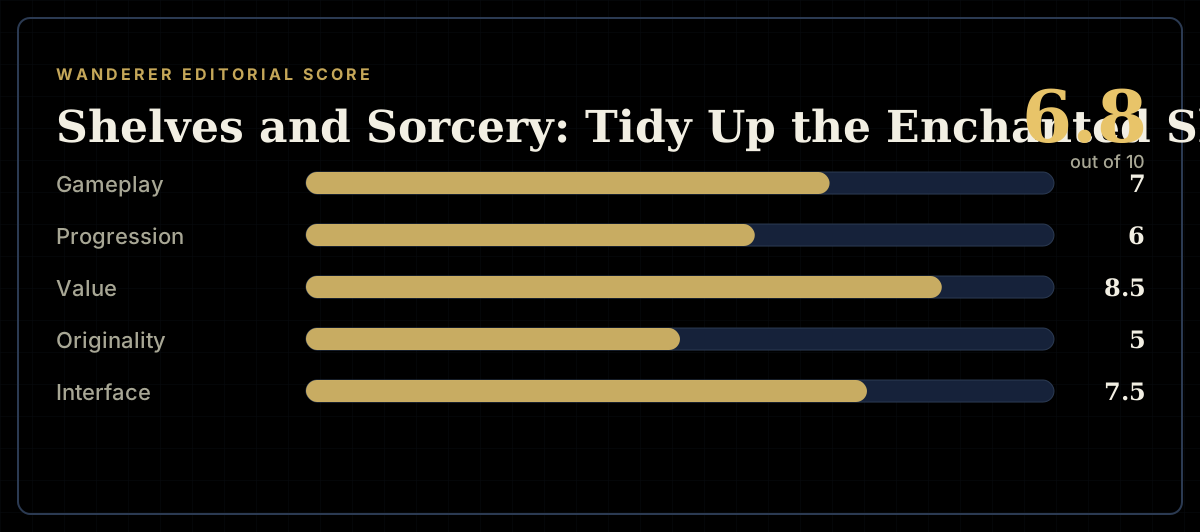
How the review scores each part of the gameWanderer Editorial -
The short versionWanderer Editorial