
Game review
Shadows of Forbidden Gods
6.5 / 10
- Developer
- Bobby Two Hands
- Publisher
- Forbidden Oak Games Limited
- Released
- 15 July 2023
- Platforms
- Windows, macOS, Linux
- Genre
- Dark-Fantasy Grand Strategy
- Monetisation
- One-time premium purchase plus one paid DLC pack (The Horrors Beneath); base game is complete without it
- Players
- Single-player only; no online, co-op or PvP modes
The short version
Shadows of Forbidden Gods casts you as an ancient, awakening evil deity secretly spreading corruption, sickness and madness through a living fantasy world simulated in the style of Crusader Kings, working through agents and cults to bring civilization to ruin without ever revealing yourself directly. Reviewers describe the concept as genuinely without peer on Steam, praising a solo developer's ability to make the simulated world feel alive, with AI rulers and heroes reacting believably to a threat they can't quite see coming.
That praise is set against one of the most consistently harsh interface complaints this lane has documented. Reviewers across the board, including many who love the underlying game, describe clicks that don't register reliably, windows that can't be closed with basic keyboard shortcuts, and mechanics that go unexplained to the point of feeling broken rather than simply under-documented. A long-promised UI overhaul went unfulfilled for roughly two and a half years after the game's last major content update, with reviewers explicitly noting an absence of visible developer activity during that stretch — a claim this review's research confirms, alongside a modest, deliberately cautious fix that finally arrived shortly before this review was written.
Biggest strengths
- A genuinely unprecedented concept that reviewers consistently say has no real equivalent on Steam, casting the player as a secretive evil god working to unravel a simulated fantasy world from the shadows
- A believable, reactive AI-driven world where rulers and heroes respond to threats and events in ways reviewers describe as making the simulation feel genuinely alive rather than scripted
- Real strategic depth for players willing to invest the time to learn its many interlocking systems, offering multiple distinct gods and win conditions across different playthroughs
Biggest weaknesses
- Interface problems draw some of the harshest, most consistent criticism this lane has documented, including unreliable click registration, an inability to close windows with the Escape key, and a map that can't be fully zoomed out to see the whole world at once
- Core mechanics are widely reported as poorly explained, with reviewers describing agent actions failing or triggering unexpected consequences without any in-game indication of why, promoting tedious trial and error rather than informed strategic decisions
- A long-promised, much-anticipated UI overhaul went unfulfilled for roughly two and a half years following the game's last major content update, a gap this review's research confirms directly against the public patch record
Who it's for: Grand strategy fans with real patience for opaque systems and a genuine appetite for an utterly unique concept, ideally willing to consult community guides. Less suited to anyone who needs a well-taught, clearly communicated interface.
Our recommendation: A genuinely one-of-a-kind strategy game worth the friction for the right audience, but go in fully expecting to fight the interface as much as the fantasy kingdoms you're trying to corrupt.
6.5 / 10
One reviewer summarizes Shadows of Forbidden Gods better than any marketing copy could: "The computer is playing Crusader Kings on a procgenned hex map. You're playing Cthulhu." Built almost entirely by a single developer, the game casts you as an ancient, awakening evil deity working in secret to corrupt and unravel a simulated fantasy world, spreading agents, cults and madness through kingdoms that don't yet know what's coming for them. Reviewers describe the concept as genuinely without real equivalent on Steam — and the reception splits sharply on how well the execution matches that ambition.
A concept and a living world reviewers can't stop praising
The praise for Shadows of Forbidden Gods' core idea is close to unanimous, even among reviewers who are otherwise harshly critical of other aspects of the game. The simulated world runs independently of the player, with AI rulers and heroes reacting to genuine threats, forming alliances, and occasionally stumbling onto the player's schemes without any scripted intervention — reviewers describe this as making the world feel authentically alive rather than a static backdrop for the player's plotting. Strategic depth runs genuinely deep for players who invest the time, with multiple distinct gods offering meaningfully different playstyles and win conditions across separate playthroughs, and reviewers repeatedly credit the sheer scope of the achievement given how small the team behind it actually is.
An interface reviewers describe in unusually harsh terms
Set against that acclaim is one of the most consistently harsh interface complaints this lane has documented. Reviewers across the review base, including many who explicitly love the underlying game, describe clicks that don't register reliably, sometimes requiring three or four attempts to select a city or unit, windows that can't be dismissed with the Escape key, and a map that can't be fully zoomed out to see the whole simulated world at once. Beyond pure interface friction, core mechanics are widely reported as poorly explained: reviewers describe agent actions failing or triggering unexpected consequences with no in-game indication of why, turning what should be informed strategic decisions into tedious trial and error. One detailed review captures the frustration precisely, describing an endless cascade of "why" questions the game simply never answers clearly.
A long silence this review's research confirms
At least one reviewer raises a specific, serious claim: that a long-promised, much-anticipated UI overhaul never materialized, and that visible developer activity essentially stopped for roughly a year before their review was written. Checking that claim against the full public patch record confirms it directly — following the game's last substantial content update, a paid DLC expansion in March 2024, the events feed shows no further public activity for roughly two and a half years. When development activity did resume, shortly before this review was researched, the developer's own patch notes are candid about the reasoning behind the long gap: a deliberate decision to avoid updating the game further for fear of breaking existing saves and community mods, only reversed when critical bugs forced action. The resulting update includes real bug fixes and some UI additions — clearer combat information, better alliance-risk visibility — but explicitly falls well short of the comprehensive overhaul reviewers had been hoping for, meaning the core interface complaints above remain largely unresolved even in the game's current state.
A weak first impression that undersells the game's depth
A smaller, more specific complaint concerns onboarding: the mandatory first campaign, using a specific starting god with limited endgame options, is described by multiple reviewers as significantly less interesting than the deities unlocked afterward, giving new players a misleadingly thin first impression of a game that genuinely opens up considerably once its full roster becomes available. Feature bloat draws a related complaint, with several reviewers describing many of the game's numerous systems as failing to combine into satisfying synergy, adding raw complexity without a corresponding increase in strategic clarity.
What the achievement data suggests
Global achievement figures show a genuine win condition achieved by 40.6% of the playerbase — a comparatively high completion rate for a strategy game reviewers otherwise describe as opaque and difficult to learn, suggesting that once players push through the documented onboarding and interface friction, victory is genuinely achievable rather than reserved only for a tiny dedicated minority.
A genre almost entirely its own
One detailed reviewer coins a term for what Shadows of Forbidden Gods represents: "Applecart Upsetting Simulation" — a game where you take a relatively stable, functioning fantasy world and methodically work to destabilize and ruin it from within, rather than the typical 4X format of building something up from nothing. That framing helps explain why direct comparisons to other strategy games consistently fall short: there simply isn't a well-established genre template this game is following, which is both its greatest strength and part of why its systems can feel so disorienting to learn. Community mod support adds a further layer of longevity for players who push through the initial learning curve, with reviewers specifically noting mods introducing entirely new playable god concepts that expand on the base game's already unusual premise.
Where it lands
Shadows of Forbidden Gods offers a genuinely unique, ambitious concept that reviewers across the board credit as unlike anything else available, built by a remarkably small team with real commitment to making its simulated world feel alive. The interface and clarity complaints are real, severe, and consistent enough to weigh heavily against that ambition, and this review's research confirms both the long silence reviewers describe and the modest, incomplete nature of the fix that eventually followed it. For grand strategy fans with genuine patience for friction and a real appetite for something they haven't played before, this remains a worthwhile, if demanding, recommendation.
Pros and cons
Pros
- A genuinely unprecedented concept that reviewers consistently say has no real equivalent on Steam, casting the player as a secretive evil god working to unravel a simulated fantasy world from the shadows
- A believable, reactive AI-driven world where rulers and heroes respond to threats and events in ways reviewers describe as making the simulation feel genuinely alive rather than scripted
- Real strategic depth for players willing to invest the time to learn its many interlocking systems, offering multiple distinct gods and win conditions across different playthroughs
- Remarkable achievement for a game built by a very small development team, with reviewers specifically crediting the scope and ambition on display given the limited resources behind it
- A dense early development history of frequent updates and community engagement, particularly through the game's first two years of Early Access and immediate post-launch support
Cons
- Interface problems draw some of the harshest, most consistent criticism this lane has documented, including unreliable click registration, an inability to close windows with the Escape key, and a map that can't be fully zoomed out to see the whole world at once
- Core mechanics are widely reported as poorly explained, with reviewers describing agent actions failing or triggering unexpected consequences without any in-game indication of why, promoting tedious trial and error rather than informed strategic decisions
- A long-promised, much-anticipated UI overhaul went unfulfilled for roughly two and a half years following the game's last major content update, a gap this review's research confirms directly against the public patch record
- The mandatory first campaign is criticized by multiple reviewers as unrepresentative and less interesting than the gods unlocked afterward, giving new players a weak first impression of the game's actual depth
- Feature bloat draws real criticism, with several reviewers describing many systems that don't combine into satisfying synergies, adding complexity without a corresponding increase in strategic clarity or fun
Screenshots
-

Shadows of Forbidden GodsImage: Forbidden Oak Games Limited via Steam -

Shadows of Forbidden GodsImage: Forbidden Oak Games Limited via Steam -

Shadows of Forbidden GodsImage: Forbidden Oak Games Limited via Steam -
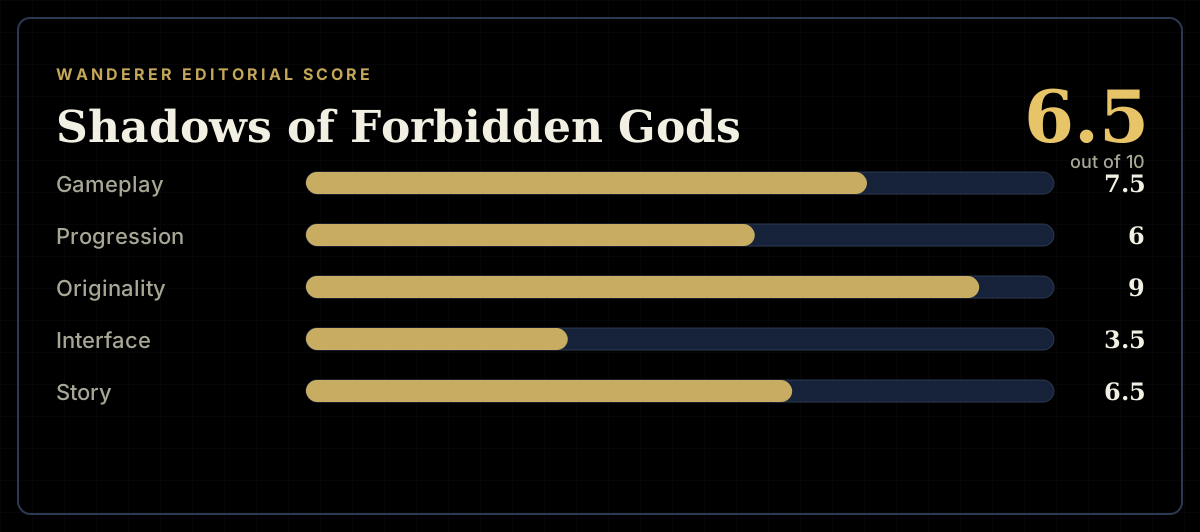
How the review scores each part of the gameWanderer Editorial -
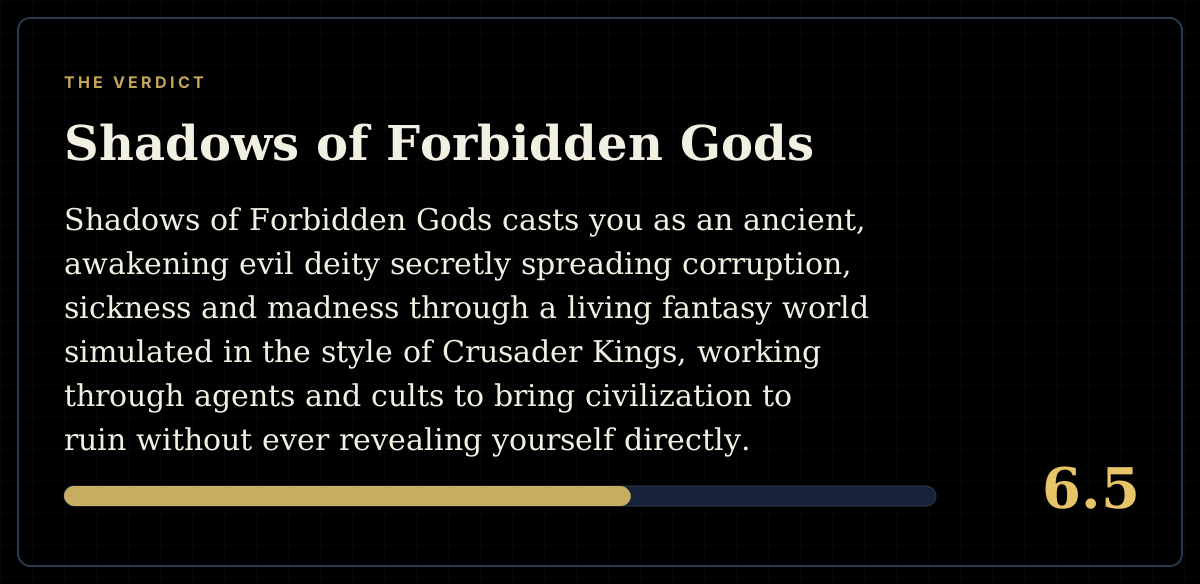
The short versionWanderer Editorial