
Game review
POTUS Election Sim
4.5 / 10
- Developer
- Dackers Studios
- Publisher
- Dackers Studios
- Released
- 3 August 2026
- Platforms
- Windows
- Genre
- Casual, Indie, Simulation, Strategy
- Monetisation
- One-time purchase, no subscription or in-game purchases
- Players
- Single-player
The short version
POTUS Election Sim, released 3 August 2026 by Dackers Studios, pitches a complete political career simulation: win a primary, take the White House, and govern two full terms writing your own responses to debates, crises, treaties and executive decisions, judged by an on-device AI rather than fixed dialogue trees. It sits Mixed with a modest sample of 33 reviews, split almost exactly down the middle, and reading through the full range shows both halves are responding to the same central mechanic rather than talking past each other. A large number of reviewers describe the AI judge as the game's core failure: multiple reviewers report responses graded primarily by length rather than content, near-identical scenarios recurring with only cosmetic detail changes regardless of the player's prior decisions, and at least one reviewer describing the judging AI outputting text in an unexpected language. Set directly against this, a genuinely engaged minority of reviewers, including some logging well over a thousand hours, describe real, ongoing enjoyment from the open-ended, self-authored nature of the concept, and specifically credit the solo developer with fast, visible responsiveness to feedback as reason for optimism about where the game is headed.
Biggest strengths
- The core concept is genuinely distinctive within the political-sim genre: writing your own words for debates, press conferences and executive decisions rather than picking from fixed dialogue options draws real, repeated praise for the creative freedom it offers
- Multiple reviewers logging well over a thousand hours describe the underlying "bones" of the game as strong enough to keep them engaged despite acknowledged flaws, with more than one explicitly hoping continued updates bring it toward the complexity of established political simulators
- Several reviewers specifically credit the solo developer with fast, consistent responsiveness to community feedback, citing this as their primary reason for continued optimism about the game's trajectory despite its rough current state
Biggest weaknesses
- A large number of reviewers report the AI judging system as fundamentally unreliable, with multiple specific accounts of responses being graded primarily by length rather than substantive content, and one reviewer describing a functionally meaningless answer scoring well purely by exceeding a minimum character count
- Multiple reviewers separately report the same specific scenarios recurring nearly verbatim across a single playthrough, with one detailed account citing an identical water-treatment prompt appearing six times in a row with only a changed street name, undermining the simulation's promise of consequential, evolving decision-making
- At least one reviewer reports the judging AI outputting text in an unexpected non-English language during evaluation, and several separately describe general bugs including a campaign incorrectly labelled as a presidential race when actually running for a lower office
Who it's for: Political-simulation fans and creative writers drawn to an open-ended, self-authored decision system who are willing to tolerate a genuinely unreliable AI judge and repetitive event variety in exchange for real conceptual ambition.
Our recommendation: Wait for further patches unless the open-ended writing concept specifically appeals to you regardless of execution quality; the core AI-judging mechanic is reported inconsistent and gameable enough by a large share of this review's sample to undercut the simulation's central promise.
4.5 / 10
Introduction
POTUS Election Sim, released 3 August 2026 by Dackers Studios, sets out to simulate an entire political career: win a primary, capture the White House, and govern two full terms writing your own responses to debates, crises, treaties, wars and even constitutional amendments, judged not by fixed dialogue trees but by an on-device AI reading the player's own words. It sits Mixed with a modest sample of 33 reviews, split almost exactly down the middle, and reading through the full range shows something specific and useful: both the praise and the criticism in this sample are responding to the exact same central mechanic, not talking past each other.
An ambitious, genuinely distinctive premise
The core idea draws real, specific credit from reviewers across both sides of the recommend line. Writing your own responses to debate questions, hecklers and policy crises, rather than selecting from a fixed menu, is repeatedly described as a genuinely fresh approach within the political-sim genre. Multiple reviewers logging well over a thousand hours describe the underlying "bones" of the game as compelling enough to keep them engaged despite acknowledged flaws, with more than one explicitly framing their continued play as a bet on the game eventually reaching the complexity of more established political simulators they admire. Several reviewers separately and specifically credit the developer with fast, consistent responsiveness to community feedback, citing this directly as their reason for staying optimistic about a title they otherwise describe as rough.
An AI judge reviewers say can be gamed and repeats itself
Set against that ambition is this sample's dominant, specific complaint: the AI system meant to evaluate the player's writing is reported as fundamentally unreliable. Multiple reviewers independently describe responses being graded primarily by length rather than substantive content, with one detailed account stating a functionally meaningless answer scored well simply by clearing a minimum character count. Separately, several reviewers report the same specific scenarios recurring nearly unchanged across a single playthrough — one detailed account describes an identical water-treatment policy prompt appearing six times in a row with only a changed street name — directly undermining the sense of consequential, evolving decision-making the premise is built around. At least one reviewer reports the judging AI outputting text in an unexpected non-English language mid-evaluation, and separate reviewers report unrelated bugs, including a campaign that incorrectly labelled a state-level race as a presidential campaign.
"An essay simulator," by more than one reviewer's own description
Beyond the specific AI-reliability complaints, several reviewers frame the moment-to-moment experience more broadly as repetitive by nature, with more than one independently landing on almost the exact same description: an "essay simulator" built around writing similar responses to similar prompts repeatedly, with limited mechanical variety surrounding that central loop. The election-sequence interface draws its own specific criticism as confusingly signposted compared to the rest of the game, adding friction at what should be a key dramatic moment in a presidential campaign.
A small, genuinely engaged fanbase betting on the developer
It would be inaccurate to characterise this review's research as uniformly critical. A meaningful minority of reviewers describe real, sustained enjoyment, including one player who documents a full campaign arc from state legislature through the presidency, complete with escalating foreign policy decisions that produced genuinely unpredictable, entertaining outcomes. Several reviewers in this group explicitly frame current flaws as temporary, expressing hope for continued updates rather than treating the AI-judging problems as fatal, and specifically credit the developer's visible, responsive iteration pace as the reason they're willing to keep playing through a rough current state rather than refunding immediately.
A specific tension: who gets to grade a political simulation?
One detailed thread running through this sample deserves direct attention because it complicates a simple pass/fail read of the AI-judging concept. More than one reviewer frames objections to the judging system not as a technical bug complaint but as a philosophical one, arguing that a single automated system judging inherently subjective political rhetoric was always going to feel arbitrary regardless of how well it's implemented — real political debate judging, after all, is contested even among human moderators and audiences. A separate, smaller group of reviewers pushes back even further, framing criticism of the AI system itself as generational discomfort with AI tools generally rather than a legitimate design complaint, with one bluntly telling critics who dislike the system to "go play a board game instead." This review doesn't find that framing persuasive as a rebuttal to the specific, concrete failures documented above — a response scoring well purely by exceeding a character count is a measurable technical shortcoming, not a subjective philosophical disagreement about what makes a good debate answer — but it's worth reporting as a genuinely-held position within this game's own small community, since it shapes how differently two reviewers can experience the exact same judging output.
Final Verdict
POTUS Election Sim pursues a genuinely distinctive, ambitious premise — a political career told entirely through the player's own written words, judged by AI rather than fixed branching dialogue — and a real, engaged minority of reviewers find enough underneath the rough edges to keep believing in it. What holds this score down is that a large share of this same review sample reports the central AI-judging mechanic as unreliable and easily gamed by simple response length, compounded by scenarios that repeat nearly verbatim regardless of player choice and a genre-typical complaint that too much of the game boils down to writing similar essays to similar prompts. Worth watching if the concept itself excites you and you're willing to bet on continued development; most buyers should wait for the judging system to become more consistent before paying full price.
Pros and cons
Pros
- The core concept is genuinely distinctive within the political-sim genre: writing your own words for debates, press conferences and executive decisions rather than picking from fixed dialogue options draws real, repeated praise for the creative freedom it offers
- Multiple reviewers logging well over a thousand hours describe the underlying "bones" of the game as strong enough to keep them engaged despite acknowledged flaws, with more than one explicitly hoping continued updates bring it toward the complexity of established political simulators
- Several reviewers specifically credit the solo developer with fast, consistent responsiveness to community feedback, citing this as their primary reason for continued optimism about the game's trajectory despite its rough current state
- At least one detailed reviewer reports a genuinely engaging, unpredictable narrative arc across a full campaign, from state legislature through a presidential term including foreign policy decisions with real, escalating consequences
Cons
- A large number of reviewers report the AI judging system as fundamentally unreliable, with multiple specific accounts of responses being graded primarily by length rather than substantive content, and one reviewer describing a functionally meaningless answer scoring well purely by exceeding a minimum character count
- Multiple reviewers separately report the same specific scenarios recurring nearly verbatim across a single playthrough, with one detailed account citing an identical water-treatment prompt appearing six times in a row with only a changed street name, undermining the simulation's promise of consequential, evolving decision-making
- At least one reviewer reports the judging AI outputting text in an unexpected non-English language during evaluation, and several separately describe general bugs including a campaign incorrectly labelled as a presidential race when actually running for a lower office
- The interface draws specific criticism during election sequences, which multiple reviewers describe as confusing and poorly signposted compared to the rest of the game
- Several reviewers frame the entire experience as effectively "an essay simulator," reporting that the bulk of playtime consists of repeatedly writing responses to similar prompts with limited mechanical variety surrounding that core loop
Screenshots
-

POTUS Election SimImage: Dackers Studios via Steam -
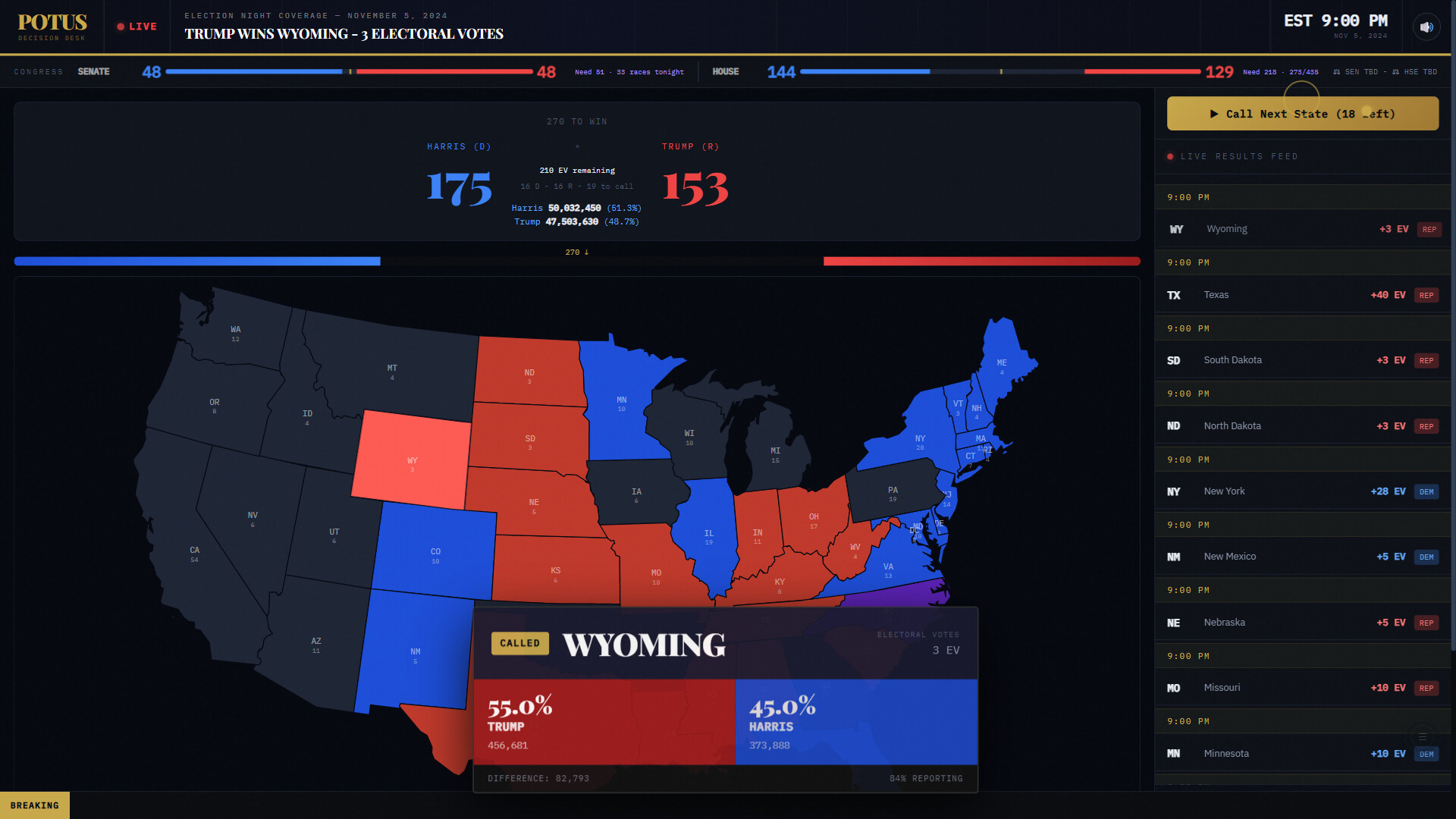
POTUS Election SimImage: Dackers Studios via Steam -

POTUS Election SimImage: Dackers Studios via Steam -
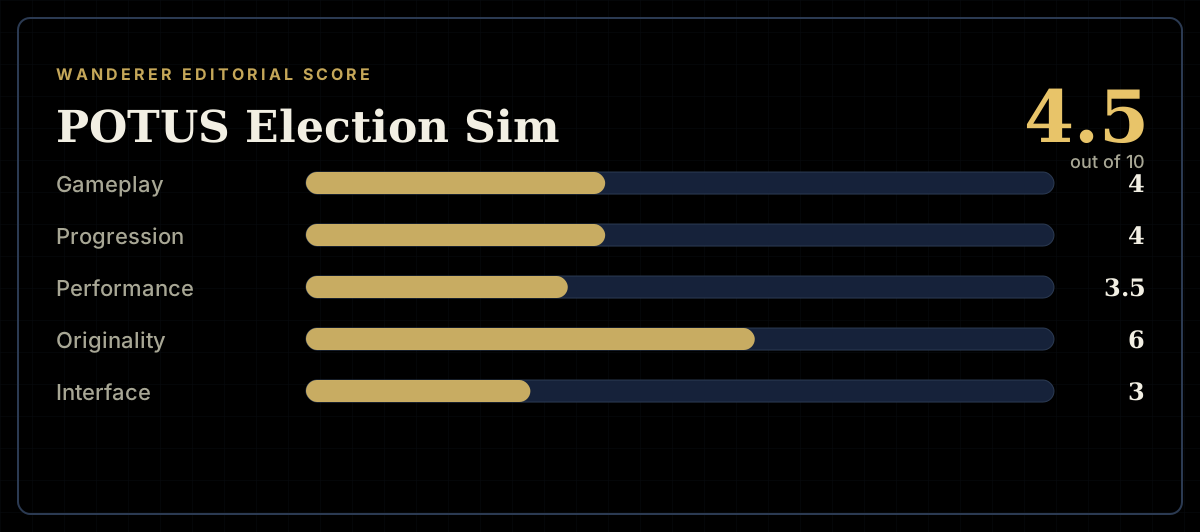
How the review scores each part of the gameWanderer Editorial -
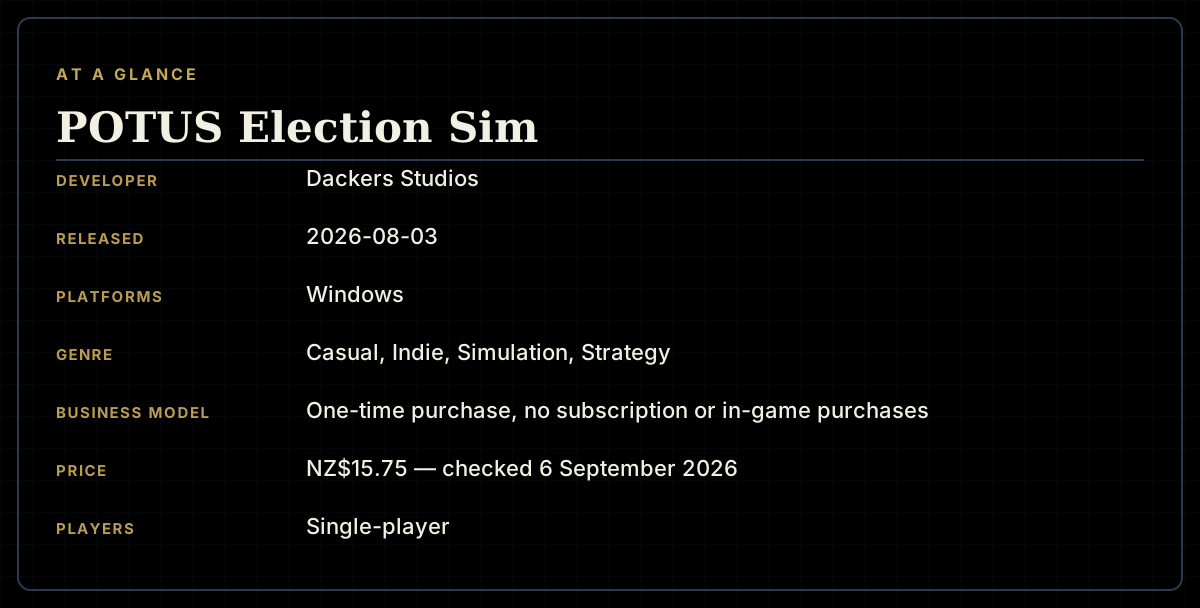
The essentials at a glanceWanderer Editorial -
The short versionWanderer Editorial