
Game review
Snakecremental
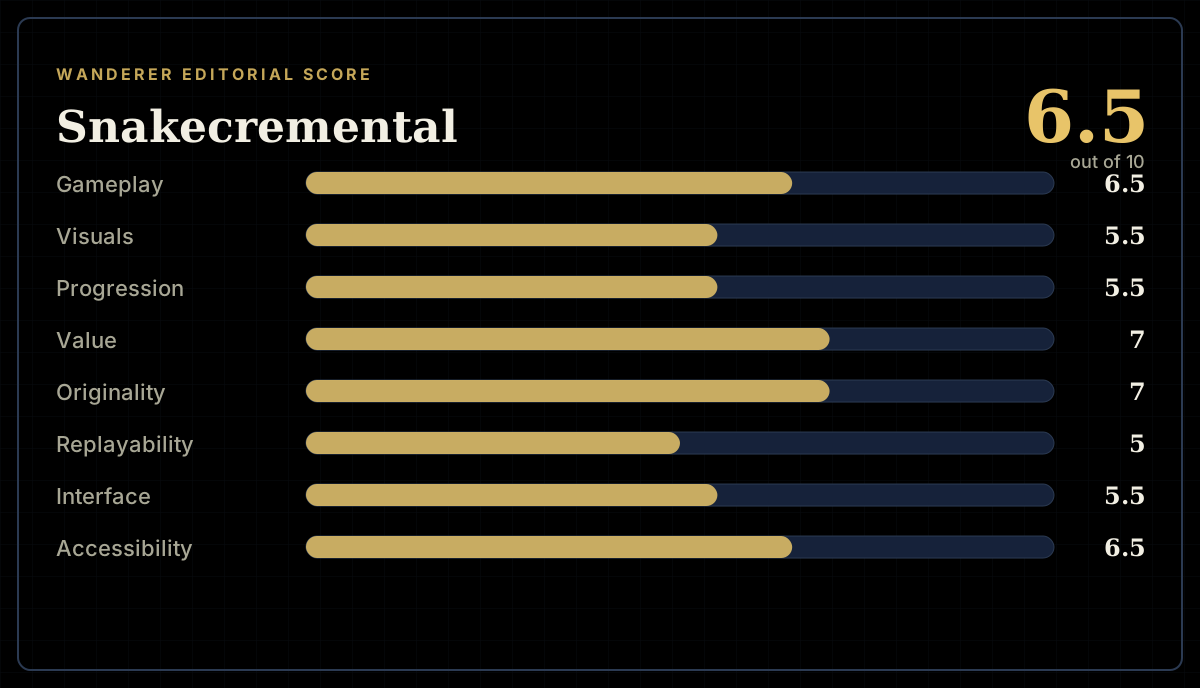
6.5 / 10
- Developer
- Walking Cat
- Publisher
- Walking Cat
- Released
- 22 April 2025
- Platforms
- Windows, macOS, Linux
- Genre
- Incremental, Arcade, Retro
- Monetisation
- One-time purchase, no DLC listed on Steam, no in-game store, no premium currency
- Players
- None — single-player only, with in-game Leaderboards and Steam Achievements the only online-adjacent features
The short version
Snakecremental's pitch — "Snake, but with a skill tree" — undersells what it actually builds: a node-based upgrade tree, closely related to the one in the incremental Nodebuster, laid directly over runs of real, skill-demanding Snake, so that owning every upgrade in the game still doesn't make you good at it. That's a genuinely uncommon design, and for the first several hours it plays like one of the smarter incrementals released this year. It is also, by its own players' account, a game with no reset button and no way back from a bad early pick, one whose difficulty stops rising gently and starts spiking hard from around the Yellow and Pink tiers onward, and whose Steam achievement list buries at least two "missable" unlocks that cost a committed completionist a second multi-hour playthrough. Steam's own achievement data backs the complaint up: of the players tracked, 69% unlock Yellow, 51% reach Pink, and just 28% ever actually finish the game.
Biggest strengths
- The skill tree is built from the same currencies Snake is already collecting, so upgrades like the tongue extension, armor nodes and healing modifiers change how a run of Snake is actually played rather than just how fast a number climbs
- At least one node explicitly rewards cross-currency planning — "yellow boost: collected yellows increase all color value" — showing the tree has real interaction between its color lanes rather than six parallel, disconnected upgrade paths
- A genuinely strong accessibility slate for an arcade-incremental hybrid — Color Alternatives, Camera Comfort, Custom Volume Controls, an adjustable difficulty that includes a turn-based easy mode, Keyboard Only Option and Playable without Timed Input are all listed as Steam categories
Biggest weaknesses
- 33 of the 68 English negative reviews on record (48.5%) use the word "grind" or "grindy," concentrated from the Yellow tier onward, and Steam's own achievement data agrees — the tracked population falls from 69.1% at Yellow to 51.1% at Pink to 34.2% at Colorless, with only 27.9% ever completing the game
- Multiple reviewers describe genuinely unresponsive, input-buffered controls, where mashed key presses queue up and briefly lock the snake out of new turns, with the joystick-to-digital conversion on Steam Deck singled out repeatedly as the worst version of this problem
- A handful of upgrades are outright downgrades once bought — a tongue upgrade that makes navigation harder, and damage-reduction nodes that also cut healing — and the game keeps no reset or respec option, so a bad early pick has to be lived with or the save deleted outright
Who it's for: Snake enthusiasts and incremental-genre regulars who want a game that asks for real manual skill rather than letting numbers do the work, and who don't mind a completion list with some sharp, unforgiving edges.
Our recommendation: Worth the NZ$5.99 for the first four to six hours alone, which is where almost every positive review concentrates its praise — a genuinely inventive marriage of arcade reflexes and node-tree planning. Go in expecting the difficulty to climb sharply rather than smoothly once the Yellow and Pink tiers open, and if you care about the full achievement list, look up which upgrades are missable before you buy anything in-run — several reviewers wish they had.
6.5 / 10
Most incremental games treat their "game" half as a formality — a button to click, a screen to glance at while the real work happens in a spreadsheet of multipliers. Snakecremental refuses that deal. Its skill tree is real, its currencies genuinely interact, and none of it matters if you can't keep a snake alive on a grid, because dying is how a run ends and turning a corner one tile too late is still entirely on you. That's a sharper, more honest hybrid than its jokey name suggests. It's also a game whose own players agree, in striking numbers, on exactly where that honesty turns into punishment.
Snake that remembers everything
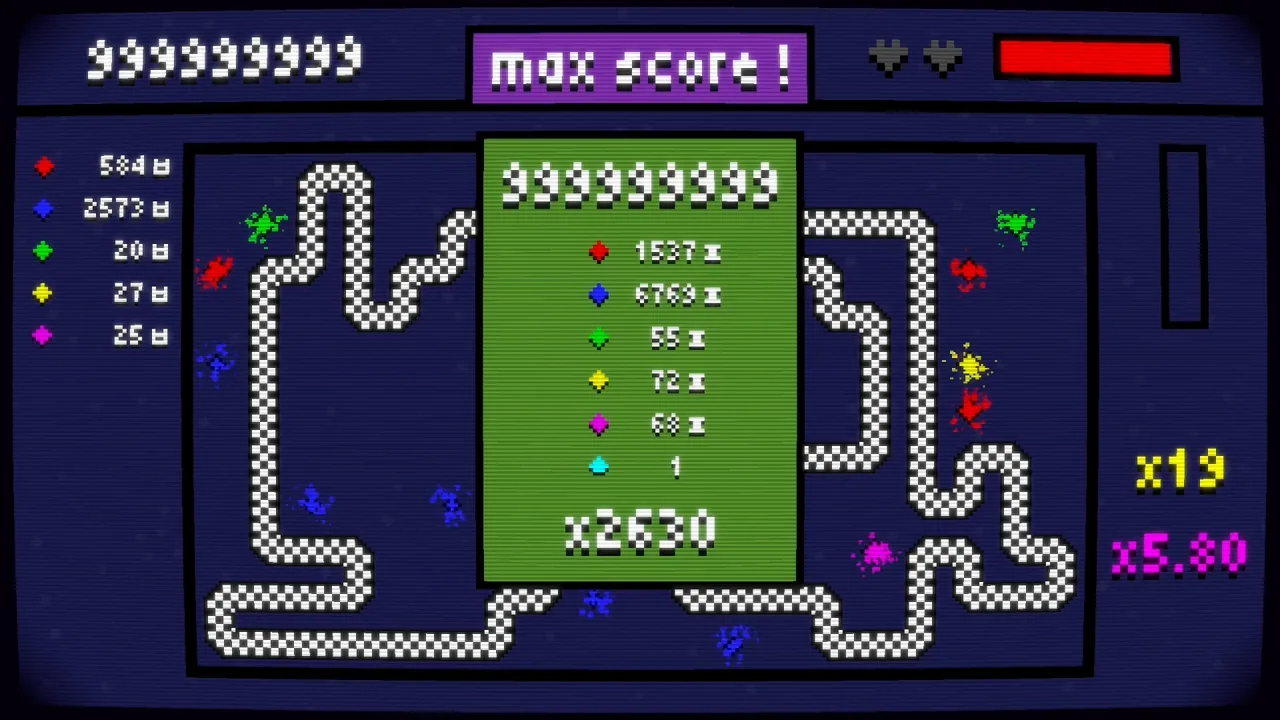
A run of Snakecremental looks, at a glance, like Snake always has: a grid, a body that grows as it eats, a wall or a bitten tail that ends things. What's different is what the food is doing behind the scenes. Colored pickups — red, blue, green, yellow, pink, and eventually a currency the game calls Colorless — aren't just points, they're the resources spent on a permanent skill tree once the run is over. One captured gameplay screen shows a snake with a red/blue/green candy-striped body worth over 80 million points per pickup at a x104 green multiplier stacked alongside separate x24, x11.0 and x4.6 bonuses running on the other colors simultaneously — proof the numbers do climb the way an incremental promises, even while every single pickup still has to be steered into by hand.
A skill tree that actually branches
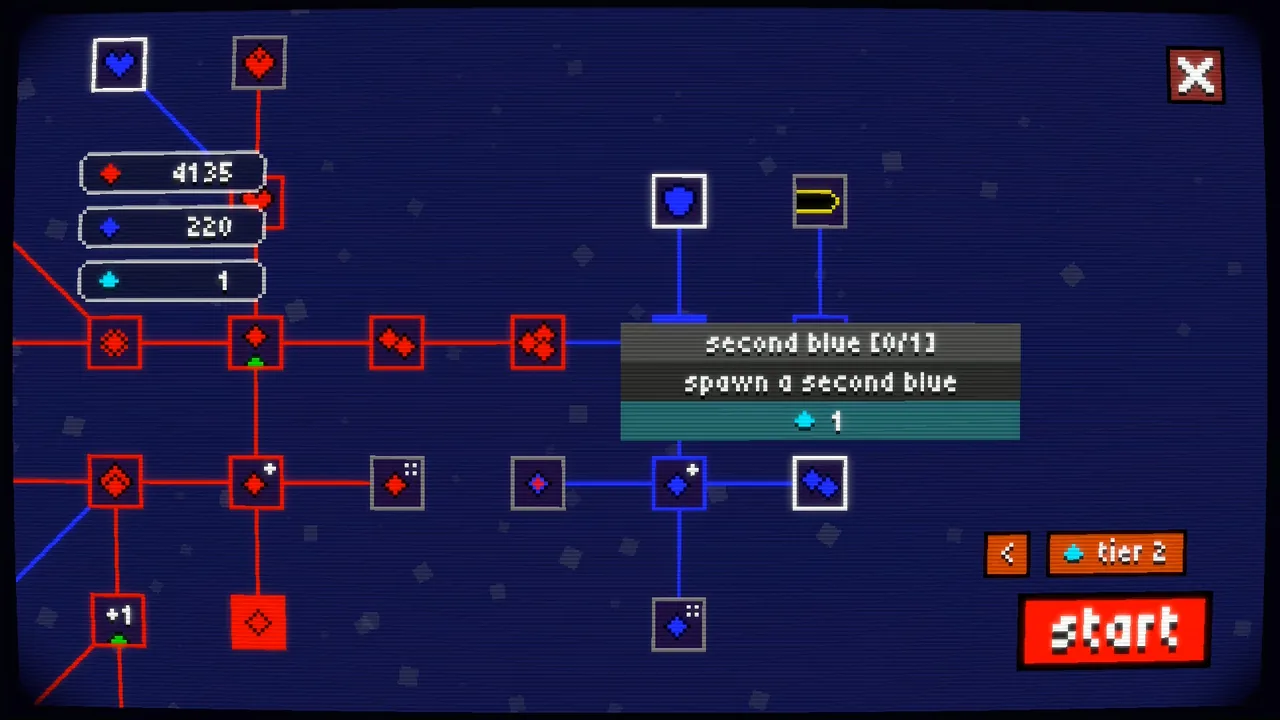
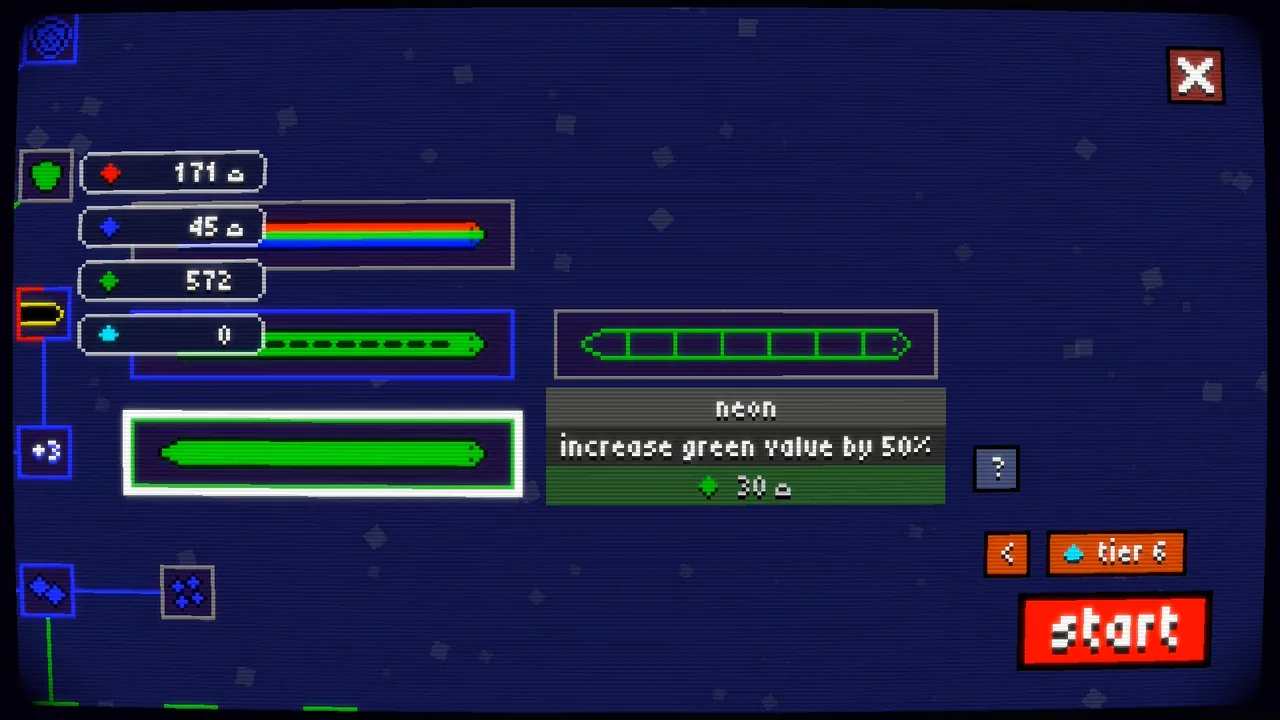
The tree itself, visible directly across several of the game's own promotional screenshots, isn't the flat upgrade list a lot of budget incrementals settle for. Each color runs its own lane of nodes — the blue lane alone shows a shield icon, an ammunition-style icon and a "second blue" node that costs a separate, rarer cyan currency to unlock — and the lanes cross. One screenshot captures a highlighted node reading "yellow boost: collected yellows increase all color value," a genuine piece of cross-currency design that rewards planning a build around synergies rather than just buying whatever's cheapest. It's also, by the reviews' own account, exactly where the trouble starts: a tongue-extension upgrade that several negative reviews single out as making navigation harder, not easier, and damage-reduction nodes that quietly reduce healing along with the damage they prevent. The tree branches in directions that don't always branch upward.
No prestige, and no way back
Ask what happens when a run of Snakecremental gets too big to manage — the genre's usual answer is a prestige or ascension button, a way to cash the mess in for a permanent bonus and start clean. Snakecremental doesn't have one. There's no reset currency, no rebirth multiplier, nothing in the achievement list or the store description resembling the loop genre veterans expect from Nodebuster, the node-clearing incremental named directly by four separate reviews in this game's own corpus as its closest relative. Everything here is a single, continuous, permanent tree, built one Snake run at a time. That has an upside the negative reviewers never once complain about: there's no exploit to be found in ascending early and often, because there's nothing to ascend to. The downside is what they complain about instead — a bad early pick, an upgrade that turns out to hurt more than help, has no undo button short of deleting the save file and starting the whole tree over. A genre built around resets exists partly to forgive mistakes. A genre built around one permanent tree has to live with them.
Where the wall actually is
"Grindy" is the single most common word in this game's negative reviews — 33 of the 68 on record, almost half, use some form of it — and Steam's own achievement data draws the same curve independently. The early game moves fast: 92.4% of the tracked population clears the first tier, 91.6% unlocks Blue. From there it tapers steadily rather than falling off one cliff: 83.6% reach Green, 69.1% reach Yellow, 51.1% reach Pink, and only 34.2% ever unlock Colorless. Just 27.9% of players who've earned any achievement at all have the one for actually beating the game. One reviewer with 17.9 hours logged put it plainly: the game "offers basically no quality of life" once the difficulty ramps, sometimes making a run harder with an upgrade meant to help. Another, at 11.7 hours: "yeah look for 5 bucks it's pretty fun, especially the first few hours. Gets STUPIDLY grindy around tier 9 though, and quickly loses appeal." The playtime numbers back the pattern up rather than undercutting it — negative reviewers logged a median 4.4 hours before writing theirs, almost exactly one full run, while the positive sample's median sits at 8.2 hours. This isn't a wave of people bouncing off the tutorial. It's a game that holds a lot of its audience right up until the wall, and then loses a large share of them there.
Controls that don't always agree with the plan
A skill tree this dependent on precise, manual Snake movement lives or dies on how the controls feel, and that's the other recurring complaint in the negative sample. Thirteen of the 68 mention "control" directly, and several describe something more specific than vague dissatisfaction: input buffering that queues up mashed key presses and briefly locks the snake out of new turns, delayed or dropped directional changes, and — repeatedly, across four separate reviews — a joystick-to- digital conversion on Steam Deck that one reviewer says causes inputs to fail to register roughly one time in five, even on the turn-based easy mode. None of this reads as a game that's unresponsive by design. It reads as a control layer that hasn't been tuned as carefully as the skill tree sitting on top of it, in a genre-arcade hybrid where responsive controls aren't a nice- to-have, they're half the pitch.
The accessibility list undercut by its own execution
Credit where it's due: Snakecremental's Steam listing carries a genuinely strong accessibility slate for a five-dollar solo release — Color Alternatives, Camera Comfort, Custom Volume Controls, an Adjustable Difficulty setting that includes a turn-based easy mode for players who want to think between moves rather than react in real time, a Keyboard Only Option, and Playable without Timed Input. That's more accessibility groundwork than most arcade-incrementals bother shipping, clicker or otherwise. The problem, per the reviews above, is that the baseline control feel undercuts the list it sits alongside — an easy mode that still drops roughly one in five inputs isn't quite delivering on what "adjustable difficulty" is meant to promise.
A developer who showed up hard, then stopped
The Steam news feed tells an unusually clean before-and-after story. Snakecremental launched 22 April 2025 on the back of a demo released three days earlier, and the developer shipped eight patches in the following seven weeks — v1.0.1 through v1.1.9, adding leaderboards, a new skin, macOS support and assorted fixes at a steady clip through late May and early June 2025. Then, beyond a June cross-promotion and a November bundle inclusion, the feed goes almost silent: one more patch, in March 2026, added Portuguese-Brazilian localization and fixed what the changelog calls "that one Unity bug," and nothing has followed in the five months since. Whether the grind wall and control complaints above were ever meant to be addressed in a balance pass that never came isn't something this review can state as fact — but a year and four months after a strong launch window, the update history reads like a game its developer considers finished rather than one still being tuned.
Not the idle game its own tags suggest
Snake's own listing is a small case study in mismatched signals. Steam's official genre line reads Casual, Indie, Simulation — none of which say much about what this actually is — and the visible tag pills include "Idler." The vote-weighted community tags, the ones players actually clicked to endorse, tell a different story: Incremental leads with 160 votes, followed by Retro, Arcade, Resource Management and Simulation, with Idler sitting eighth at 89. The reviews agree with the voters, not the label. "THIS IS NOT AN IDLE GAME," one four-hour player wrote in capital letters, warning that the "idler" and "clicker" tags are simply wrong. Another: "Don't be fooled... at least not as far as I've played it yet." For readers used to a game that keeps earning while they're away, like Wanderer, that distinction matters more than a genre tag usually would — nothing in Snakecremental progresses unless a hand is on the controls.
Final verdict
Snakecremental earns real credit for a design idea most incrementals never attempt: making the arcade half of an arcade-incremental hybrid actually matter, so that the skill tree changes how you play Snake instead of replacing the need to play it well. For four to six hours, by its own players' overwhelming account, that idea works. It loses ground for what happens after — a difficulty curve that tapers from a comfortable 92% clearing the opening tier down to barely a quarter of players ever finishing the game, controls that a sizeable minority call genuinely unreliable rather than merely demanding, a permanent tree with no way to undo a bad pick short of starting over, and an achievement list that punishes completionists for choices they had no way of knowing were permanent. NZ$5.99 is a fair price for what the first several hours deliver. Just know that the later tiers are where this library's readers report the game stops being clever and starts being a test of patience instead.
Pros and cons
Pros
- The skill tree is built from the same currencies Snake is already collecting, so upgrades like the tongue extension, armor nodes and healing modifiers change how a run of Snake is actually played rather than just how fast a number climbs
- At least one node explicitly rewards cross-currency planning — "yellow boost: collected yellows increase all color value" — showing the tree has real interaction between its color lanes rather than six parallel, disconnected upgrade paths
- A genuinely strong accessibility slate for an arcade-incremental hybrid — Color Alternatives, Camera Comfort, Custom Volume Controls, an adjustable difficulty that includes a turn-based easy mode, Keyboard Only Option and Playable without Timed Input are all listed as Steam categories
- A one-time NZ$5.99 purchase with no DLC, no in-game store and no premium currency anywhere on its Steam listing, and reviewers who finished it are broadly comfortable calling it worth the money
- Several of the game's own positive reviews go out of their way to correct Steam's "Idler" tag on its behalf, warning newcomers this demands active, skillful play throughout rather than the background automation the label implies
Cons
- 33 of the 68 English negative reviews on record (48.5%) use the word "grind" or "grindy," concentrated from the Yellow tier onward, and Steam's own achievement data agrees — the tracked population falls from 69.1% at Yellow to 51.1% at Pink to 34.2% at Colorless, with only 27.9% ever completing the game
- Multiple reviewers describe genuinely unresponsive, input-buffered controls, where mashed key presses queue up and briefly lock the snake out of new turns, with the joystick-to-digital conversion on Steam Deck singled out repeatedly as the worst version of this problem
- A handful of upgrades are outright downgrades once bought — a tongue upgrade that makes navigation harder, and damage-reduction nodes that also cut healing — and the game keeps no reset or respec option, so a bad early pick has to be lived with or the save deleted outright
- At least two Steam achievements are "missable" in ways only discoverable after the fact — buying a specific upgrade too early, or too late, permanently locks a hidden unlock — pushing completionists toward a second three-to-eight-hour playthrough just to finish the list
- Development support has gone quiet: after roughly eight patches in Snakecremental's first seven weeks on sale, Steam's own news feed shows exactly one further update in the following fourteen months, a March 2026 localization patch, and nothing in the five months since
Screenshots
-
SnakecrementalImage: Walking Cat via Steam -
SnakecrementalImage: Walking Cat via Steam -
SnakecrementalImage: Walking Cat via Steam -
How the review scores each part of the gameWanderer Editorial -

The game at a glanceWanderer Editorial -
The short versionWanderer Editorial