
Game review
Romancing SaGa 2: Revenge of the Seven
8 / 10
- Developer
- Square Enix, xeen Inc.
- Publisher
- Square Enix
- Released
- 24 October 2024
- Platforms
- Windows, PlayStation 4, PlayStation 5, Nintendo Switch, Xbox One, Xbox Series X|S
- Genre
- JRPG
- Monetisation
- One-time purchase, no DLC or in-game currency
- Players
- Single-player
The short version
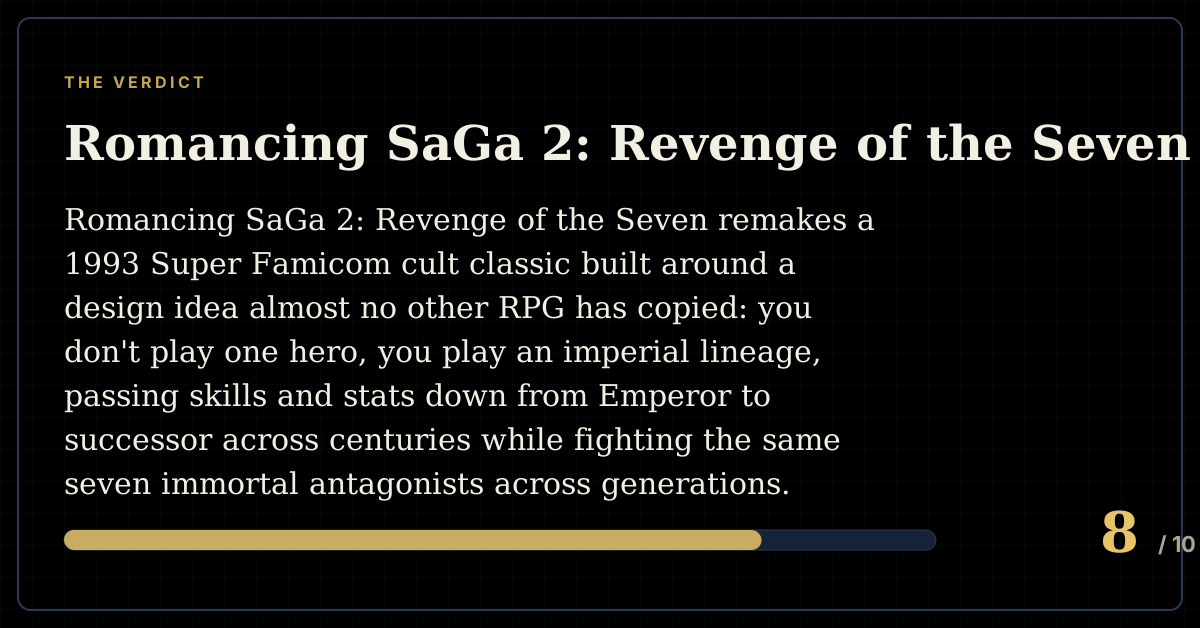
Romancing SaGa 2: Revenge of the Seven remakes a 1993 Super Famicom cult classic built around a design idea almost no other RPG has copied: you don't play one hero, you play an imperial lineage, passing skills and stats down from Emperor to successor across centuries while fighting the same seven immortal antagonists across generations. Critics were close to unanimous — OpenCritic rates it "Strong" at 82 from 72 reviews — and Steam agrees at Very Positive, 93.2% across nearly 3,900 reviews. What that headline score doesn't fully capture is that a real, specific slice of its own negative reviews are still actively arguing with a design choice that's original to 1993, not new to this remake: fighting the same enemies too often makes them scale up and start one-shotting the player, an intentional anti-grinding philosophy the remake preserves and, if anything, makes more visible than the original ever did. Only about 12% of players have the achievement for finishing the main story, a real, measurable sign of how many bounce off that friction before the payoff arrives.
Biggest strengths
- The generational succession system, where stats, skills and equipment pass from a retiring Emperor to their chosen successor across an in-game span of centuries, remains a genuinely unique structural idea more than three decades after the original popularised it
- Critics were close to unanimous in their praise, with OpenCritic rating it "Strong" at 82 from 72 reviews, and it's Very Positive on Steam at 93.2% across nearly 3,900 reviews
- The PC port is unusually well-regarded even among detailed critical reviews, with specific praise for mouse support and controller-free playability that reviewers say is rare for a JRPG this systems-heavy
Biggest weaknesses
- The signature anti-grinding mechanic — enemies scale up in difficulty the more you fight them, to the point of one-shotting characters who over-engage with combat — is a genuine, top-voted source of frustration among players unfamiliar with the original SaGa design philosophy it's faithfully carried forward from
- The generational succession structure that gives the game its identity is also its biggest emotional cost for some players: multiple detailed reviews say losing an attached-to character to a scripted time skip, sometimes with little warning, was the specific point they stopped playing
- Missable content tied to unclear time-skip windows draws repeated, specific complaints, including quests that remain active and "given" by characters who should already be dead according to the story's own internal logic
Who it's for: JRPG players specifically curious about non-linear, systems-driven design, and longtime SaGa series fans, are the ideal audience — this is widely considered one of the best entry points to a notoriously unusual series. Players who want to level up freely, grind at their own pace, or stay attached to one set of named party members for an entire campaign should read the specific complaints below carefully; the generational structure and anti-grinding scaling aren't bugs to be patched, they're the entire point, and both are exactly what a meaningful share of this game's negative reviews are reacting against.
Our recommendation: Recommended, especially for players willing to let go of conventional JRPG expectations around levelling and character permanence. This is a genuinely rare kind of game built on ideas from 1993 that still haven't been widely copied, modernised here with an unusually well-regarded PC port. Go in expecting a game about managing decline and succession across centuries, not one about a single hero's steady power fantasy, and it delivers something most of the genre still doesn't attempt.
8 / 10
An empire, not a hero
Most JRPGs, even good ones, are built around a single protagonist's steady climb from nobody to world-saver. Romancing SaGa 2 was never that game, and Revenge of the Seven — Square Enix's full remake of the 1993 Super Famicom original — doesn't try to soften that. The player rules the Empire of Varennes across a span of in-game centuries, and the actual playable character changes as each Emperor eventually gives way to a chosen successor who inherits their stats, techniques and unfinished business fighting the seven immortal antagonists the empire has warred against since its founding. It's a structural idea almost no other RPG series has directly copied in the thirty-plus years since, and it remains the single most distinctive thing about this game — critics and Steam's own review base broadly agree on that much, with OpenCritic rating the remake "Strong" at 82 from 72 critics and Steam sitting Very Positive at 93.2% across nearly 3,900 reviews.
A design philosophy the remake didn't soften, and some players didn't expect
Where Steam's own audience is visibly still working something out, thirty years after the original shipped, is the game's approach to combat progression. Fighting the same enemies repeatedly doesn't just fail to trivialise them here — it actively scales them up, to the point that multiple detailed negative reviews describe going from comfortably beating an enemy type to being one-shot by the identical enemy shortly after, seemingly as a direct consequence of engaging with combat more. Read in isolation, that sounds like a bug or a balance failure, and several reviews treat it that way. It isn't new to this remake: the mechanic is original to the 1993 SaGa design philosophy specifically built to discourage mindless grinding, and multiple critic reviews note that Revenge of the Seven's actual changes here are about making the underlying systems more visible and legible to a modern audience, not about altering how they function. That context doesn't make the friction disappear for players who bounce off it — several specifically say the discovery that "engaging with the battle system more makes the game harder" pushed them toward running past every enemy they could, which is its own kind of dispiriting outcome even if it's technically a valid strategy the game supports.
The generational succession system creates a related, more emotionally-charged version of the same tension. Passing a character's accumulated growth to a successor is the game's central conceit, and reviewers who embrace it describe genuine investment in watching an empire's fortunes play out across centuries rather than one hero's arc. But for players who get attached to a specific named character the way most RPGs train you to, losing that character to a scripted time skip — sometimes with limited warning that it's coming — is repeatedly cited as the exact moment several reviewers stopped enjoying the game. Layered on top, unclear time-skip windows create real, specific missable-content frustration: several reviews describe quests that remain active and offered by characters who, by the story's own internal logic, should no longer be alive after a generational transition the player didn't realise was imminent.
The numbers back up how real the drop-off is
This isn't just review-text impressions. Steam's global achievement data shows the achievement for completing the main story sitting at only about 11.8% — a genuinely low figure for a JRPG with a review base this positive, and one that corroborates the specific pattern the negative reviews describe: players who enjoy the opening hours but stop before the systems' demands and rewards fully pay off. It's worth being precise about what that figure does and doesn't prove — SaGa games have always had a reputation as more demanding and less hand-holding than the JRPG mainstream, and a low completion rate on a famously unconventional game isn't automatically evidence of a design failure. But it is real, measurable evidence that the friction described above turns away a meaningful share of the people who bought the remake, whatever the reason.
What isn't in dispute
Away from the succession-and-scaling debate, there's real consensus. The PC port draws specific, repeated praise even from otherwise critical reviewers — one detailed review calls it "one of the best ports I've ever seen," citing genuinely intuitive mouse support and controller-free playability that JRPGs this systems-dense rarely manage well. The Free Scenario structure, letting players tackle the game's major story arcs in close to any order they choose, preserves the same non-linear freedom the 1993 original built its reputation on. And the decision to make systems more transparent rather than rebuilding them from scratch is one multiple outlets specifically credit as evidence of respect for the source material, rather than a lack of ambition.
Verdict
Romancing SaGa 2: Revenge of the Seven succeeds specifically because it refuses to sand down what made the 1993 original strange and demanding in the first place — a structural idea about empire and succession that no other RPG series has meaningfully copied, and an anti-grinding combat philosophy that rewards careful, strategic engagement over brute-force levelling. That fidelity is exactly why a real, vocal slice of its own player base is still working through genuine frustration with mechanics that are faithfully thirty years old rather than remake missteps. Go in knowing what kind of game this is — one about managing decline and succession across centuries rather than one hero's steady rise — and it delivers something genuinely rare in the genre. Go in expecting a conventional JRPG power fantasy, and the specific friction points above are exactly where that expectation will break.
Pros and cons
Pros
- The generational succession system, where stats, skills and equipment pass from a retiring Emperor to their chosen successor across an in-game span of centuries, remains a genuinely unique structural idea more than three decades after the original popularised it
- Critics were close to unanimous in their praise, with OpenCritic rating it "Strong" at 82 from 72 reviews, and it's Very Positive on Steam at 93.2% across nearly 3,900 reviews
- The PC port is unusually well-regarded even among detailed critical reviews, with specific praise for mouse support and controller-free playability that reviewers say is rare for a JRPG this systems-heavy
- The Free Scenario system lets players tackle major story arcs in almost any order, giving the same non-linear freedom the 1993 original was known for
- Small, careful changes make the underlying systems more legible to modern players without altering how they actually work, a deliberate choice reviewers across multiple outlets credit as respecting rather than diluting the source material
Cons
- The signature anti-grinding mechanic — enemies scale up in difficulty the more you fight them, to the point of one-shotting characters who over-engage with combat — is a genuine, top-voted source of frustration among players unfamiliar with the original SaGa design philosophy it's faithfully carried forward from
- The generational succession structure that gives the game its identity is also its biggest emotional cost for some players: multiple detailed reviews say losing an attached-to character to a scripted time skip, sometimes with little warning, was the specific point they stopped playing
- Missable content tied to unclear time-skip windows draws repeated, specific complaints, including quests that remain active and "given" by characters who should already be dead according to the story's own internal logic
- Steam's global achievement data shows only about 11.8% of players have completed the main story, a genuinely low figure that corroborates how much of the audience doesn't push through the friction points above
- At least one long, detailed 86-hour review from a self-described longtime fan argues the remake specifically undersells what made the 1993 original special, a dissenting voice worth weighing against the otherwise strong critical consensus
Screenshots
-

Romancing SaGa 2: Revenge of the SevenImage: Square Enix via Steam -

Romancing SaGa 2: Revenge of the SevenImage: Square Enix via Steam -

Romancing SaGa 2: Revenge of the SevenImage: Square Enix via Steam -
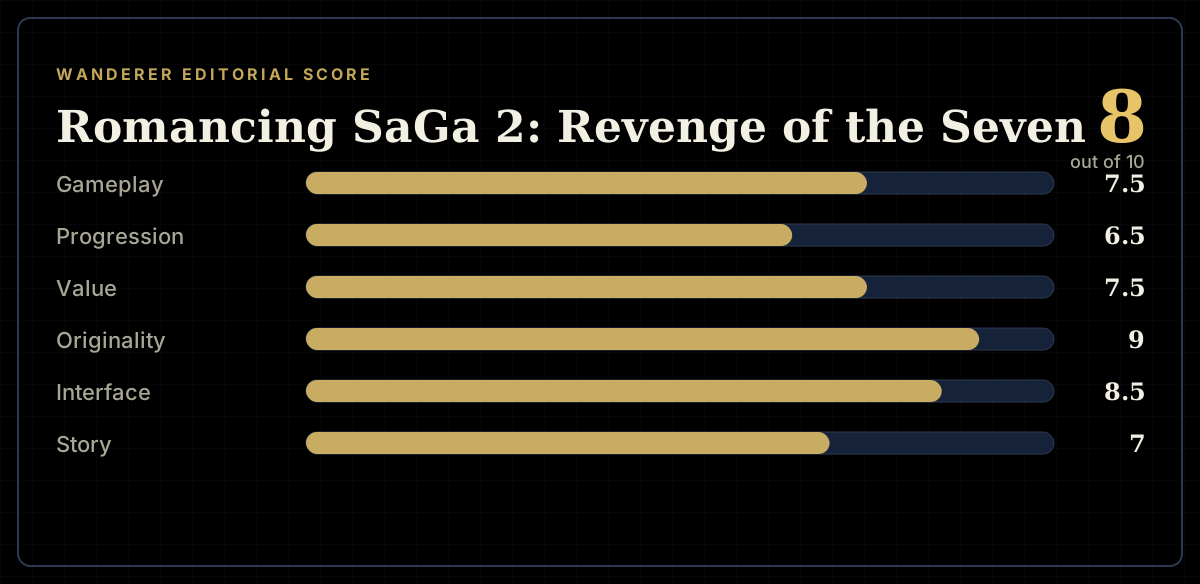
How the review scores each part of the gameWanderer Editorial -
The short versionWanderer Editorial