
Game review
Visions of Mana
6.5 / 10
- Developer
- Square Enix
- Publisher
- Square Enix
- Released
- 29 August 2024
- Platforms
- Windows, PlayStation 4, PlayStation 5
- Genre
- Action RPG
- Monetisation
- One-time purchase, no in-game currency
- Players
- Single-player
The short version
Visions of Mana is the first new mainline Mana game since 2006's Trials of Mana on the SNES, built around a three-character party that swaps elemental "vessel" classes on the fly, and it's Mostly Positive across just over 2,100 Steam reviews at 77%. The combat is a genuine highlight, an improvement several longtime fans specifically credit over 2020's Trials of Mana remake, and its art direction and soundtrack draw close to unanimous praise even from the game's harshest critics. What holds it back is everything built around that combat: exploration has been flattened by a map that marks every treasure chest and point of interest in advance, class progression has been simplified into freely swapping vessels rather than the series' traditional class-advancement system, and a story multiple longtime fans call the weakest the series has told feels conspicuously thin in its closing hours. Days after launch, NetEase began laying off nearly the entire staff of Ouka Studios, the Tokyo developer it had built specifically to make games like this one — a real, separately documented event that several players have connected to the game's unfinished-feeling final stretch.
Biggest strengths
- Three-character party combat, switching between elemental vessel classes mid-fight, is repeatedly singled out as an improvement over the Trials of Mana remake's combat, even by reviewers who are otherwise critical of the game
- Art direction and environment design draw close to unanimous praise, including from the most detailed negative reviews
- The soundtrack is consistently named as one of the game's best elements across both positive and negative reviews
Biggest weaknesses
- Every treasure chest and point of interest is marked on the map from the outset, which several detailed reviews argue removes the sense of discovery that made earlier Mana games' worlds rewarding to explore
- The series' traditional class-advancement system is gone, replaced by freely swapping between unlocked vessel classes at will — a simplification multiple longtime-fan reviews specifically mourn as a loss of RPG depth
- Story and characters are called the weakest in the series by multiple detailed, high-playtime reviews, with the story's back half in particular criticised as rushed and underdeveloped
Who it's for: Longtime Mana fans who came in with tempered expectations after the mixed Trials of Mana remake are the most likely to have a good time, especially if combat and presentation matter more to them than a deep RPG structure underneath it. Players new to the series looking for a substantial, richly systemized JRPG, or longtime fans specifically nostalgic for the original games' harder, more layered exploration and class systems, are more likely to end up among the reviewers calling this the series' weakest recent entry.
Our recommendation: A cautious recommendation, mainly for existing fans of the series and for players who prioritise combat feel and presentation over story and exploration depth. New players curious about the Mana series are better served starting with the well-regarded Trials of Mana remake first; if this one's systems still appeal after that, buy on a sale given how consistently reviewers flag its second half as thinner than its opening hours.
6.5 / 10
The first new Mana in eighteen years, and a franchise finally moving on from Trials
Visions of Mana is the first entirely new mainline entry the Mana series has had since Dawn of Mana and the original Trials of Mana closed out the SNES-and-early-2000s era of the franchise. Square Enix spent the years leading up to it re-releasing and remastering the back catalogue — the excellent 2020 Trials of Mana remake most prominently — so this was always going to be judged as much against that recent remake as against the series' classic reputation. The verdict from just over 2,100 Steam reviews is "Mostly Positive" at 77%, a real step down from the remake's own reception, and reading through the detailed negative reviews makes clear it isn't one single flaw driving that gap — it's a series of smaller simplifications that, added together, leave the game feeling thinner than what came before it.
Combat that earns its praise, wrapped around a world that doesn't
The single most consistent point of agreement across both positive and critical reviews is that the combat works. Val, the player's controlled protagonist, leads a three-character party built around swapping "vessels" — elemental classes tied to spirits the party gathers across the story — mid-fight, and multiple longtime fans specifically call it an improvement over the Trials of Mana remake's own combat system. It's fast, it's readable, and the vessel-swap mechanic gives fights a rhythm that holds up across the reviews that otherwise have plenty to complain about elsewhere.
The world those fights happen in is where the complaints concentrate. Previous Mana games built their appeal partly on exploration that rewarded curiosity — finding a treasure chest tucked somewhere the map didn't already tell you about, or discovering a shortcut that changed how you thought about a zone. Visions of Mana's map marks every chest and point of interest from the start, which more than one detailed review calls out specifically as removing that sense of discovery rather than assisting it. A second, related complaint concerns class progression itself: the series has traditionally used a class-advancement system where characters commit to and grow into a class over time, and Visions of Mana replaces that with vessels the player can freely swap at will. It's a legitimate design choice with its own logic — more flexibility, less commitment friction — but reviewers who grew up with the older systems consistently describe it as a loss of depth rather than a modernisation, and it's hard to read that many independent, detailed accounts saying the same thing as pure nostalgia.
A story several longtime fans call the series' weakest, and the signs of why
Where Visions of Mana loses the most ground with its own core audience is the story. Multiple long, detailed reviews — several with 60-plus hours logged, ruling out early bounce-off as the explanation — independently call it the weakest narrative the series has produced, with specific frustration directed at underdeveloped characters and a back half that feels compressed relative to the game's opening hours. That complaint has a concrete, checkable example behind it rather than just vibes: at least one late-game dungeon is built around a switch that raises the area's water level exactly once, is never used again, and is never referenced by anything else in the dungeon — precisely the kind of loose thread that shows up when content gets cut rather than redesigned. Documented technical issues compound the impression of a rushed finish: crashes, enemies clipping through the floor, and a specific, reproducible bug where players emerge from battle able to dash and jump but not walk, fixable only by reloading the game.
None of this happened in a vacuum. Days after the game launched, reports confirmed that NetEase — the Chinese conglomerate that owns Ouka Studios, the Tokyo developer built specifically to produce games like this one, staffed with veterans hired from Capcom and Bandai Namco — had cut nearly the entire Ouka team, with the studio's closure widely expected to follow as part of a broader NetEase pullback from Japanese game development investment. Square Enix published the game and Ouka built it; the layoffs are NetEase's decision, not Square Enix's, and there's no confirmed reporting that says the game's development was cut short by the same turmoil that led to the studio's closure days later. But the timing is close enough, and the game's own back half thin enough, that it's easy to see why several players have connected the two — and worth reporting plainly rather than pretending the coincidence doesn't exist.
What still lands
It would be a disservice to all of the above to undersell what the game gets right. Art direction and environment design draw close to unanimous praise, including from reviewers who are otherwise sharply critical of the story and progression systems — it's a genuinely beautiful game to walk through, zone to zone. The soundtrack gets the same treatment: named as a highlight in nearly every detailed review this piece drew from, whatever else that review had to say. And Square Enix built in an unusually thorough accessibility suite for the genre — camera comfort options, adjustable difficulty, a keyboard-only control scheme — the kind of feature set more RPGs this size should ship with as standard rather than exception.
Verdict
Visions of Mana plays like a game whose combat team and art team delivered exactly what a new mainline Mana entry needed, while everything built around that core — exploration, class depth, and especially the story's back half — came in noticeably thinner than the series' own recent remake led fans to expect. The real, separately documented collapse of its developer days after launch doesn't excuse the specific, checkable signs of cut content reviewers point to, but it does explain why so many of them are willing to be generous about it rather than simply calling the game bad. Existing fans with tempered expectations, especially anyone who enjoyed the Trials of Mana remake's combat and wants more of it, will likely have a good time. Anyone hoping for the series' traditional depth of exploration and class-building, or a story that closes as strongly as it opens, should read the detailed negative reviews before buying at full price.
Pros and cons
Pros
- Three-character party combat, switching between elemental vessel classes mid-fight, is repeatedly singled out as an improvement over the Trials of Mana remake's combat, even by reviewers who are otherwise critical of the game
- Art direction and environment design draw close to unanimous praise, including from the most detailed negative reviews
- The soundtrack is consistently named as one of the game's best elements across both positive and negative reviews
- Accessibility options are unusually thorough for the genre, including camera comfort settings, adjustable difficulty and a keyboard-only control option
- The opening hours introduce the vessel-swapping system and party dynamics at a well-paced clip that several reviewers credit even while criticising what comes later
Cons
- Every treasure chest and point of interest is marked on the map from the outset, which several detailed reviews argue removes the sense of discovery that made earlier Mana games' worlds rewarding to explore
- The series' traditional class-advancement system is gone, replaced by freely swapping between unlocked vessel classes at will — a simplification multiple longtime-fan reviews specifically mourn as a loss of RPG depth
- Story and characters are called the weakest in the series by multiple detailed, high-playtime reviews, with the story's back half in particular criticised as rushed and underdeveloped
- A late-game dungeon built around a one-time water-level switch that is never referenced again is one of several specific examples reviewers point to as evidence of cut content in the game's closing stretch
- Documented technical issues include crashes, enemies falling through the floor, and a movement-lock bug that has left some players unable to walk (only dash and jump) until reloading the game
- Ouka Studios, the Tokyo developer NetEase built specifically to produce games like this one, had nearly its entire staff cut within days of the game's launch as part of NetEase's broader pullback from Japanese game investment — a separately reported, real event that adds an uncomfortable context to a game whose second half several players already felt was rushed
Screenshots
-

Visions of ManaImage: Square Enix via Steam -

Visions of ManaImage: Square Enix via Steam -

Visions of ManaImage: Square Enix via Steam -
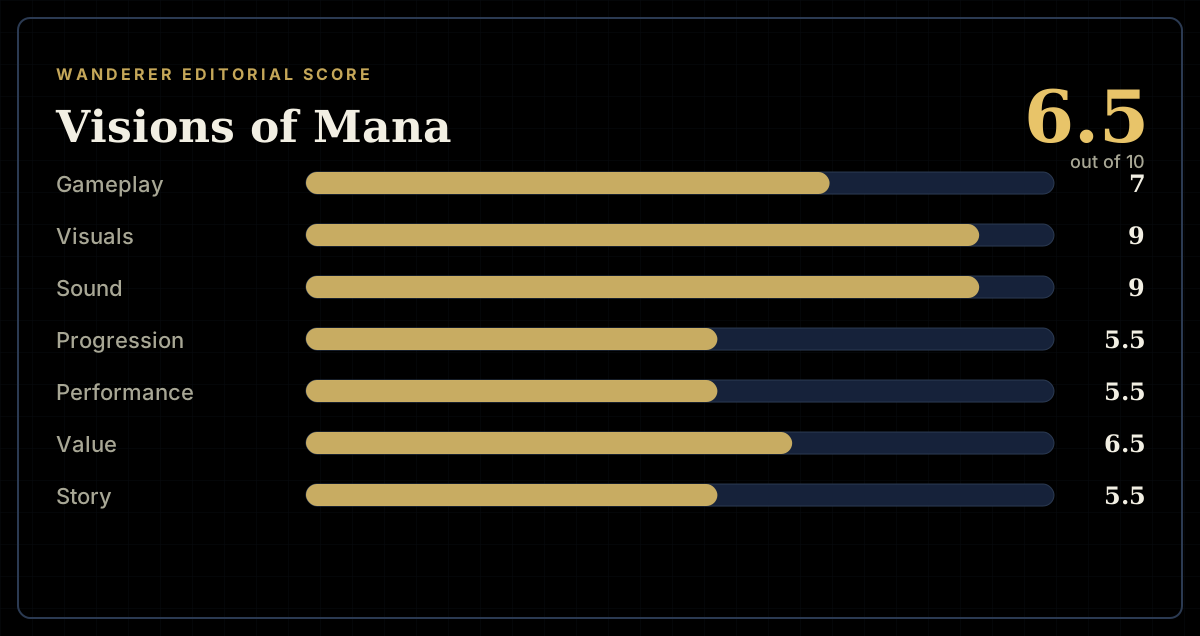
How the review scores each part of the gameWanderer Editorial -
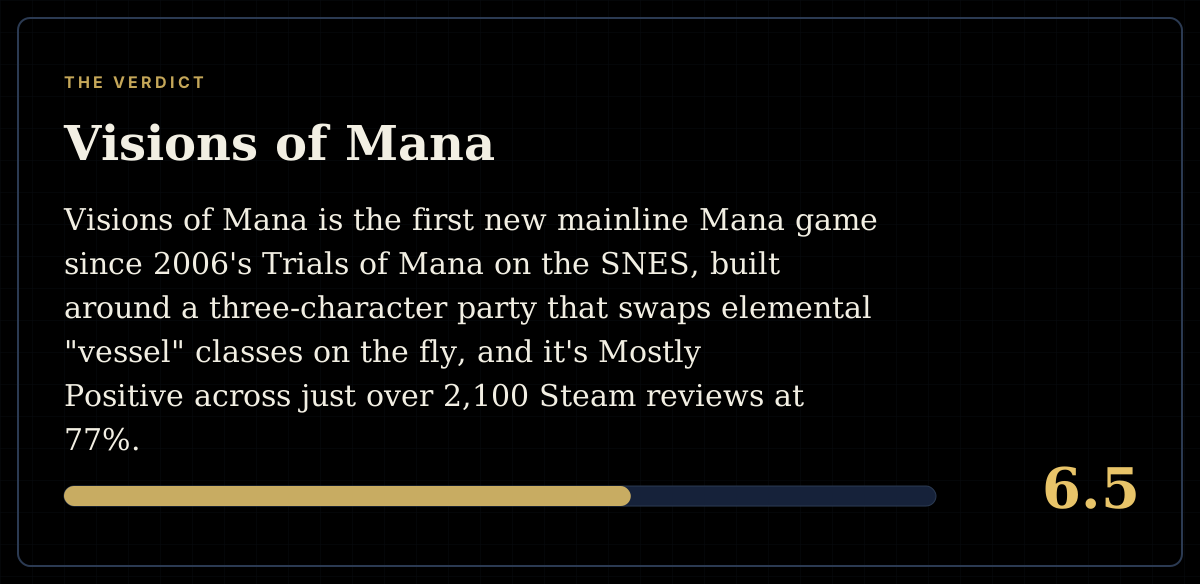
The short versionWanderer Editorial