
Game review
Rise of the Ronin
6.5 / 10
- Developer
- Team Ninja / Koei Tecmo
- Publisher
- Koei Tecmo
- Released
- 22 March 2024
- Platforms
- PlayStation 5, Windows
- Genre
- Action RPG
- Monetisation
- One-time purchase, no in-game currency
- Players
- Online co-op (mission-based, up to two additional players)
The short version
Rise of the Ronin puts Team Ninja's parry-driven, Souls-adjacent combat into an open recreation of 1860s Japan on the brink of the Meiji Restoration, and on its native PS5 it landed reasonably well — 76 on Metacritic from critics, a notably higher 86 from players, the usual split for a Team Ninja release. A year later, the PC port arrived to a very different reception: Mixed at 64% across roughly 6,500 Steam reviews, and reading them makes clear why — stuttering that shows up on hardware as strong as an RTX 4090, a performance cliff that consistently appears right after the two-hour Steam refund window closes, and graphics settings multiple reviewers say make almost no visible difference. The frustrating part, repeated across dozens of these same reviews, is that most of their authors say the combat and the setting are genuinely good — they just can't recommend the specific product Koei Tecmo shipped on this platform.
Biggest strengths
- Team Ninja's signature counter-and-parry combat draws consistent praise from both critics and the Steam userbase, including from reviewers who otherwise can't recommend the game because of performance
- The historical setting — Yokohama, Edo and Kyoto during the real political upheaval of the Bakumatsu period — gives the open world a distinct backdrop most open-world action games don't use
- A branching political structure lets the player choose to side with the Shogunate or the Anti-Shogunate factions, adding real weight to some story choices even where critics say the surrounding cast gets overcrowded
Biggest weaknesses
- The PC port suffers from severe, well-documented stuttering that multiple reviewers report even on top-end hardware including the RTX 4090, more than a year after release
- Performance consistently falls off a cliff as soon as the tutorial ends and the open world begins — a timing several reviewers point out lands suspiciously close to Steam's two-hour refund window
- Several detailed reviews report that graphics settings have minimal visible impact on either performance or visual quality, undermining the usual PC-port promise of scalability
Who it's for: Fans of Team Ninja's combat (Nioh, Wo Long) who already own a PS5 are the safest audience — that's where this game's reputation was actually earned. PC players should treat this as a title to watch for patches rather than buy on release-week enthusiasm; the open-world's own formulaic mission design and a faction story that critics say loses coherence in its second half were already the softer parts of the experience even before the port problems are added on top.
Our recommendation: Recommended on PS5, where the combat and setting substantially outweigh the story and open-world repetition critics flagged at launch. On PC, wait for confirmation that the stuttering and post-tutorial performance cliff have actually been fixed before buying — a large, still-growing share of the Steam review base is reporting the same specific problem well over a year after release, which is a longer tail than a normal launch-week port issue.
6.5 / 10
A samurai epic that earned its reputation on the platform it actually shipped well on
Rise of the Ronin is Team Ninja's first open-world game, built on the same counter-and-parry combat foundation that made Nioh and Wo Long: Fallen Dynasty into cult favourites, and set during a real, specific slice of Japanese history: the final years of the Tokugawa shogunate, as Western contact and internal factionalism pushed the country toward the Meiji Restoration. The player creates a customisable ronin swordfighter and can choose to align with the Shogunate or the forces working against it, moving through Yokohama, Edo and Kyoto as the political situation shifts. On PS5, where it launched in March 2024, the reception was the shape Team Ninja releases usually take: a 76 average from critics on Metacritic, and a notably higher 86 from the game's own player base — critics respecting the combat while flagging real structural issues, players more willing to forgive them because the swordfighting is that good.
The combat holds up; the open world around it doesn't always
Nobody disputes that the combat is the game's spine. The parry-and-counter system that defines Team Ninja's fighting games translates well into an open-world context, and critics who otherwise had reservations about the game still single out specific moments — a clean, perfectly timed counter against a tough enemy — as some of the best action combat available on the platform. Where critics were more consistently critical was the open world wrapped around that combat: TheSixthAxis and other outlets at launch described the mission design as formulaic, built from a small rotating set of encounter templates — clear this camp, escort this person, assassinate this target — that repeat often enough across the map to wear thin well before the campaign's end. It's a familiar complaint for the genre, but a specific and repeated one here rather than a vague "open-world fatigue" gripe.
The story follows a similar pattern of strong opening, softer close. Choosing a faction gives some real weight to the game's politics, and the setting itself — a genuine historical turning point rather than a generic fantasy backdrop — gives Rise of the Ronin a identity most open-world action games don't have. But as the story introduces more of the era's real historical figures and factional players, critics consistently say the cast outgrows what the script can service: nobody gets enough screen time to leave a strong impression, and by the second half several reviews describe the plot as losing its earlier clarity entirely. It's not a story that falls apart, by most accounts, so much as one that can't sustain the scale it built for itself.
What the PC audience is actually living with
None of the above is really what Rise of the Ronin's Steam page is about a year and a half after the PC port's March 2025 release. The Steam review score sits at Mixed, 64% positive across roughly 6,500 reviews — a real step down from the PS5 reception — and the negative reviews are overwhelmingly about one specific, recurring technical problem rather than a spread of different complaints. Player after player reports the same shape of issue: the prologue and early tutorial run acceptably, and then, right as the open world actually opens up, performance collapses into visible stuttering regardless of graphics settings. Several reviewers explicitly flag that this drop-off lands suspiciously close to Steam's two-hour refund window, meaning a meaningful number of buyers discover the real performance profile of the game only after they've lost the ability to get their money back. One especially detailed, 35-hour review updated as recently as late November notes that even after patches, shadow quality remains worse than the PS5 Pro version, and that the core stuttering under high frame rates without frame generation is still present.
What makes this pattern worth taking seriously rather than dismissing as a vocal minority is how consistently reviewers separate the port problems from the game itself. Reviewer after reviewer writes some version of "the combat is great, I just can't recommend this in its current state" — including several with over 100 hours logged, which rules out an early bounce-off explanation. One reviewer draws a direct, specific comparison to another Team Ninja PC port with a rocky launch, Wo Long: Fallen Dynasty, and says this one is worse. That's a meaningfully different story from "the game is bad," and it's the story Steam's own numbers are actually telling — a large install (over 150GB, several reviewers note) that a meaningful share of buyers say still doesn't look like it's using that space to deliver equivalent fidelity to the PS5 version it's built from.
Verdict
Rise of the Ronin is a genuinely well-regarded action game on the platform it was built for first: PS5 owners get Team Ninja's best combat system wrapped around a distinctive historical setting, with real if imperfect structural flaws in its open-world design and second-half plotting that critics flagged honestly at launch rather than a game anyone is pretending is flawless. On PC, the calculus changes: the same combat is there, but a well-documented, still-ongoing performance problem specifically timed to hit right after most players' realistic refund window means the platform this review was actually conducted on is not currently the way to experience what critics and PS5 players liked about this game. If you own a PS5, this is a strong, distinctive open-world action game worth playing. If Steam is your only option, wait for confirmation that the stuttering has genuinely been resolved before spending on it.
Pros and cons
Pros
- Team Ninja's signature counter-and-parry combat draws consistent praise from both critics and the Steam userbase, including from reviewers who otherwise can't recommend the game because of performance
- The historical setting — Yokohama, Edo and Kyoto during the real political upheaval of the Bakumatsu period — gives the open world a distinct backdrop most open-world action games don't use
- A branching political structure lets the player choose to side with the Shogunate or the Anti-Shogunate factions, adding real weight to some story choices even where critics say the surrounding cast gets overcrowded
- Online co-op lets up to two additional players join specific story missions, with in-game rewards for playing together
- PS5 reception has genuinely held up over time: an 86/100 Metacritic user score against a 76 critic average, the kind of gap that usually means players are more forgiving of a game's rough edges than critics were
Cons
- The PC port suffers from severe, well-documented stuttering that multiple reviewers report even on top-end hardware including the RTX 4090, more than a year after release
- Performance consistently falls off a cliff as soon as the tutorial ends and the open world begins — a timing several reviewers point out lands suspiciously close to Steam's two-hour refund window
- Several detailed reviews report that graphics settings have minimal visible impact on either performance or visual quality, undermining the usual PC-port promise of scalability
- Critics found the open world's mission design formulaic, built from a small handful of repeating encounter templates that wear thin well before the story concludes
- The faction-politics story is broadly praised early on but multiple critics say it loses coherence in its second half as the cast grows too large for any one character to leave a real impression
Screenshots
-

Rise of the RoninImage: KOEI TECMO GAMES CO., LTD. via Steam -

Rise of the RoninImage: KOEI TECMO GAMES CO., LTD. via Steam -

Rise of the RoninImage: KOEI TECMO GAMES CO., LTD. via Steam -
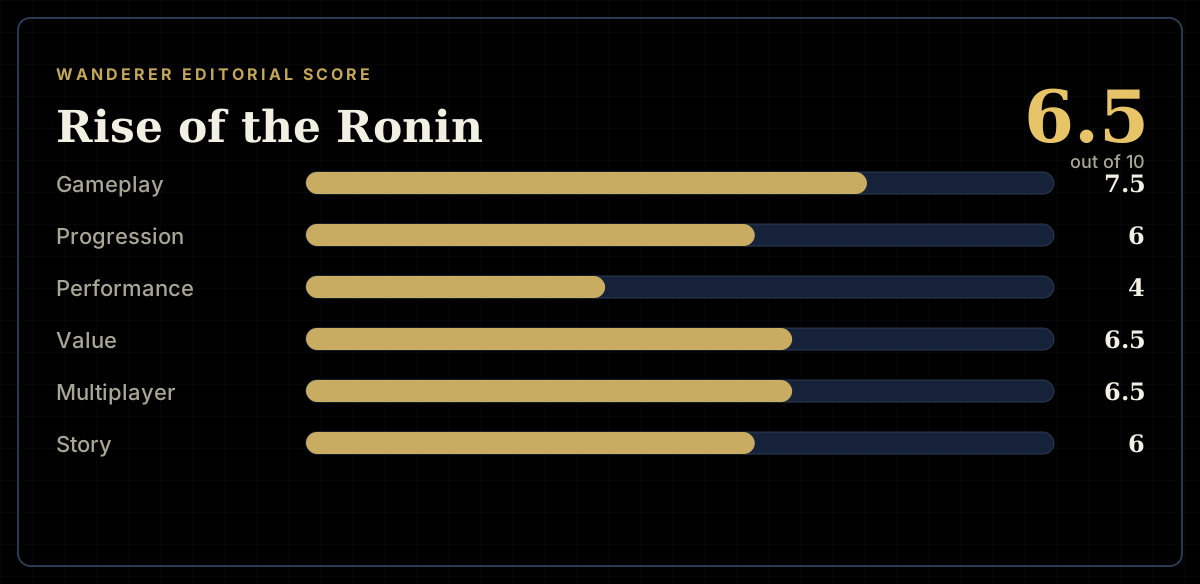
How the review scores each part of the gameWanderer Editorial -
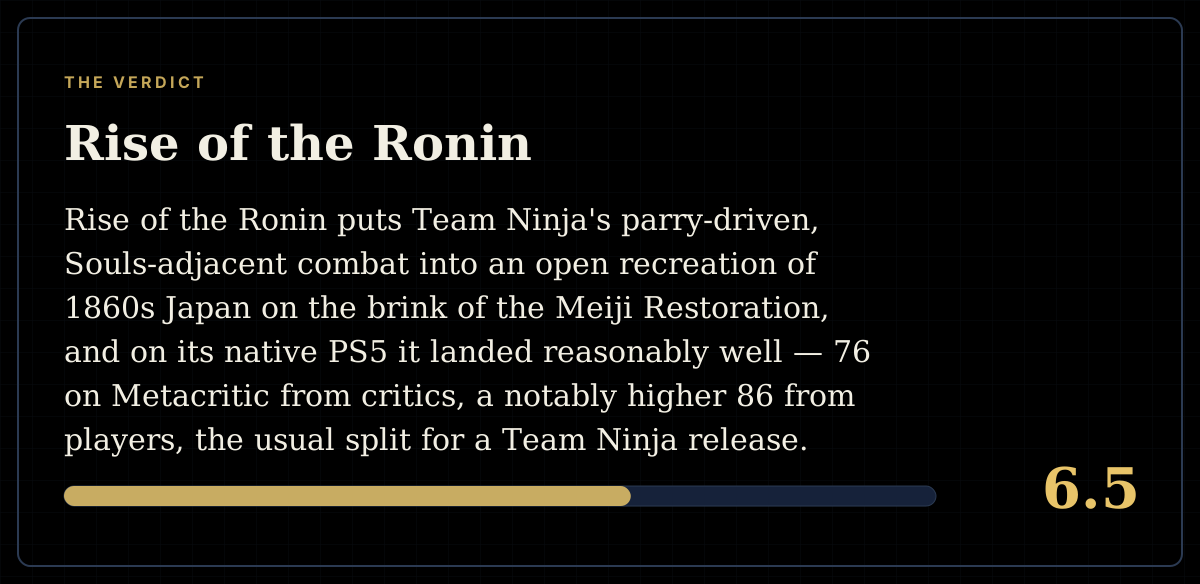
The short versionWanderer Editorial