
Game review
Persona 3 Reload
8.5 / 10
- Developer
- ATLUS
- Publisher
- SEGA
- Released
- 1 February 2024
- Platforms
- Windows, PlayStation 4, PlayStation 5, Xbox One, Xbox Series X|S
- Genre
- JRPG
- Monetisation
- One-time purchase, with a separately sold Expansion Pass DLC
- Players
- Single-player
The short version
Persona 3 Reload takes a genre-defining 2006 JRPG and rebuilds it with Persona 5's presentation, full voice acting and a new limit-break system called Theurgy, and the result is Overwhelmingly Positive across roughly 43,000 Steam reviews — a rare consensus for a game asking players to commit 60-100 hours to a story about mortality, found family and a countdown clock nobody can stop. What keeps that consensus from being uncomplicated is Atlus's own handling of the re-release: a Digital Premium Edition marketed as including "all purchasable additional content" that turned out not to include the Episode Aigis expansion once it was announced months later, a controversy specific enough that dozens of the game's most-upvoted reviews are about the storefront listing rather than the game itself.
Biggest strengths
- Theurgy gives every party member a personality-flavoured limit-break mechanic that meaningfully rewards playstyles beyond exploiting elemental weaknesses
- Full voice acting across every social link rank turns scenes that were text-only in 2006 into genuinely well-performed character writing
- Social links can no longer break or silently reverse from neglect, removing one of the original's most punishing and least-loved systems without changing what the links are about
Biggest weaknesses
- The Digital Premium Edition's own store listing promised "all purchasable additional content" before later being edited to list only cosmetics, once the Episode Aigis expansion was revealed and priced separately — dozens of the game's most-upvoted Steam reviews document this specifically, with dates and screenshots
- Persona 3 Portable's female protagonist route, widely regarded by longtime fans as offering the series' most distinct social-link writing, is absent, and Atlus has said its cost and development time made it unworkable for this remake
- Party members under AI control frequently decline to use their own charged Theurgy attacks or the Persona 5-style Shift command even when it is the obviously correct move, pushing dedicated players toward manual control of the whole party
Who it's for: JRPG players who have never touched Persona 3 in any of its earlier forms are the ideal audience — this is the most accessible, best-presented version of the story that exists. Persona 4 Golden and Persona 5 Royal veterans coming in expecting equivalent systems (full party AI competence, a female protagonist option) should adjust expectations first. Anyone burned before by day-one deluxe editions that quietly redefine their own contents should buy the base game only, and buy Episode Aigis later once its price and inclusion are clear.
Our recommendation: Recommended, and for most players strongly so — this is as good as Persona 3 has ever looked or played, and the base $70 USD asking price is fair for a game of this length and quality. Hold off on the Digital Premium or Deluxe editions unless the current storefront listing explicitly and currently states what DLC they contain; the original marketing for this exact release did not survive its own launch window.
8.5 / 10
Rebuilding a game everyone already agreed was great
Persona 3 was never the series' most polished entry — Persona 4 and Persona 5 both improved on nearly every system it introduced — but it has spent close to two decades being the entry longtime fans argue is the most emotionally serious. Persona 3 Reload doesn't try to reinvent that reputation. It rebuilds the 2006 original almost scene-for-scene inside the visual language Persona 5 popularized: sharp UI typography, fully animated cutscenes, a jazz-inflected soundtrack that treats its own menus as performance. Ninety-five percent of roughly 43,000 Steam reviews recommend it, and recent sentiment sits a point or two above the lifetime figure rather than below it, which is the opposite of the pattern that usually shows up when a remake's launch controversy keeps compounding. The game itself, in other words, has settled into being loved. What hasn't settled is how Atlus chose to sell it.
Theurgy and the return of SEES
Combat is still the series' turn-based backbone: exploit an enemy's elemental weakness, knock them down, chain a "One More" follow-up action, and if the whole enemy line goes down at once, trigger an All-Out Attack. Reload's one genuine mechanical addition is Theurgy, a limit-break gauge unique to each SEES member that fills according to how that character actually fights — the protagonist charges his by switching Personas mid-battle, others by taking hits, guarding, or landing weakness attacks. It's a smart piece of design specifically because it rewards behavior the old formula didn't: instead of every fight collapsing into "attack the weakness, always," Theurgy gives characters a second, personality-shaped reason to act differently from each other.
The catch is that this only really works when the player is in direct control. Left to AI, party members frequently sit on a maxed Theurgy gauge and never use it, and the same AI is notably reluctant to use the Shift command that lets a genre veteran coming from Persona 5 Royal switch active characters mid-turn. It isn't a bug exactly — nothing crashes, nothing behaves incorrectly by the game's own logic — but it means Reload's best new combat idea is gated behind a level of manual party management that Persona 5 had mostly automated away. Players who liked handing off most of a fight to AI and focusing on their own character will notice the difference immediately.
Tartarus, softened but not solved
Tartarus, the single procedurally-arranged tower SEES climbs floor by floor every full moon, was always Persona 3's most divisive structural choice — praised for its atmosphere, criticized for asking players to grind visually similar floors for dozens of hours. Reload doesn't replace it, and doesn't really try to disguise what it is. What it adds are small, real improvements: party members now talk to each other while exploring, breaking up the silence that made repetition feel worse than it was, and a fortune-teller back at the dorm's social hub, Club Escapade, lets players spend a resource to shape upcoming climbs rather than accepting whatever the tower generates. Neither change reinvents Tartarus. Both make the hours spent in it noticeably less monotonous than the original release, which is honestly the right scope of ambition for a remake built on faithfulness rather than redesign.
Global achievement data backs up just how long a commitment this remains: 88% of players have cleared the game's earliest story achievement, but only 7.3% have reached the achievement tied to the ending. That's a steep curve, but it's the normal shape for a 60-to-100-hour JRPG built around a calendar system rather than evidence of a game people specifically bounce off — the middle-of-the-list achievements decline gradually rather than cliff-dropping at any one obvious wall, which is the pattern you'd expect from natural attrition on a long game rather than a specific point where the design loses people.
The story Persona 3 has always told, and the version of it that's missing
None of the above is where Reload's story lives, and the story is still the reason this entry has the reputation it does. SEES fights Shadows during the supernatural "Dark Hour," and the game spends its full length quietly building toward the specific, deliberately uncomfortable relationship its cast has with death and time running out — themes Persona 4 and Persona 5 both softened in favor of more conventional mystery and heist framing. Full voice acting is the single biggest presentational upgrade over the 2006 original: social link scenes that were text-and-portrait exchanges are now fully performed, and the new cast handles the material well enough that even critical reviews single out specific voice performances for praise.
What's genuinely absent is Kotone Shiomi, the female protagonist introduced in Persona 3 Portable's separate route. Longtime fans consistently describe her version of the story as the more fully realized one — her social links reshape relationships with the male cast in ways the original protagonist's route never explores, and her route contains some of the series' more direct queer storytelling. Producer Wada has said the decision came down to cost and development time rather than a creative call, which reads as honest but doesn't change what's missing: this remake tells one specific half of a story that Persona 3's own history has already told two ways, and picks the half that existed first rather than the one many longtime fans consider the stronger write.
The premium edition problem
Here is where Reload's launch stopped being a clean, uncomplicated critical success. Atlus revealed and priced Episode Aigis — a story epilogue that shipped as a standard, no-extra-cost part of the PS2-era Persona 3: FES back in 2008 — as a separate NZ$56.95 Expansion Pass roughly six weeks after launch. The problem isn't that Atlus charges for new content; it's that the Digital Premium Edition's own store listing, at launch, described its bonus content as "all purchasable additional content," a phrase multiple reviewers have since backed up with archived versions of the page from before the Expansion Pass existed. Once the Expansion Pass was announced, that language was quietly edited to describe cosmetics specifically, and premium-edition buyers who'd paid extra expecting future DLC included found out the promise didn't survive its own launch window.
This is not a fringe complaint. Among the roughly 2,100 negative English-language Steam reviews, the top four most-upvoted — several with 100+ hours logged, ruling out drive-by review-bombing — are specifically about this bait-and-switch, not about pacing, Tartarus or any gameplay system. One reviewer with 123 hours put it plainly: content included in a standard release sixteen years ago is now a $35 add-on stacked on top of a premium tier that was sold on the promise of already covering it. A smaller, related complaint concerns the Digital Deluxe edition's soundtrack and artbook, which only open through their own separate launcher executables rather than as portable audio or PDF files — a minor annoyance next to the DLC pricing story, but one more example of the premium tiers underdelivering on what a reasonable buyer would expect.
Verdict
None of this changes what Persona 3 Reload is at the level of moment-to-moment play: a meticulous, gorgeously voiced rebuild of one of the JRPG genre's most respected stories, with a combat addition in Theurgy that's genuinely well designed even if the AI doesn't always use it right. The 95% positive score across a review base this large isn't an accident, and recent sentiment holding steady rather than sliding says the core experience has aged well in the year and a half since launch. But a review that only talked about Tartarus and Theurgy would be leaving out the specific, well-documented story a lot of that same review base is actually telling — that Atlus sold a premium tier on a promise its own storefront couldn't keep six weeks later, and that the version of this story fans consider the more complete one still isn't the one being sold. Buy the base game without hesitation. Be considerably more careful about anything sold alongside it.
Pros and cons
Pros
- Theurgy gives every party member a personality-flavoured limit-break mechanic that meaningfully rewards playstyles beyond exploiting elemental weaknesses
- Full voice acting across every social link rank turns scenes that were text-only in 2006 into genuinely well-performed character writing
- Social links can no longer break or silently reverse from neglect, removing one of the original's most punishing and least-loved systems without changing what the links are about
- The rebuilt Tartarus tower adds character banter and a fortune-teller service that lets players shape runs, softening one of the series' most repetitive dungeons without redesigning it beyond recognition
- New orchestral arrangements sit alongside the original soundtrack's most iconic tracks, and the response from longtime fans of the 2006 score has been close to unanimous
Cons
- The Digital Premium Edition's own store listing promised "all purchasable additional content" before later being edited to list only cosmetics, once the Episode Aigis expansion was revealed and priced separately — dozens of the game's most-upvoted Steam reviews document this specifically, with dates and screenshots
- Persona 3 Portable's female protagonist route, widely regarded by longtime fans as offering the series' most distinct social-link writing, is absent, and Atlus has said its cost and development time made it unworkable for this remake
- Party members under AI control frequently decline to use their own charged Theurgy attacks or the Persona 5-style Shift command even when it is the obviously correct move, pushing dedicated players toward manual control of the whole party
- Buying the base game, the Expansion Pass and the soundtrack/artbook separately after being misled about what the premium tier included pushes the full package well past what most JRPGs of this length ask for
- Steam Deck performance was notably inconsistent at launch, with several verified reviews reporting frame drops into the high teens in crowded areas like Paulownia Mall
Screenshots
-

Persona 3 ReloadImage: SEGA via Steam -

Persona 3 ReloadImage: SEGA via Steam -

Persona 3 ReloadImage: SEGA via Steam -
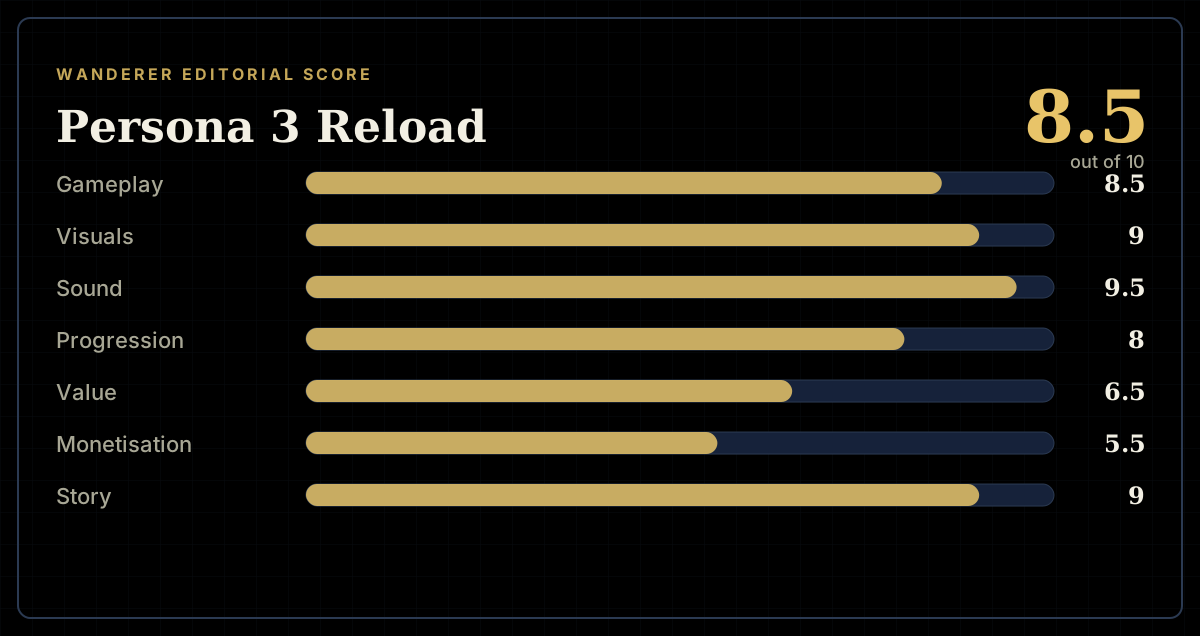
How the review scores each part of the gameWanderer Editorial -
The short versionWanderer Editorial