
Game review
DRAGON QUEST III HD-2D Remake
6.5 / 10
- Developer
- Square Enix, ARTDINK
- Publisher
- Square Enix
- Released
- 14 November 2024
- Platforms
- Windows, PlayStation 5, Nintendo Switch, Xbox Series X|S
- Genre
- JRPG
- Monetisation
- One-time purchase, no DLC or in-game currency
- Players
- Single-player
The short version
DRAGON QUEST III HD-2D Remake rebuilds the 1988 game that opened the Erdrick Trilogy in the same painterly pixel-and-3D style Square Enix used for Octopath Traveler, keeping the vocation-based party system and dungeon-crawling structure that made the original foundational to the genre. Overall Steam sentiment sits at Mostly Positive across 4,000 reviews, but that combined figure hides a striking split: English-language reviews are Very Positive at 91%, while the game's own Japanese-language reviews — the audience closest to the source material — sit at a genuinely Mixed 54%. That gap traces back to a real, publicly acknowledged controversy: gender selection was changed from "Male/Female" to unlabelled "Appearance A/B" options, a costume was redesigned to cover more skin, and series creator Yuji Horii commented on the change himself, though his own team later said an English-subtitled clip of those comments had been taken out of context. Set that controversy and a genuinely inconsistent English translation aside, and what's left is a faithful, handsome remake of a 36-year-old game that a large number of its own reviewers say isn't worth its full asking price.
Biggest strengths
- The HD-2D art style — detailed pixel character work over 3D environments with dramatic lighting — is close to universally praised, including by the game's harshest critics
- The vocation (class-change) system that Dragon Quest III popularised in 1988 remains genuinely satisfying to build around, giving the party real flexibility without the density of a modern JRPG's skill trees
- As the narrative beginning of the Erdrick Trilogy, it holds real historical and lore significance for the series that longtime fans specifically value
Biggest weaknesses
- Gender selection was changed from explicit "Male" and "Female" labels to unlabelled "Appearance A/B" options, a change series creator Yuji Horii publicly commented on ("who is even complaining about this?") — though his own representatives later said an English-subtitled clip of those remarks was taken out of context
- The game's Japanese-language Steam reviews sit at a Mixed 54%, a striking gap against the English-language reviews' 91% positive that suggests the audience closest to the source material is considerably more divided than English-speaking buyers
- The single most-upvoted English negative review specifically calls out inconsistent, flatly inaccurate translation work, and other reviewers separately flag specific terminology errors and an odd, occasionally Buddhist-prayer-like dialogue style forced onto one in-game village
Who it's for: Longtime Dragon Quest fans revisiting the series' roots, and JRPG players curious about the genre's foundational vocation and party-building systems, are the best audience — especially played at a patient, old-school pace rather than expecting a modern JRPG's density of systems. Buyers specifically bothered by the gender-selection change, or hoping for a wholesale reimagining rather than a visual and quality-of-life upgrade over the 1996 Super Famicom remake this and every prior port descends from, should read the specific complaints below before buying at full price.
Our recommendation: Worth playing for series fans and JRPG historians, but wait for a sale — "wait for it to be cheaper" is one of the single most repeated phrases across this game's own negative reviews, from reviewers who otherwise like what the remake does. At NZ$94.95 for a fundamentally 1988-era RPG with modern presentation layered on top, the price is the complaint that shows up most consistently, independent of the controversy or the translation issues.
6.5 / 10
The trilogy's beginning, painted in HD-2D
Dragon Quest III first released in Japan in 1988, telling the story that chronologically opens the "Erdrick Trilogy" even though it was the third game made — a structural trick the series has leaned on since. This HD-2D remake, developed with ARTDINK using the same painterly pixel-over-3D visual style Square Enix debuted with Octopath Traveler, rebuilds that specific game rather than reinventing it: the same vocation system that lets any party member change class and carry forward a portion of their old abilities, the same overworld structure, the same fundamental turn-based combat. It's a game aimed squarely at players who already know why Dragon Quest III matters to the genre's history, more than an attempt to win over people who don't.
What the remake actually changes, and what it doesn't
The vocation system remains the mechanical highlight, and reviewers across the sentiment spectrum agree on this: letting any character retrain into any unlocked class, carrying forward partial stat growth and select abilities, gives party building a flexibility that still feels good more than three decades after the original popularised the idea. Visually, the HD-2D treatment is close to universally praised — richly detailed sprite work set against 3D environments with genuinely dramatic lighting, the same formula that made Octopath Traveler and its own HD-2D siblings look distinctive on modern hardware.
What the remake doesn't do, according to a large and specific share of its own reviewers, is meaningfully expand what's underneath that visual layer. Every prior version available on smartphones, Nintendo Switch and PlayStation 4 already descended from a 1996 Super Famicom remake of the original 1988 release, and several detailed reviews argue this HD-2D version is best understood as another pass over that same 1996 foundation — new coat of paint, some new quality-of-life features, one additional character class — rather than a from-scratch reimagining. For players expecting the scope of, say, the Persona 3 Reload or Final Fantasy VII remakes released the same year, that's a real gap between expectation and what's delivered, and it feeds directly into the price complaint below.
A price complaint that shows up almost everywhere
If there's one thing nearly every negative review agrees on regardless of anything else they say, it's that NZ$94.95 (roughly $60 USD) is too much to ask for a game whose fundamental design dates to 1988, refreshed rather than rebuilt. "Wait for a sale," in some phrasing, appears across a genuinely large share of the negative sample, frequently from reviewers who otherwise say positive things about the vocation system or the visual style. It's a specific, consistent complaint rather than the kind of scattered value grumbling that shows up on almost any game — multiple reviewers with 100-plus hours logged, who clearly got real value out of their purchase by any objective measure, still conclude the asking price doesn't match what a 2024 audience should expect for their money next to genuinely new content.
The controversy, and the gap it left behind
The most consequential story around this remake's launch wasn't about price, though. Dragon Quest III originally let players pick an explicitly labelled "Male" or "Female" protagonist; this remake replaces those labels with unlabelled "Appearance A" and "Appearance B" options, and a female warrior costume was redesigned to cover more skin than before. Series creator Yuji Horii commented on the change directly, asking "who is even complaining about this?" — comments that circulated widely in an English-subtitled clip taken from a much longer Japanese-language discussion. Horii's own representatives later stated that clip had mistranslated and decontextualised the original remarks, and the specific translation choices cited (including "puritan" reportedly rendered as "sex education") suggest the viral version overstated what was actually said.
Whatever the accurate reading of Horii's comments, the underlying change to the game itself is real and verifiable, and it appears to have landed very differently with different audiences. Steam's Japanese-language reviews for this game sit at a genuinely Mixed 54% — the audience with the most direct connection to the original 1988 game and its creator's own public remarks is meaningfully more divided than the English-language audience playing the localised, English-scripted version, which sits at a Very Positive 91%. That's an unusual, striking gap for a game this well-regarded overall, and it's worth reporting as a documented fact about how differently this specific release has been received across language communities, independent of any conclusion about who's right in the broader argument.
Verdict
Strip away the controversy and the price complaints, and DRAGON QUEST III HD-2D Remake is exactly what it says on the cover: a handsome, faithful visual and quality-of-life pass over one of the genre's foundational games, built around a vocation system that still holds up and an HD-2D art style that continues to be one of Square Enix's best current ideas. What keeps it from an easy recommendation at full price is that the improvements really are mostly visual rather than structural, that a specific and real translation quality problem sits in its most-upvoted English review, and that the audience closest to the source material is considerably more divided than the English-speaking Steam base's own numbers suggest. Buy it for the nostalgia and the vocation system, but follow the advice a large share of this game's own reviewers are giving for free: wait for it to be on sale, and go in knowing this is a loving restoration rather than a from-scratch reinvention of a game that's already been available, in slightly plainer form, for years.
Pros and cons
Pros
- The HD-2D art style — detailed pixel character work over 3D environments with dramatic lighting — is close to universally praised, including by the game's harshest critics
- The vocation (class-change) system that Dragon Quest III popularised in 1988 remains genuinely satisfying to build around, giving the party real flexibility without the density of a modern JRPG's skill trees
- As the narrative beginning of the Erdrick Trilogy, it holds real historical and lore significance for the series that longtime fans specifically value
- Accessibility options are notably thorough for the genre, including adjustable difficulty, a keyboard-only control scheme and camera comfort settings
- English-language Steam sentiment is genuinely strong at 91% positive, suggesting the core remake lands well for the audience actually playing it in English
Cons
- Gender selection was changed from explicit "Male" and "Female" labels to unlabelled "Appearance A/B" options, a change series creator Yuji Horii publicly commented on ("who is even complaining about this?") — though his own representatives later said an English-subtitled clip of those remarks was taken out of context
- The game's Japanese-language Steam reviews sit at a Mixed 54%, a striking gap against the English-language reviews' 91% positive that suggests the audience closest to the source material is considerably more divided than English-speaking buyers
- The single most-upvoted English negative review specifically calls out inconsistent, flatly inaccurate translation work, and other reviewers separately flag specific terminology errors and an odd, occasionally Buddhist-prayer-like dialogue style forced onto one in-game village
- "Wait for a sale" is one of the single most repeated phrases across the negative review sample, from reviewers who otherwise enjoyed the remake — a specific, consistent value complaint rather than a scattered one
- This is fundamentally a visual and quality-of-life modernisation of the 1996 Super Famicom remake that every prior smartphone, Switch and PS4 version was already built on, not a from-scratch reimagining, which several longtime fans say makes the asking price hard to justify next to those cheaper existing versions
Screenshots
-

DRAGON QUEST III HD-2D RemakeImage: Square Enix via Steam -

DRAGON QUEST III HD-2D RemakeImage: Square Enix via Steam -

DRAGON QUEST III HD-2D RemakeImage: Square Enix via Steam -
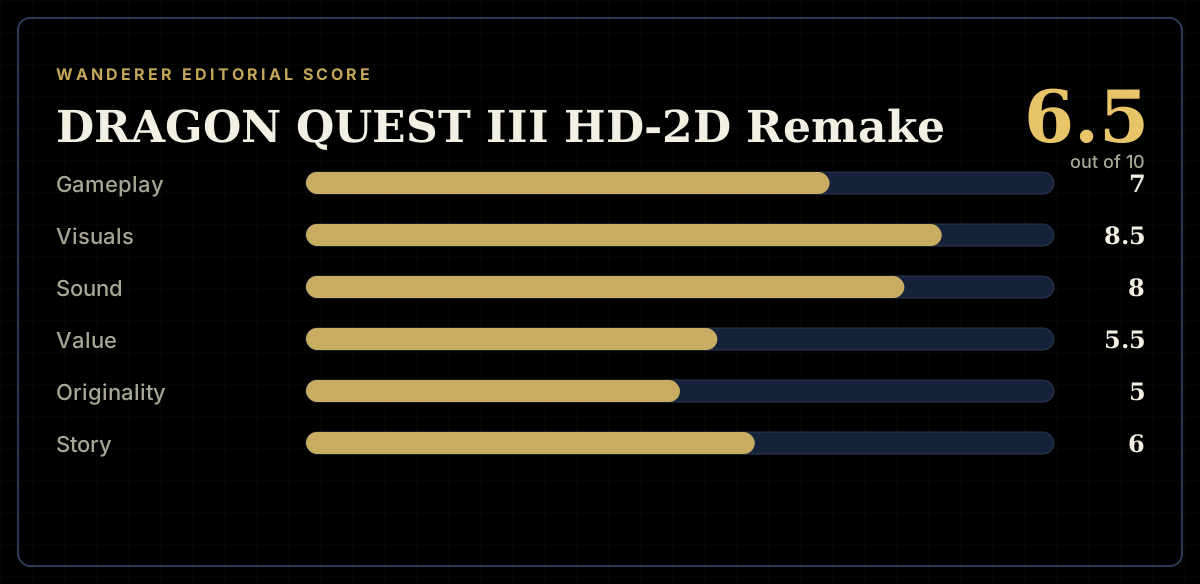
How the review scores each part of the gameWanderer Editorial -
The short versionWanderer Editorial