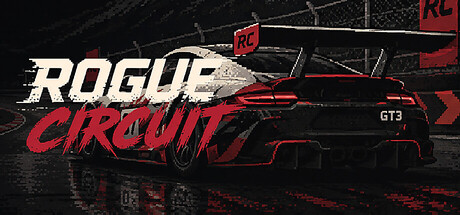
Game review
Rogue Circuit Review
6.5 / 10
- Developer
- Jorge Francisco Bescos Gascon
- Publisher
- Jorge Francisco Bescos Gascon
- Released
- 14 September 2026
- Platforms
- ["Windows", "Linux"]
- Genre
- Racing
A Racing Game Where the Deckbuilding Is the Point
Rogue Circuit's pitch is an unusual one: it's a racing game where the actual racing is often something you delegate rather than perform directly. Built solo by developer Jorge Francisco Bescos Gascon, the game has you choose a car and driver, then build a five-card loadout spanning Driver, Tuning, Technique, Powerup, and Revenge categories as you climb through a championship. You can let your chosen driver race autonomously while the game's TV-style camera follows the overtakes and impacts, or grab manual control whenever a corner or a rival demands your direct input. That flexibility — hands-off strategy game one moment, hands-on arcade racer the next — is the game's central hook, and it's a genuinely uncommon way to frame a roguelite deckbuilder.
Five Card Types, No Prescribed Synergies
Where a lot of deckbuilders hand players explicit combo hints, Rogue Circuit deliberately doesn't: tuning cards change the car itself, technique cards react dynamically to race conditions, powerups trigger on specific track sections, and revenge cards turn collisions into a mechanical advantage, but the game leaves it up to the player to notice which combinations actually work well together rather than flagging synergy bonuses outright. Every rival driver is building their own loadout at the same time, so a championship gets more chaotic and more dangerous as it goes on — early laps against unequipped AI opponents give way to a field of rivals wielding the same card toolkit the player has been assembling, which is a smart way to keep pace with a growing deck without resorting to simple stat inflation.
The Driver card category adds a layer most racing-deckbuilder hybrids wouldn't bother with: drivers aren't just stat sticks but AI personalities with their own racing behavior, meaning a loadout decision about who's behind the wheel changes how the car handles even before any tuning or technique cards get factored in. Combined with experience earned mid-race feeding directly into new card choices as levels arrive, the loop encourages constant small decisions — replace a working card for a stronger one, or stick with a combo that's already paying off — rather than a single big deckbuild made before a run even starts, which keeps the strategic layer active throughout a race rather than front-loaded into a menu screen.
One Voice From the Starting Grid
Rogue Circuit launched with almost no public track record — a single day-of-release news post and, so far, one review — but that lone review is a useful, credible data point. Writing in Spanish, the reviewer calls the game very entertaining and frenetic, saying it hooks you because "it never stops," and specifically praises how the race stops being just driving cars around a track and becomes closer to a battlefield as more powerful cards pile up on both sides. Their one real complaint: the game can feel overwhelming without a tutorial, something they explicitly say they'd have appreciated as a newcomer to the format. For a genre mashup this unusual — part racing game, part card-based strategy layer — a stronger onboarding path would go a long way toward making that initial learning curve feel intentional rather than sink-or-swim.
Depth for Tinkerers, By Design
Beyond the core championship mode, Rogue Circuit ships with a Custom mode that lets players hand-pick maps, weather, card categories, tiers, lap counts, and experience rules, plus a Sandbox mode for directly equipping specific cards to test combinations without the pressure of an actual race. That's an unusually generous amount of experimentation tooling for a $4.99 solo-developer release, and it signals a design philosophy built around player-driven discovery rather than a tightly scripted campaign — appropriate for a game whose core selling point is figuring out which of its unlabeled card synergies actually click. Weather effects and distinct GT3 and Halloween presentations add some visual variety to races on top of the card-driven strategy layer, giving the championship a bit of atmospheric range alongside its mechanical one.
Full controller support rounds out a feature list that's surprisingly complete for a first release from a single developer, and the ability to follow any driver on track, or let the game's camera automatically hunt down overtakes and revenge-card impacts, suggests real thought went into making the hands-off half of the experience watchable rather than just functional. It's the kind of production-value detail that's easy to skip on a tight solo-dev budget, and its presence here is a good sign for how the game's rougher onboarding edges might get smoothed out over time.
A Cheap, Ambitious Experiment Worth Watching
At under five dollars, Rogue Circuit is priced like exactly what it is: a scrappy, ambitious solo project testing out a genre combination that doesn't have many direct precedents. That ambition is also where its rough edges show — a single early reviewer's complaint about a missing tutorial is exactly the kind of onboarding gap that's easy to forgive in a passion project but still genuinely limits how approachable the game is for players unfamiliar with either racing roguelites or card-based strategy layers. There's real mechanical depth on offer here, from the escalating AI-rival card economy to the sandbox tooling for build experimentation, but it currently asks players to find their own footing rather than guiding them into it.
Verdict
Rogue Circuit takes a genuinely novel swing at fusing racing with roguelite deckbuilding, letting players toggle between hands-off strategic oversight and hands-on driving as a championship escalates into a battlefield of tuned cars and powered-up rivals. The one public review so far — enthusiastic but pointing squarely at a missing tutorial — captures the experience well: there's a frenetic, absorbing game here for players willing to push through an unguided first few races, backed by Custom and Sandbox modes that reward tinkerers. At $4.99 from a solo developer, it's a low-cost, high-curiosity pick for anyone drawn to genre mashups that don't play it safe.
Screenshots
-
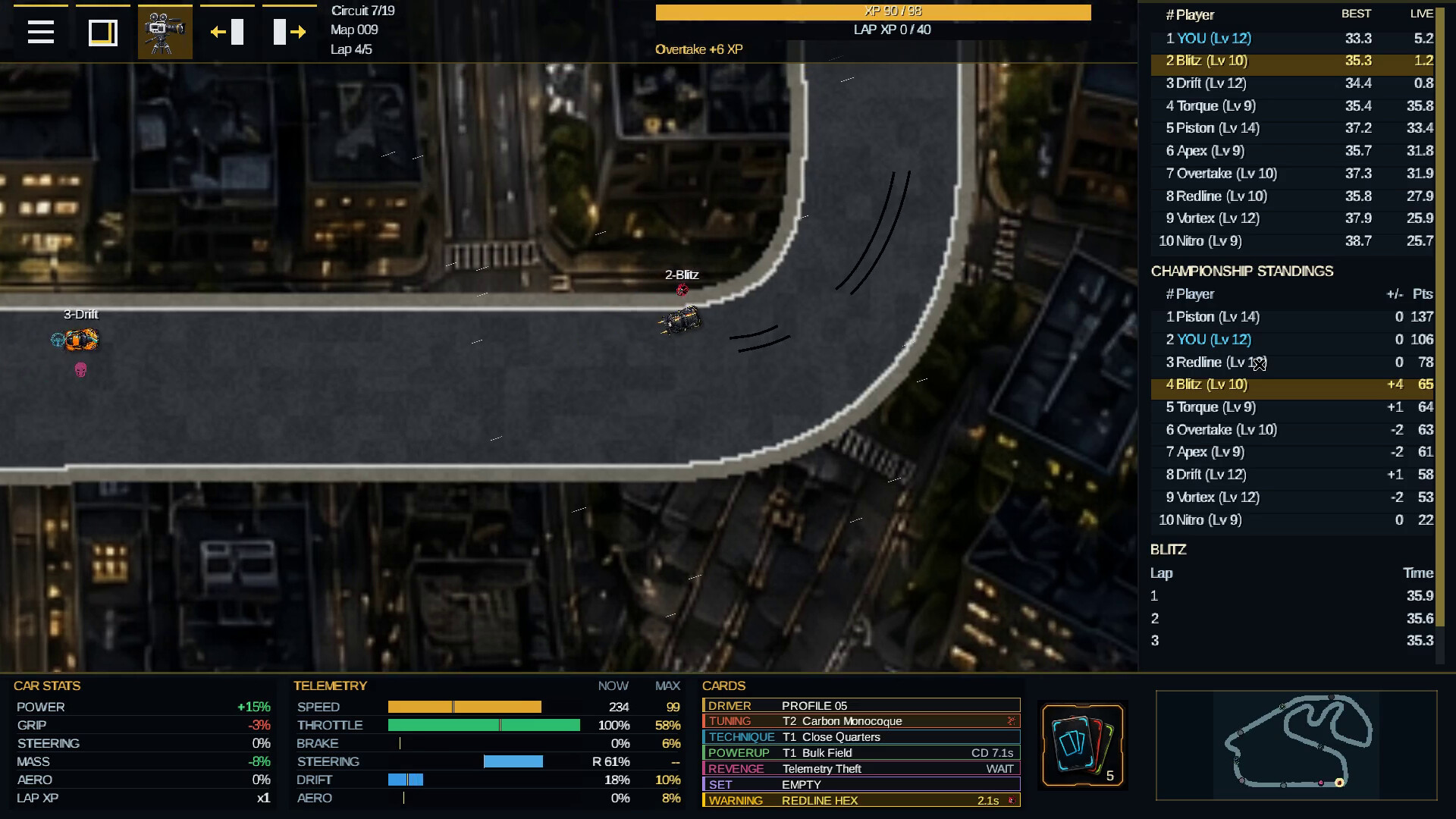
The dense racing HUD, tracking lap times, championship standings, and the player's equipped card loadout.Image: Jorge Francisco Bescos Gascon via Steam -
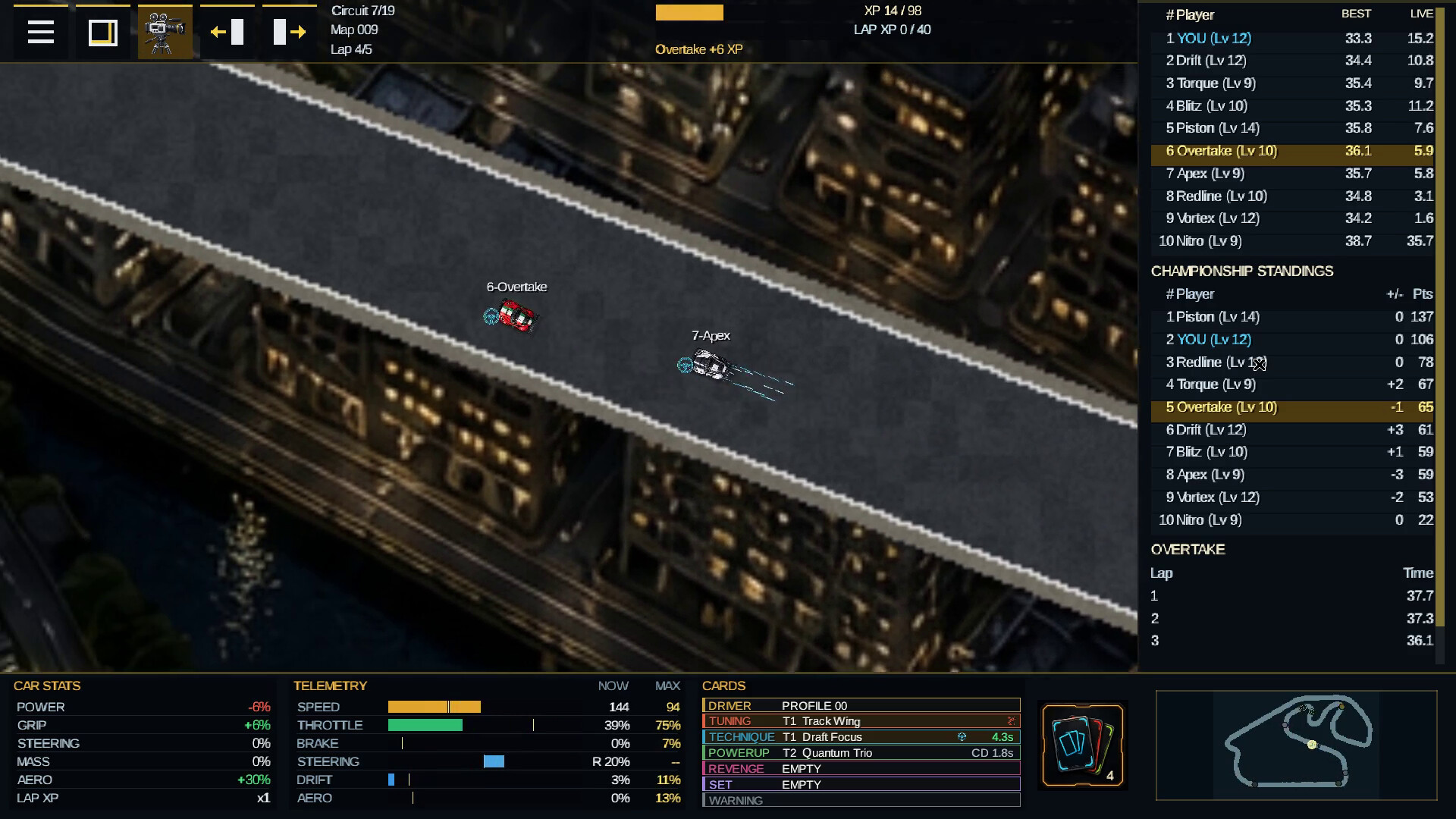
Battling for position on a bridge straight, with XP and championship standings updating live.Image: Jorge Francisco Bescos Gascon via Steam -
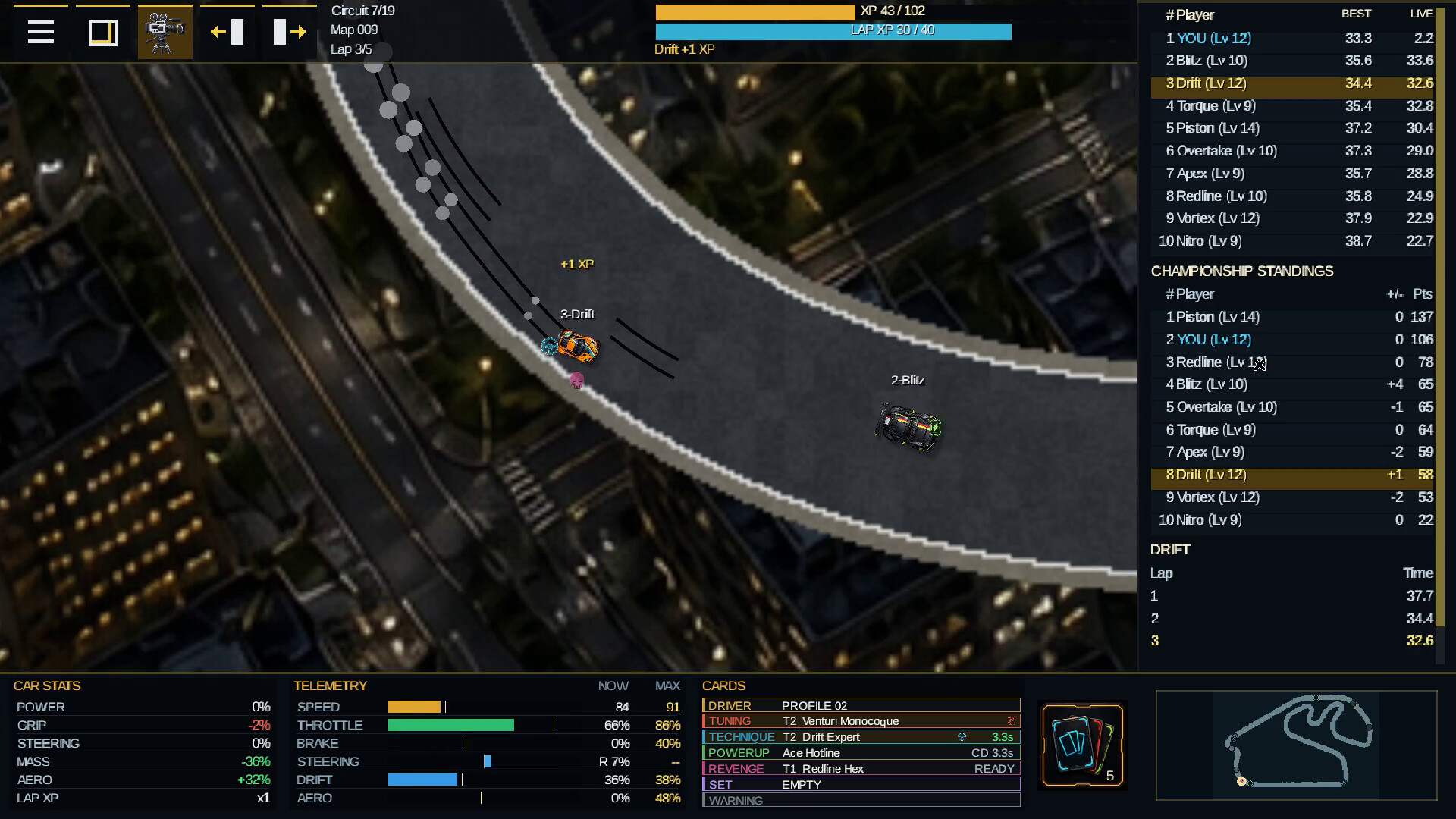
Drifting through a curve for bonus XP, with car telemetry tracking grip, aero, and steering in real time.Image: Jorge Francisco Bescos Gascon via Steam