
Game review
RLG:Origins
5.5 / 10
- Developer
- Stardust Factory Studio
- Publisher
- Stardust Factory Studio
- Released
- 17 September 2026
- Platforms
- Windows
- Genre
- RPG
A Thirty-Eighth Consecutive Launch Without a Single Review
RLG:Origins entered Early Access on Steam on 17 September 2026, and at the time of writing it has zero user reviews on either side of the ledger. That absence carries extra weight here, because this is a game whose entire pitch rests on a single unverified mechanical claim: that free-text input genuinely drives investigation, negotiation, and combat, rather than routing the player back to a dressed-up dialogue menu underneath. Without any player feedback yet to confirm or refute that claim in practice, everything below reflects only what the store page itself describes.
No Dialogue Options — Your Words Are the Choice
The core pitch is stated plainly on the store page: "No dialogue options. Your words are the choice." Players type freeform text — the store page's own examples range from "Swing a sword. Cast a spell. Use an ability all your own" to "Pet a cat. Cook a meal. Throw a pickle" — and that text is meant to function as the actual mechanism for investigation, negotiation, combat, and eventually an intervention into the game's central oath. This sits RLG:Origins closer to a tabletop role-playing session mediated by a always-on game master than to a conventional RPG's branching dialogue tree, and it's an unusually bold structural claim for a game this early in Early Access to make without a review history to back it up. Text parsers and freeform input systems have a long, uneven history in RPGs going back decades, and the recurring failure mode is always the same: a system that handles the developer's own showcased examples gracefully but breaks down, misreads intent, or falls back to generic responses the moment a player tries something the design team didn't anticipate. Nothing on the store page addresses how the game handles genuinely unexpected or off-the-wall player input once it strays from the kind of example phrasing quoted above. Unlike most of the store page's claims, this one is at least partly checkable from the game's own screenshots: they show a persistent status header listing the traveler's role, carried items, and capabilities, sitting above a scrolling text log and a plain input field reading "Type an action: speak, inspect, or move..." — a genuinely minimalist presentation, closer to a classic text adventure than to any illustrated visual novel screen. One screenshot shows the typed command "Stand and fight" producing narrated enemy movement and prompting the companion for a further order, which is a real example of typed input driving a narrated event rather than a hidden menu underneath. That confirms the basic loop exists and runs as pitched, even if it says nothing about how gracefully the system handles input the developer didn't anticipate.
An AI Game Master Bound by Fixed Rules
The store page discloses directly that "AI takes on the roles of GM and characters," while stressing that the world's facts, enemy behaviour, oath terms, and consequences are "governed by fixed rules" rather than reshaped by clever persuasion. The developer is explicit that a key that never existed will not simply appear because a player asks for it, and that evidence left behind or lost stays lost — a framing clearly aimed at pre-empting the most common complaint levelled at AI-driven interactive fiction, where a sufficiently persistent or cleverly worded player can talk their way past any obstacle regardless of the world's supposed rules. That's a meaningful design commitment worth naming clearly for prospective buyers: the free-text system is not, by the developer's own account, a persuasion sandbox where the right words unlock any outcome, but an AI-driven interface constrained by a scripted world state underneath it. Whether that constraint holds up consistently in an AI-mediated system, without ever producing an inconsistent judgment call or a moment where the fixed rules seem to bend, is exactly the kind of thing a body of player reviews would normally help confirm — and there isn't one yet.
One Companion Chosen From Three, Each Gatekeeping Different Truths
Players choose a single companion to accompany them into the sealed Fourth Door, and that choice is framed as consequential rather than cosmetic: each companion carries different knowledge, fears, and secrets, which in turn changes which evidence becomes discoverable and which conversational paths stay open. The store page states outright that a truth hidden on one expedition "may reveal itself differently on the next," positioning the companion pick as the primary replay lever, similar in spirit to the archetype-and-party systems seen in other small narrative RPGs this cycle, but narrowed here to a single companion rather than a full party. One screenshot shows this in practice: a companion named Rischel stands before an antechamber containing a previous expedition's abandoned roster, one that lists Rischel's own brother among the dead — a concrete, personal stake attached to the investigation rather than a generic "help the traveler" motivation, and evidence that at least this companion's backstory is woven directly into the discoverable evidence rather than existing only as flavour text.
A Demanding, Multi-Ending Investigation With No Guaranteed Good Outcome
The store page is unusually blunt about difficulty and tone: "many expeditions will end in tragedy," and defeating an enemy or naming a suspected truth is explicitly not the same as proving it, requiring the player to observe, form hypotheses, and sometimes find a path that avoids combat altogether. Endings are described as shaped cumulatively by what was learned, who was trusted, and what responsibilities were accepted, rather than resolved by a single final choice — and the developer states plainly that "no ending saves everything." Combined with the free-text interface, this suggests a game aiming for genuine narrative variance rather than a fixed number of discrete branching endpoints, though without any completed playthroughs on record from outside the studio, the actual range of outcomes remains a claim rather than a confirmed feature. Steam's category listing also confirms the game is playable without timed input and supports keyboard-only control, which fits naturally with a text-entry-driven interface but says nothing about how forgiving the system is toward typos, ambiguous phrasing, or players whose first language isn't the two the game supports, English and Japanese.
Verdict
RLG:Origins is a structurally ambitious Early Access RPG built around free-text investigation, negotiation, and combat mediated by an AI game master that the developer insists is bound by fixed underlying rules rather than persuadable into anything. Its single-companion, evidence-gated replay structure and stated willingness to let expeditions end badly give it real narrative ambition on paper. At the time of writing it has zero user reviews, so the central, hardest-to-fake claim — that typed freeform input actually functions as meaningfully different from a dialogue menu, consistently and without the AI GM breaking its own stated rules — remains entirely unverified by anyone outside the studio.
Screenshots
-
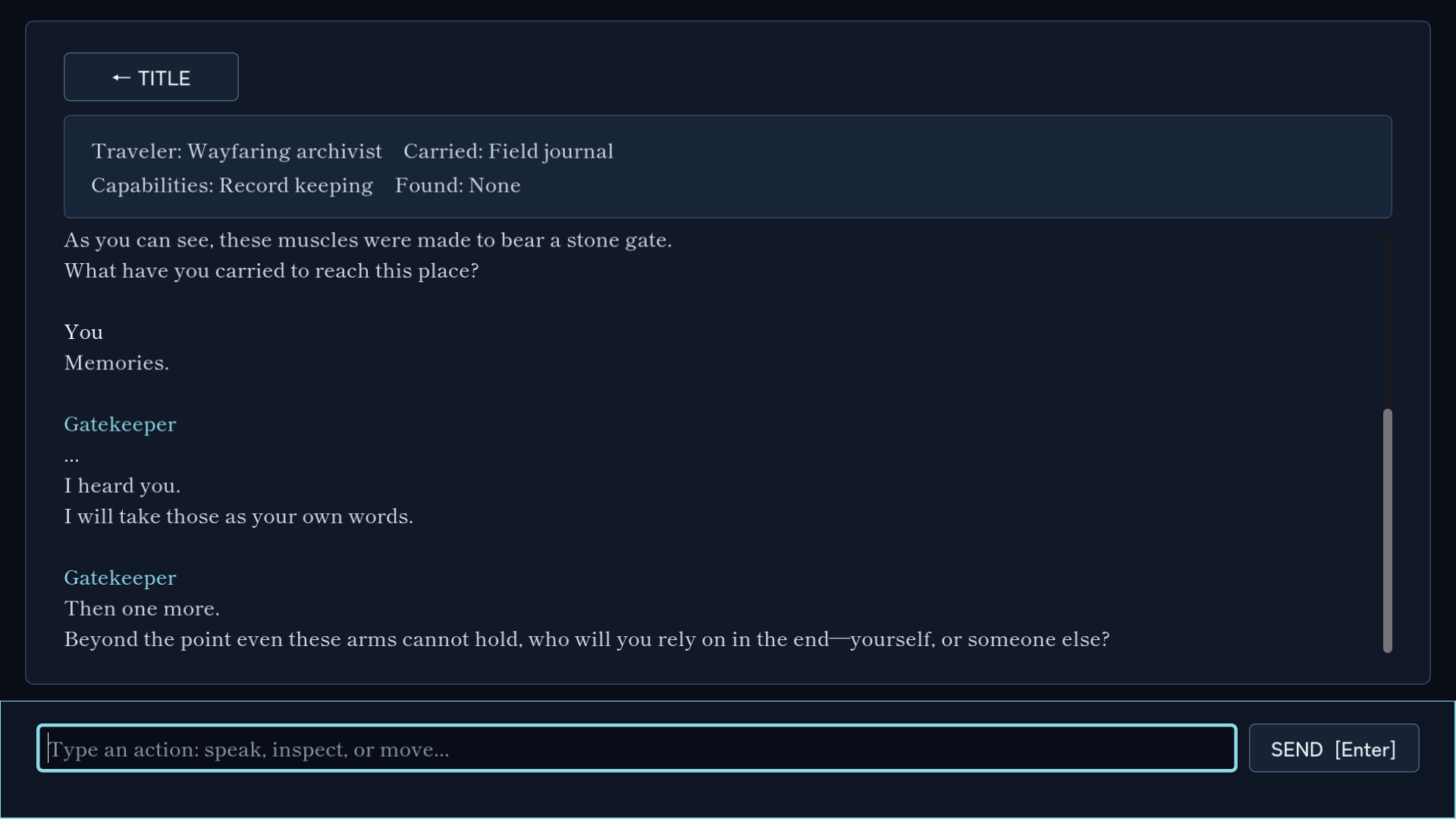
The actual interface is a plain, minimalist text log with a persistent status header and a genuine freeform text-input box, not an illustrated visual novel screen — confirming the store page's 'no dialogue options' claim in a real gameplay context.Steam store page -
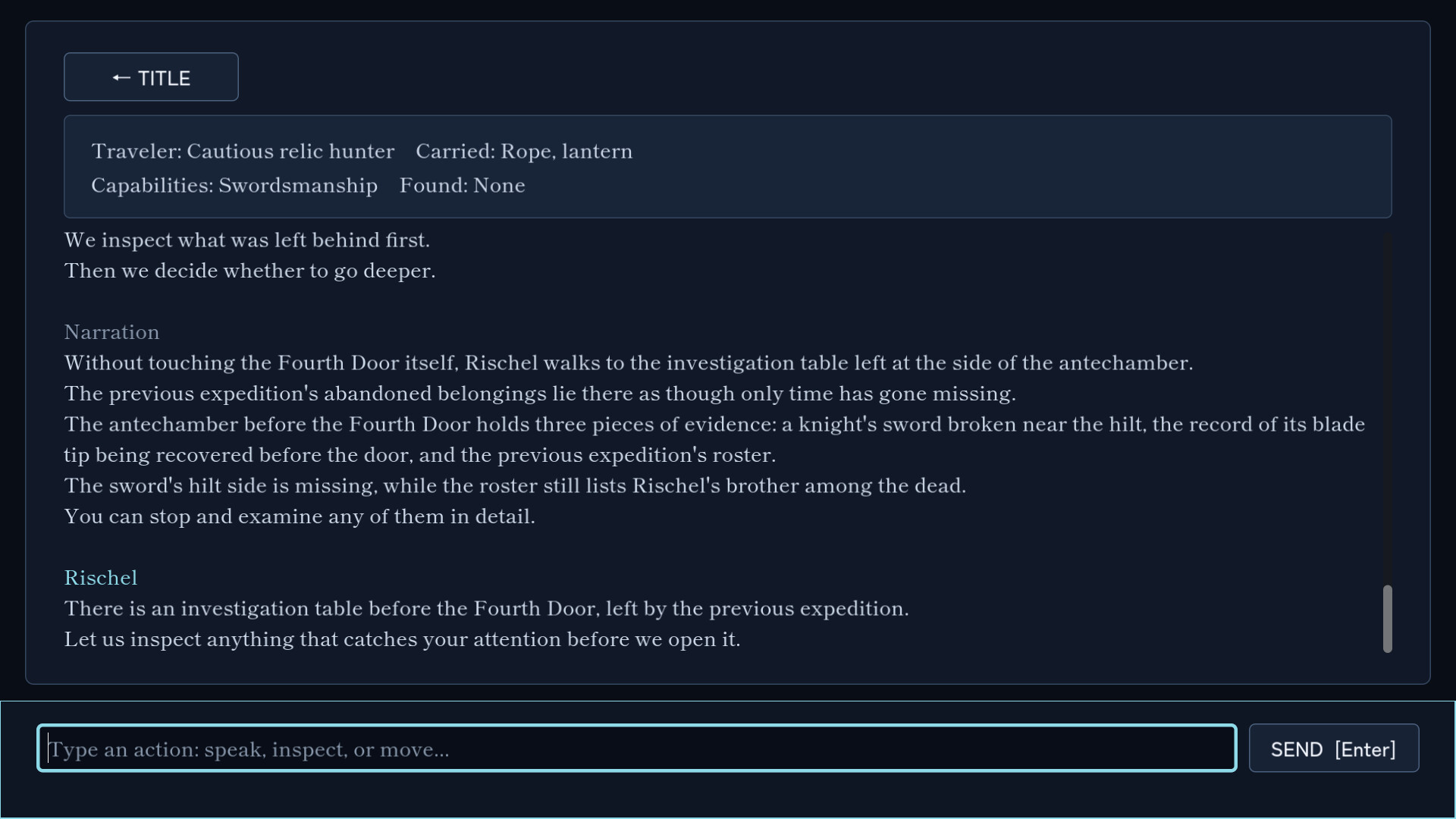
The chosen companion, Rischel, has a personal stake in the expedition — a roster on this screen lists Rischel's own brother among the previous expedition's dead, giving the evidence-gathering loop a stated emotional throughline.Steam store page -
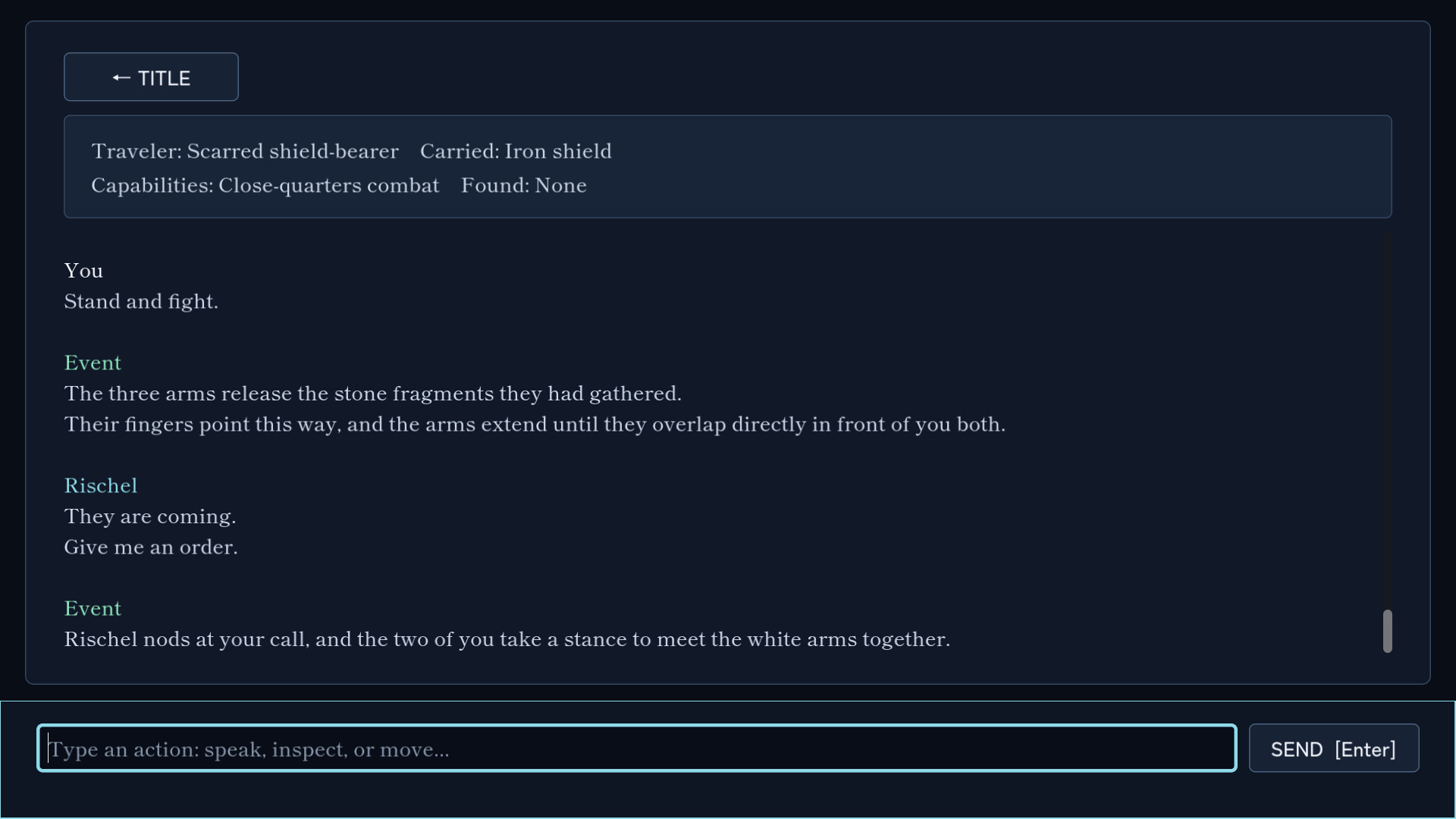
A real combat exchange shows the free-text system driving narrated events rather than a menu: typing 'Stand and fight' produces enemy movement description and prompts the companion to await a further spoken order.Steam store page