
Game review
Reynard
5.5 / 10
- Developer
- Filipinjo, bostjang
- Publisher
- Hyper Fox Studios
- Released
- 22 February 2019
- Platforms
- Windows
- Genre
- RPG
- Monetisation
- Paid, no in-app purchases found
- Players
- false
The short version
Reynard wears its influences proudly — top-down dungeon delving indebted to old-school Zelda, item and room variety indebted to The Binding of Isaac — and delivers a genuinely tough, rewarding core loop with a deep item and rune-crafting system underneath. But a tower-defense mechanic layered on top of boss encounters lands, by wide reviewer consensus, as unbalanced and poorly integrated, and clunky keyboard controls push the game hard toward controller-only territory.
Biggest strengths
- A genuinely charming retro pixel-art presentation with catchy chiptune music that reviewers consistently single out as a highlight
- A deep item, rune and crafting system rewarding careful weapon and build choices, with reviewers specifically enjoying comparing pros and cons of new gear mid-run
- Real, substantial difficulty that rewards persistence and pattern-learning rather than punishing randomly, backed by a tiered "league" achievement ladder for players chasing extra challenge
Biggest weaknesses
- Tower-defense segments tied to boss encounters are widely described as unbalanced, luck-dependent and poorly integrated with the rest of the game — one detailed review calls the maps "not balanced at all," reducing strategy to whether a specific cheap tactic clears a given map
- Keyboard controls are consistently reported as clunky and imprecise for a fast-paced action game, with multiple reviewers explicitly recommending a controller instead
- Several reviewers report a real lack of in-game clarity around core systems, including confusion over what unlocking weapons actually does and how to use the blacksmith
Who it's for: Fans of punishing top-down action roguelikes who specifically want Zelda-style dungeon structure over the genre's more common bullet-hell approach, and who own a controller.
Our recommendation: Worth a look for genre fans prepared to fight through some real friction, ideally on a controller and with realistic expectations about the tower-defense sections.
5.5 / 10
What it is
Reynard puts players in control of a fox protagonist — a nod to the medieval "Reynard the Fox" folklore its name borrows from — delving into procedurally generated dungeons for coin and gear while chasing down a specific quest thread reviewers reference as rescuing a character named Prascilla. The influences are worn openly and specifically: reviewers consistently describe it as "old school Zelda" crossed with "The Binding of Isaac," and that combination shows up directly in design — top-down, room-by-room dungeon structure in the Zelda mold, layered with Isaac-style item variety, room-to-room randomisation, and a punishing difficulty curve that rewards learning enemy patterns over button-mashing. A rune-and-crafting system lets players slot damage buffs into weapons, adding a genuine build-planning layer several reviewers say they enjoy engaging with directly, weighing a new item's pros and cons against their current loadout mid-run.
It released on 22 February 2019 at NZD 11.39, developed by the two-person team of Filipinjo and bostjang under the small studio banner Hyper Fox Studios, with full controller support alongside keyboard controls. Its review corpus is thin — 28 total reviews, 24 in English — but Mostly Positive overall, and detailed enough on both sides to build a real picture of what the game does well and where it falls short.
Where the Zelda-Isaac fusion works
The reviews that engage with Reynard's core dungeon-crawling loop in depth are consistently positive about the fundamentals. One detailed early review, accompanied by recorded gameplay, describes it as "a fast and loose mix of old school Zelda and Binding of Isaac," praising the "charmingly retro" graphics and "super catchy" chiptune soundtrack. Others highlight the genuine difficulty as a selling point rather than a flaw: "CHALLANGE! That's how you can describe the game in 1 word," writes one reviewer with several hours logged who still hadn't beaten it; another specifically enjoys the process of reading through new weapons' stated tradeoffs to decide whether they suit their current build. The achievement data backs up a real sense of depth beneath that difficulty — a tiered "league champion" ladder (Orange, Green, Indigo) sits alongside gauntlet-style challenge achievements at the very bottom of the completion curve, some under 1%, indicating genuinely difficult end-game content that a small dedicated fraction of players pursue seriously.
The developer also comes across as personally engaged with the community in a way small teams often struggle to sustain: one reviewer recounts the developer live-streaming and defeating a particularly frustrating boss on camera specifically to demonstrate the intended strategy — a frustrating experience for that reviewer in the moment, perhaps, but a clear sign of a developer paying attention to what players are struggling with rather than leaving them to figure it out alone.
Where it falls down
The most detailed critical review makes a specific, structural complaint about the tower-defense sections layered onto boss encounters: the TD maps are "not balanced at all," reducing much of the challenge to "a matter of 'Can I beat this map with a few bubble turrets?' If not, then you lose" — a description of shallow, luck-dependent design rather than a meaningful strategic layer. A separate reviewer, otherwise positive about the "cute roguelike Zelda game" underneath, independently reaches the same conclusion: the tower-defense-after-boss-fights structure "seems poorly thought out and tacked on," specifically criticising an awkward control switch between build mode and combat mode as a concrete point of friction rather than a vague complaint.
Control quality more broadly draws repeated criticism, particularly on keyboard. One reviewer explicitly recommends playing with a controller after finding the fast pace led to frequent misclicks on keyboard; another calls keyboard controls "really wonky" and reports having to rebind several key bindings just to make the game comfortable to play. A separate strand of complaints concerns clarity: multiple reviewers report confusion about basic systems, including how to actually use weapons at the blacksmith and what unlocking gear between runs is meant to accomplish, pointing to a game that could use clearer onboarding for its more involved systems.
A frustration that cuts both ways
Several of the most negative-leaning accounts in the corpus are worth reading carefully because they aren't simple dismissals — they're frustration from players who clearly wanted to like the game more than they ended up doing. One reviewer describes spending roughly four hours stuck on a specific "Santa boss" before giving up, only to watch the developer defeat it live on stream "in front of me" as a demonstration — an anecdote that captures both sides of Reynard's identity at once: a genuinely difficult, occasionally frustrating game, backed by a developer clearly willing to engage directly with struggling players rather than leave them stuck. Another reviewer specifically calls out a "sinister ghost" boss on the third level as feeling unfairly placed rather than challengingly designed, describing its slow movement combined with cramped room layout as producing cheap hits rather than skill-based ones. These are the kinds of specific, granular difficulty complaints that distinguish a genuinely unbalanced encounter from a merely hard one, and they're worth weighing against the broader praise for the game's difficulty as a feature rather than a flaw.
Value at its price point
At NZD 11.39, Reynard sits in reasonable budget-indie territory, and several reviewers explicitly frame it as good value even while flagging its rough edges — "pretty good for its price," "a lot of stuff to discover and pretty easy to pick up." That combination of real content depth (a rune and item system, a tiered challenge ladder, full controller support) against a modest asking price is a fairer trade than many small roguelikes offer, provided a buyer goes in with accurate expectations about the control friction and tacked-on tower-defense sections rather than expecting the polish of a larger studio's take on the same influences.
Verdict
Reynard is a small, genuinely ambitious two-person project that gets its core Zelda-meets-Isaac dungeon-crawling right — charming presentation, real difficulty, and an item system worth engaging with seriously — while stumbling on a bolted-on tower-defense mechanic that a consistent chorus of reviewers say undermines rather than adds to the experience. Play it on a controller, expect the boss tower-defense sections to be the weakest part of the package, and go in prepared to learn its systems largely through trial and error rather than clear in-game guidance.
Pros and cons
Pros
- A genuinely charming retro pixel-art presentation with catchy chiptune music that reviewers consistently single out as a highlight
- A deep item, rune and crafting system rewarding careful weapon and build choices, with reviewers specifically enjoying comparing pros and cons of new gear mid-run
- Real, substantial difficulty that rewards persistence and pattern-learning rather than punishing randomly, backed by a tiered "league" achievement ladder for players chasing extra challenge
- Full controller support, which multiple reviewers say resolves most of the game's control complaints entirely
Cons
- Tower-defense segments tied to boss encounters are widely described as unbalanced, luck-dependent and poorly integrated with the rest of the game — one detailed review calls the maps "not balanced at all," reducing strategy to whether a specific cheap tactic clears a given map
- Keyboard controls are consistently reported as clunky and imprecise for a fast-paced action game, with multiple reviewers explicitly recommending a controller instead
- Several reviewers report a real lack of in-game clarity around core systems, including confusion over what unlocking weapons actually does and how to use the blacksmith
- At least two reviewers report the game crashing periodically, with one specifically noting a discussion-thread bug report that went unaddressed for months
- A niche, low-review-count corpus (28 total, 24 English) leaves less independent corroboration than this lane's stronger picks
Screenshots
-

ReynardImage: Hyper Fox Studios via Steam -

ReynardImage: Hyper Fox Studios via Steam -

ReynardImage: Hyper Fox Studios via Steam -
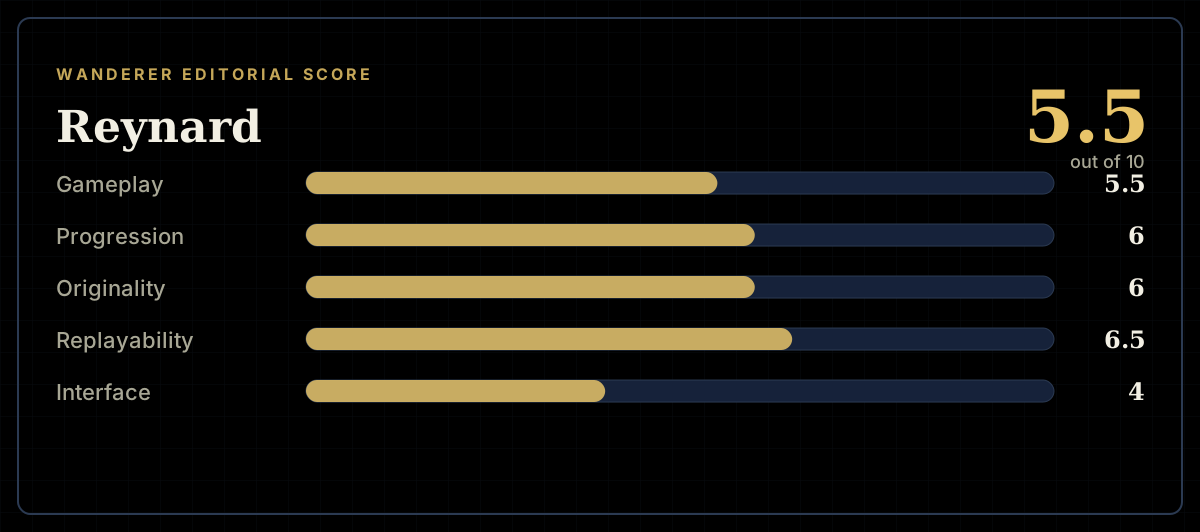
How the review scores each part of the gameWanderer Editorial -
The short versionWanderer Editorial