
Game review
Cook Dungeon
3 / 10
- Developer
- L-S STUDIO
- Publisher
- L-S STUDIO
- Released
- 12 December 2019
- Platforms
- Windows
- Genre
- RPG
- Monetisation
- Paid, no in-app purchases found
- Players
- false
The short version
Cook Dungeon's core idea — randomly combining any two items or foods to 'cook' unpredictable new gear while descending a procedurally generated dungeon — is a genuinely different hook for a budget roguelike, but the game never explains what anything does, ships without a settings menu or tutorial, and multiple reviewers independently identified sprites lifted from Pokemon. The developer partially responded by redrawing some flagged art after the backlash, which is worth crediting, but it doesn't undo the rest of the rough edges.
Biggest strengths
- A genuinely distinct core hook: any two items or foods can be randomly combined into unpredictable new gear via a "cooking" mechanic, rather than a fixed crafting tree
- The developer visibly responded to the community's biggest complaint, redrawing at least some flagged sprites after backlash rather than ignoring it entirely
- Very low asking price, and at least one player reports genuine long-term engagement built around the game's glitches and speedrunning potential
Biggest weaknesses
- Multiple reviewers independently and specifically identified sprites lifted from Pokemon, a serious and documented originality problem for a paid release
- No tutorial and no in-game explanation of what any item or cooked result actually does, leaving basic mechanics like healing reportedly non-functional or undiscoverable
- No settings menu at all, including no way to adjust an audio mix multiple reviewers call jarringly loud on startup
Who it's for: Only for players specifically curious about the cooking-fusion gimmick who can tolerate an unexplained, buggy budget roguelike for a couple of dollars.
Our recommendation: Skip it — the asking price is low, but so is what's actually here, and the art-theft dispute is a real, documented mark against it.
3 / 10
What it is
Cook Dungeon frames itself as a highly random dungeon-exploration roguelike with a single mission: rescue a princess from a procedurally generated dungeon. Structurally that's a familiar budget-indie premise, but the game's own hook is its item system — rather than a conventional crafting tree, almost any two items or food ingredients found in the dungeon can be combined at random to "cook" a new, unpredictable result. It released on 12 December 2019 at NZD 2.99, single-player, with Steam Achievements and Leaderboards but no multiplayer.
Twenty Steam reviews have accumulated since, splitting to Mostly Negative (7 positive, 13 negative overall; 5 of 14 English-language reviews positive), and the English-language corpus is unusually specific for a game this small and this cheap — several reviewers describe near-identical technical and design complaints independently, plus a documented dispute over the game's artwork that played out in the reviews themselves shortly after launch.
An interesting idea, undermined by a lack of information
The cooking mechanic is the one thing reviewers on both sides of the recommendation line credit as genuinely different. But nearly every review that engages with it in detail concludes the same way: there's no way to learn how it actually works. One reviewer describes testing it "extensively" looking for a pattern connecting ingredients to results and coming away convinced it's simply random, with no discoverable logic to reward experimentation the way a real crafting or alchemy system would. That same review goes further, reporting that basic expected functionality — specifically, healing — appears to not work at all, with no in-game text explaining what any item does to help a player figure out why. A second, more heated review makes the identical complaint in blunter terms: "the game doesn't teach you how to play," items are unexplained, and "healing is impossible."
This is a design problem distinct from the game simply being small or cheap. A randomized system can absolutely work as a core hook — plenty of well-regarded roguelikes build entire identities around unpredictable item combinations — but it needs either legible feedback about what happened and why, or a tutorial establishing the rules a player is meant to work within. Cook Dungeon reportedly has neither, which turns its most interesting idea into a source of frustration rather than discovery.
The art dispute
The most consequential complaint in the corpus isn't about mechanics at all. Multiple reviewers, independently, identify specific item and creature sprites as visibly lifted from Pokemon. One review, dated with an edit from 16 December 2019 — four days after release — documents the aftermath directly: "the devs took notice of what we were saying in regards to some item sprites... they've been redrawn," while noting that other sprites "you can still tell were inspired from games like Pokemon" remained unchanged at the time of the edit. A second review covering the same episode is less generous about the developer's conduct, describing the developer as responding "as if nothing he did was wrong" in the community discussion around the accusations, while still crediting them for not deleting the thread and for eventually replacing some of the disputed art.
That combination — a real, substantiated complaint, a partial and grudging-sounding correction, and remaining unaddressed art even after the correction — is a more serious mark against a $3 game than any of its technical rough edges. It's the kind of finding that's fully checkable rather than a one-person accusation: multiple independent reviewers name the same source material, and the developer's own after-the-fact edit implicitly concedes the point by describing sprites as having been redrawn.
Other rough edges, and a note on the positive corpus
Other complaints stack up around the edges: a startup audio mix reviewers call uncomfortably loud with no settings menu available to adjust it, and a general "shovelware" framing from more than one reviewer given the combination of unexplained systems and disputed art. On the positive side, reviews that recommend the game generally do so in modest terms tied directly to the low price — "ok for $1.40 (30% off)," "I like this game, for what it is and the price" — rather than describing it as well-made outright. One Steam profile in the corpus shows an outlier playtime figure in the hundreds of thousands of minutes, which that same review attributes to the game's glitches and "amazing speed running potential" rather than to the core loop itself; it's worth noting as a data point about a speedrunning subculture the game apparently developed, not as evidence the base game holds up to extended, straightforward play.
What the achievement list suggests about scope
The game's own Steam achievement list is short on ambition even by budget-roguelike standards: ten of its 25 achievements are simply "BOSS 1" through "BOSS 10," a naming convention that suggests a finite, numbered sequence of boss encounters rather than the kind of open-ended, procedurally varied challenge a "highly random dungeon exploration" pitch implies. That's not disqualifying on its own — plenty of good roguelikes structure progress around a fixed sequence of set-piece fights — but it sits oddly next to a marketing pitch built entirely around randomness and unpredictability, and it reinforces the review corpus's broader sense that there's less actual variety here than the premise promises.
Verdict
Cook Dungeon's random item-fusion hook is a real, interesting idea for a budget roguelike, and its developer deserves some credit for responding to the loudest complaint against it rather than staying silent. But an unexplained, seemingly patternless core system, missing basics like a settings menu and tutorial, and a partially-resolved art-theft dispute add up to a game that doesn't clear the bar even at its very low asking price, when so much better and more original budget roguelikes exist on Steam.
Pros and cons
Pros
- A genuinely distinct core hook: any two items or foods can be randomly combined into unpredictable new gear via a "cooking" mechanic, rather than a fixed crafting tree
- The developer visibly responded to the community's biggest complaint, redrawing at least some flagged sprites after backlash rather than ignoring it entirely
- Very low asking price, and at least one player reports genuine long-term engagement built around the game's glitches and speedrunning potential
Cons
- Multiple reviewers independently and specifically identified sprites lifted from Pokemon, a serious and documented originality problem for a paid release
- No tutorial and no in-game explanation of what any item or cooked result actually does, leaving basic mechanics like healing reportedly non-functional or undiscoverable
- No settings menu at all, including no way to adjust an audio mix multiple reviewers call jarringly loud on startup
- The random cooking mechanic reportedly has no discoverable logic connecting ingredients to results, undermining any sense that experimentation is being rewarded
- The developer's public response to the art-theft complaints was reported by at least one reviewer as defensive rather than fully accountable, even after making some art changes
Screenshots
-

Cook DungeonImage: L-S STUDIO via Steam -

Cook DungeonImage: L-S STUDIO via Steam -

Cook DungeonImage: L-S STUDIO via Steam -
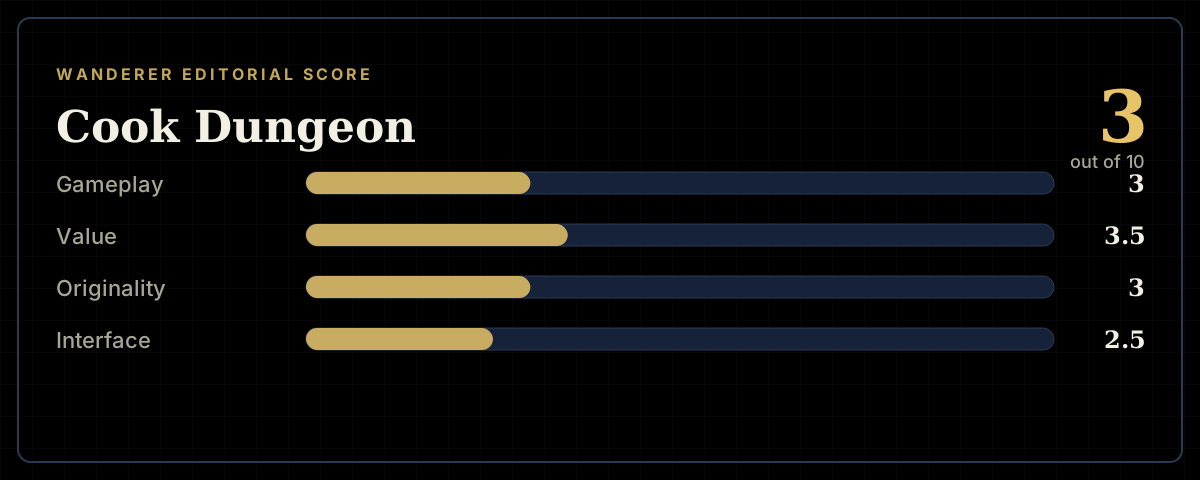
How the review scores each part of the gameWanderer Editorial -
The short versionWanderer Editorial