
Game review
Overdungeon
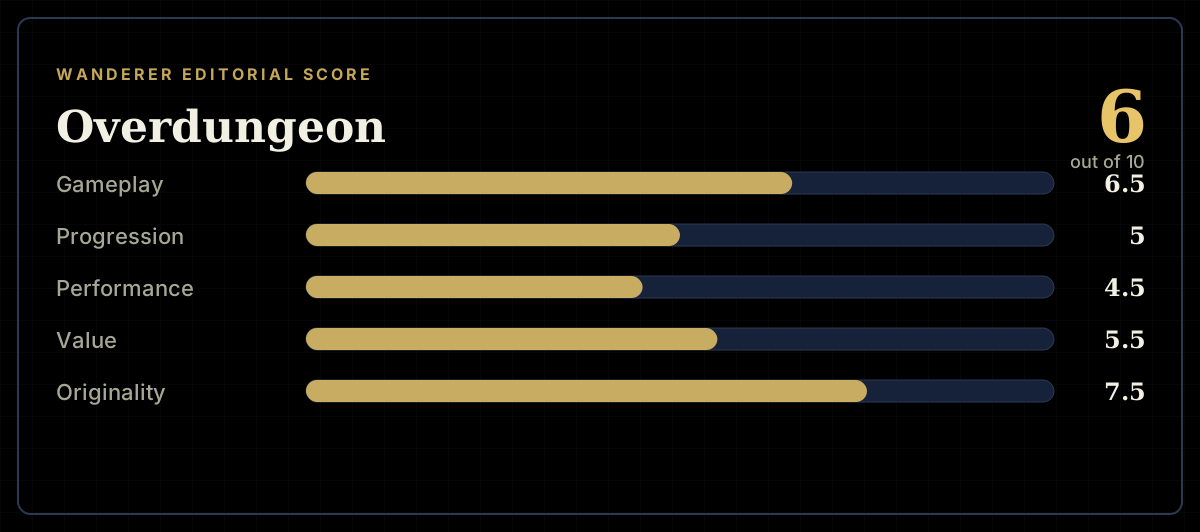
6 / 10
- Developer
- Pocketpair
- Publisher
- Pocketpair
- Released
- 22 August 2019
- Platforms
- Windows
- Genre
- RPG
- Monetisation
- Paid, no in-app purchases found
- Players
- false
The short version
Overdungeon's pitch is a genuinely fun collision of ideas: deckbuilding roguelike structure crossed with a real-time tug-of-war battlefield where summoned chickens, bears and turrets fight it out automatically while you keep feeding the board more cards. It's Pocketpair's first released game, made years before Palworld turned them into a household name, and its history is unusually well documented in the developer's own words: a bad publisher contract led to a full four years of abandonment before Pocketpair regained the rights and resumed patching in 2023.
Biggest strengths
- A distinctive, chaotic real-time hybrid of deckbuilding and tug-of-war tower defense that multiple reviewers say delivers on its "Slay the Spire meets Clash Royale" pitch
- Bright, distinct low-poly visuals and a pleasant soundtrack that reviewers say hold up well
- Later content additions (per one long-term reviewer's updated account) added ascension-style difficulty modes, challenge fights and an RPG-like skill-progression mode well beyond the game's thin Early Access starting point
Biggest weaknesses
- Multiple independent reviews report the game effectively abandoned for roughly four years (2019/2020 to 2023), with one describing a profile showing over 800 hours logged calling it "straight up abandonware" that "doesn't even load anymore" in that state
- The developer's own explanation cites a soured publisher contract and a pivot to their next project, Craftopia, as the reason — support resumed in 2023 but has again gone quiet since, per the most recent news activity
- A detailed Early Access-era review documents cramped battlefield space causing cluttered, hard-to-read combat once a fight escalates, alongside thin starting content (a single real dungeon, minimal deck variety)
Who it's for: Deckbuilder fans who want something louder, faster and messier than Slay the Spire's careful arithmetic, and who are curious about Pocketpair's pre-Palworld work.
Our recommendation: A genuinely fun, unusual hybrid worth trying on sale, with the expectation that ongoing support has been sporadic at best and long silent stretches are part of this game's actual history, not a risk you're taking on blind.
6 / 10
What it is
Overdungeon's own developer describes its origin in the plainest possible terms: Pocketpair CEO Takuro Mizobe wondered what would happen if you combined two of his favourite games, Slay the Spire and Clash Royale, and Overdungeon is the answer. The deckbuilding, roguelike overmap structure and card-collection loop come straight from Slay the Spire's playbook, but battles play out in real time on a tug-of-war battlefield: cards summon creatures, build turrets, or cast spells, and once played, everything fights automatically while you keep feeding more cards into the fray, trying to push the fight toward the enemy's side before they push it toward yours. One reviewer's description captures the chaotic tone better than any marketing copy could: "you fill the board with chickens and bears and cats and stuff, and then the enemy fills their side of the board with chickens and bears and cats and stuff, so then you have to make towers to shoot at them."
It released on 22 August 2019 at NZD 21.99, and this review exists partly because of what happened afterward. Overdungeon was Pocketpair's first released game — years before Palworld made the studio a household name, and before Craftopia, the "everything game" they built in between. That chronology matters directly to this game's story, not just as trivia.
A fun, distinctive hybrid — when it's actively supported
Reviewers who caught the game in a well-supported window are consistently enthusiastic about the core concept. One long-term player's review, updated after further play, calls it "the game that keeps on giving," noting that beyond the base loop, Pocketpair added StS-style ascension difficulty modes, standalone challenge fights, and "an RPG-ish mode with skill ups" — real structural expansion well past the game's initial scope. A detailed, mechanically-literate Early Access review compares the tug-of-war structure specifically to Starcraft 2's Direct Strike custom map crossed with Slay the Spire, praising the "crazy shenanigans" possible when card interactions chain together — "sending a billion chickens (that spawn smaller chickens!) at your enemy" is offered as a specific, delighted example of the kind of chaos the design rewards rather than punishes.
That same detailed review is also where the game's rough edges are catalogued most precisely: at the time of writing, only one real dungeon existed, the arena was "far too small" for how cluttered fights become once summons pile up, and the game badly needed long-term deck-building progression between runs rather than a small handful of premade starting decks. Critically, this same reviewer closes with an unprompted, specific request that reads almost prophetic in hindsight given what came later: "No microtransactions! EVER!" — a plea Pocketpair, to its credit, appears to have honoured; nothing in the review corpus or store listing indicates any in-app purchases were ever added.
The four-year gap, in the developer's own words
The most important thing to know about Overdungeon isn't a mechanical detail, it's what happened to it after launch, and unusually for this lane, the full explanation comes directly from the developer rather than being pieced together from reviewer speculation. Multiple reviews report the game as functionally abandoned for years: one describes a profile with over 800 hours logged bluntly calling it "straight up abandonware [that] dost even load anymore"; another with over 270 hours states flatly "unfinished story and no more updates... get ur refund if u just bought this game."
Pocketpair addressed this directly in a news post dated 20 May 2023, titled "Why The Overdungeon's Update Took 4 Years To Come Alive." In their own words: after release, they "worked crazily to release patches daily," but signed a publisher contract that "didn't work out well as opposed to our expectations." Unable to make a living from the game as it stood, they "gave up on updating Overdungeon" and redirected their efforts into their next project, Craftopia — a decision they describe as "really painful" to make while Overdungeon still had unresolved bugs. The post confirms Pocketpair regained full rights to the game as the studio grew larger, resuming updates through several patches culminating in version 1.3.4 in September 2023, with a stated commitment to keep reflecting player feedback. Coverage from outlets like Rock Paper Shotgun independently corroborates this account and timeline. Since that 2023 update wave, however, the news feed shows only sale announcements, with no further content patches confirmed as of this review.
The Palworld connection, and why it's more than trivia
It would be easy to treat Pocketpair's later fame as an unrelated footnote, but the developer's own account of Overdungeon's history draws a direct line between the two. In the same post explaining the four-year gap, Pocketpair states plainly that the choice to abandon Overdungeon and build Craftopia instead was a survival decision — they "couldn't make a living" continuing to support their first game as it stood. That's a genuinely useful piece of context for any studio's origin story: Overdungeon wasn't a side project or a cash-grab abandoned out of indifference, it was a small studio's first serious commercial attempt that didn't generate enough revenue to sustain itself, forcing a pivot that eventually led, through Craftopia, to the studio that made Palworld. Read with that context, the reviewer complaints about a bad publisher contract and years of silence aren't just a black mark against the game — they're a data point in a larger, now-public story about how a small, personal passion project ("full of our souls and passions," in Pocketpair's own words) can get sidelined by the business realities of keeping a young studio afloat, only to be revisited once that studio found its footing elsewhere.
What the achievement data adds
The completion curve across Overdungeon's 54 tracked achievements runs from a healthy 62.1% at the top down to a cluster sitting at or below 1.2% for the hardest, most specific challenges — conditions like clearing a run using only building cards, only spell cards, or defeating the final boss using only traps. That kind of long tail, ending in achievements requiring an entire run built around a single, deliberately restrictive constraint, points to a genuine breadth of viable deck archetypes still being explored by a small dedicated fraction of the playerbase — consistent with reviewer accounts of "still finding new combos to build decks around" well past 100 hours of play, and a useful counterweight to the abandonment narrative when it comes to judging whether the underlying systems have enough depth to reward that kind of dedicated engagement.
Verdict
Overdungeon is a genuinely inventive, fun-when-supported hybrid that deserved better than the years of silence it got, and its origin as Pocketpair's very first game — made by the same team that would go on to build one of the biggest games of 2024 — gives it a historical interest well beyond its own mechanics. The developer's unusually candid explanation for its abandonment, and the real content additions made both before that gap and after Pocketpair's 2023 return, argue for real, if inconsistent, care behind the project. Recommended for deckbuilder fans drawn to its chaotic, real-time spin on the formula, with realistic expectations about a support history that's already gone quiet more than once.
Pros and cons
Pros
- A distinctive, chaotic real-time hybrid of deckbuilding and tug-of-war tower defense that multiple reviewers say delivers on its "Slay the Spire meets Clash Royale" pitch
- Bright, distinct low-poly visuals and a pleasant soundtrack that reviewers say hold up well
- Later content additions (per one long-term reviewer's updated account) added ascension-style difficulty modes, challenge fights and an RPG-like skill-progression mode well beyond the game's thin Early Access starting point
- A rare case where a long period of apparent abandonment comes with a direct, detailed, on-the-record explanation from the developer rather than silence
Cons
- Multiple independent reviews report the game effectively abandoned for roughly four years (2019/2020 to 2023), with one describing a profile showing over 800 hours logged calling it "straight up abandonware" that "doesn't even load anymore" in that state
- The developer's own explanation cites a soured publisher contract and a pivot to their next project, Craftopia, as the reason — support resumed in 2023 but has again gone quiet since, per the most recent news activity
- A detailed Early Access-era review documents cramped battlefield space causing cluttered, hard-to-read combat once a fight escalates, alongside thin starting content (a single real dungeon, minimal deck variety)
- Achievement data shows several extremely low-completion entries (several under 1.2%) tied to specific challenge conditions, suggesting some end-game content is either very difficult or rarely attempted
- No confirmed ongoing content roadmap beyond the 2023 update wave, leaving its long-term future uncertain
Screenshots
-

OverdungeonImage: Pocketpair via Steam -

OverdungeonImage: Pocketpair via Steam -

OverdungeonImage: Pocketpair via Steam -
How the review scores each part of the gameWanderer Editorial -
The short versionWanderer Editorial