
Game review
Nowhere Prophet
6.5 / 10
- Developer
- Sharkbomb Studios
- Publisher
- No More Robots
- Released
- 19 July 2019
- Platforms
- Windows
- Genre
- RPG
- Monetisation
- Paid, no in-app purchases found
- Players
- false
The short version
Nowhere Prophet leads a caravan of followers across an irradiated wasteland toward a legendary Crypt, fighting positional card battles where permanently losing a follower is a real, weighty cost rather than a reset button. Its review corpus contains one of the more substantive, well-argued genre disputes this lane has documented: detailed critics argue the card pool lacks the build-defining synergy that makes deckbuilders like Slay the Spire compelling, while equally detailed defenders argue those same critics are judging the game by a different genre's standards and missing what it's actually going for.
Biggest strengths
- A distinctive, well-realized post-apocalyptic caravan setting with real narrative texture, praised consistently for its art, music and sense of place
- Positional, grid-based combat that adds a genuine tactical layer beyond simple card-value comparison, drawing favourable comparisons to Banner Saga and FTL
- Real, meaningful stakes from permanent follower death, giving individual units — and their loss — emotional and mechanical weight rare in the genre
Biggest weaknesses
- A detailed, well-argued critical contingent says most cards are balanced individually rather than designed for cross-card synergy, meaning deck choices are more about picking the statistically best option than building toward a distinct strategy
- Permanent follower death combined with the AI drawing from the same card pool as the player produces reviewer-documented swings where fights can become effectively unwinnable through bad luck rather than a punishable mistake
- A detailed 82-hour review reports enjoyment declining specifically because, in that reviewer's assessment, core mechanics work against the conventions that make the deckbuilder-roguelike genre satisfying elsewhere
Who it's for: Deckbuilder and roguelike fans specifically drawn to positional combat and permanent-loss stakes, who are prepared to adapt their strategy fight-to-fight rather than build toward one dominant deck archetype.
Our recommendation: Worth it for genre fans willing to engage with its specific design philosophy on its own terms — read a few detailed negative reviews first to see if that philosophy sounds appealing or frustrating to you personally.
6.5 / 10
What it is
Nowhere Prophet casts the player as The Prophet, guided by a voice from the Old World toward a legendary Crypt across an arid, irradiated wasteland, leading a caravan of followers who fight in positional, grid-based card battles along the way. One reviewer frames its lineage neatly: "Hearthstone, FTL and Banner Saga walk into a bar" — cards summon followers onto a battlefield where position genuinely matters, resources must be managed across a long journey rather than a single fight, and followers who die in battle or to random events along the road stay dead, turning the roguelike genre's usual permadeath stakes into something with real emotional as well as mechanical weight. It released on 19 July 2019 at NZD 30.99, developed by Sharkbomb Studios and published by No More Robots.
Its 510-review English corpus sits at Mostly Positive (399 to 111), and reading through it reveals something this lane hasn't quite encountered in this exact shape before: a genuinely substantive, well-argued dispute about the game's fundamental design philosophy, carried out by detailed, high-playtime reviewers on both sides rather than a simple split between fans and haters.
The case that it's a great, distinctive experience
Reviewers who love Nowhere Prophet describe something closer to devotion than casual enjoyment. "It bothers me that it has so many lukewarm and frustrated reviews," writes one, with nearly 11,000 minutes logged, arguing many negative reviews were written before the game's balance had settled and that the complexity simply "takes a significant investment of time and practice" to click. Another, identifying themselves as one of the lead designers of the card game Duelyst, calls it a title with "everything I want in a single player card game experience" specifically for combining cards, positioning, and narrative "heart" in one package — a credible, informed endorsement given that reviewer's stated background in the genre. A player who eventually beat the game after extensive play calls it "perfect in every way," specifically praising the existence of six different endings as evidence of real structural ambition beyond a single linear campaign.
The case that the design fights its own genre
The most detailed critical reviews make a specific, structural argument rather than a general difficulty complaint. One, admitting "this was a hard game to give a thumbs down" precisely because they enjoy this kind of game generally, states plainly: "the game is a deck builder but there is very little building occurring," since cards are "balanced by their price/rarity to buy," making the correct choice usually the objectively best available card rather than a strategic pick that opens up a distinct build. A separate, even more detailed review — from a player with 82 hours logged who initially loved the game — traces their declining enjoyment directly to this same root cause, contrasting Nowhere Prophet explicitly against Slay the Spire: where that genre benchmark designs cards "to explicitly work with other cards to create powerful synergies," this reviewer argues Nowhere Prophet's cards "were more or less designed to work by themselves," leaving little of the build-crafting satisfaction the genre is known for. Combined with permanent follower loss and an AI opponent drawing from the identical card pool, that reviewer reports fights swinging unpredictably from trivial to catastrophic based on card draw luck rather than player skill, eventually souring their experience enough to recommend easy mode as the only way they still find the game enjoyable.
A dispute this review can't fully settle
What makes this corpus worth engaging with in depth, rather than averaging into a single score, is that both sides are arguing from real, substantial time invested rather than a quick bounce-off. Defenders explicitly push back on the "too hard" framing as a mismatch of expectations rather than a flaw — "so many negative reviews complaining the game is too hard," writes one, going on to describe specific mechanical counters (like managing the game's "wounds" system) that critics may not have fully engaged with. Critics counter that they did engage seriously, for dozens of hours in some cases, before concluding the underlying systems themselves were the problem rather than their own unfamiliarity. This review can't adjudicate which framing is more accurate for any individual player — it depends heavily on what a given reader wants from a deckbuilder's card design specifically, and readers drawn to games precisely because of tight, synergy-driven deckbuilding should weigh the critical case especially seriously before buying.
What the achievement data suggests about who's right
The game's own completion data offers a useful, if imperfect, data point in this dispute. The "campaign_won" achievement sits at 18.2% — a genuinely healthy full-completion rate for a roguelike, well above the sub-5% or even sub-2% completion rates this lane has documented in several other, similarly difficulty-focused titles. That's meaningfully hard to square with a reading of the game as fundamentally broken or unfairly punishing at its core: whatever friction exists between the card design and player expectations, nearly one in five owners who engage with the game seriously enough to leave a mark on its achievement data do eventually win a full run. That leans toward the defenders' framing — that the difficulty is real but ultimately fair and learnable — without fully resolving the more specific complaint about card synergy, since a game can have a learnable, completable difficulty curve while still under-delivering on the specific kind of build-crafting satisfaction a Slay the Spire veteran might be hoping for. The two arguments, in other words, aren't actually mutually exclusive: the game can be beatable and fair in the aggregate while still failing to deliver a particular flavour of deckbuilding depth that its harshest critics specifically wanted.
Positioning as the game's real differentiator
It's worth dwelling on what several reviewers agree is the genuinely distinctive part of the design, regardless of which side of the synergy debate they land on: the grid-based positioning system. Unlike a typical card battler where units simply trade damage in the abstract, Nowhere Prophet requires thinking about which lane a follower occupies, how far enemies need to travel to reach the caravan's leader, and how area-effect cards interact with clustered formations. Even the game's most detailed critics don't dispute that this layer adds real tactical texture beyond simple card-value comparison — the disagreement is specifically about deckbuilding variety, not about whether the combat itself has depth. That's a useful distinction for a prospective buyer: if positional, FTL-and-Banner-Saga-style tactical combat is the main draw, the corpus suggests that part of the experience holds up regardless of the synergy debate; if deep, build-defining card synergy in the Slay the Spire mold is specifically what's being sought, that's the part worth scrutinising further before buying.
Verdict
Nowhere Prophet is a genuinely distinctive, well-crafted roguelike with real narrative texture and a positional combat system that rewards careful, adaptive play — and it's also a game whose card design draws real, substantive disagreement from experienced genre players about whether it delivers genuine strategic depth or just variance dressed up as difficulty. Worth trying for players drawn to its specific caravan-survival premise and permanent-loss stakes, with the expectation that its approach to deckbuilding is a real point of contention rather than settled consensus.
Pros and cons
Pros
- A distinctive, well-realized post-apocalyptic caravan setting with real narrative texture, praised consistently for its art, music and sense of place
- Positional, grid-based combat that adds a genuine tactical layer beyond simple card-value comparison, drawing favourable comparisons to Banner Saga and FTL
- Real, meaningful stakes from permanent follower death, giving individual units — and their loss — emotional and mechanical weight rare in the genre
- Six distinct endings and enough structural depth that a genuinely positive, high-playtime contingent of reviewers calls it one of their favourite games in the genre outright
Cons
- A detailed, well-argued critical contingent says most cards are balanced individually rather than designed for cross-card synergy, meaning deck choices are more about picking the statistically best option than building toward a distinct strategy
- Permanent follower death combined with the AI drawing from the same card pool as the player produces reviewer-documented swings where fights can become effectively unwinnable through bad luck rather than a punishable mistake
- A detailed 82-hour review reports enjoyment declining specifically because, in that reviewer's assessment, core mechanics work against the conventions that make the deckbuilder-roguelike genre satisfying elsewhere
- A real, ongoing disagreement in the review corpus over whether "too hard" complaints reflect genuine balance problems or a mismatch between player expectations and the game's actual design philosophy, which this review can't fully resolve either way
Screenshots
-

Nowhere ProphetImage: No More Robots via Steam -

Nowhere ProphetImage: No More Robots via Steam -

Nowhere ProphetImage: No More Robots via Steam -
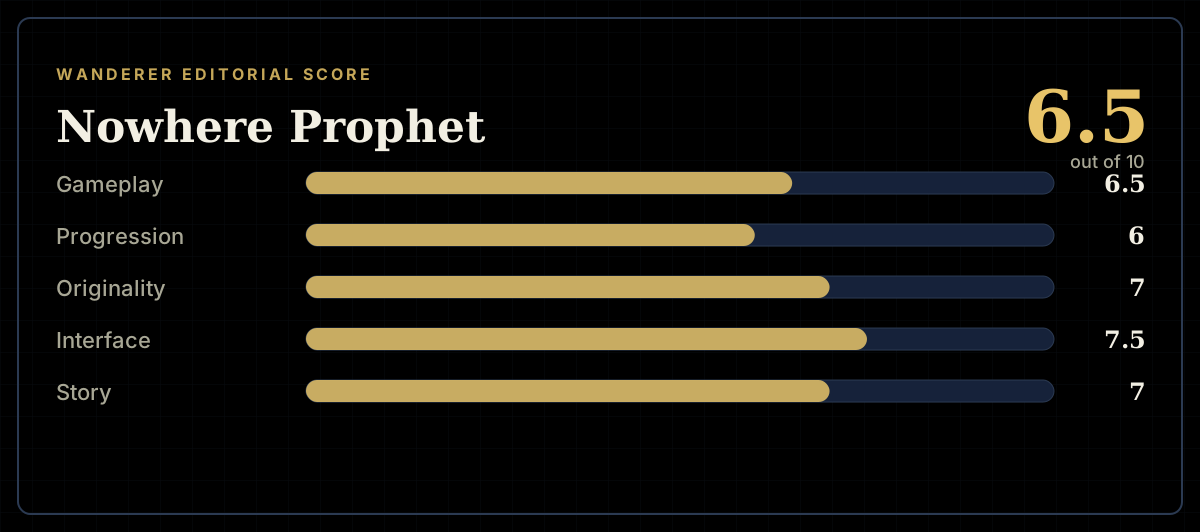
How the review scores each part of the gameWanderer Editorial -
The short versionWanderer Editorial