
Game review
Deck Hunter
3.5 / 10
- Developer
- L_Draven
- Publisher
- L_Draven
- Released
- 30 May 2019
- Platforms
- Windows
- Genre
- RPG
- Monetisation
- Paid, no in-app purchases found
- Players
- false
The short version
Deck Hunter borrows Slay the Spire's overmap structure and adds a genuinely interesting hidden-combo system that rewards playing cards in a specific sequence — a real, distinctive idea that several reviewers single out as the game's best feature. But years of Early Access produced an upgrade system that openly rewards stalling fights rather than winning them efficiently, weak card synergy compared to the genre benchmark it's measured against, and a development history that, per Steam's own news feed, went fully quiet for more than three years after a real and reasonably active patch cadence.
Biggest strengths
- A genuinely distinctive hidden-combo system, where playing specific cards in sequence triggers bonus effects, that multiple reviewers single out as the most fun and successful part of the design
- Card evolution and an alchemy-based crafting system add an unusual RPG-adjacent layer on top of standard deckbuilding
- Cute, fitting art style, at least on the cards and assets the developer finished before development slowed
Biggest weaknesses
- An upgrade-per-use system built around cards leveling up the more they're played in a single fight actively rewards deliberately dragging fights out ("stalling") rather than winning efficiently, a perverse incentive multiple reviewers call out directly
- Weak card synergy compared to the genre's benchmark, with several reviewers reporting that most card choices differ from each other only in minor numerical ways rather than opening up distinct strategies
- A documented, roughly three-year-plus silence in the developer's own patch history after a real, reasonably active update cadence from 2019 through late 2022, matching a reviewer's direct claim the game was "abandoned before being finished"
Who it's for: Only for Slay the Spire fans specifically curious about its combo mechanic who are prepared for a rough, seemingly abandoned Early Access experience at a very low price.
Our recommendation: Skip it — the price is low but so is the amount of finished, functioning game behind it at this point.
3.5 / 10
What it is
Deck Hunter sets its roguelike deckbuilding in the World of Klanojh, cursed by an angry goddess, with the player guiding a character named Avery through card-based battles against fantasy creatures to restore balance. Structurally it follows Slay the Spire's playbook closely — an overmap of branching paths, card rewards after victories, escalating difficulty — but adds two mechanics meant to differentiate it: a hidden combo system that triggers bonus effects when specific cards are played in the right sequence, and an alchemy/crafting system letting players fuse cards or equipment together. It entered Early Access on 30 May 2019 at a budget NZD 4.79, developed solo by L_Draven, and remains in Early Access more than six years later.
Its review corpus, 163 reviews in English, sits at Mixed (94 positive, 69 negative) — a genuinely divided verdict rather than a clear consensus, and reading through it reveals real praise and real, specific frustration in roughly equal measure.
The idea that works
The combo system draws consistent, specific praise across otherwise mixed reviews. One reviewer calls it "an interesting innovation and pretty fun," while another, more critical overall, still credits it as "really cool" and reports that once they understood it, runs became noticeably more engaging and skill-driven than typical roguelike deckbuilders. A third reviewer explicitly lists card evolution, card alchemy and equipment-based character growth as genuine RPG spice layered on top of a Slay the Spire-style map structure, calling that combination "great" even while cataloguing significant problems elsewhere. There's real, distinctive design thinking in Deck Hunter's core hook, and it's worth taking that seriously rather than dismissing the whole project — several reviewers who ultimately don't recommend the game still make a point of saying so.
Where the design undermines itself
The most consistently repeated structural complaint concerns how cards gain power: they level up based on how many times they're played within a single fight, which directly incentivises dragging fights out rather than ending them quickly. One reviewer names this dynamic outright — "it encourages you to stall every single fight" — and a separate, detailed review proposes a specific fix (upgrading a chosen card at the end of a fight rather than per-use), arguing the current system actively punishes efficient, skillful play in favour of grinding out card levels. A related complaint concerns synergy: multiple reviewers directly compare the card design against Slay the Spire's distinct per-class identities (aggressive draw-heavy decks, defensive tank decks, elemental damage-over-time builds) and find Deck Hunter's cards differing mostly in minor numerical tweaks rather than opening genuinely different strategic approaches.
A development history that stopped
Steam's own news feed for Deck Hunter tells a fuller story than any single review. It shows a real, reasonably consistent patch cadence from launch through 2022 — community updates, balance patches, a "Major Update" push in April 2020, and a full "Re-Design of Deck Hunter" announced in May 2021 followed by further redesign news into 2022. The most recent entry, dated 18 October 2022, discusses "Updates, Planning and deadline." Nothing has followed since — over three years of silence on a game still officially in Early Access. That timeline directly corroborates a reviewer's blunt assessment that the game "was abandoned before being finished," and explains why several reviews note unfinished placeholder card art still present after years of development.
One specific review is worth quoting directly because it captures a real trust concern rather than a vague complaint about abandonment. It quotes a patch note verbatim: "Now the game includes a connection to a backend in order to get always the latest versions of the game files avoiding do steam updates," and reacts with alarm at a solo hobby project introducing a mechanism to modify files on a player's machine outside Steam's own trusted update pipeline, without what the reviewer considered a clear justification given how slowly the game was otherwise being developed. This review can't independently verify what that backend connection does or confirm any actual security issue — no evidence of malicious behaviour is presented anywhere in the corpus — but the discomfort itself, from a fan of the genre who otherwise wanted to like the game, is a legitimate and specific concern worth surfacing rather than a hyperbolic one to dismiss.
Balance complaints that go beyond stalling
Beyond the stalling incentive, reviewers describe specific encounter-design problems that suggest balance was never fully settled even during the game's active development years. One reviewer describes a particular enemy type that flees after a single turn while stealing two cards directly from the player's deck — including, in some cases, an irreplaceable starter card the player has no way to recover, calling the design choice "stupid" outright. Another reports enemies generally feeling "really tanky" while dealing enough damage that protecting the player's health pool leaves little room to do anything else strategically, arguing the game abandons design lessons that "much more popular games" in the genre have already worked out. These are the kinds of specific, granular complaints that distinguish real, uncorrected balance problems from general difficulty — the sort of thing a longer, more sustained development cycle would ordinarily catch and fix, and didn't here.
What the achievement data suggests about difficulty versus luck
The unusually steep achievement-completion cliff — from 96.8% for an early tutorial-style achievement down to a cluster under 1% for equipment and mastery-related achievements — lines up with reviewer complaints about the game leaning on random card acquisition rather than consistent skill-based progression. A cliff this sharp, rather than the smoother, more gradual decay curves this lane has found in better-tuned games, suggests that reaching the hardest content depends heavily on getting lucky with specific card or equipment drops rather than simply playing well and improving over time — precisely the kind of design gap a reviewer means when they say "if you have the luck to acquire the right cards anyway" as a prerequisite for making real progress.
Verdict
Deck Hunter has a real, worthwhile idea at its center — a combo system that rewards sequencing rather than raw stats — wrapped in a card-upgrade structure that undercuts good play, weak inter-card synergy, and a development story that, per the developer's own documented patch history, appears to have quietly stopped after a genuine multi-year effort. At its low price it's a low-risk curiosity for genre completionists, but the game most reviewers wanted this to become never fully arrived, and Steam's own news feed suggests it isn't coming now.
Pros and cons
Pros
- A genuinely distinctive hidden-combo system, where playing specific cards in sequence triggers bonus effects, that multiple reviewers single out as the most fun and successful part of the design
- Card evolution and an alchemy-based crafting system add an unusual RPG-adjacent layer on top of standard deckbuilding
- Cute, fitting art style, at least on the cards and assets the developer finished before development slowed
- Extremely low asking price for what is, in its better moments, a real and playable roguelike deckbuilder
Cons
- An upgrade-per-use system built around cards leveling up the more they're played in a single fight actively rewards deliberately dragging fights out ("stalling") rather than winning efficiently, a perverse incentive multiple reviewers call out directly
- Weak card synergy compared to the genre's benchmark, with several reviewers reporting that most card choices differ from each other only in minor numerical ways rather than opening up distinct strategies
- A documented, roughly three-year-plus silence in the developer's own patch history after a real, reasonably active update cadence from 2019 through late 2022, matching a reviewer's direct claim the game was "abandoned before being finished"
- One reviewer flags a specific, verbatim-quoted patch note describing a new backend connection added to push file updates outside Steam's own update system, reacting with a real security and trust concern about a solo developer's ability to remotely modify game files post-purchase
- A steep achievement-completion cliff (96.8% for the easiest down to 0.2% for the hardest) suggests late-game content is gated heavily behind luck-dependent card acquisition rather than skill
Screenshots
-

Deck HunterImage: L_Draven via Steam -

Deck HunterImage: L_Draven via Steam -

Deck HunterImage: L_Draven via Steam -
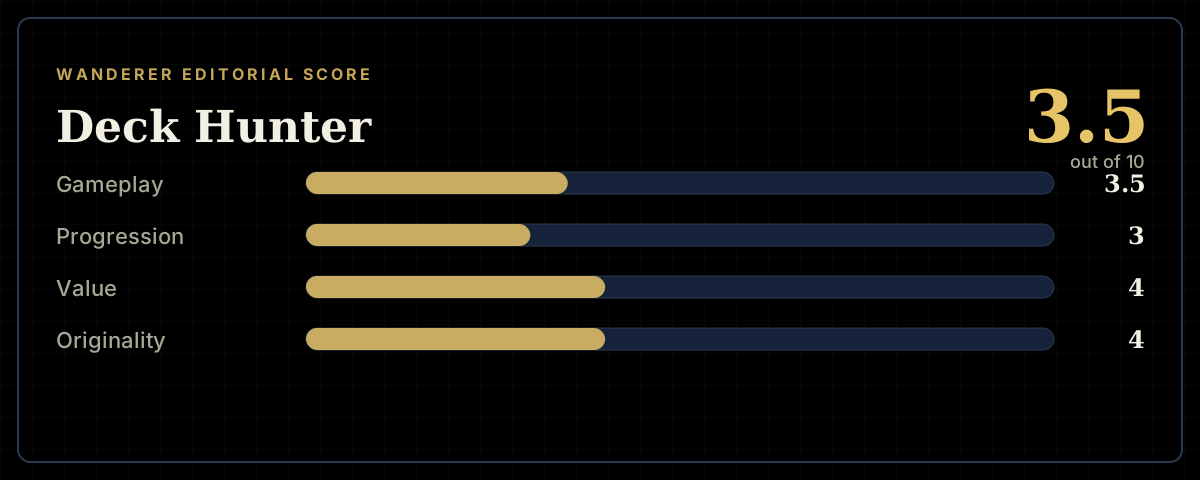
How the review scores each part of the gameWanderer Editorial -
The short versionWanderer Editorial