
Game review
Erannorth Reborn
6 / 10
- Developer
- Spyridon Thalassinos
- Publisher
- Spyridon Thalassinos
- Released
- 17 October 2019
- Platforms
- Windows
- Genre
- RPG
- Monetisation
- Paid base game with additional purchasable DLC
- Players
- false
The short version
Erannorth Reborn pairs deckbuilding with RPG character customization at a scale few solo-developed games attempt — many playable races and classes, a genuine perk-and-stat layer sitting alongside the card system, and enough combinations to have produced reviewers with hundreds of hours logged. But its most detailed critics make a specific, well-argued case that the cards themselves scale linearly with none of the build-defining 'X-factor' effects that make genre benchmarks like Slay the Spire compelling, leaving a game that's complex to learn but, by their account, repetitive to actually play once learned.
Biggest strengths
- An unusually large scope for a solo-developed game: many playable races and classes, each with its own achievement-tracked mastery path, adding up to 58 tracked Steam achievements
- Genuinely balances RPG stat/perk progression against deckbuilding rather than treating one as decoration for the other, according to both fans and several critics
- Extremely high playtimes among its fanbase, several logging 200-350+ hours, indicating real long-term replayability for the right player
Biggest weaknesses
- A detailed, well-argued negative review directly compares the card design to Slay the Spire and finds it lacking: cards scale linearly with cost and value rather than offering build-defining effects, leaving little difference between many strategic choices
- The game is largely storyless, with only a handful of "event"-style interactions and little differentiation in dialogue between races or classes
- Combat is reported to feel "samey" once its systems are learned, with weak audio and visual feedback that undersells the fantasy setting
Who it's for: Deckbuilder enthusiasts who specifically want heavy RPG-style character-building layered on top, and who are comfortable with the game's risque fan-service art style.
Our recommendation: Try before a full-price commitment if possible — the split between its fans and detractors is unusually well-argued on both sides, and which side you land on depends heavily on what you want from a deckbuilder.
6 / 10
What it is
Erannorth Reborn combines roguelike deckbuilding with the kind of character-building depth usually reserved for full RPGs: pick a race and class combination, and the game hands you a starting deck shaped by that choice, then layers stats, perks and equipment on top that meaningfully interact with how your cards perform. It's the work of a single credited developer, Spyridon Thalassinos, and the scope on display is unusual for a solo project — enough race and class combinations that the game tracks a "Mastery" achievement for each one individually, contributing to a total of 58 Steam achievements. Up front, the game offers extensive customisation of its own rules: difficulty, run length, and specific modes including a gauntlet format for players seeking a longer, harder challenge.
It released on 17 October 2019 at NZD 26.29, with additional paid DLC added afterward per multiple reviewer accounts. Its Steam page carries official content descriptors noting nudity, fantasy drug references and alcohol, and describing character and card art as featuring "revealing and skimpy outfits" with partial or full nudity — worth stating plainly up front, since the art style is a recurring point of discussion in the review corpus itself, for reasons both positive and negative. Its English-language review corpus of 306 sits at a healthy Very Positive (256 to 50), and among its positive reviews sit some remarkably high playtime figures: reviewers logging 21,166 minutes (over 350 hours) and 21,703 minutes (over 360 hours) while still actively engaging with the game's harder difficulty options.
What its fans find here
The strongest praise centers on how seriously the game treats its dual identity as both a card game and an RPG. One heavily-upvoted positive review calls it "a fantastic gem of a deck builder combined with the character customizations you'd expect from an RPG," specifically highlighting the extensive rule and mode customisation available from the start. Multiple long-session players describe a real sense of ongoing discovery: one reviewer, self-described as trying "just about every deck-building game on the market," frames Erannorth as rewarding exactly that kind of dedicated genre enthusiast, while another with over 220 hours logged specifically recommends manually unlocking cards rather than skipping that process, calling the unlock journey itself "half the joy." A returning reviewer who updated their account after 60 additional hours reports the game "only gotten better," crediting both paid DLC and free updates for improved character art and expanded content since launch.
That last point matters for evaluating a five-year-old-plus indie title: this isn't reviewed here as a static, abandoned release, but the reviewer testimony suggests real post-launch investment from a solo developer continuing to refine the game well past its initial release.
The detailed case against it
The corpus's most substantial critical review, from a reviewer who put 72 hours in and bought the DLC before ultimately not recommending it, makes a specific, structural argument rather than a general complaint. It grants that Erannorth balances RPG stats against deckbuilding well — "it's just as important to manage your deck as your perks" — but argues the cards themselves are the weak link: nearly everything scales linearly with cost, and there are, in this reviewer's words, "no X-factor cards" of the kind that define genre benchmark Slay the Spire, where specific character builds can be transformed by rare, unusual card effects. Without that variety, the review argues, "there's nothing in Erannorth that will dramatically change your strategy," and runs "start to feel samey very quickly" even across different race and class combinations. A second, shorter negative review reaches an almost identical conclusion independently after only 9 hours: "the game is too dull or repetitive," despite enjoying the process of learning its rules initially.
The same detailed review extends the critique to presentation: combat visuals and audio are "pretty unexciting" and don't sell the fantasy setting, the game is "essentially storyless" beyond a handful of repeated events, and the risque art style goes, in this reviewer's specific phrasing, "beyond the occasional embarrassment and into straight-up annoying sometimes." A separate, blunter review independently makes the same visual complaint even more sharply, describing character models as looking like they were "taken from a porn game from 2004" — a pointed criticism worth including because it's about production quality and dated presentation, not merely the presence of fan service itself, which several other reviewers don't object to at all.
Reconciling two well-argued positions
What makes this corpus worth reading in full, rather than skimming for a star rating, is that neither side is arguing in bad faith or from a place of not understanding the game. The reviewer who put in 72 hours and bought the DLC before ultimately not recommending it clearly engaged seriously with the systems before reaching that conclusion, and explicitly credits the game for balancing its RPG and card layers well even while arguing the cards themselves are the weak link. Conversely, the reviewers logging 300-plus hours aren't naive to the game's flaws either — one explicitly acknowledges "there's a lot written about this game's flaws already that I don't care to recapitulate" before making their own positive case specifically to fellow "deckbuilding nerds" who try every game the genre has to offer. That's a genuinely useful signal for a prospective buyer: this isn't a game where positive reviews are naive and negative ones are better-informed, or vice versa. It's a game whose core design produces sharply different outcomes depending on what a specific player values most — breadth of character-building options, or depth and variety in the cards themselves — and both camps have articulated their position about as clearly as a Steam review allows.
A note on scope for a solo project
It's worth weighing the sheer amount of content against the fact that this is, credited-wise, a one-person project. Fifty-eight tracked achievements spanning dozens of race and class mastery paths, ongoing DLC releases, and free content updates years after launch represent a genuinely significant sustained effort from a single developer, even if the critics are right that the underlying card design doesn't match the structural ambition around it. That context doesn't change whether the core loop holds up for any individual player, but it's relevant to judging the game against realistic expectations for its scale of production rather than against AAA or larger-studio deckbuilders.
Verdict
Erannorth Reborn is a genuinely ambitious solo-developer project, and its achievement data — a long, gradual completion curve running from 67.5% down to under 1% across 58 tracked masteries — confirms real, sustained depth that a dedicated subset of players has clearly explored thoroughly. But its most articulate critics raise a real structural concern rather than a matter of taste: linear card scaling and an absence of build-defining effects can make a deckbuilder's complexity feel like overhead rather than depth once the initial learning curve is cleared. Recommended for players specifically drawn to heavy character customisation layered onto cards, with the caveat that the core card design itself may not hold up to comparison against the genre's best once the novelty wears off.
Pros and cons
Pros
- An unusually large scope for a solo-developed game: many playable races and classes, each with its own achievement-tracked mastery path, adding up to 58 tracked Steam achievements
- Genuinely balances RPG stat/perk progression against deckbuilding rather than treating one as decoration for the other, according to both fans and several critics
- Extremely high playtimes among its fanbase, several logging 200-350+ hours, indicating real long-term replayability for the right player
- Extensive customisation of game rules, difficulty and length offered up front, including a gauntlet mode for players who want a harder, longer challenge
Cons
- A detailed, well-argued negative review directly compares the card design to Slay the Spire and finds it lacking: cards scale linearly with cost and value rather than offering build-defining effects, leaving little difference between many strategic choices
- The game is largely storyless, with only a handful of "event"-style interactions and little differentiation in dialogue between races or classes
- Combat is reported to feel "samey" once its systems are learned, with weak audio and visual feedback that undersells the fantasy setting
- A steep initial learning curve built on a large glossary of keywords and stat interactions, with multiple reviewers reporting they refunded or struggled before that complexity paid off
- Character and card art is explicitly flagged by official content descriptors as featuring nudity and revealing outfits, and at least one detailed reviewer finds the style dated and "annoying" rather than appealing even by the standards of fantasy fan service
Screenshots
-

Erannorth RebornImage: Spyridon Thalassinos via Steam -

Erannorth RebornImage: Spyridon Thalassinos via Steam -

Erannorth RebornImage: Spyridon Thalassinos via Steam -
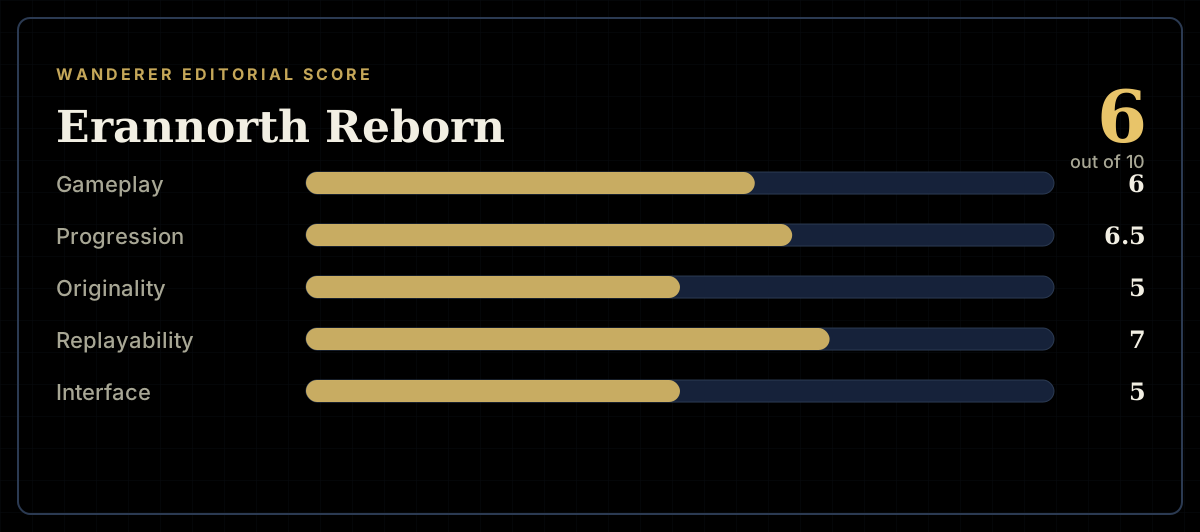
How the review scores each part of the gameWanderer Editorial -
The short versionWanderer Editorial