
Game review
Portal Knights
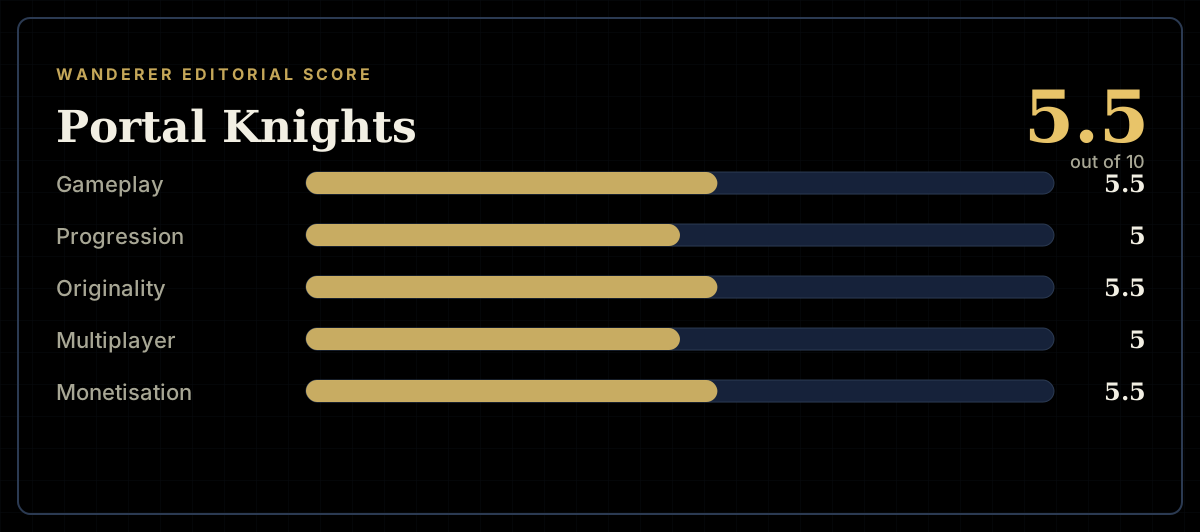
5.5 / 10
- Developer
- Keen Games GmbH
- Publisher
- 505 Games
- Released
- 18 May 2017
- Platforms
- Windows, macOS
- Genre
- Voxel Action RPG
- Monetisation
- Paid, one-time purchase, plus several cosmetic and content DLC packs.
- Players
- Online and local co-op for up to four players, though the connection system has drawn specific criticism.
The short version
Portal Knights combines voxel-based building with real-time RPG combat and class progression across a chain of small floating islands, and its accessible, colourful presentation has earned it Very Positive status across nearly 17,000 reviews. What a large and consistent share of that same review base argues, from launch week in 2017 through recent reviews in 2025 and 2026, is that the game's content doesn't expand to match its ambition — a small set of enemy types, quest structures and world variety recur without much change across a run, and the game never fully resolves whether it wants to be a survival-crafting game or an action RPG.
Biggest strengths
- An approachable, colourful voxel art style that reads well in screenshots and appeals to a broad, casual audience.
- Real RPG structure layered onto voxel building and crafting, including class choice and combat skills rather than pure sandbox freedom.
- Local and online four-player co-op gives the core loop genuine social value when it works as intended.
Biggest weaknesses
- A consistent, launch-to-present complaint describes enemy types, quests and world variety as repetitive, with the game's content failing to expand meaningfully as a playthrough continues.
- Several reviewers describe an unresolved identity conflict between survival-crafting and action-RPG design, arguing the game does neither particularly well as a result.
- A 2017 review describes the multiplayer connection system as unreliable specifically when trying to join a friend's game.
Who it's for: Players looking for a light, colourful, approachable voxel RPG to enjoy in short co-op sessions, without expecting the long-term content depth of genre peers like Minecraft or Terraria.
Our recommendation: A pleasant, accessible pick for casual co-op sessions; go in expecting the content variety to run dry well before a completionist playthrough does.
5.5 / 10
A colourful, approachable voxel RPG
Portal Knights' pitch is direct: "join this cooperative, 3D sandbox action RPG to level up your character, craft epic weapons, conquer enemies in real-time, and build almost anything. Craft your adventure. Forge your hero." The official screenshot shows the tone well — three brightly-costumed characters, including a bee-costumed player avatar, wading through a flower-and-mushroom-strewn field toward a half-built stone fortress, with a floating chunk of terrain drifting in the sky behind them. That floating-island structure is the game's clearest distinguishing idea relative to genre giants like Minecraft and Terraria: rather than one continuous world, the game is built from a chain of smaller, self-contained islands connected by portals, each meant to offer a fresh biome and challenge set. Reviewers consistently credit the presentation and the basic RPG-building fusion as genuinely appealing, particularly for newer or younger players looking for a gentler entry point into the survival-crafting genre than its more demanding peers offer.
A recurring argument that the content doesn't keep pace
Set against that accessible charm is a remarkably consistent complaint that's followed the game since its earliest post-launch reviews. "I've been playing this game since Early Access, and back then it showed promise... Now it's very disappointing," reads a 2017 review, going on to describe combat as "dull, boring and repetitive, you would just spam attack and dodge and that's about it." A separate 2017 review makes the structural point directly: "This game can't decide whether it wants to be a survival crafting game or an adventure RPG game, and ends up doing neither well," describing base- building and crafting stations as functionally at odds with the more linear adventure progression the game also wants to offer. A 2018 review breaks its assessment down plainly: "repetitive worlds - repetitive enemies - repetitive quests," even while crediting "pretty graphics" and four-player co-op as genuine strengths. This pattern isn't confined to launch-era disappointment either — a 2025 review describes being recommended the game as "Minecraft with a goal" and finding that framing didn't hold up: "the game works fine, but it's just not fun for me," rating it a middling 6 out of 10 specifically on the grounds of thin long-term engagement. The specificity and consistency of this complaint across nearly a decade suggests a real, structural content-pacing issue rather than a matter of a few players simply wanting more from a naturally modest game.
Two more specific, practical complaints
Beyond the broader content-depth debate, two narrower issues are worth flagging on their own. A 2017 review focused specifically on multiplayer describes the connection system as unreliable when trying to join a friend's session, a real practical barrier for a game whose co-op is one of its main selling points. Separately, a February 2026 review raises a specific and verifiable design flaw around DLC integration: "It's a nice game, but I don't like looting stuff I can't use because I don't own the DLC," describing enemies dropping items tied to optional paid content that a base-game owner can see but not use. That's a concrete monetisation friction point distinct from the broader repetition complaint, and one a prospective buyer should factor in separately when deciding whether to buy the base game alone or budget for the DLC packs up front.
A fairer comparison than "Minecraft with a goal"
It's worth pushing back gently on the framing at least one reviewer describes being sold on, since holding Portal Knights to a direct Minecraft comparison sets up a mismatch the game was probably never going to survive. Minecraft's entire design philosophy is built around near-total systemic freedom and emergent possibility over years of play; Portal Knights is a much smaller, more curated experience explicitly structured around discrete islands, quest chains and RPG progression rather than open-ended systemic depth. Judged against that more modest, more structured ambition — closer to a light action RPG with a building layer bolted on than a sandbox with an RPG bolted on — the repetition complaints land somewhat differently. A handful of islands and enemy types is a real limitation for a hundred-hour sandbox game; it's a less damning one for a shorter, session-based co-op title that was probably never trying to be Minecraft in the first place, regardless of what recommendation or marketing led some players to expect that comparison.
What the class system actually offers
It's worth being specific about what RPG structure the game does provide, since the repetition complaints focus mostly on world and enemy variety rather than the character-building layer itself. Players choose between warrior, ranger and mage archetypes, each with distinct combat styles, skill trees and preferred equipment types, giving even a single playthrough some build-level variety independent of the environment around it. Reviewers who focus specifically on this system, rather than the broader world content, tend to rate it more favourably — the complaint in this review's research is almost never about class balance or combat responsiveness in isolation, but about how few new situations that combat gets applied to as a playthrough continues. That's a meaningfully narrower problem than "the whole game is shallow," and worth keeping distinct when deciding whether the game's actual weak point matters to a given buyer's priorities.
Final verdict
Portal Knights succeeds at what it visibly sets out to be: an approachable, colourful, easy-to-pick- up voxel RPG well suited to short co-op sessions, and its Very Positive rating reflects genuine, broad appeal on those terms. Where this review's score lands more cautiously is in taking seriously a consistent, decade-spanning argument that the game's content doesn't expand to match its early promise — repetitive worlds, enemies and quests recurring across a run in a way multiple reviewers independently describe using nearly identical language, from 2017 through 2026. That's a fair trade for players who want a light, casual voxel RPG rather than a genre-defining sandbox, and a reasonable reason for players expecting Minecraft- or Terraria-level long-term depth to look elsewhere.
Pros and cons
Pros
- An approachable, colourful voxel art style that reads well in screenshots and appeals to a broad, casual audience.
- Real RPG structure layered onto voxel building and crafting, including class choice and combat skills rather than pure sandbox freedom.
- Local and online four-player co-op gives the core loop genuine social value when it works as intended.
- A manageable, bite-sized island structure that makes individual play sessions easy to pick up and put down.
Cons
- A consistent, launch-to-present complaint describes enemy types, quests and world variety as repetitive, with the game's content failing to expand meaningfully as a playthrough continues.
- Several reviewers describe an unresolved identity conflict between survival-crafting and action-RPG design, arguing the game does neither particularly well as a result.
- A 2017 review describes the multiplayer connection system as unreliable specifically when trying to join a friend's game.
- A February 2026 review reports a specific, current design flaw: enemies drop loot tied to DLC packs the player doesn't own, visible but unusable.
Screenshots
-

Portal KnightsImage: 505 Games via Steam -

Portal KnightsImage: 505 Games via Steam -

Portal KnightsImage: 505 Games via Steam -
How the review scores each part of the gameWanderer Editorial -
The short versionWanderer Editorial