
Game review
Overland
6.5 / 10
- Developer
- Finji
- Publisher
- Finji
- Released
- 19 September 2019
- Platforms
- Windows, Mac, Linux
- Genre
- Strategy
- Monetisation
- Paid, no in-app purchases found
- Players
- false
The short version
Overland puts players in charge of a small, ever-changing group of survivors road-tripping across a creature-infested, post-apocalyptic United States, managing fuel, supplies and permanent character loss across small, turn-based tactical encounters. Its distinctive minimalist art style and genuine emotional attachment to randomly generated travelers draw wide, consistent praise. But this review corpus splits almost evenly on a single, specific question: whether the game's unforgiving, lightly tutorialized difficulty represents tight, deliberate balance that rewards careful play, or a genuinely broken system where killing enemies spawns more of them and storage limitations make survival close to impossible.
Biggest strengths
- A distinctive, charming minimalist art style and understated character design that reviewers consistently praise as a highlight independent of the difficulty debate
- Genuine, well-earned emotional attachment to randomly generated survivors and pets, with permanent loss carrying real weight across a run
- A meaningful contingent of reviewers who completed the game report a tightly balanced, deliberately difficult experience that rewards careful resource management and calculated risk-taking once its systems are understood
Biggest weaknesses
- A large, equally detailed contingent argues the difficulty is not merely hard but broken — citing a specific mechanic where killing a spawned creature can immediately spawn a replacement, effectively punishing combat engagement regardless of skill
- Minimal tutorialization means many core systems (storage limits, refueling rules, when a companion can or can't perform an action) are learned only through repeated, punishing failure, which a real share of reviewers experience as unfair rather than intentionally mysterious
- Restrictive inventory and vehicle storage rules that multiple reviewers call illogical, including a widely cited specific complaint that a character's personal backpack can hold more than the group's actual car
Who it's for: Fans of harsh, high-permadeath-stakes tactical survival games (Into the Breach, FTL) who are willing to learn entirely through trial, error and repeated failure.
Our recommendation: Worth trying if punishing, minimally-explained difficulty appeals to you as a feature rather than a flaw — read both sides of the fairness debate below before buying, since your tolerance for that specific design philosophy will determine your experience more than anything else.
6.5 / 10
What it is
Overland sends a small, shifting group of survivors on a road trip across a post-apocalyptic United States overrun by hostile creatures, managing scarce fuel and supplies across small, grid-based tactical encounters where death is permanent and every decision — who to rescue, what to carry, when to fight versus flee — carries lasting weight. Developed and published by Finji, it released on 19 September 2019 at NZD 28.99, presenting its post-apocalyptic setting through a distinctive, minimalist low-poly art style rather than the genre's usual grim realism.
Its review corpus, 294 in English, sits at a genuine Mostly Positive 76.9% (226 to 68), and reading through it in depth reveals a corpus split almost precisely along one specific fault line: is this game's difficulty a deliberate, well-tuned feature, or a genuine design failure?
Presentation and emotional weight that earn near-universal praise
Regardless of where reviewers land on the difficulty question, this corpus agrees closely on Overland's presentation and its ability to create real attachment to randomly generated characters. "The art, music, and overall style of the game is great," writes one otherwise critical reviewer, echoing a sentiment repeated across nearly every review in the corpus. A separate, especially warm account describes the emotional stakes directly: after building a small found-family of survivors and a rescued dog across a run, one reviewer describes a wrenching moment of having to leave a founding character behind when the group's car filled up — "I was shocked by the logic they put in," they write, describing a system responsive enough to create real, unscripted narrative moments purely through mechanical constraints.
The case that the difficulty is broken, not just hard
A large, detailed share of critical reviews argues Overland's difficulty crosses from challenging into unfair. "Its way too hard, I mean it, its literally impossible," writes one reviewer, identifying a specific mechanical culprit: "if you kill one [creature] (which you even cant all the time, you need a weapon) another one immediately spawns in its place... this mechanic alone ruins the game." The same review flags a specific storage inconsistency: "items that can be stored in the vehicle is a joke, my character with a backpack can take more items than my car." A separate, especially detailed review frames the broader design failure precisely: "combat is always a last resort and a bad idea. You gain nothing from it, and cause more creatures to spawn in almost every map. But you are given almost no tools to do anything except fight" in many situations — a specific, mechanically literate critique of a core systemic contradiction rather than a general complaint about difficulty in the abstract.
The case that the difficulty is fair, deliberate, and learnable
Set directly against that critique, an equally detailed contingent argues the game is fair once properly understood. "The path to victory is narrow but it's definitely there," writes one reviewer who completed the game on their first playthrough, describing Overland as sitting "basically... by way of Into the Breach, in the style of Firewatch." Another pushes back specifically against the "too hard" framing: "it seems to me many reviewers do not understand how to play this game, and find it difficult because of that... failure occurs often because of bad choices long before the game's RNG becomes punishing." A third reviewer, who also won on their first attempt, states plainly: "I'm somewhat baffled by the 'it's too hard' reviews, perhaps they are from an old build," while still acknowledging real, harsh lessons learned the hard way along their own run.
A genre-literate middle-ground critique
Beyond the pure fairness debate, at least one detailed reviewer raises a different, more structural concern about tactical depth specifically: "superficially similar to XCOM's 'move and shoot' 2-point turns, Overland fails to provide any tactical or strategic depth," arguing the combat-avoidance-first design philosophy, while thematically coherent, leaves players with too few meaningful choices in actual encounters compared to genre benchmarks. That's a fair, more measured critique distinct from the "it's broken" camp — accepting the game's difficulty as intentional while still questioning whether its moment-to-moment tactical decisions are deep enough to justify repeated, punishing restarts.
What the achievement data actually shows
Overland's achievement data offers a genuinely useful, concrete data point for this entire debate: the core "WinGame" achievement sits at 21.2% — a real, non-trivial share of the playerbase, directly undercutting the "literally impossible" framing from the harshest critics, while still confirming this is a genuinely difficult game that most buyers don't finish. Earlier milestones show a smoother expected decline (90.5% for the tutorial win, 65.8% for the first biome), suggesting the difficulty curve does ramp up meaningfully in the mid-to-late game rather than being uniformly brutal from the start — a pattern consistent with reviewers on both sides of the debate, who generally agree the opening hours are manageable and the disagreement concerns what happens once the game's later biomes and escalating creature threats kick in.
Verdict
Overland succeeds unambiguously on presentation and emotional design, building real attachment to randomly generated survivors through a distinctive, minimalist art style. Its difficulty, however, is a genuine and unresolved point of disagreement within its own review corpus — a meaningful share of players experience specific, mechanically grounded frustrations that go beyond ordinary difficulty, while a roughly equal share finds the same systems fair and rewarding once learned. The achievement data suggests the truth sits closer to "hard but fair for those who push through" than "broken," but prospective buyers should weigh their own tolerance for minimally-explained, high-permadeath-stakes trial and error carefully before committing.
Pros and cons
Pros
- A distinctive, charming minimalist art style and understated character design that reviewers consistently praise as a highlight independent of the difficulty debate
- Genuine, well-earned emotional attachment to randomly generated survivors and pets, with permanent loss carrying real weight across a run
- A meaningful contingent of reviewers who completed the game report a tightly balanced, deliberately difficult experience that rewards careful resource management and calculated risk-taking once its systems are understood
- Distinctive tension and atmosphere, with one detailed reviewer specifically praising the "constant looming unease" of escalating creature threats as a deliberate, successful design choice rather than an unfair spike
Cons
- A large, equally detailed contingent argues the difficulty is not merely hard but broken — citing a specific mechanic where killing a spawned creature can immediately spawn a replacement, effectively punishing combat engagement regardless of skill
- Minimal tutorialization means many core systems (storage limits, refueling rules, when a companion can or can't perform an action) are learned only through repeated, punishing failure, which a real share of reviewers experience as unfair rather than intentionally mysterious
- Restrictive inventory and vehicle storage rules that multiple reviewers call illogical, including a widely cited specific complaint that a character's personal backpack can hold more than the group's actual car
- A forced "ironman" save structure combined with the steep learning curve means a bad early decision can doom an entire run with no way to recover, which a detailed critical review argues most new players won't push through long enough to master
- Reported achievement-tracking inconsistencies, with at least one reviewer noting they received credit for specific milestones without meeting the stated condition
Screenshots
-

OverlandImage: Finji via Steam -

OverlandImage: Finji via Steam -

OverlandImage: Finji via Steam -
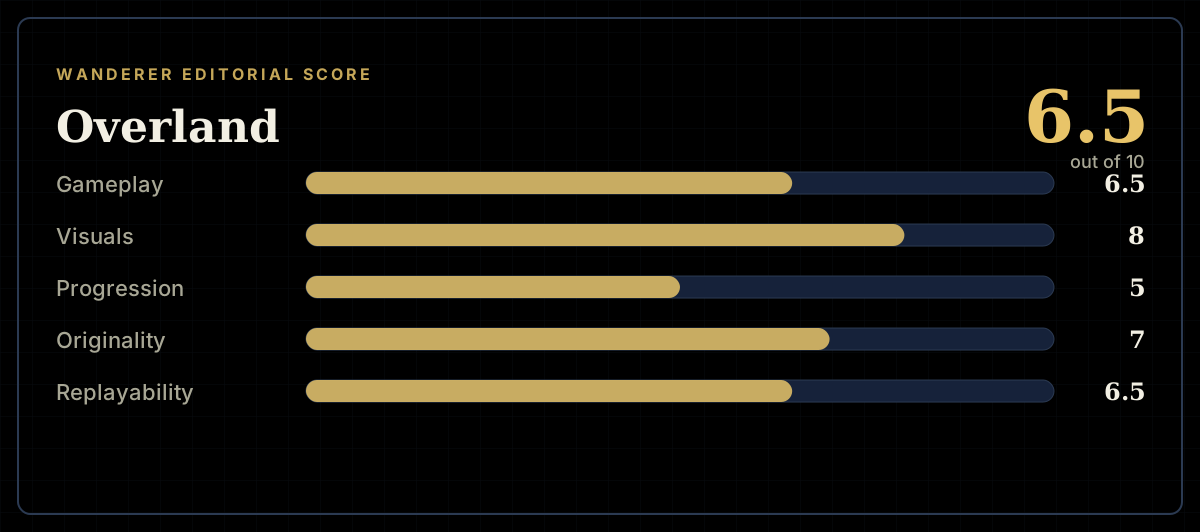
How the review scores each part of the gameWanderer Editorial -
The short versionWanderer Editorial