Game review
Nova Drift
8 / 10
- Developer
- Chimeric
- Publisher
- Pixeljam
- Released
- 12 August 2024
- Platforms
- Windows, macOS
- Genre
- Roguelite / Arcade Shooter
- Monetisation
- One-time purchase at NZ$12.99, plus one DLC. No microtransactions. Checked 4 August 2026.
- Players
- Single-player only, with Steam leaderboards
The short version
Nova Drift's premise is that an action RPG's build system belongs inside an arcade shooter, and it's right. You pilot one ship that mutates as you level — weapons, shields, hull, body types — and the interactions between those parts produce genuinely emergent builds. One player describes abandoning weapons and shields entirely to turn the ship itself into a projectile. That's the game. The catch is that it controls like Asteroids, not like a twin-stick shooter, deliberately, and that single decision accounts for most of its refunds and nearly all of its negative reviews.
Biggest strengths
- Build synergy of genuine ARPG depth — modules interact rather than stack, and wild combinations are discoverable rather than prescribed
- Enormous variety of unlockable weapons, shields, bodies and ship classes that change how a run is played, not just its numbers
- Superb soundtrack and a clean, readable neon presentation
Biggest weaknesses
- The steer-and-thrust control scheme is the single most common complaint and drives most refunds
- Screen wrapping applies to you but not consistently to enemies, which produces confusing encounters at speed
- Unlocking the mods needed for the best builds is a grind, and early runs are noticeably thinner
Who it's for: Roguelite players who play for build discovery rather than execution, and anyone who remembers steering with thrust and rotation and liked it. Not for players who expect twin-stick aiming, and not for anyone who needs varied environments.
Our recommendation: Buy it — at thirteen dollars with a 96% score this is one of the easiest recommendations in the genre, with one caveat you should take seriously. Spend your first hour accepting that the ship steers and thrusts rather than strafes; almost everyone who bounced off did so in that hour, and almost everyone who pushed through describes the momentum as the point. If you know for certain you want twin-stick controls, this isn't the game and no amount of build depth will fix that.
8 / 10
A recent review of Nova Drift, from a player nine hours in: "In my most successful run, I abandoned normal weapons and even my shields to turn myself into a bullet. I felt unstoppable."
That's what this game is for. Everything else is a discussion about how you steer.
An ARPG in an arcade cabinet
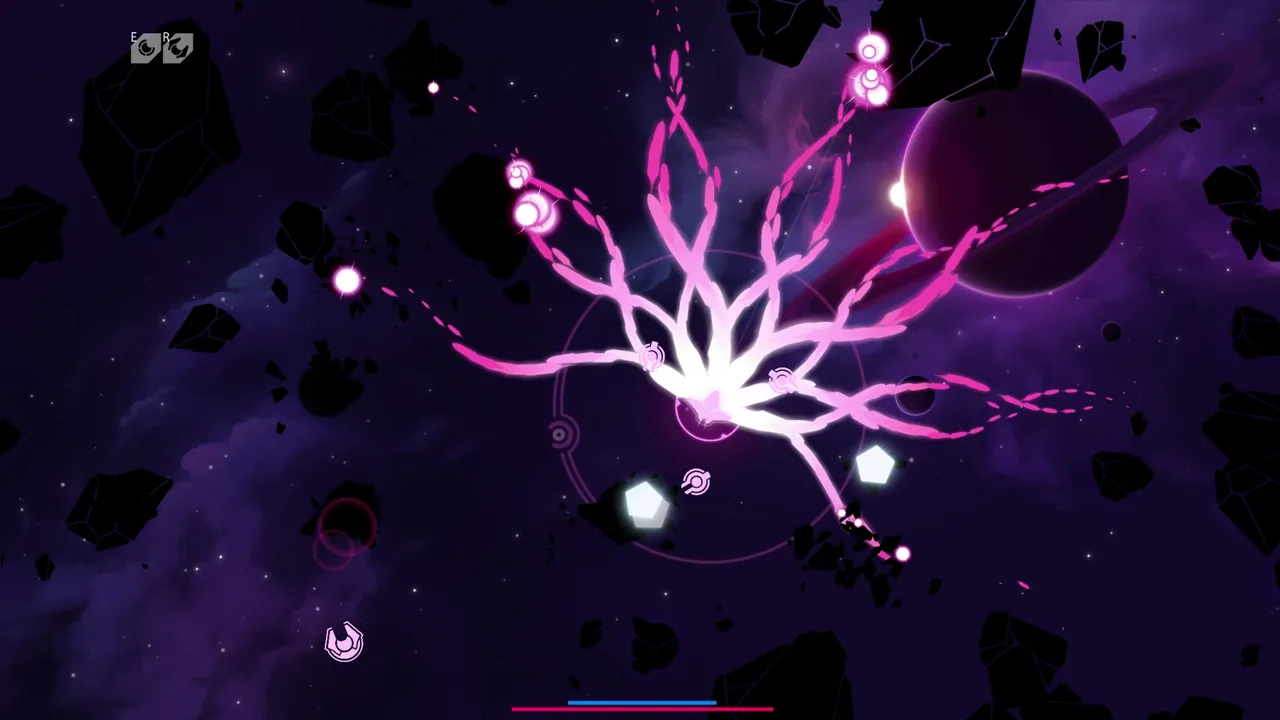
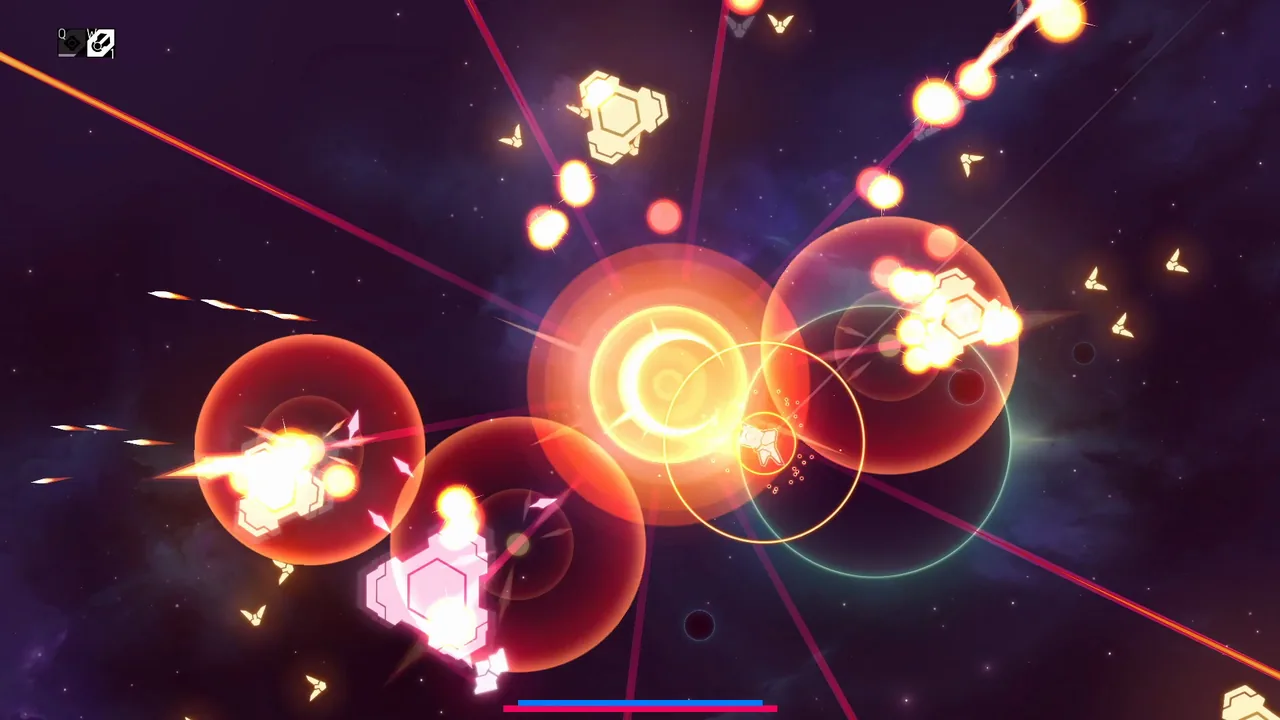
The pitch is unusual and it works. Take the build-crafting depth of an action RPG — modules that interact, synergies that break the game if you find them, meaningful class identities — and put it inside a single-screen arcade shooter that lasts twenty minutes.
You fly one ship. As you level you choose upgrades across weapons, shields, hull and body, and the crucial design decision is that these interact rather than accumulate. A shield that reflects damage becomes a weapon if you build into collisions. A body that trades hull for speed changes which weapons are viable. Take enough mods in one direction and the ship stops resembling a ship.
That produces the thing the genre's best entries all have: runs that go somewhere you didn't plan. Where Vampire Survivors escalates and Brotato optimises, Nova Drift mutates — the interesting question isn't which upgrade is strongest but which combination stops being a shooter.
It's wrapped in a good-looking neon presentation with a genuinely excellent soundtrack, it costs thirteen dollars, and 96% of more than fourteen thousand reviewers recommend it. The median recent player has 24 hours in it.
The controls, which are the whole conversation
Now the part that decides whether you'll like it, because almost every negative review is about the same thing.
Nova Drift does not have twin-stick controls. You steer by rotating and you move by thrusting, with momentum carrying you — the Asteroids model. You do not strafe. You cannot simply point in one direction and move in another.
The negative reviews are emphatic and consistent: "Love the concept, hate the controls." "Refunded because of thrust controls." "Every single death I feel like I died because I was fighting the controls, not the game." Several are from players with an hour logged, which tells you exactly where the filter sits.
Here's the thing that makes this worth explaining rather than just flagging. One reviewer went and found the developer's reasoning: the Asteroids scheme is deliberate, chosen over the modern twin-stick convention on purpose. And a recent positive review completes the thought — initially irritated that it wasn't twin-stick, they came round because "it really is about drifting around and the momentum and inertia of the various objects, including yourself."
The game is called Nova Drift. The controls aren't an oversight; they're the noun.
That doesn't make the complaints wrong. Inertial control genuinely is harder to read at speed, and the screen-wrapping — which applies to your ship but not consistently to everything else — creates moments that feel arbitrary. But it does mean the decision facing you is "do I want this kind of game" rather than "is this game badly made."
Where the depth actually lives
Worth being specific about the build system, because "lots of synergies" is what every roguelite claims and most of them mean "numbers that add up."
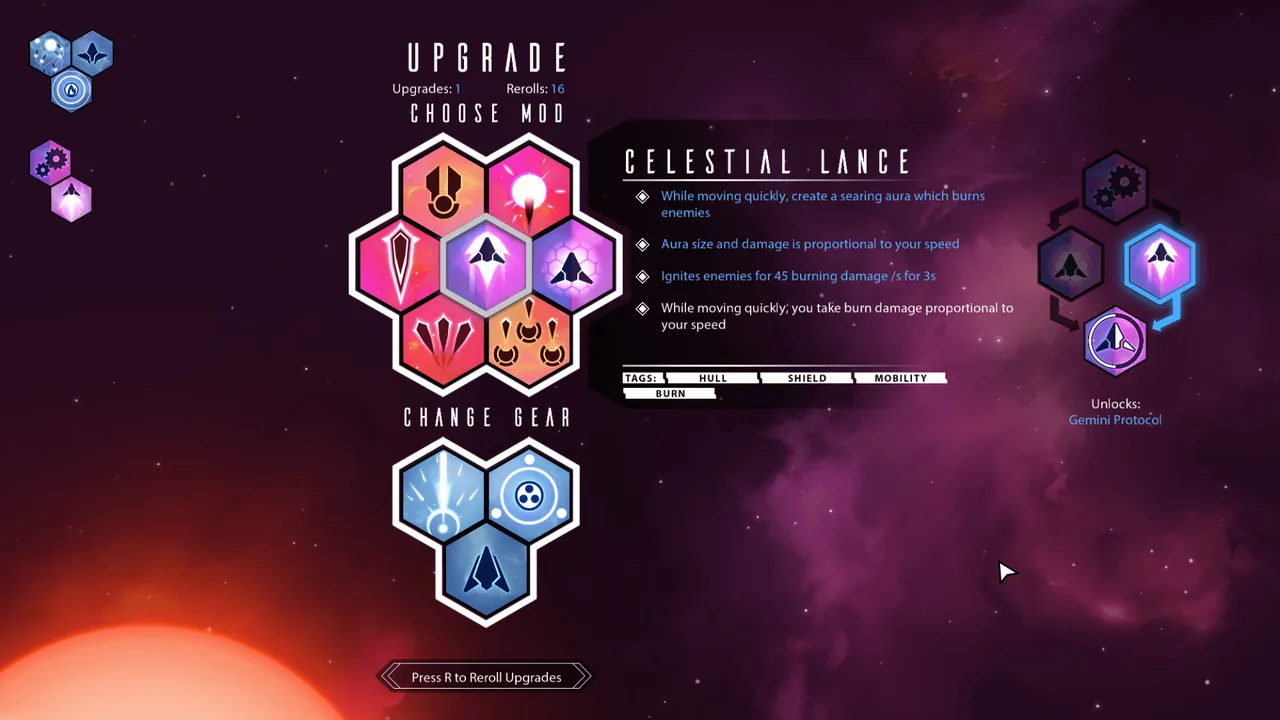
Nova Drift separates your ship into four decisions that constrain each other. Body sets your chassis — hull, speed, and often a rule change like ramming damage or shield mechanics. Weapon is your primary output and has its own upgrade tree. Shield is a defensive system with active behaviour rather than a health bar. Construct covers drones, mines and other things that act independently.
The interesting part is that upgrades frequently modify a category rather than a stat. Something that improves projectile behaviour changes every weapon differently. Something that alters shield recharge is worthless on a body that trades shields away, and transformative on one built around them. So a run isn't "collect the good items" — it's noticing at level six that the parts you've been offered point somewhere specific, and committing.
That's why the standout reviews describe identities rather than loadouts: the player who became a projectile, the one who abandoned weapons for drones, the one who built entirely around collisions. Those aren't optimal builds discovered from a wiki, they're the shapes the system bends into when you push it.
The comparison that clarifies it: most survivors-likes give you a growing list of things that fire automatically. Nova Drift gives you one ship whose rules you rewrite mid-run. That's an ARPG's pleasure, and getting it in twenty-minute sessions for thirteen dollars is the whole reason this game sits at 96%.
The smaller marks
Three other things recur, and none is fatal.
The unlock grind. The best builds depend on mods you unlock over many runs, so the first hours are a thinner version of the game. A well-argued 2020 review makes the sharper version of this point: if the fun is in crazy builds, then time spent grinding toward the parts that enable them is time spent not having the fun.
Balance drift. A reviewer who placed third in a developer-run speedrun event — and was still seventh at the time of writing — says the game became progressively less balanced across updates. That's a specific complaint from someone with the standing to make it, and worth weighing if you intend to play at a high level.
Repetition. It's one arena. The enemies vary, the builds vary wildly, but the space you fight in doesn't, and several players report it going stale faster than the build variety alone would suggest. Some also find it too easy even with modifiers stacked.
8.0 out of 10. Rated 8.0 out of 10.
Nova Drift is a small, sharp, unusually intelligent game and thirteen dollars is close to a rounding error against what it offers. If build discovery is why you play roguelites — if the appeal of Dungeon Clawler or an ARPG is the moment the parts start multiplying each other — this belongs in your library.
Two points come off for the unlock grind ahead of the good builds and for a single setting that wears thin. None come off for the controls, because they're a deliberate and coherent choice — but they are the reason this isn't a universal recommendation, and if you already know you want to strafe, believe yourself.
Pros and cons
Pros
- Build synergy of genuine ARPG depth — modules interact rather than stack, and wild combinations are discoverable rather than prescribed
- Enormous variety of unlockable weapons, shields, bodies and ship classes that change how a run is played, not just its numbers
- Superb soundtrack and a clean, readable neon presentation
- Exceptional value at thirteen dollars, with a 24-hour median playtime among recent reviewers
- Difficulty modifiers let you stack challenge deliberately once the base game gets comfortable
- 96% positive across more than fourteen thousand reviews, which is rarefied territory
Cons
- The steer-and-thrust control scheme is the single most common complaint and drives most refunds
- Screen wrapping applies to you but not consistently to enemies, which produces confusing encounters at speed
- Unlocking the mods needed for the best builds is a grind, and early runs are noticeably thinner
- Long-term players report balance drifting across updates, including one competitive-level reviewer who stopped playing over it
- The single arena setting gets visually repetitive well before the build variety runs out
- Even with modifiers enabled, some players find the challenge too soft
Screenshots
-
Nova DriftImage: Pixeljam via Steam -
Nova DriftImage: Pixeljam via Steam -
Nova DriftImage: Pixeljam via Steam -
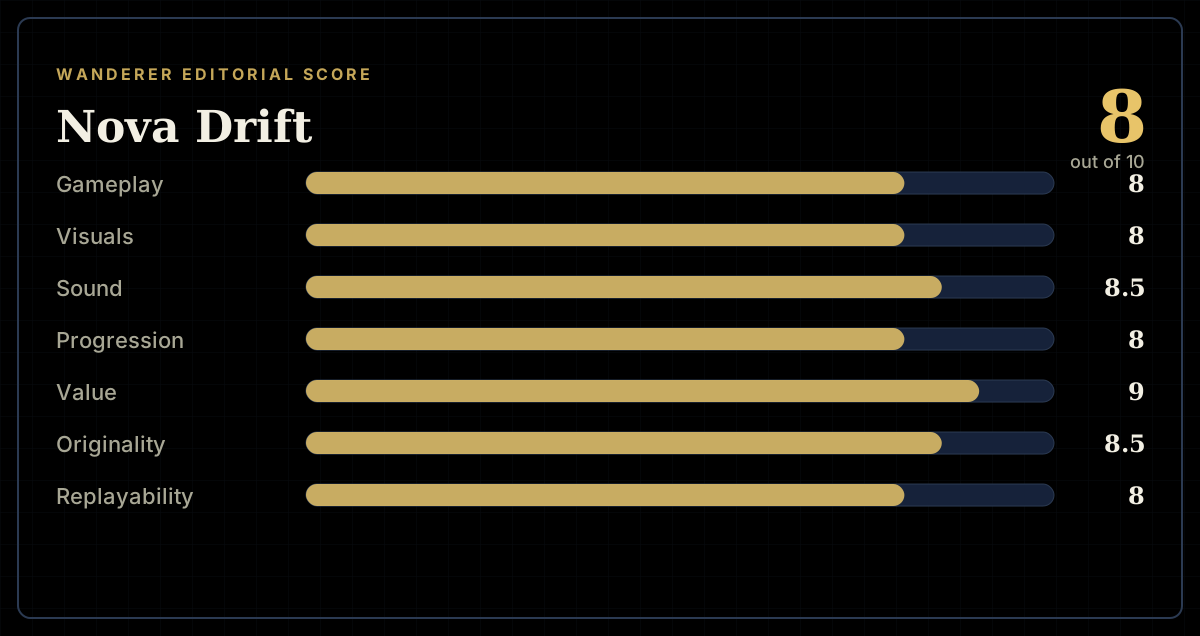
How the review scores each part of the gameWanderer Editorial -
The short versionWanderer Editorial