
Game review
Dungeon Clawler
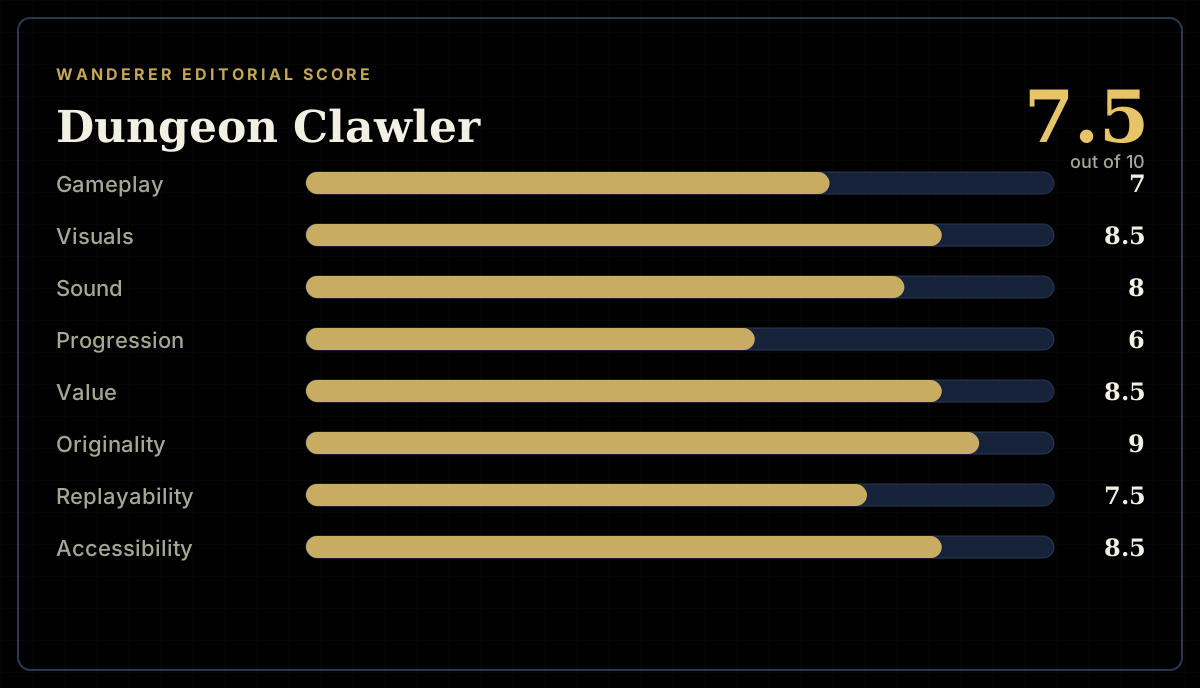
7.5 / 10
- Developer
- Stray Fawn Studio
- Publisher
- Stray Fawn Publishing
- Released
- 30 April 2026
- Platforms
- Windows, macOS, Linux
- Genre
- Roguelite Deckbuilder
- Monetisation
- One-time purchase with no in-game spending. Two optional extras — a NZ$6.65 Supporter Pack framed explicitly as funding development, and a NZ$7.10 soundtrack. Base game listed at NZ$12.99 and frequently discounted — checked 4 August 2026.
- Players
- Single-player only
The short version
Instead of drawing cards, you drop a claw into a machine full of your own weapons and items and grab whatever it can hold. It's the best new idea a deckbuilder has had in years — your inventory is a physical object, items sink and pile and get buried, and the enemy can dump junk into your machine to bury the sword you need. Where it divides people is agency. The claw looks like skill and behaves like physics, and once the item pool grew large enough, plenty of long-time players concluded they were pulling a lever rather than making a decision. Cheap, gorgeous, unusually accessible, and still arguing with itself about what kind of game it is.
Biggest strengths
- The claw machine is a genuinely original draw mechanic, and making your inventory a physical space that things sink into changes how you think about items
- Enemies interfering with your machine — burying your gear, dropping junk in — turns a gimmick into a real combat system
- Beautiful, cheerful art and a soundtrack good enough that people buy it separately
Biggest weaknesses
- The single most persistent criticism across two years is that outcomes rest on the claw and item placement more than on decisions
- Adding more items over time diluted the pool, and players report builds coming together less reliably now than they used to — one described it as going from claw machine to slot machine
- Meta-progression is thin, offering small boosts and character unlocks rather than a reason to keep returning
Who it's for: Roguelite players who want a genuinely fresh core mechanic and don't need every loss to be their own fault. Not for optimisers who want deterministic builds, and not for players who bounce off physics-driven randomness.
Our recommendation: At thirteen dollars — often less on sale — it's an easy recommendation for the novelty alone, and over half of all players have won a run, so it isn't the wall some reviews suggest. Go in expecting the claw to decide more than you'd like. If you're the kind of player who wants to build a machine and watch it work, this is the wrong genre entry; if you enjoy playing the hand you're dealt badly and laughing about it, it's excellent.
7.5 / 10
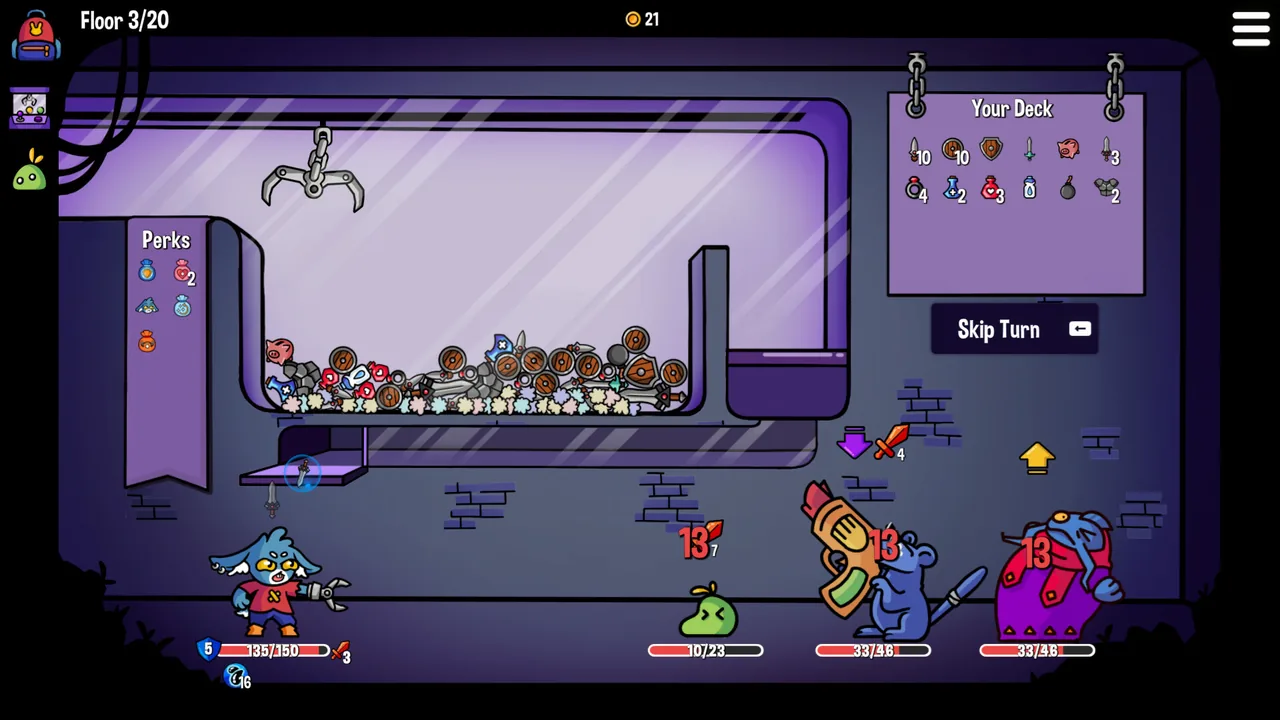
Every deckbuilder since Slay the Spire has drawn cards from a shuffled pile. Dungeon Clawler drops a claw into a glass box full of your stuff and grabs whatever it can hold.
That's the whole pitch, and it's a much better idea than it sounds. Your inventory stops being an abstraction and becomes a physical space. Heavy items sink. Things you've collected pile up and bury each other. The sword you desperately need is at the bottom of the machine underneath thirty other objects, and the claw has a grip strength.
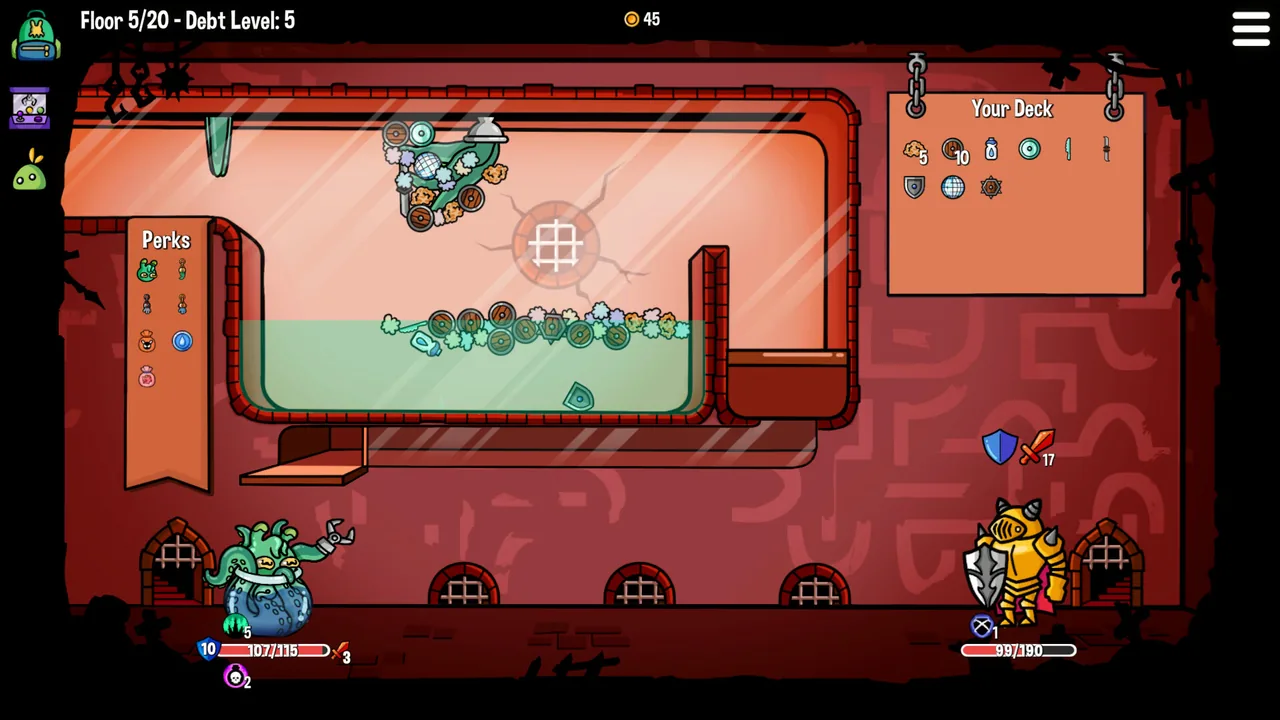
Then the enemies start dumping junk into your machine to bury your good gear, and the gimmick stops being a gimmick and becomes a combat system.
What it does that nobody else does
The best moments here come from spatial reasoning that no card game can produce. You're not counting draws or calculating deck thinning — you're looking at a heap of objects and working out which grab gets you the most useful combination this turn, knowing the pile will resettle afterwards.
Item weight, shape and position all matter. Clearing junk has real value because it changes what's reachable later. And because the machine persists through a fight, a bad grab isn't just a wasted turn, it's a rearrangement you'll live with.
Stray Fawn have wrapped it in the kind of production that makes small games punch up — bright, characterful art, a soundtrack good enough that people buy it separately, and a level of accessibility the genre rarely bothers with: adjustable difficulty, keyboard-only and mouse-only control schemes, and hardware requirements low enough that reviewers keep describing it as running on a potato.
At thirteen New Zealand dollars, that's already a lot of game.
The argument
Now the part every prospective buyer should read, because it's been running for two years and it isn't settled.
The complaint, from players who love the genre and often have thousands of minutes logged, is that the claw looks like skill and behaves like physics. You aim, but the outcome depends on how objects happened to settle, which items happen to be near the surface, and what the enemy just dropped on top of them. When it goes wrong, it doesn't feel like a decision you got wrong — it feels like a machine that didn't cooperate.
That criticism has a specific and interesting evolution. Early reviews, from the 2024 Early Access period, complained the item pool was too small — that magnets and poison were the only builds that reliably assembled, and everything else was theoretical. The 2026 complaint is the opposite: the developers kept adding items, the pool got large, and now the odds of drawing the two or three things that combo have dropped. One player put it exactly: it went from a claw machine to a slot machine.
That's a real design lesson, and it's not unique to this game. Adding content to a randomised builder without adding selection tools dilutes it. Slay the Spire manages a large card pool because you're constantly filtering — removals, upgrades, shops, targeted rewards. Balatro manages it because rerolls and vouchers let you hunt. Dungeon Clawler's players are asking for the same thing in their own vocabulary: more tools to customise the run, more ways to influence what's in the machine.
What the data says back
Here's where I'd push back on the harshest reviews, though.
If this game were the coin flip its critics describe, very few people would be finishing it. In fact, 52% of all players have won a run with the starting character. Four more characters sit between 20% and 42%. That's an unusually high completion rate for a roguelite — most of the genre's big names sit far below it — and it means the game is considerably more winnable than the "pure luck" framing suggests.
The deep tail tells the other half of the story: the highest difficulty ladders drop to 1.4%, and several late characters sit under 4%. So the shape is a game that's generous about your first victory and brutal about mastery. That's a defensible curve. It's just not the curve of a game where skill doesn't matter.
Where the critics are unambiguously right is the boss design. The final encounter can flood your machine with debris and debuffs, and if the build you spent an hour assembling is now buried under spikes, there is no play available to you. That's not difficulty, it's a mechanic that can switch your agency off at the worst possible moment.
The meta-progression is thin too — small permanent boosts and character unlocks, not enough to make a lost run feel like it built toward something. One reviewer's summary is fair: it sits between roguelike and roguelite and doesn't fully commit to either.
One more thing
The most-upvoted negative review in the whole corpus isn't about gameplay at all. It's about promotional panels on the main menu, which the reviewer describes as ad creep imported from mobile games into something they'd paid for. That review dates from April 2025, so check the current build before weighing it heavily — but the strength of feeling behind it is worth knowing about, because it clearly landed with a lot of people.
7.5 out of 10. Rated 7.5 out of 10.
Dungeon Clawler has the freshest core idea in its genre and executes it with real charm, real accessibility and an honest price. I'd recommend it to almost anyone curious about it, and the half-of-all-players win rate says most people get a satisfying arc out of it.
It falls short of the genre's best because the thing that makes it special is also the thing that takes decisions away. When the claw cooperates it's brilliant; when it doesn't, you're a spectator. More selection tools — a way to filter, reroll or arrange what's in the machine — would resolve most of the two-year argument at a stroke, and would turn a very good novelty into a genuinely great deckbuilder.
Pros and cons
Pros
- The claw machine is a genuinely original draw mechanic, and making your inventory a physical space that things sink into changes how you think about items
- Enemies interfering with your machine — burying your gear, dropping junk in — turns a gimmick into a real combat system
- Beautiful, cheerful art and a soundtrack good enough that people buy it separately
- Unusually accessible for the genre, with adjustable difficulty, keyboard-only and mouse-only options, and it runs on almost any hardware
- Wide character roster that genuinely changes how a run plays, with win-rate data showing people working through it
- Very cheap, frequently discounted, and monetised cleanly — the only extras are a soundtrack and an optional supporter pack
Cons
- The single most persistent criticism across two years is that outcomes rest on the claw and item placement more than on decisions
- Adding more items over time diluted the pool, and players report builds coming together less reliably now than they used to — one described it as going from claw machine to slot machine
- Meta-progression is thin, offering small boosts and character unlocks rather than a reason to keep returning
- Difficulty spikes hard rather than ramping, with normal fights trivial and bosses abruptly lethal
- The final boss can flood your machine with debris and debuffs, which can invalidate a build you spent a whole run assembling
- A strongly-upvoted complaint concerns promotional panels on the main menu, which several players consider out of place in a paid game
Screenshots
-
Dungeon ClawlerImage: Stray Fawn Publishing via Steam -
Dungeon ClawlerImage: Stray Fawn Publishing via Steam -
Dungeon ClawlerImage: Stray Fawn Publishing via Steam -
How the review scores each part of the gameWanderer Editorial -
The short versionWanderer Editorial