
Game review
No Case Should Remain Unsolved
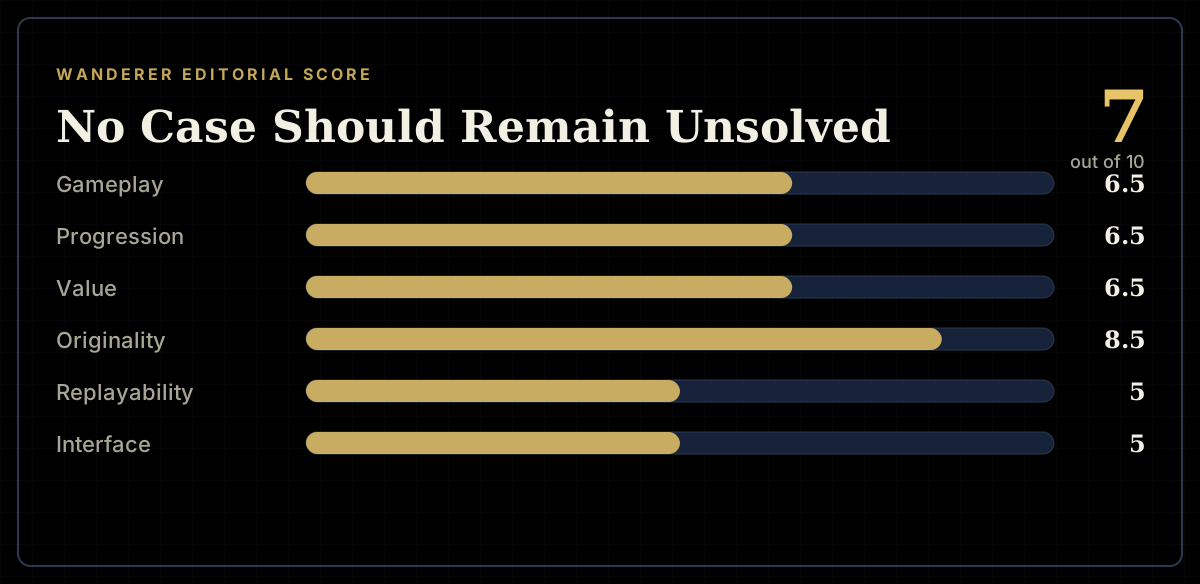
7 / 10
- Developer
- Somi
- Publisher
- Somi
- Released
- 17 January 2024
- Platforms
- Windows
- Genre
- Deduction adventure game
- Monetisation
- One-time purchase, no in-game store or additional currency purchases
- Players
- Single-player only
The short version
No Case Should Remain Unsolved reopens a twelve-year-old cold case, handing you fragmented, out-of-order witness testimony that you must reconstruct into the correct sequence and correct speaker to uncover what actually happened. It's a genuinely inventive structural idea — the mystery is told as a literal puzzle rather than a puzzle wrapped around a mystery — and this review's sample confirms the concept works remarkably well once it clicks, earning the game a string of international design awards. What holds a meaningful portion of the audience back is a specific, widely repeated complaint: the interface offers minimal tutorial guidance, throwing players into a genuinely complex information-management system without adequately teaching its own rules, leaving many describing real frustration before the underlying puzzle logic reveals itself.
Biggest strengths
- The core structural conceit — reconstructing a mystery as a literal jigsaw puzzle of dialogue fragments rather than a conventional investigation — earns wide, specific praise as a genuinely inventive and well-executed approach to the deduction genre
- The game has received substantial international recognition, including a Best Game Design award at Tokyo Game Show, an Excellence in Game Design award at BitSummit, multiple awards at BIC Festival, and the Most Amazing Award at A MAZE./Berlin
- Multiple reviewers describe a genuine, satisfying "click" moment once the reasoning system's logic becomes clear, several specifically praising how methodically the game rewards careful attention over guesswork
Biggest weaknesses
- A specific, widely repeated complaint concerns the interface itself, with multiple reviewers independently describing being thrown into a genuinely complex dialogue-organization system with minimal tutorial guidance, leaving them confused about basic mechanics for a meaningful portion of their playthrough
- Several reviewers describe genuine information overload, citing dozens of simultaneously tracked dialogue fragments and character voices that become difficult to hold in mind at once, with at least one reviewer specifically wishing for an in-game search function
- Multiple reviewers directly and unfavorably compare the game's depth to genre benchmarks like Return of the Obra Dinn and The Rise of the Golden Idol, describing this entry as a worthwhile but less demanding or rewarding version of the same core idea
Who it's for: Fans of narrative deduction games like Return of the Obra Dinn, The Rise of the Golden Idol, and Unheard who enjoy piecing together a story from fragmented evidence, and players with patience for a genuinely demanding, minimally-guided interface in exchange for a distinctive structural payoff.
Our recommendation: A genuinely original, internationally recognized deduction game well worth its low price for patient genre fans — just brace for a real, widely-reported learning curve with the interface itself before the puzzle's underlying logic starts to click.
7 / 10
Twelve years after Senior Inspector Jeon Gyeong's retirement, a young officer arrives asking her to reexamine a case that never should have gone cold. No Case Should Remain Unsolved hands you that case not as a conventional investigation but as a literal puzzle: fragmented pieces of witness testimony, disconnected from who said them or when, that you must physically reassemble into the correct order and correct speaker to reveal the truth. This review's sample shows that structural idea earning genuine international acclaim — and also shows, with striking consistency, exactly where its execution asks more of players than it initially explains.
An idea genre fans and award juries both recognize
The praise for the game's central conceit is specific and comes from reviewers who clearly know the deduction genre well. "As opposed to many games where the narrative can be a bit of a puzzle to figure out, this game's narrative is told as a literal puzzle. You read testimony of a crime, use keywords to uncover new testimony, and rearrange the testimony you have to determine who said it and when," one reviewer writes, capturing precisely what sets this apart from typical detective games. Another describes the payoff of persistence: "eventually the pieces started to come together and everything began to work out. Made me feel like a real detective." That praise isn't confined to player reviews — this review's research into the game's partner-events feed confirms substantial award recognition, including a Best Game Design award at Tokyo Game Show, an Excellence in Game Design award at BitSummit, and the Most Amazing Award at A MAZE./Berlin, a genuinely unusual level of formal critical recognition for a small indie deduction game.
The interface complaint that dominates the negative sample
Set against that acclaim, this review's negative sample converges with real consistency on one specific, structural problem: the game simply doesn't teach its own systems well. "It throws a lot of information at you really fast with little explanation on game mechanics," one reviewer writes. Another goes further, describing the confusion directly: "The story is good but the game UI is very unintuitive. Such as needing to click on the correct #tag to unlock conversation but the two dialogues may not even be related. It also didn't tell players that they need to reorganise the dialogue into correct sequence by using the small arrow" — a specific, concrete example of a core mechanic left unexplained. A third reviewer, someone who says they normally love logic puzzles, describes real difficulty getting past this initial barrier: "the user experience and amount of text you have to parse and maintain knowledge about is pretty overwhelming, combined with you just being thrown directly into the deep end of a pretty alien UI with zero tutorial." This is a genuinely different complaint from "the puzzle was too hard" — it's specifically about the game failing to adequately onboard players into systems that, once understood, several reviewers describe as genuinely rewarding.
A fair comparison to genre benchmarks
Several reviewers place the game directly against acknowledged genre landmarks, and the comparison isn't uniformly favorable. "It's not bad but the people praising this game as 'making you feel like a true detective' have obviously not played many detective games. If you're fresh off games like Obra Dinn, Golden Idol, Painscreek Killing, Unheard, etc. This game will not satisfy you," one reviewer writes, treating it as a solid but less demanding entry in a genre with higher benchmarks. That's a fair, informed critique worth passing along directly to genre veterans specifically, even as this review's overall assessment finds the game's structural originality — telling its mystery through literal puzzle mechanics rather than conventional investigation — genuinely distinctive on its own terms.
Length, price, and a documented crash concern
A smaller but real thread of complaints concerns value and stability. "The story was quite nice and play style was very interesting, the play time is waaaaaayyy too short, to a degree I almost felt scammed... It felt more like a demo with price tag on it," one reviewer writes. Separately, at least one reviewer documents a genuine technical problem worth flagging directly: "Couldn't play the game because it kept crashing. Played almost 1 hour, crashed every twenty minutes and you have to manually save so all progress gets lost with every crash." That combination — frequent crashes paired with a manual-only save system — is a specific, serious reliability concern distinct from the broader interface and length complaints.
What the achievement data confirms about the completion curve
Steam's own completion figures paint an unusually flat picture rather than the steep cliffs common in longer games: all nine tracked achievements sit in a narrow 65.0-78.5% band. That's consistent with a short, largely linear experience where most players who start the game do see it through to one of its endings — supporting reviewer descriptions of a compact, self-contained mystery rather than one with a long tail of optional content most buyers never touch. It also indirectly supports the interface complaint: since the game is genuinely completable by most buyers, the reported frustration seems concentrated in the learning-curve phase rather than reflecting players abandoning the game outright.
An award-winning, actively localized release
This review found no basis for concern about the game being neglected. No Case Should Remain Unsolved's partner-events feed documents a genuinely impressive post-launch record: an original soundtrack release, more than ten separate language localizations added progressively through 2024 and 2025, and a steady stream of international award recognition well after its initial January 2024 launch.
Final verdict
No Case Should Remain Unsolved earns its considerable acclaim through a genuinely inventive structural idea, telling its mystery as a literal reconstructable puzzle rather than a conventional investigation — and this review's sample confirms that idea lands powerfully once its systems click. The specific, widely reported difficulty many players have simply learning those systems in the first place is a fair and real criticism worth taking seriously, alongside a documented crash-and-lose-progress concern. Go in patient with the interface, and this is a distinctive, well-regarded entry in the deduction genre well worth its low price.
Pros and cons
Pros
- The core structural conceit — reconstructing a mystery as a literal jigsaw puzzle of dialogue fragments rather than a conventional investigation — earns wide, specific praise as a genuinely inventive and well-executed approach to the deduction genre
- The game has received substantial international recognition, including a Best Game Design award at Tokyo Game Show, an Excellence in Game Design award at BitSummit, multiple awards at BIC Festival, and the Most Amazing Award at A MAZE./Berlin
- Multiple reviewers describe a genuine, satisfying "click" moment once the reasoning system's logic becomes clear, several specifically praising how methodically the game rewards careful attention over guesswork
- The short, focused runtime is credited by several reviewers as appropriately scoped for the puzzle format, delivering a complete, self-contained mystery without unnecessary padding
- Steam's own partner-events feed documents exceptional, sustained post-launch investment in accessibility, with more than ten language localizations added over the course of 2024 and 2025, plus a released original soundtrack
Cons
- A specific, widely repeated complaint concerns the interface itself, with multiple reviewers independently describing being thrown into a genuinely complex dialogue-organization system with minimal tutorial guidance, leaving them confused about basic mechanics for a meaningful portion of their playthrough
- Several reviewers describe genuine information overload, citing dozens of simultaneously tracked dialogue fragments and character voices that become difficult to hold in mind at once, with at least one reviewer specifically wishing for an in-game search function
- Multiple reviewers directly and unfavorably compare the game's depth to genre benchmarks like Return of the Obra Dinn and The Rise of the Golden Idol, describing this entry as a worthwhile but less demanding or rewarding version of the same core idea
- Several reviewers report the runtime is too short relative to the asking price, with at least one describing the experience as feeling "like a demo with a price tag on it" and wishing for several additional episodes
- At least one reviewer documents a specific, serious technical complaint: repeated crashes combined with a manual-save-only system that repeatedly erased significant progress, forcing the same sections to be redone multiple times
Screenshots
-

No Case Should Remain UnsolvedImage: Somi via Steam -

No Case Should Remain UnsolvedImage: Somi via Steam -

No Case Should Remain UnsolvedImage: Somi via Steam -
How the review scores each part of the gameWanderer Editorial -
The short versionWanderer Editorial