
Game review
Machinika: Atlas
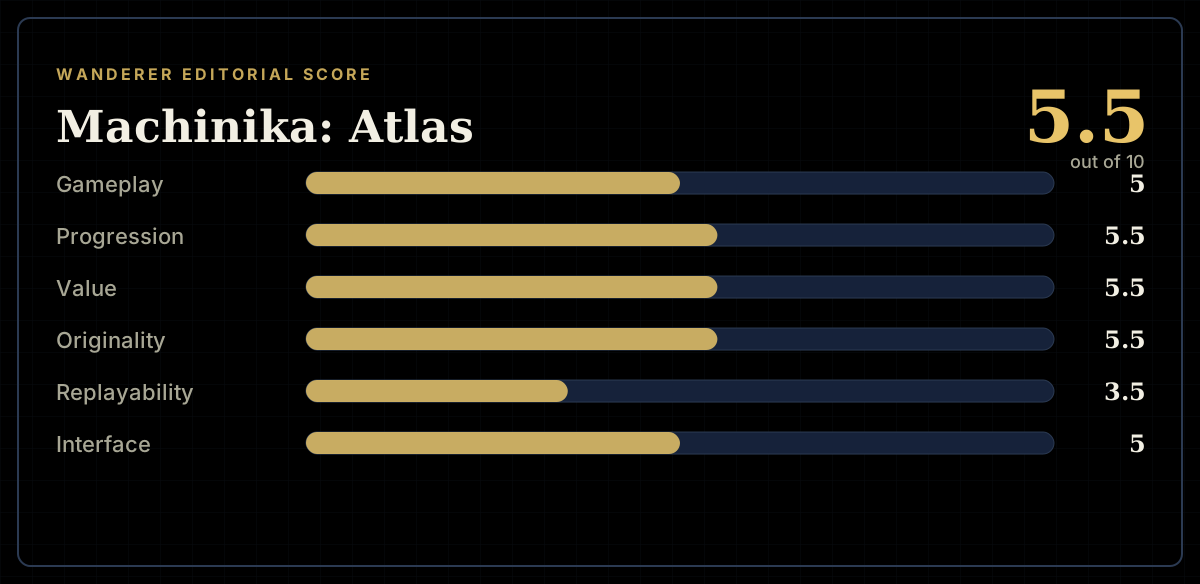
5.5 / 10
- Developer
- Littlefield Studio
- Publisher
- Dear Villagers
- Released
- 17 September 2024
- Platforms
- Windows, Linux
- Genre
- Sci-fi escape-room puzzle adventure
- Monetisation
- One-time purchase, no in-game store or additional currency purchases
- Players
- Single-player only
The short version
Machinika: Atlas continues the story begun in Machinika Museum, sending you aboard an alien vessel to repair strange mechanisms and uncover what happened to its crew. This review's sample shows near-universal agreement that the sequel's visuals and production values improved meaningfully over the original, set against an equally consistent complaint that the puzzle design itself took a step backward — either too simple to engage seriously, or too obscure to solve fairly, with comparatively few of the satisfying "aha" moments the original was known for. Compounding that disappointment, a real portion of reviewers document specific, reproducible bugs capable of halting progress entirely at particular chapters, alongside a hint system several describe as unhelpful to the point of being nearly useless.
Biggest strengths
- The graphics, lighting, and overall production values draw near-universal praise as a genuine improvement over the original Machinika Museum, with reviewers describing considerably more polished animation and camera work
- Some reviewers specifically credit the game with meaningful quality-of-life improvements over its predecessor, including the option to toggle between classic point-and-click movement and a more modern control scheme
- The atmosphere and alien-mechanism aesthetic remain a genuine strength, with reviewers describing a convincing "fish out of water" feeling while exploring the vessel
Biggest weaknesses
- A widely repeated complaint holds that this entry's puzzles are either too simple to meaningfully challenge experienced players, or in a smaller number of cases too obscure to solve without guesswork, with few of the satisfying discovery moments reviewers associate with the original game
- Multiple reviewers document specific, reproducible bugs capable of halting all progress, including a reported hardlock at Chapter 3 and a crash at the start of Chapter 6 that at least one reviewer says a refund request was denied over
- The in-game hint system is repeatedly described as unhelpful, with several reviewers reporting identical, generic hint text across different puzzles rather than guidance specific to the puzzle at hand
Who it's for: Existing fans of Machinika Museum curious about the continuation, and fans of "The Room"-style escape-room puzzlers looking for a short, atmospheric sci-fi entry with modest difficulty.
Our recommendation: A visually improved but mechanically disappointing sequel best purchased on a discount — existing fans of the original should adjust expectations for the puzzle design specifically, and everyone should be aware of documented chapter-blocking bugs before committing a full playthrough.
5.5 / 10
Machinika: Atlas picks up where Machinika Museum left off, sending you aboard a mysterious alien vessel to repair strange mechanisms and piece together what happened to its crew. This review's sample treats the comparison to that beloved predecessor as central to any honest assessment — and the resulting picture is one of clear visual improvement paired with a real, widely felt step backward in the puzzles that made the original worth playing in the first place.
A visual upgrade nearly everyone credits
The praise for how this sequel looks is close to unanimous. "Littlefield Studios really put a lot of work into this project! The graphics, the texturing, lighting, an incredible number of animations and camera moves...very impressive!" one reviewer writes. Another, comparing directly to the original's technical limitations, confirms the improvement concretely: "A more optimized, polished game, which will go on almost any [system] in high quality (the first part itself went in 30-50 fps due to the lack of" optimization). A third reviewer credits real quality-of-life additions alongside the visual polish: "this game improves on it with leagues of QoL. You can now swap between the classic point-and-click movement of the previous" entry and a more modern control scheme.
The puzzle complaint that recurs across nearly every critical review
Set against that visual praise, this review's negative sample converges with real consistency on the puzzle design itself. "I liked it enough to play it through to the end but I felt like it really cheaped out on the puzzles this time - nothing very challenging, only one or two satisfying 'a-ha' moments, and it overuses the little drone mechanic," one reviewer writes. Another, having also loved the original, describes the same disappointment more sharply: "I would much rather recommend Machinika Museum to anyone interested. If you've played and enjoyed Museum, stop there. Atlas is... well it 'continues' the story (as flimsy as it is) but the puzzles are either incredibly simplistic or frustratingly obtuse." A third makes a genre-savvy comparison: "'Machinika Museum', the first game, was like 'The Room' in that it concentrated on individual devices as its puzzles. 'Machinika: Atlas' appears to have followed the format of 'The Room Two' where it expanded from singular contraptions into entire rooms of puzzles, but in doing so, it could not mat[ch the depth of either approach]."
Specific, documented bugs that block progress entirely
Beyond puzzle-design disappointment, several reviewers report concrete technical failures serious enough to halt play. "There is a bug at the beginning of chapter 6 which makes the game crash. Despite asking for help, I am unable to continue the game. A refund has also been refused twice despite the game not being fit for purpose!" one reviewer writes. Another reports a different, equally serious blocker: "Game hardlocks on chapter 3, some graphic glitch removes the thing you gotta do so you can progress at all." These are specific, reproducible complaints distinct from the broader puzzle-quality criticism, and worth taking seriously as concrete reliability risks rather than folding into general disappointment.
An unhelpful hint system, described repeatedly
A separate, specific complaint concerns the in-game hint system meant to help players past difficult puzzles. "Tons of bugs. Hint system is worthless. Skip puzzle option works about half the time. The hint system failure really upsets me the most. The dev completely dropped the ball there. Every single hint is the exact same for all puzzles" regardless of the specific problem, one reviewer writes. Another echoes the same frustration: "Hints are extremely unhelpful most of the time. 'It looks like this is not setup correctly' isn't actually a hint." That's a genuinely damaging gap for a puzzle game specifically, since a broken hint system removes the safety net that would otherwise soften the impact of the obscure puzzles other reviewers describe.
A specific responsiveness claim this review could only partly confirm
One reviewer states directly: "apparently the devs went radio silent after release and aren't trying to patch the game in a timely manner." This review's own check of the partner-events feed found a real, if limited, basis for that concern: four small updates were released in the roughly two months following launch, but the feed then shows a gap of about a year before any further documented activity, consisting of a single security-focused update. This review could not confirm whether the specific chapter-blocking crash bugs described by reviewers were addressed during that initial active window or remain present in the current build — the claim of reduced responsiveness is partially, not fully, corroborated by the available record.
What the achievement data confirms
Steam's own completion figures show a fairly standard puzzle-adventure curve for the main story, with achievements tied to each chapter falling gradually from 93.1% to 78.6% by Chapter 4. The steepest drops come at completionist-specific achievements — finishing without hints, under a time limit, or collecting every optional letter — falling to between 4.9% and 15.2%, suggesting the base story is broadly accessible to most buyers even if, per reviewer accounts, that accessibility comes at the cost of meaningful challenge.
A fair middle-ground reading worth including
Several reviewers land on a considered, balanced verdict worth citing directly: "A good puzzle game, but which lacks the original's magic... Good puzzles - none too tough, once you understand that you frequently need to fiddle with items before they can be used. Great aesthetics with set design." That's a fair summary of where this review's own assessment lands too — not a bad game by any means, but a clear step down in the specific quality that made its predecessor memorable.
Final verdict
Machinika: Atlas delivers real, visible improvements in presentation and technical polish over Machinika Museum, but a large, consistent portion of this review's sample agrees the puzzle design itself — the core reason fans loved the original — took a step backward, compounded by specific, documented bugs and an unhelpful hint system. Existing fans should adjust their expectations accordingly, and everyone should be aware of the reported chapter-blocking bugs before committing to a full playthrough.
Pros and cons
Pros
- The graphics, lighting, and overall production values draw near-universal praise as a genuine improvement over the original Machinika Museum, with reviewers describing considerably more polished animation and camera work
- Some reviewers specifically credit the game with meaningful quality-of-life improvements over its predecessor, including the option to toggle between classic point-and-click movement and a more modern control scheme
- The atmosphere and alien-mechanism aesthetic remain a genuine strength, with reviewers describing a convincing "fish out of water" feeling while exploring the vessel
- The game is short enough to complete in a single sitting for most players, with several reviewers reporting full completion including all achievements in around six hours
- Steam's own partner-events feed documents several small updates released in the two months following launch, showing an initial period of active developer responsiveness to launch-window issues
Cons
- A widely repeated complaint holds that this entry's puzzles are either too simple to meaningfully challenge experienced players, or in a smaller number of cases too obscure to solve without guesswork, with few of the satisfying discovery moments reviewers associate with the original game
- Multiple reviewers document specific, reproducible bugs capable of halting all progress, including a reported hardlock at Chapter 3 and a crash at the start of Chapter 6 that at least one reviewer says a refund request was denied over
- The in-game hint system is repeatedly described as unhelpful, with several reviewers reporting identical, generic hint text across different puzzles rather than guidance specific to the puzzle at hand
- One reviewer's specific claim that the developers went largely silent after launch is only partially corroborated: this review's own check of the partner-events feed found a cluster of small updates within the first two months, followed by a roughly year-long gap before any further documented activity, and could not confirm whether the specific chapter-blocking bugs reported by reviewers were addressed in that window
- Several reviewers describe the story and writing as thin or "flimsy," with the sequel's narrative motivations feeling less developed than the atmosphere and presentation surrounding them
Screenshots
-

Machinika: AtlasImage: Dear Villagers via Steam -

Machinika: AtlasImage: Dear Villagers via Steam -

Machinika: AtlasImage: Dear Villagers via Steam -
How the review scores each part of the gameWanderer Editorial -
The short versionWanderer Editorial