Game review
Nantucket
5.5 / 10
- Developer
- Picaresque Games
- Publisher
- Picaresque Games
- Released
- 18 January 2018
- Platforms
- Windows, macOS, Linux
- Genre
- Seafaring strategy RPG
- Monetisation
- One-off purchase, with two DLC packs (Songs of the Braves, Masters of the Seven Seas); no in-game currency or gameplay-affecting purchases
- Players
- None; single-player only
The short version
Nantucket's premise — continuing Ishmael's story years after Moby-Dick, captaining a whaling ship through more than a thousand scripted events across an authentically researched 19th century setting — earns genuine, specific praise for its atmosphere, music, and the sheer novelty of a whaling-RPG hybrid built on real historical detail. That praise sits uneasily alongside an unusually large, convergent body of reviews describing the dice-based combat and random event system as unfair to the point of actively working against the player rather than challenging them, with several detailed accounts of campaign-ending random events striking with no apparent connection to preparation, and the climactic Moby Dick boss fight specifically singled out as broken and "cheap." Global achievement data backs this up more directly than most: only about a third of players reach even the game's first combat milestone, and fewer than one in two hundred ever finish the story. The developer's own patch history shows real support through two DLC packs in 2018 and 2019, but nothing since — meaning the specific stability and balance complaints raised across the review sample have gone unaddressed for roughly seven years.
Biggest strengths
- A genuinely distinctive setting — continuing Ishmael's story after Moby-Dick with real historical whaling detail — that multiple reviewers specifically praise as immersive and well-researched
- A strong, well-regarded musical score and art direction that reviewers credit even when otherwise critical of the game's systems
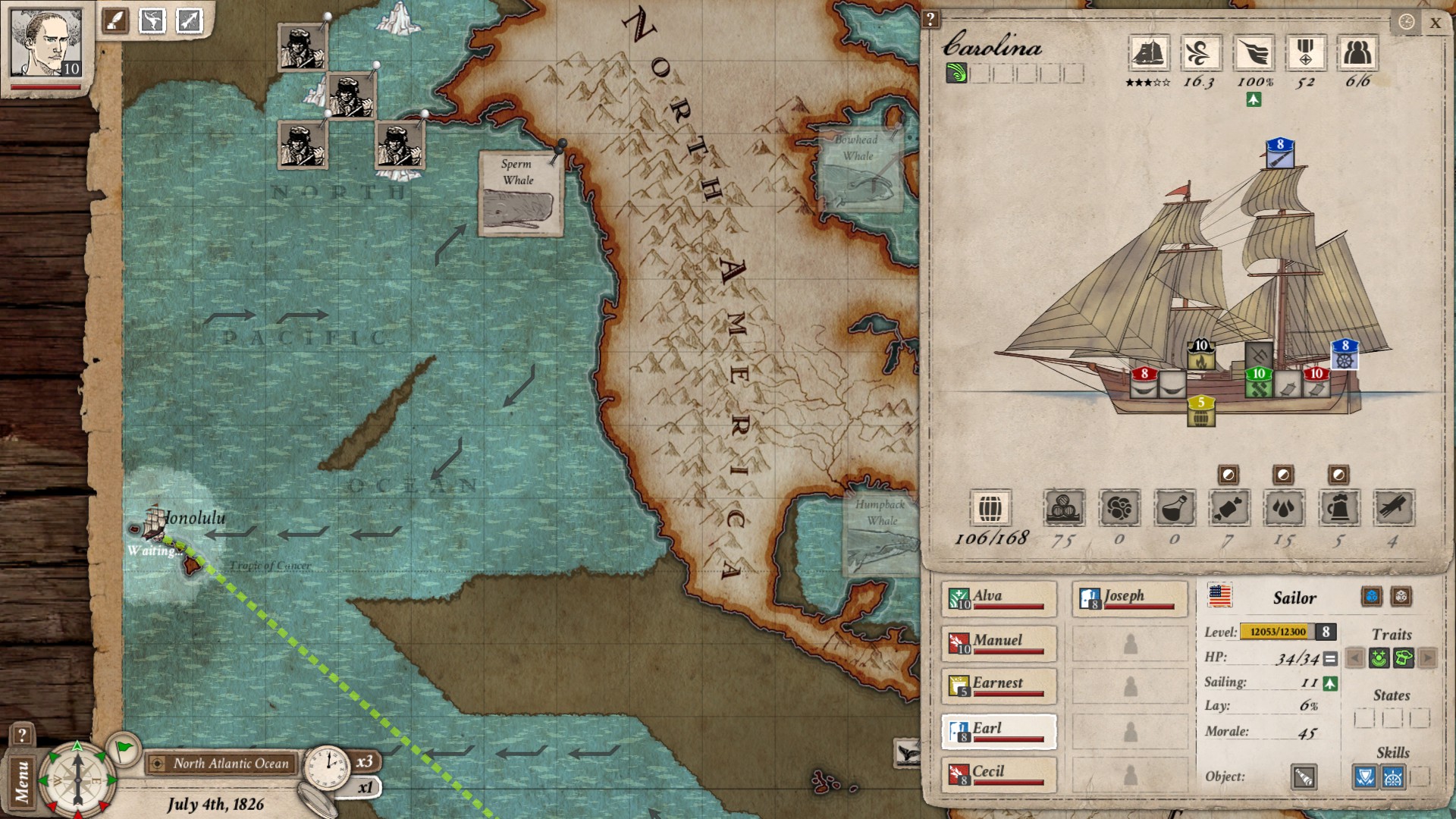
- Over a thousand scripted random events give genuine narrative variety to the core sailing loop
Biggest weaknesses
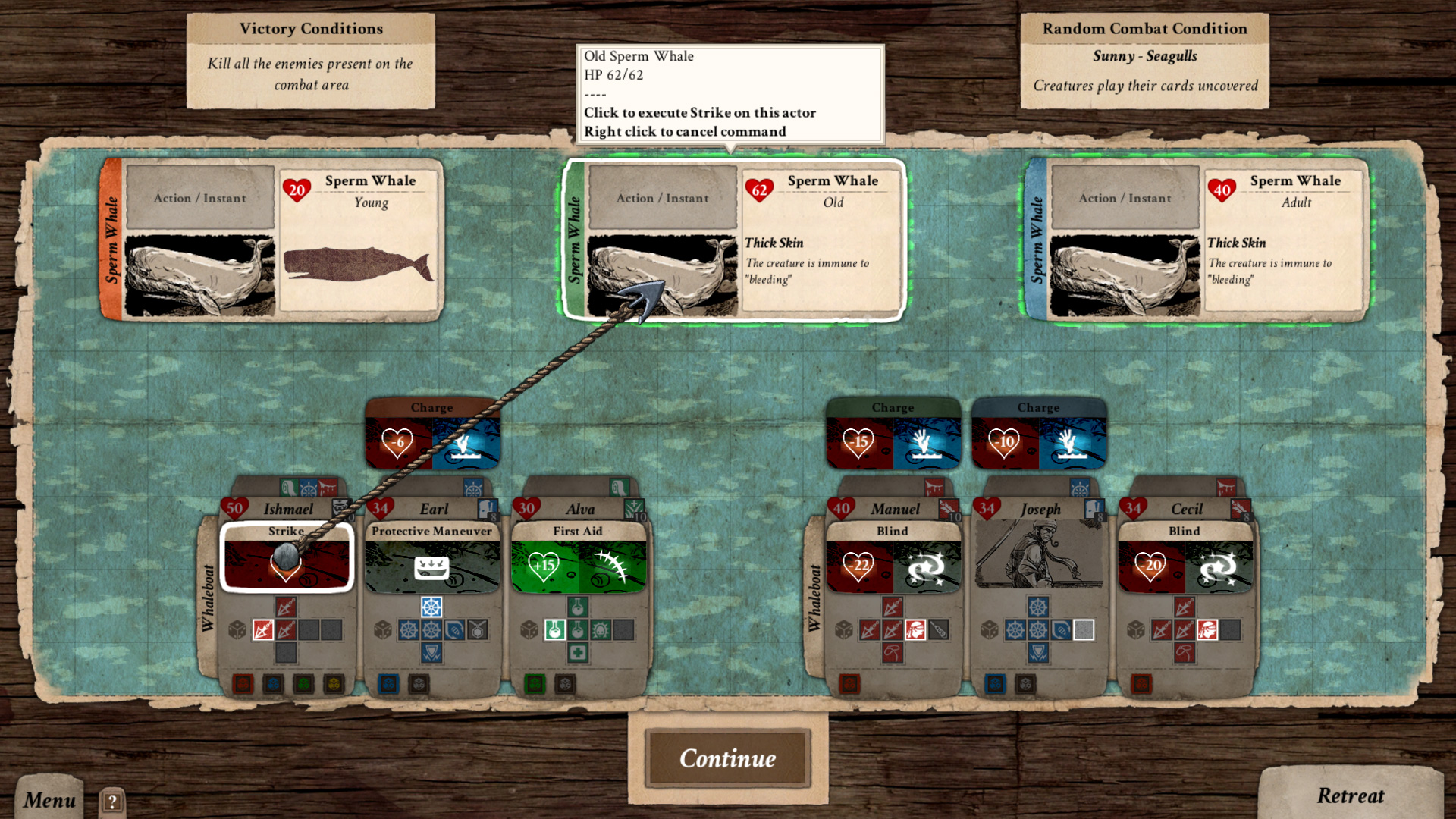
- An unusually large, convergent share of reviewers describe the dice-based combat as excessively random, with specific accounts of good preparation failing to meaningfully improve outcomes
- Multiple detailed reviews describe campaign-ending random events striking with no clear connection to player choices or preparation, undermining a sense of fair consequence
- The climactic Moby Dick boss encounter draws specific, pointed criticism as broken and "cheap," with more than one reviewer citing it as the point where they gave up on the game
Who it's for: Fans of Moby-Dick and 19th century maritime history specifically curious about an unusual RPG setting, and strategy fans with a high tolerance for punishing, luck-heavy combat. Poorly suited to anyone who needs combat outcomes to track predictably with preparation and skill, or players on Linux given persistent, unresolved crash reports.
Our recommendation: Worth a look for the setting and atmosphere alone if bought at a steep discount; go in expecting the combat and random events to feel unfair at times, since years without a patch mean that's unlikely to change.
5.5 / 10
Nantucket puts players in the boots of Ishmael, the sole survivor of the Pequod, years after the events Herman Melville narrated in Moby-Dick, captaining a whaling ship across a researched, historically grounded 19th century ocean in search of profit, purpose, and eventually the white whale itself. Released in January 2018, it built a modest but genuinely devoted following — 76% Mostly Positive across 559 English reviews — anchored in praise for its unusual setting and atmosphere. Reading closely through the sample reveals real affection for what the game is about, running headlong into an unusually large, specific body of criticism about how it actually plays.
A setting reviewers say is genuinely special
The praise for Nantucket's premise and atmosphere is specific and consistent. One reviewer with 15 hours invested writes: "90% of this game is fantastic. The way it looks, sounds and feels immerses you in the middle of 19th century whaling industry. The story continues from the end of Moby Dick and is a nice continuation especially for those who have read the book." Another, more critical overall, still credits the fundamentals: "Nantucket is a beautiful game with a wonderful musical score. The story premise is very well considered and makes for a very interesting premise to kick off a game about whaling and captaining your own ship." That's real, specific agreement on exactly what the game gets right, even from reviewers who ultimately can't recommend it.
Combat reviewers call unfair rather than difficult
Set directly against that praise is the sample's dominant, most convergent complaint. One detailed reviewer explains: "If you enjoy losing randomly, you will love this game. If you want to learn a system that is hard satisfying and complex, look elsewhere. Even when you use all of the classes as intended, you make the game a waiting sim." Another goes further, specifically calling out boarding combat: "there was more than one case where combat started, the enemies decided whom to attack, and I could just have pressed alt + F4. All three pirates attacked my captain." A third reviewer frames the mechanical issue precisely: "there's too much luck involved during battles. Too much randomness, caused by the use of dice (uncontrolled randomness with independent events) instead of, for example, cards (controlled randomness with variable probabilities)." Three independent, technically specific accounts of the same underlying problem — combat outcomes disconnected from player skill or preparation — is strong convergence worth treating as an accurate account of the shipped game rather than a few unlucky sessions.
Random events several reviewers say ignore your preparation
A related but distinct complaint concerns the game's signature random-event system, which the marketing frames as a strength. One reviewer's account is specific: "I leave port with 86 days worth of water. 3 days in I get a decision card stating I'm running out of water...? Some of these random events are totally unrelated to what's going on on the ship." Another describes the consequence bluntly: "Autosave simulator. At any moment an event occurs that destroys your team or ship. And there is no way to prepare for it. You have to load autosaves. Over and over." That's a meaningfully different complaint from the combat criticism above — not that outcomes are random, but that the randomness doesn't appear to respect the state the player has carefully built, which undercuts the sense of agency the RPG framing promises.
A climactic fight singled out for the same reason
The complaints above converge sharply at the game's ending. One reviewer states it directly: "The final boss battle against Mobydick ruined the experience for me. making an boss invincible is fine but allowing him to become invincible again makes it feel cheap and completely based on rng." Another separately confirms: "Beating Moby Dick is broken." Given how central the whale hunt is to the entire premise, a broken or unsatisfying final encounter is a serious structural flaw rather than a minor late-game bug, and it lines up precisely with the achievement data discussed below.
What the numbers confirm
Global achievement statistics offer a stark, corroborating read on how the review sample's complaints actually played out at scale. Only 35.1% of players reach the FirstBlood milestone — their very first combat encounter — a notably low bar to clear compared to similar games in this lane, consistent with reviewers describing early, unfair losses driving people away quickly. The completion-tier achievement, MasterOfTheSevenSeas, sits at just 0.5% of the playerbase, meaning fewer than one in two hundred owners ever finish the story that centers on the exact Moby Dick encounter reviewers call broken.
A game the developer stopped supporting years ago
Checked against the developer's own partner-events history, active support ended with a September 2019 hotfix following the Masters of the Seven Seas DLC — meaning the specific combat balance, random-event fairness, and platform-stability complaints raised throughout this review sample have had no apparent fixes in roughly seven years. That includes persistent Linux crash-on-launch reports from more than one reviewer, which, absent any patch activity since 2019, appear likely to remain permanent for anyone on that platform.
Verdict
Nantucket's whaling-RPG setting is genuinely distinctive, well-researched, and worth real credit — reviewers who love Moby-Dick specifically find something here no other game offers. That distinctiveness is seriously undercut by combat and random events an unusually large, convergent share of the same review sample describes as unfair rather than merely difficult, corroborated directly by achievement data showing most players never get far and almost none finish. With no patches in roughly seven years, treat any purchase as buying the game exactly as it stands today.
Sources: Steam store page and appdetails API (release date, pricing, platform data); Steam's aggregate review data (query_summary totals, English-language sample); individually read user reviews, both positive and negative, sorted by helpfulness and recency; Steam's global achievement statistics API; Picaresque Games' own partner-events patch history from 2018 through its final 2019 hotfix.
Pros and cons
Pros
- A genuinely distinctive setting — continuing Ishmael's story after Moby-Dick with real historical whaling detail — that multiple reviewers specifically praise as immersive and well-researched
- A strong, well-regarded musical score and art direction that reviewers credit even when otherwise critical of the game's systems
- Over a thousand scripted random events give genuine narrative variety to the core sailing loop
- Two DLC packs (Songs of the Braves, Masters of the Seven Seas) added real post-launch content during the game's active support window
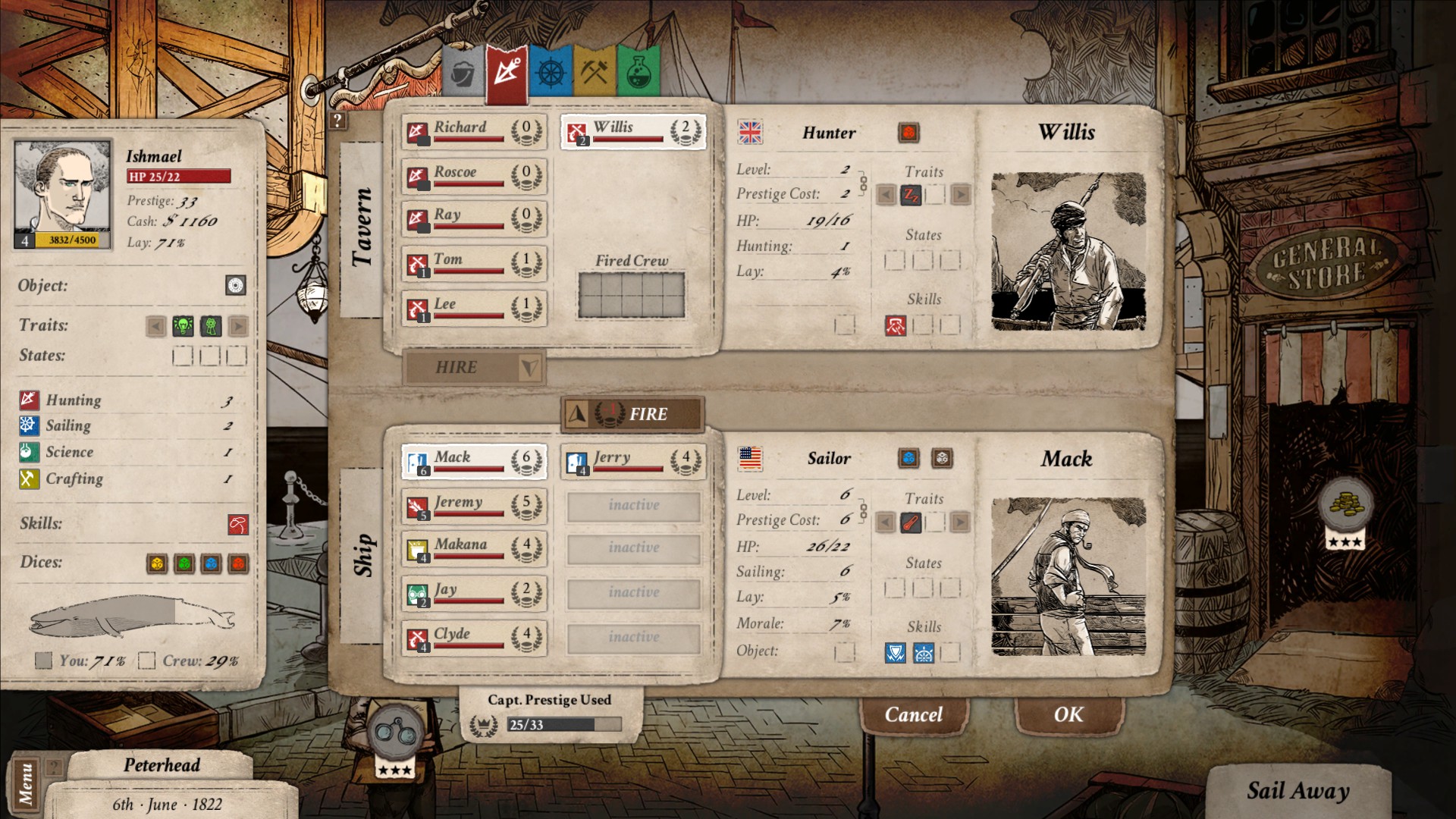
- Deep crew and ship management systems give dedicated players real room to develop a personalized playstyle within the RPG framework
Cons
- An unusually large, convergent share of reviewers describe the dice-based combat as excessively random, with specific accounts of good preparation failing to meaningfully improve outcomes
- Multiple detailed reviews describe campaign-ending random events striking with no clear connection to player choices or preparation, undermining a sense of fair consequence
- The climactic Moby Dick boss encounter draws specific, pointed criticism as broken and "cheap," with more than one reviewer citing it as the point where they gave up on the game
- No developer support since a 2019 patch, meaning persistent, specific complaints (including Linux crash-on-launch reports) have gone unaddressed for roughly seven years
- Global achievement data shows only about a third of players reach the game's first combat milestone, and fewer than one in two hundred ever complete the story
Screenshots
-
NantucketImage: Picaresque Games via Steam -
NantucketImage: Picaresque Games via Steam -
NantucketImage: Picaresque Games via Steam -
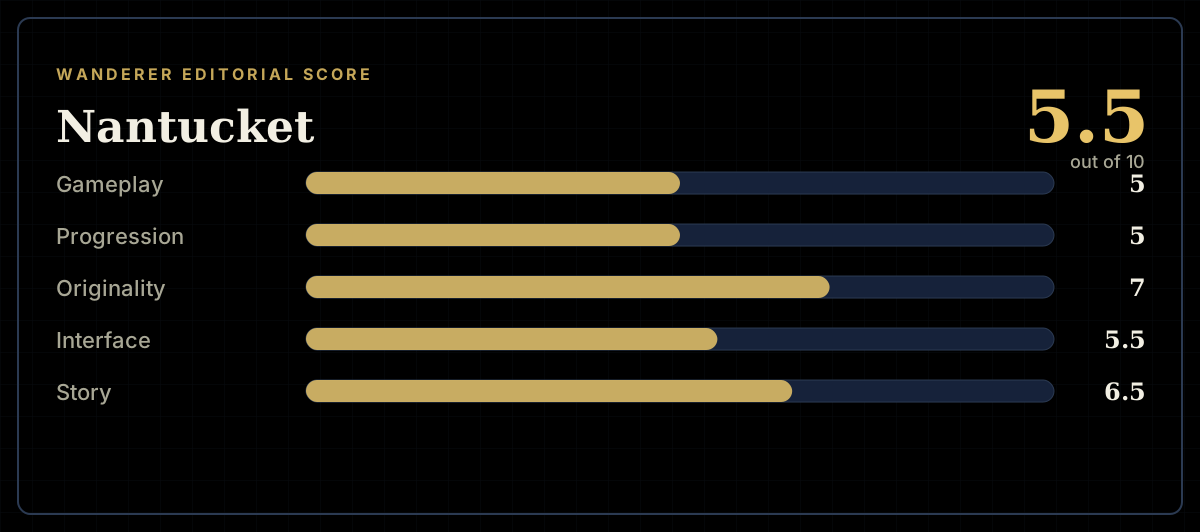
How the review scores each part of the gameWanderer Editorial -
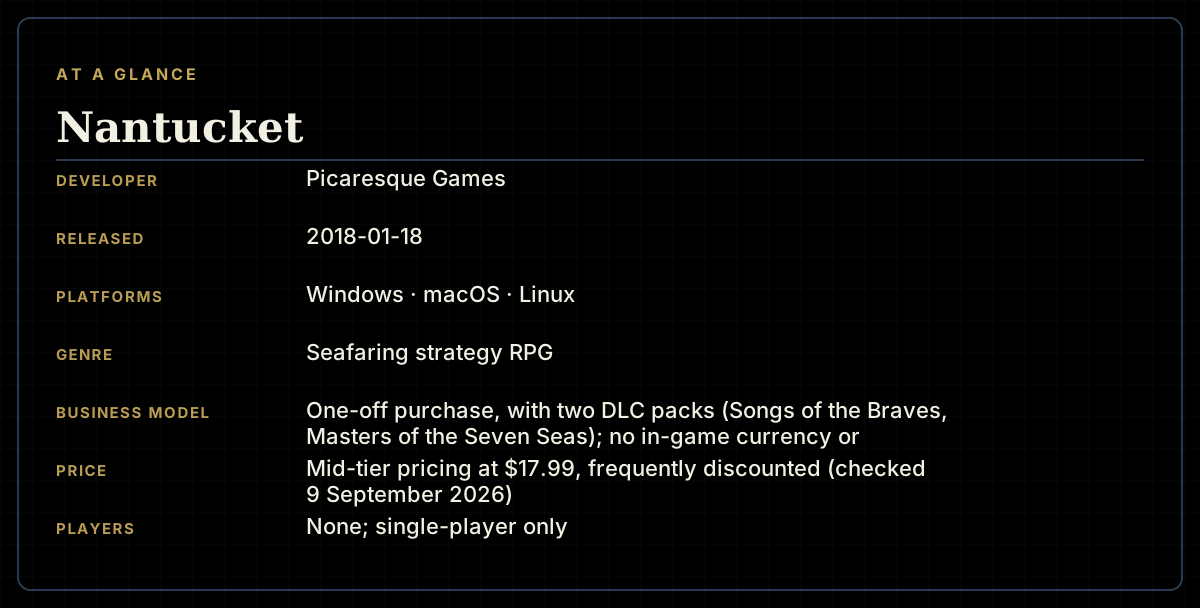
The specsWanderer Editorial -
The short versionWanderer Editorial