Game review
Loot Box Quest
6 / 10
- Developer
- Going Loud Studios
- Publisher
- Going Loud Studios
- Released
- 13 December 2017
- Platforms
- Windows, macOS, Linux
- Genre
- Satirical idle clicker
- Monetisation
- One-off purchase, no in-game currency, ads or gameplay-affecting purchases — a pointed choice given the game's own subject matter
- Players
- None; single-player only
The short version
Loot Box Quest is honest about what it is in a way few clicker games bother to be: a solo developer's public statement of principle against loot-box monetisation, built inside the exact genre those systems infest, complete with an in-game message reminding players of Steam's two-hour refund window in case they've had enough. That self-awareness carries the first hour further than the underlying clicking mechanics would alone, and reviewers who read the story as intended describe a genuinely clever arc about slowly becoming the thing you set out to satirize. The trouble is a single, blunt structural choice undermines the whole pitch for anyone who approaches it as a game rather than a statement: once you reach the ending, there is no restart, no New Game+, and no reason to ever open it again, which is an unusually self-defeating design for something built in the very genre defined by number-go-up compulsion loops.
Biggest strengths
- A genuinely clever, self-aware premise — an idle clicker whose own narrative arc has the player slowly becoming the loot-box industry they started out mocking — executed with real craft for a one-week solo project
- An in-game reminder of Steam's refund window, delivered in character, is a small but pointed piece of design that several reviewers specifically call out as a highlight
- No in-game currency, ads or monetisation of any kind, a deliberate and consistent choice given the subject matter
Biggest weaknesses
- There is no restart, New Game+ or any form of replay once the single playthrough ends, an unusually self-defeating structural choice for a game built in the genre defined by "one more upgrade" compulsion
- A specific, detailed reviewer dispute of the store page's own claim that players "won't have to click too much" — citing a 5,000-click achievement with no automation available — is worth taking at face value as a real gap between marketing and mechanics
- Split critical reception on the satire itself: several reviewers found it genuinely funny and sharp, while others call it "unfunny and boring," arguing it fails as commentary by simply replicating the tedium it's supposedly critiquing rather than subverting it
Who it's for: Players curious about a short, cheap, self-aware satire of loot box monetisation who don't mind treating it as a one-sitting statement piece rather than a game meant to be replayed. Less suited to clicker-genre regulars looking for the usual prestige/rebirth loop, since this one deliberately doesn't have one.
Our recommendation: Worth its very low asking price for the novelty and the story, on the understanding that it's a one-and-done experience rather than a normal incremental game with any lasting pull.
6 / 10
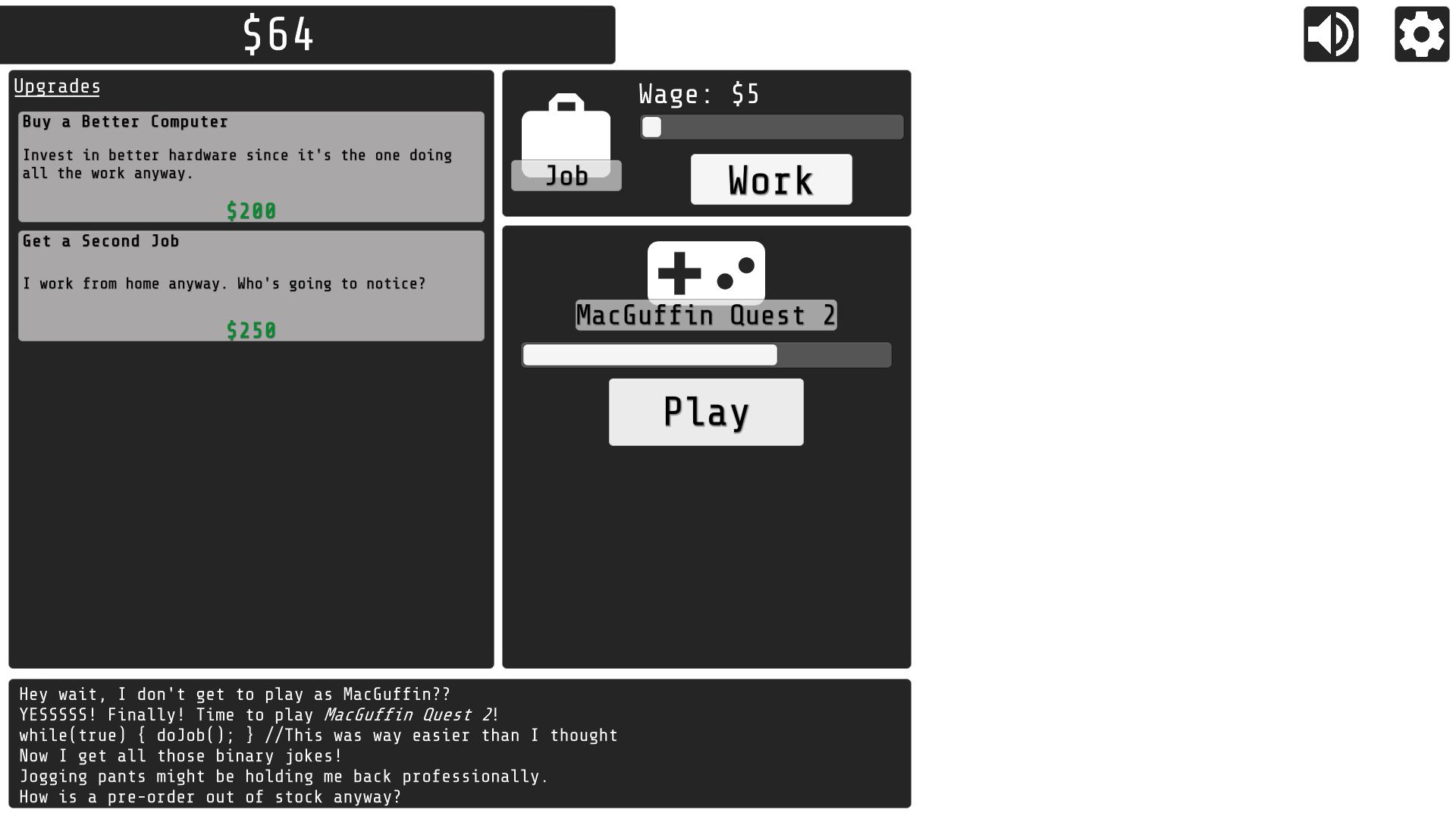
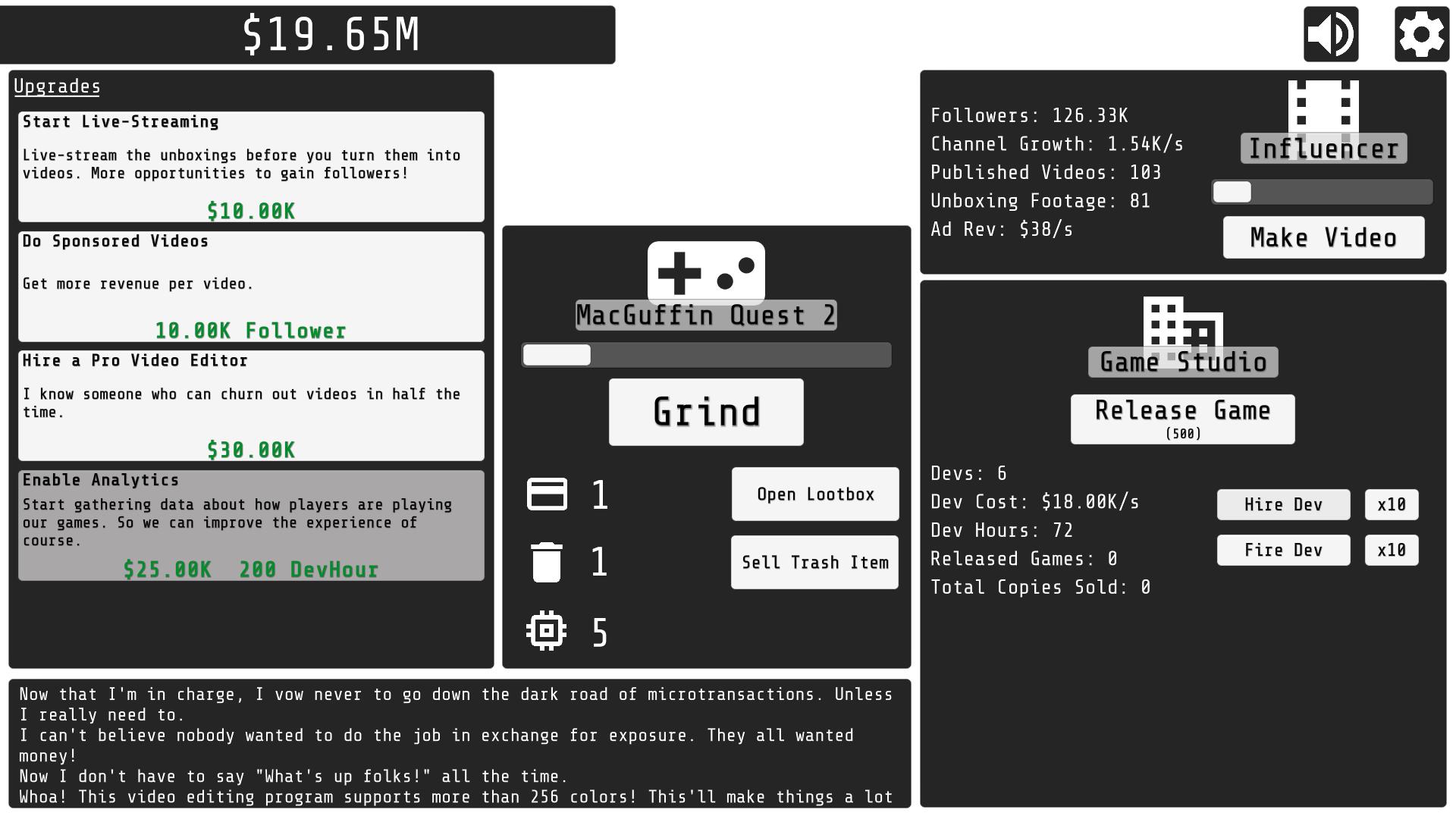
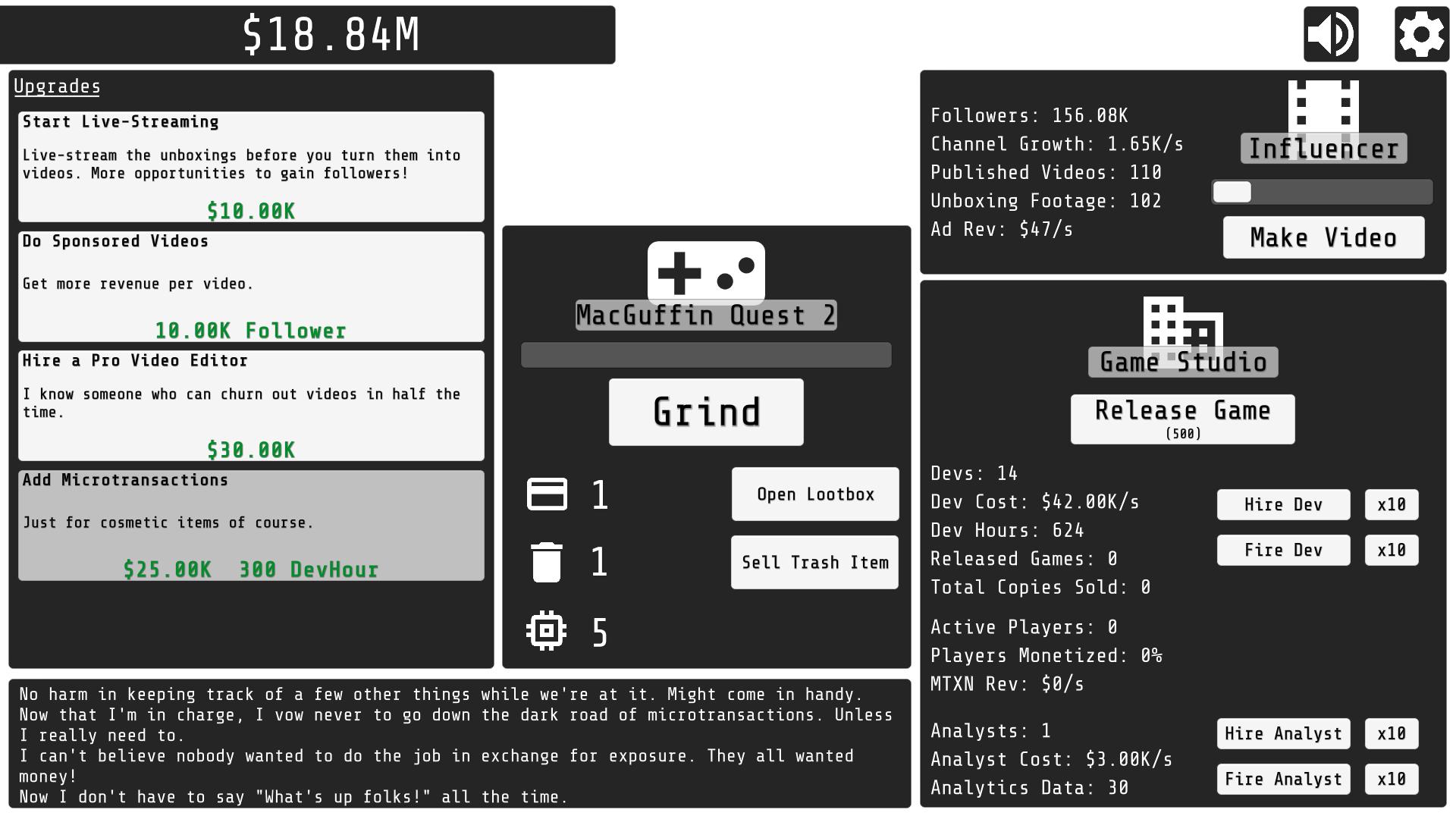
Loot Box Quest wears its intentions on its sleeve from the store page down: built by a solo developer as a one-week challenge, it bills itself as "the spiritual successor to DLC Quest" and promises "a sense of pride and accomplishment in the way that only repetitive clicking can deliver" — a direct jab at EA's infamous Battlefront II defense of loot boxes, made two months after that controversy broke. Underneath the joke is a genuine idle clicker: click to earn currency, spend it on upgrades, watch the numbers climb, following a text-based story about a character who starts out disgusted by loot boxes and gradually becomes exactly the kind of predatory monetisation designer they set out to expose. It's a smart premise for a $1.49 solo project, and the review sample splits almost evenly on whether the execution around that premise earns its keep.
A statement that plays like it means it
The strongest praise in the review sample is for exactly what the game set out to be: a piece of commentary rather than a conventional clicker. One detailed review describes it as "a deceptively simple incremental game that uses the familiar structure of clicker mechanics as a platform for satire, quietly dissecting the very systems it imitates." Another puts the character arc plainly: "you start off as someone who cares for games and dislikes transactions and eventually as the game continues, you slowly become the thing you hate." The most-cited specific moment across positive reviews is a message the game itself delivers around the two-hour mark, breaking the fourth wall in the developer's own voice to remind the player they may still be eligible for a Steam refund if they're not having fun — a small gesture that costs the developer real potential revenue and reads, to the reviewers who mention it, as more sincere than any amount of in-fiction satire could manage on its own. Achievement data backs up that most buyers do see the story through: milestones tied to reaching the ending sit in the 64-66% range, high for a game with no mechanical requirement forcing completion.
The joke that becomes the complaint
Set against that is a real split among reviewers over whether the satire actually lands as commentary or simply becomes the thing it mocks by being genuinely tedious to play. One detailed negative review states this directly: "Loot Box Quest is supposedly a game that makes fun of loot boxes and their stupidity, but really it's incredibly unfunny and boring - so, in that sense, it emulates loot boxes quite effectively." That's a sharper criticism than ordinary "this clicker is boring" feedback — it's arguing the satire fails on its own terms by replicating tedium rather than subverting it, and it's a fair reading given how many reviewers on both sides describe the actual clicking as thin. A second, more concrete complaint disputes the store page's own marketing directly: one reviewer quotes the "you won't have to click too much" promise verbatim and calls it a lie, citing a specific achievement requiring 5,000 manual clicks with no automation option available to bypass it — a checkable claim that matches the game's own published achievement list, which does include a 5,000-click milestone completed by 77.9% of the playerbase, exactly the kind of grind the reviewer describes rather than something invented for the complaint.
One playthrough, then nothing
The single structural decision drawing the most consistent frustration, independent of how anyone feels about the satire, is that Loot Box Quest cannot be replayed. One reviewer calls this "one major massive glaring flaw the dev's kind of fail to point out to people before they buy the game," noting that reaching the ending leaves no restart option, no New Game+, nothing — the save simply ends. For a game built in a genre whose entire appeal usually rests on a rebirth or prestige loop that gives "one more run" a reason to exist, choosing not to include any form of replay at all is either a pointed thematic statement (the loot-box grind has an end, unlike the real thing) or a genuine oversight, and the review sample doesn't settle which. Either way, it caps the game's value proposition hard at a single sitting regardless of price.
A resemblance worth naming plainly
One further complaint is worth reporting as exactly what it is: an attributed reviewer comparison, not an established fact. A single detailed review calls Loot Box Quest "a ripoff of a MUCH better game that features prestiging and intelligent crafting," naming a specific earlier free browser game ("Succubox") as the thing it more closely resembles, and recommending it over this paid release. This review found no independent way to confirm derivation or timeline between the two titles, and reports the claim only as one reviewer's specific, named comparison rather than a verified allegation.
Verdict
Loot Box Quest is at its best in its opening stretch and its closing message — a clever, cheaply made statement against loot-box monetisation that a fair share of reviewers found genuinely sharp, anchored by a refund reminder that's more convincing than most games' actual writing. It's at its weakest in the gap between what the store page promises (light clicking, quick fun) and what a specific, checkable achievement requires (thousands of unaided clicks), and in a total absence of any reason to play it twice. Buy it for the idea and the price; don't expect a second session.
Sources: Steam store page and appdetails API (release date, pricing, platform data); Steam's aggregate review data (query_summary totals, English-language sample); individually read user reviews, both positive and negative, sorted by helpfulness and recency; Steam's global achievement statistics API; Going Loud Studios' partner-events feed (confirmed empty — no patches or announcements posted since launch).
Pros and cons
Pros
- A genuinely clever, self-aware premise — an idle clicker whose own narrative arc has the player slowly becoming the loot-box industry they started out mocking — executed with real craft for a one-week solo project
- An in-game reminder of Steam's refund window, delivered in character, is a small but pointed piece of design that several reviewers specifically call out as a highlight
- No in-game currency, ads or monetisation of any kind, a deliberate and consistent choice given the subject matter
- Extremely low price matches the extremely short runtime honestly, rather than padding for a higher asking price
- Achievement data shows most buyers who start it do reach the ending, meaning the story payoff the positive reviews describe is genuinely accessible to nearly everyone who tries it
Cons
- There is no restart, New Game+ or any form of replay once the single playthrough ends, an unusually self-defeating structural choice for a game built in the genre defined by "one more upgrade" compulsion
- A specific, detailed reviewer dispute of the store page's own claim that players "won't have to click too much" — citing a 5,000-click achievement with no automation available — is worth taking at face value as a real gap between marketing and mechanics
- Split critical reception on the satire itself: several reviewers found it genuinely funny and sharp, while others call it "unfunny and boring," arguing it fails as commentary by simply replicating the tedium it's supposedly critiquing rather than subverting it
- One reviewer names a specific earlier free browser game ("Succubox") as the thing this game's mechanics closely resemble, alleging Loot Box Quest offers a slower, less refined version of an existing free experience
- The developer has posted no patches or updates since launch, so any of the above issues, including the click-count discrepancy, are very unlikely to see a fix
Screenshots
-
Loot Box QuestImage: Going Loud Studios via Steam -
Loot Box QuestImage: Going Loud Studios via Steam -
Loot Box QuestImage: Going Loud Studios via Steam -
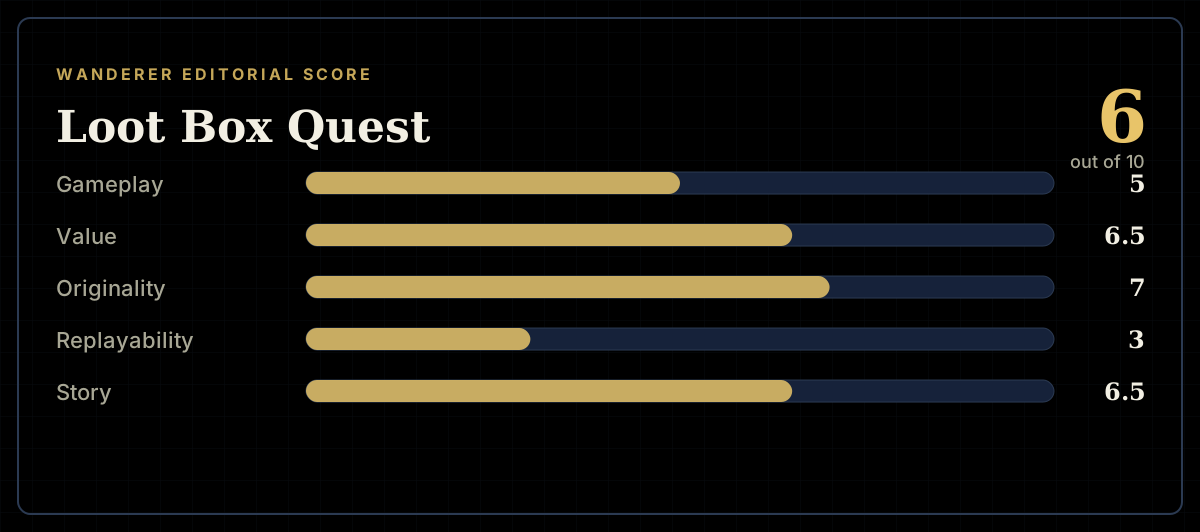
How the review scores each part of the gameWanderer Editorial -
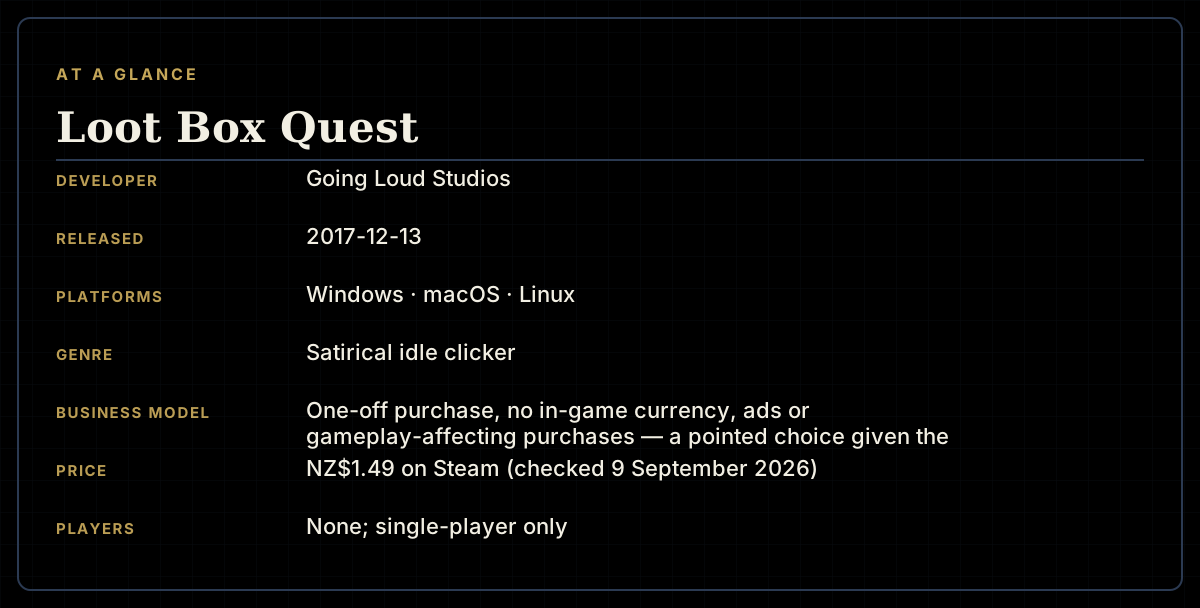
The specsWanderer Editorial -
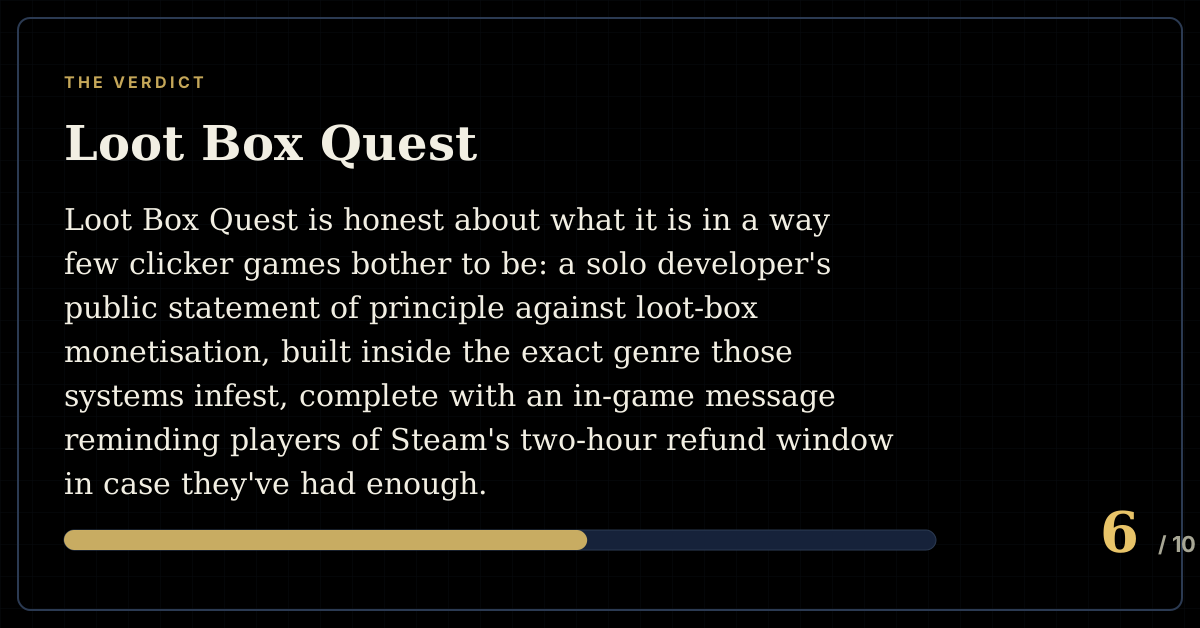
The short versionWanderer Editorial