
Game review
LEARNING ROGUE
6.5 / 10
- Developer
- YIICTSC
- Publisher
- YIICTSC
- Released
- 26 August 2026
- Platforms
- Windows
- Genre
- RPG
A Fifty-Seventh Consecutive Launch Without a Single Review
LEARNING ROGUE launched on Steam on 26 August 2026 from developer YIICTSC, and at the time of writing it has zero user reviews. That absence matters more than usual here, because the game's entire pitch rests on a specific hybrid claim — that solving real study questions can be woven convincingly into a card-based roguelike loop — and whether that fusion actually feels rewarding rather than gimmicky is exactly the kind of judgment call that needs a real audience of players, not just a store page description, to settle.
Turning Correct Answers Into Combat Resources
The core loop asks players to work through focused learning challenges, assignments, and tracked learning records, then carry whatever they accomplish directly into card-based roguelike battles — correct answers translate into attacks, defenses, rewards, and access to new routes through a run. That's a genuinely different design proposition from the usual educational-game formula of quizzes bolted onto an unrelated minigame as a reward: here the store page frames understanding the material as the mechanism that expands a player's in-run options, rather than treating the quiz and the game as two separate systems that merely take turns. The stated design intent — that the better a player understands a given challenge, the more options they have on the next run — suggests skill expression is meant to come from actual comprehension rather than reflexes or grinding, which is an unusual axis for a roguelike to build its difficulty curve around. Whether that translation from "correctly answered question" to "meaningful tactical option" holds up in practice, rather than reducing to a thin points-for-right-answers system, is precisely the kind of design nuance that only sustained player feedback can confirm. Screenshots show the learning challenges themselves are genuinely simple at the tier shown — a basic single-digit addition question with four multiple-choice answers — which fits a game built to include a dedicated Primary School world alongside its High School and Magic tiers, and suggests the difficulty of the study material is meant to scale alongside the roguelike's own escalating stakes rather than staying uniformly easy or hard throughout.
Card Collection, Deckbuilding, and Fusing Cards Together
Beyond the study loop, the game layers on a fairly conventional but sturdy deckbuilding structure: collecting cards, shaping a deck around a preferred play style, and fusing cards together to create stronger combined effects. Card fusion in particular is a more involved system than simple deck curation, since it implies a crafting-like decision tree on top of the usual "which cards do I run" question — a player has to decide not just what to include, but what to sacrifice or combine to reach a stronger result. Encounters are framed as requiring adaptation, turning a small tactical advantage into a winning strategy across a run, which is standard roguelike-deckbuilder language but at least signals that the card system is meant to carry real strategic weight rather than existing purely as a wrapper around the educational content. Screenshots reveal the deckbuilding goes further than the store text describes: combat cards are reskinned as school supplies, with attacks like "Pencil Attack" and defensive plays like "Defend with Notebook" facing off against enemies such as a chalk spirit and a crow messenger, and at least one card shown converts a defeated enemy directly into a new collectible card for the player's own deck — a monster-catching hook layered on top of the study mechanic that the key feature list doesn't call out by name, and a genuinely clever way to make winning a fight feel like it expands the player's toolkit rather than just clearing an obstacle.
Three Themed Worlds and a Bundle of Bite-Sized Mini-Games
Content is split across three distinct story themes — Primary School, High School, and Magic — each bringing its own atmosphere, encounters, and ways of testing a growing deck, which gives the learning material a loose narrative throughline rather than presenting three interchangeable difficulty tiers. Completing learning objectives also unlocks a specific, named set of mini-games: After-School Poker, Elementary Wanderer, Principal Showdown, and Paper Airplane Battles, described as bite-sized activities meant to make every achievement feel rewarding. Naming these mini-games individually rather than describing them generically suggests they're meant to function as genuine standalone rewards worth looking forward to, not filler screens between study sessions, though only real play time can confirm whether four mini-games are enough variety to stay interesting across a full playthrough spanning three separate worlds. The choice to keep the mini-games unrelated to the study material itself — poker, an exploration segment, a boss-styled showdown, and a paper-airplane shooting gallery — also suggests the developer is deliberately giving players a mental break from the learning loop rather than doubling down on education at every turn, which could matter for anyone worried the whole package might feel like schoolwork with a card game bolted on.
Display Options, Controller Support, and a Fair One-Time Price
Language support is limited to English and Japanese, with dedicated hiragana display options alongside the standard English and Japanese text — a sensible accommodation for a game explicitly built around reading and comprehension rather than one that could get by with subtitles alone. Every screenshot on the store page, including the combat UI and the sample learning-challenge screen, is shown entirely in Japanese despite English being a listed supported language, which is a detail worth flagging plainly rather than guessing at: it may simply reflect which build the screenshots happened to be captured from, but it leaves the actual quality and completeness of the English localisation unconfirmed ahead of a purchase. Full Xbox controller support is listed as a key feature, and the store page is explicit that this is a one-time purchase with no daily playtime limit, an important clarification for an educational game given how much of that genre elsewhere gates content behind timers or subscriptions. An internet connection is required specifically for online leaderboards, assignments, co-op, and race features, while save data itself is stored locally without cross-platform synchronisation — a reasonable tradeoff for a solo-priced Steam release, though anyone hoping to continue a run across multiple devices should know that going in. At NZ$6.39 with no discount, the price sits well below most narrative or systems-heavy RPGs, positioning LEARNING ROGUE as a low-risk try rather than a full-price commitment.
Verdict
LEARNING ROGUE attempts something genuinely uncommon for the RPG space: building a card-based roguelike whose core resource — options during a run — is earned by actually understanding study material, rather than by grinding or reflexes. The deckbuilding and card-fusion systems underneath that hook look sturdy enough to stand on their own, screenshots confirm a genuinely clever monster-into-card capture mechanic layered on top, and the three themed worlds and four named mini-games suggest a reasonable amount of content for the price. Whether the educational hook enhances the roguelike loop or just interrupts it, whether four mini-games and three worlds deliver enough lasting variety, and how complete the English localisation actually is given every available screenshot is shown in Japanese, are exactly the kinds of questions a launch with zero reviews can't yet answer. It launched on 26 August 2026 with zero user reviews so far, so how well the study-to-combat translation actually plays out across a full run remains unverified by anyone outside the studio.
Screenshots
-
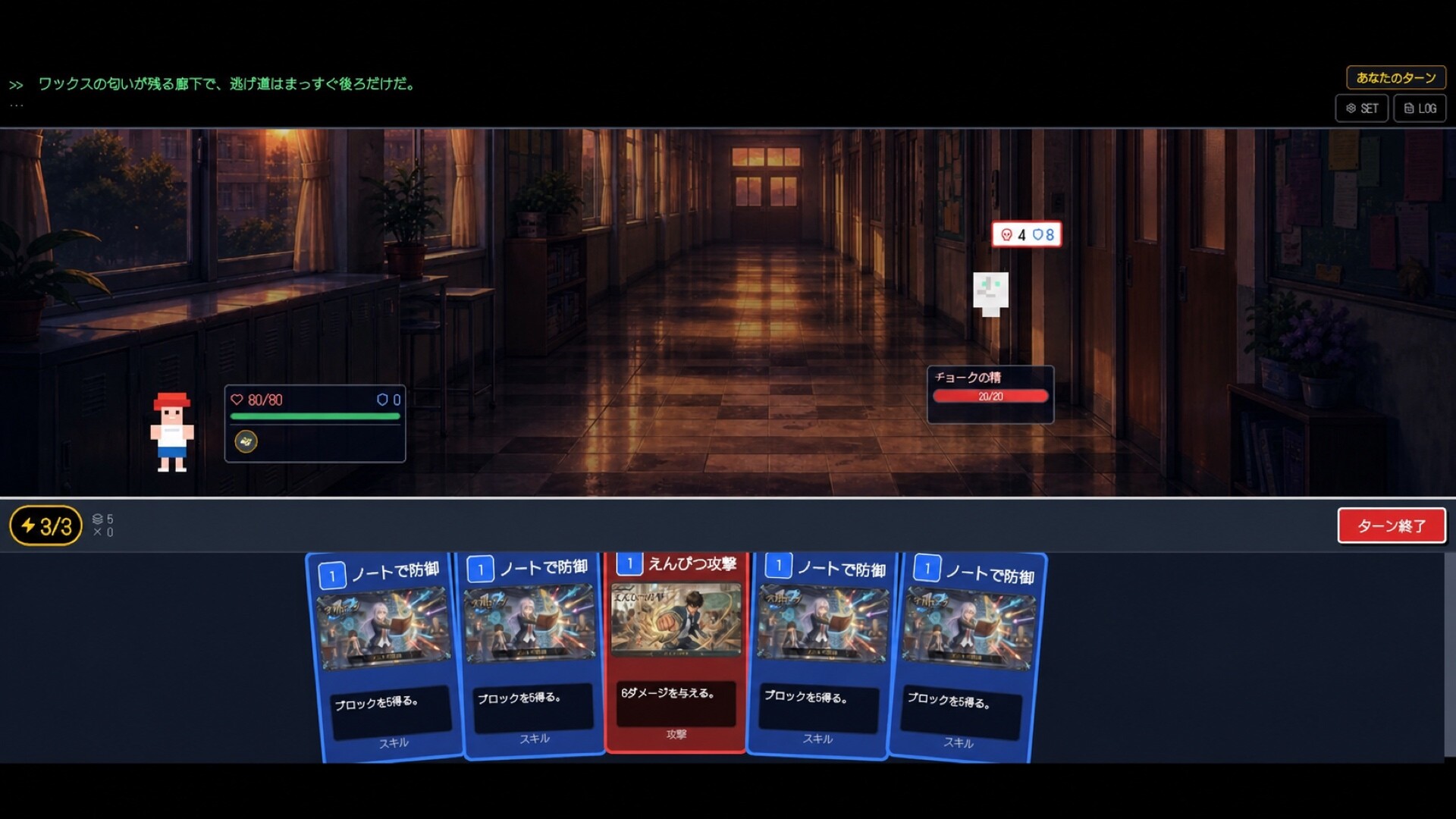
Card combat reskinned with school supplies — Notebook Defense and Pencil Attack cards fighting a chalk-spirit enemy in a school corridor.Steam store page -
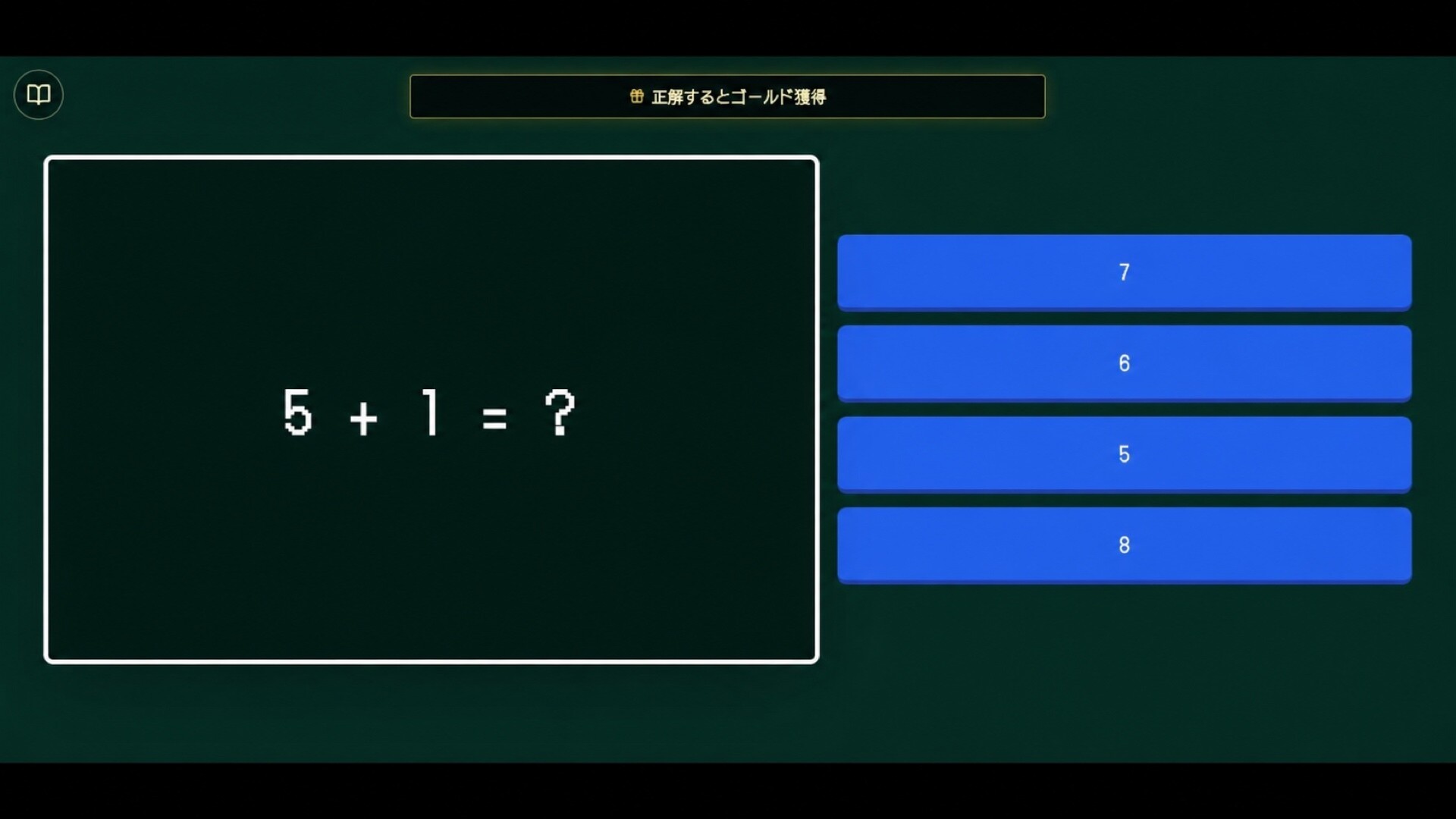
A learning challenge screen posing a basic arithmetic question with multiple-choice answers, feeding directly into the card battle.Steam store page -
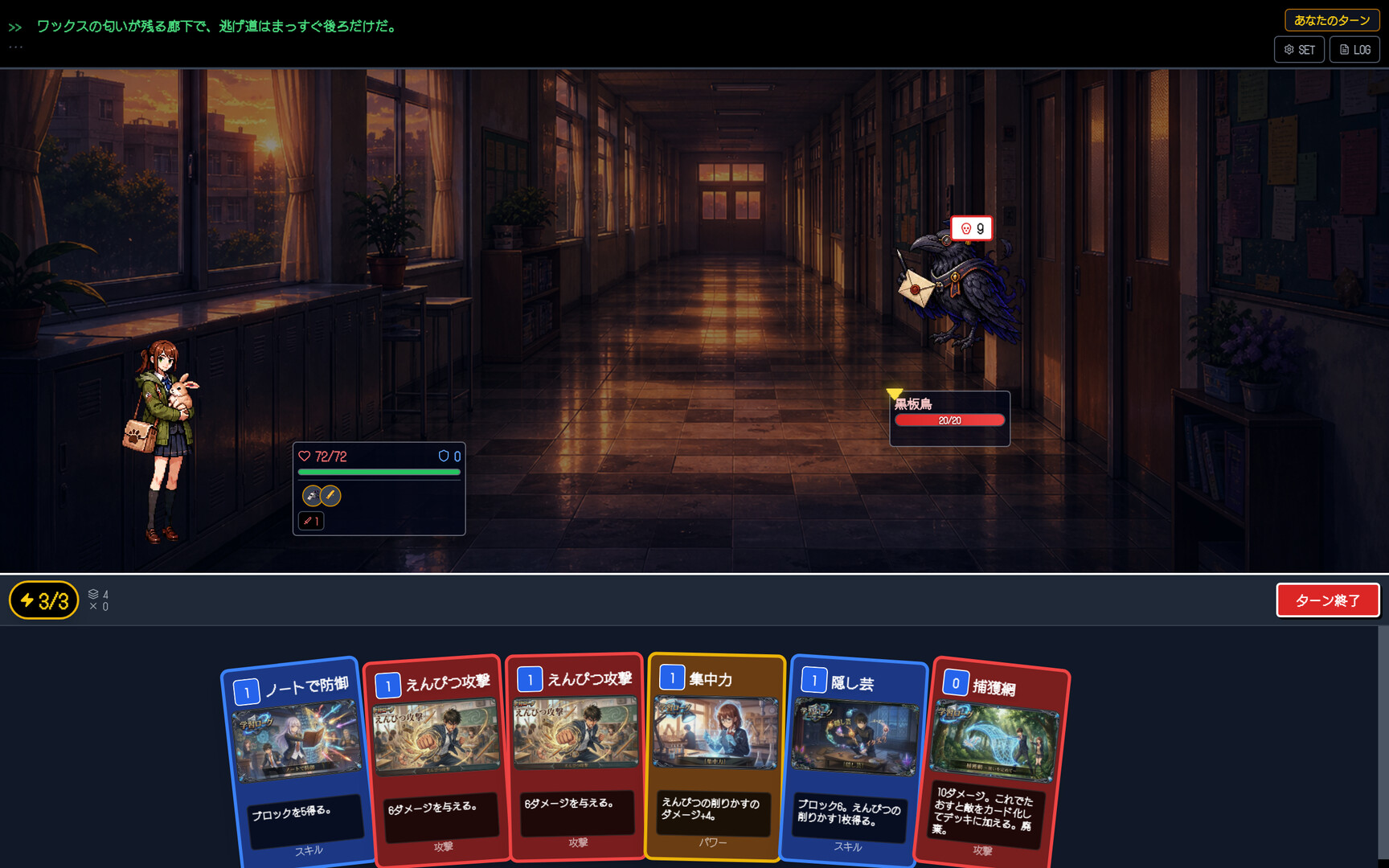
A different playable character faces a crow enemy; one card shown converts a defeated foe directly into a collectible card for the deck.Steam store page