
Game review
Hyper Light Drifter
6.5 / 10
- Developer
- Heart Machine
- Publisher
- Heart Machine
- Released
- 31 March 2016
- Platforms
- Windows, macOS, Linux
- Genre
- Action RPG
- Monetisation
- Paid, one-time purchase. No in-app purchases or DLC.
- Players
- Local co-op only, despite some player expectations of online support.
The short version
Hyper Light Drifter's pixel art and Disasterpeace soundtrack are about as close to universally praised as anything in this genre gets, and 15,000-plus reviews at Very Positive reflect that. What's just as consistent, spanning the entire decade since release, is a specific and recurring pattern of reviewers explicitly saying they wanted to love the game and couldn't — pointing at wordless, deliberately obtuse storytelling and combat that never quite clicked for them. A separate, more clear-cut concern is accessibility: the game ships with no option to disable its flashing-light effects, a gap reviewers are still reporting as recently as mid-2026.
Biggest strengths
- Genuinely stunning, distinctive pixel art and a haunting Disasterpeace score that draw near-universal praise even from reviewers critical of everything else.
- A wordless storytelling approach that, for players it works for, delivers real emotional weight without a single line of dialogue.
- A tightly designed, hand-crafted world that rewards exploration over the more common procedurally generated approach in the genre.
Biggest weaknesses
- A recurring, specific pattern across a full decade of reviews describes wanting to love the game and being unable to, citing combat that "never clicked" and storytelling too obtuse to stay invested in.
- No option exists to disable the game's flashing-light visual effects, a real accessibility gap still being reported by photosensitive players as recently as mid-2026.
- Co-op is local-only, and at least one detailed report describes the second player as having almost no meaningful way to interact with the game's systems.
Who it's for: Fans of atmospheric, visually distinctive action RPGs who are comfortable with minimal narrative guidance and don't need combat feel to be the game's primary strength; approach with caution if sensitive to flashing lights.
Our recommendation: Worth experiencing for the art and atmosphere alone, but temper expectations for the combat and story delivery, and be aware there's no built-in way to reduce the flashing visual effects.
6.5 / 10
An aesthetic achievement that's barely aged a day
Hyper Light Drifter's presentation is the one part of its reputation that goes essentially unchallenged across its entire review history. The store page's spare framing — "explore a beautiful, vast and ruined world riddled with dangers and lost technologies" — undersells just how distinctive the execution is. The official screenshot shows it directly: a lone drifter and a black canine companion resting by a campfire against a bleeding, glitch-streaked crimson skyline and looming ruined architecture, a composition that reads as much like a painting as a game screenshot. Disasterpeace's score, also responsible for Fez and It Follows, draws praise even from the game's harshest critics — one detailed 2025 review that ultimately doesn't recommend the game still opens by conceding "the environments are beautiful, the soundtrack is lovely [and] haunting." Nothing in this review's research turned up a meaningful dissenting voice on the art direction specifically; if Hyper Light Drifter is remembered for one thing without qualification a decade on, it's this.
"I wanted to love this" as a recurring, specific pattern
What's more interesting than a simple positive-versus-negative split is how consistently a particular kind of negative review recurs, using strikingly similar language across years that couldn't have coordinated with each other. "I really wanted to like this game. I really, really wanted to. But I hated it," reads a 2017 review. "I want to like this game, I really do," opens a 2022 review, going on to describe combat that "never clicked" and storytelling too "obtuse" to sustain investment. A January 2026 review titled "Style over substance" makes the same structural complaint in more analytical terms: stunning pixel art and a "hauntingly beautiful soundtrack," undercut by mechanics that don't deliver on the presentation's promise. Checking a broad sample of negative reviews, roughly one in five open with almost this exact framing — not simple dislike, but a specific, repeated disappointment from players who came in primed to love the game and didn't. That's a meaningfully different signal than ordinary negative reviews, and it suggests the gap between Hyper Light Drifter's presentation and its actual play experience is real and consistently felt, not a fringe reaction.
A clear-cut accessibility gap, not a matter of taste
Distinct from the subjective combat-and-story debate, one complaint in the review sample is not a matter of opinion: the game ships with no option to turn off its flashing-light visual effects. A June 2026 review states the problem plainly: "no option to turn off flashing lights. a lot of them in the intro and first playable screen. i am only mildly sensitive to flashing and literally cannot play this." This is the kind of gap that a simple settings toggle would resolve, and its absence a full decade after release is a legitimate, actionable criticism regardless of how a given player feels about the combat or narrative choices discussed above. Co-op draws a related, more specific complaint about mismatched expectations: a 2017 review notes the store page implies broader multiplayer support than the local-only co-op actually delivers, and a 2024 review reports that in practice "the second player is useless... only the first player can interact with things" — a functional co-op mode that doesn't meaningfully split responsibilities between two people.
A platform-specific bug worth knowing about
Rounding out the technical picture, a documented and apparently well-known issue affects Linux, SteamOS and Steam Deck players specifically: a 2018 review describes the game freezing "after a half-hour of gameplay," a problem that "only starts happening after playing for a couple hours" in some cases, describing it as "a well-known issue" on that platform at the time. This review can't confirm whether the issue persists in its original form today, but it's worth flagging for anyone planning to play primarily on Steam Deck.
Why wordless storytelling is a genuine gamble, not a flaw by default
It's worth resisting the urge to treat the "wanted to like it" pattern as proof the storytelling approach itself is a mistake, since plenty of reviewers describe the opposite experience just as sincerely. The game's decision to convey its entire narrative through environmental detail, wordless cutscenes and symbolic imagery is a real creative choice with real payoff for players willing to meet it on its own terms — several positive reviews specifically credit that approach with an emotional impact a more conventional, dialogue-heavy game couldn't have achieved the same way. The fairest way to read the recurring disappointment isn't that the choice was wrong, but that it's a genuinely higher-variance one: a wordless, ambiguous narrative either resonates strongly or leaves a player adrift with nothing to hold onto, and there's less of a reliable middle ground than a game with explicit dialogue and exposition would offer. That variance is a fair thing for a prospective player to weigh going in, rather than a defect to expect the game to fix.
Final verdict
Hyper Light Drifter's art direction and score remain genuinely exceptional, and this review has no reservations recommending the game on that basis alone. Where the recommendation gets more qualified is in taking seriously a specific, decade-spanning pattern of players who wanted the combat and storytelling to match that presentation and didn't find it did, alongside a real, unaddressed accessibility gap around flashing lights that has nothing to do with taste. This is a game worth experiencing for what it does exceptionally well, with realistic expectations about the parts of it that a meaningful, consistent share of its own audience has never quite connected with.
Pros and cons
Pros
- Genuinely stunning, distinctive pixel art and a haunting Disasterpeace score that draw near-universal praise even from reviewers critical of everything else.
- A wordless storytelling approach that, for players it works for, delivers real emotional weight without a single line of dialogue.
- A tightly designed, hand-crafted world that rewards exploration over the more common procedurally generated approach in the genre.
- Historically significant as one of the works that helped define modern "atmospheric pixel art action RPG" as its own recognisable subgenre.
Cons
- A recurring, specific pattern across a full decade of reviews describes wanting to love the game and being unable to, citing combat that "never clicked" and storytelling too obtuse to stay invested in.
- No option exists to disable the game's flashing-light visual effects, a real accessibility gap still being reported by photosensitive players as recently as mid-2026.
- Co-op is local-only, and at least one detailed report describes the second player as having almost no meaningful way to interact with the game's systems.
- A well-documented SteamOS/Linux/Steam Deck bug causes the game to freeze after roughly half an hour to a couple of hours of continuous play.
Screenshots
-

Hyper Light DrifterImage: Heart Machine via Steam -

Hyper Light DrifterImage: Heart Machine via Steam -

Hyper Light DrifterImage: Heart Machine via Steam -
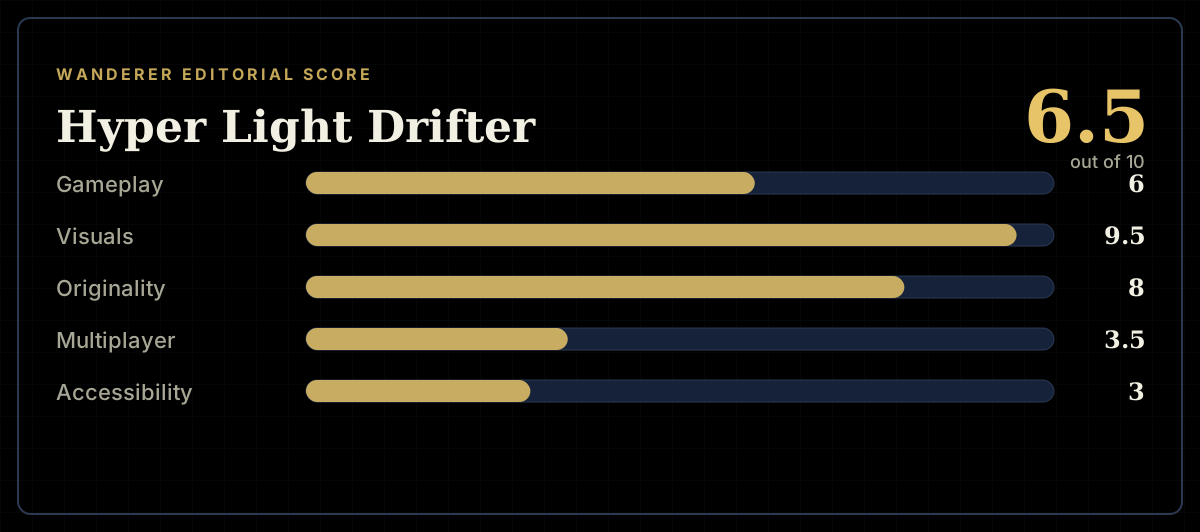
How the review scores each part of the gameWanderer Editorial -
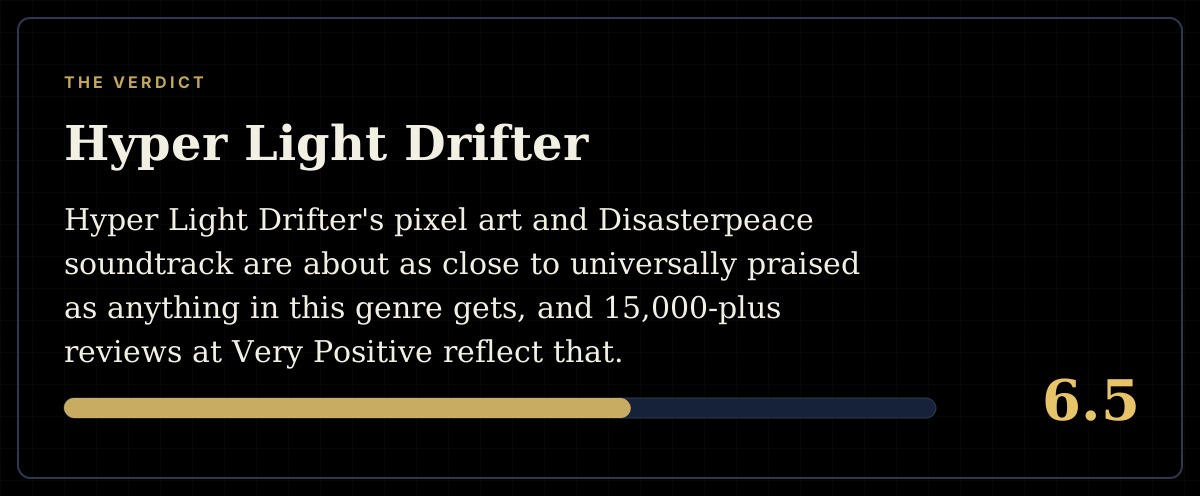
The short versionWanderer Editorial