
Game review
Honkai: Star Rail
7.5 / 10
- Developer
- miHoYo
- Publisher
- HoYoverse
- Released
- 26 April 2023
- Platforms
- Windows, PlayStation 5, Android, iOS
- Genre
- Turn-Based Sci-Fi RPG
- Monetisation
- Free to play with a single warp (gacha) currency split across a limited character banner, a limited Light Cone (weapon) banner and a permanent standard banner, a Trailblaze Power stamina cap on farmable stages, a monthly subscription and a per-patch battle pass
- Players
- No real-time co-op or PvP. A lightweight "Assist" system lets you borrow a friend's showcased character as a guest slot in Simulated Universe and boss content, but the game is built and balanced as a single-player experience
The short version
Honkai: Star Rail commits to turn-based combat in a genre that mostly ran away from it, and the Weakness Break and Toughness system it builds around that decision is smarter than a first glance suggests — enemy vulnerabilities, a shared Skill Point economy, and Ultimates that ignore turn order all interact in ways that reward actually reading a fight. The problem is that the same game hands you an auto-battle button and a Quick Clear function that skip past most of that thinking once your roster is built, and a large share of the playerbase uses both constantly.
What keeps people logging in isn't the fighting, it's the writing — Star Rail's story arcs, especially Penacony, are a level of sustained narrative ambition the gacha genre rarely attempts, let alone lands. But the daily loop is stingy by design (roughly 20 minutes of stamina a day, then you're done), power creep between new characters is documented and aggressive, and the monetisation adds a wrinkle Genshin doesn't have: some characters' kits are functionally incomplete until a specific Eidolon unlocks a mechanic, not just a stat boost.
Biggest strengths
- Weakness Break ties elemental typing, a shared Skill Point resource and off-turn Ultimates into a combat puzzle that rewards planning a turn order rather than just building the biggest number
- The Penacony story arc is sustained, structurally ambitious narrative writing that holds up against genre peers regardless of the gacha wrapper around it
- Trailblaze Power caps at 240 and refills in about 24 hours, so the game never demands more than a short daily session to stay caught up on farmable content
Biggest weaknesses
- Auto-battle and the Quick Clear button let a built roster finish most farmable content without a single manual input, which quietly removes the reason to engage with Weakness Break at all past the story missions
- Several newer 5-star characters have kit-defining mechanics locked behind a specific Eidolon rather than unlocked at base copy, so "usable" and "finished" can be two different purchases
- Relic substat RNG stacks main stat, sub-stat count and sub-stat roll quality on top of each other, and the community's own numbers put the odds of a specific desired main stat as low as roughly 1.4 percent per drop
Who it's for: Players who want a turn-based RPG with real systems depth and are willing to read a lot of dialogue for it. Less suited to anyone who wants their gacha spend to buy character power rather than character convenience, or anyone allergic to menus.
Our recommendation: Play it for the combat system and the story, both of which are genuinely among the best the genre offers. Go in accepting that the daily loop is short on purpose, that auto-battle will eventually replace half your active playtime, and that a favourite character's "finished" kit may cost more than the character itself.
7.5 / 10
A turn-based bet in an action-RPG market
Every other major HoYoverse release is built around real-time movement and combat. Star Rail isn't. It's a party-of-four, menu-driven, turn-based RPG that would look at home next to a mid-2000s console JRPG, released into a mobile market that had mostly decided turn order belonged in idle games, not premium live-service titles. That's the bet at the center of this review, and it's worth separating from whether it's also a good gacha game — those are different questions, and Star Rail answers one more convincingly than the other.
Anyone coming from Genshin Impact should recalibrate immediately. There's no open world to climb or glide across — combat happens on contained battle stages, exploration is a fixed 2.5D path through hub areas, and the traversal systems that carry Genshin's pacing simply don't exist. What Star Rail asks instead is whether a turn-based system stays interesting for hundreds of hours, and whether a story-first structure justifies a much smaller moment-to-moment gameplay footprint.
Weakness Break is a real system, not a JRPG costume
The core loop looks simple on paper: pick a target, use a Skill or Basic Attack, watch a Toughness bar drop. What makes it worth taking seriously is how the pieces interact. Every enemy displays an elemental weakness alongside its Toughness gauge, and hitting that weakness chips the gauge down faster than any other damage type. Empty it and the enemy is Weakness Broken — stunned, delayed in the turn order, and hit with a bonus effect specific to the element that broke them (Fire applies a burn, Ice freezes them in place, Imaginary reduces their action gauge further). That's the layer most turn-based RPGs stop at. Star Rail adds two more.
Skill Points are a shared party resource, not a per-character cooldown. You start a fight with three banked, cap at five, and every Basic Attack refunds one while every Skill costs one — the game is quietly asking you to manage a currency across four characters, deciding whose turn deserves the point more than another's. Then there's the Ultimate: unlike a Skill, it doesn't wait for its owner's turn, firing the instant its energy bar fills and interrupting the action order whenever you choose, which turns "break this enemy now or bank my Ultimate for the next wave" into a genuinely tactical decision rather than a scripted set piece. Layer a four-character team against staggered weaknesses, with buffers, debuffers and hypercarries all wanting a slice of that same Skill Point pool, and the system produces real team-building depth — closer to a proper tactical RPG's decision space than the "press ultimate when ready" rhythm the genre's mobile entries usually settle for.
Auto-battle is where that system quietly gets abandoned
Here's the part Wanderer's readers will care about more than most: Star Rail ships with a full auto-battle toggle and a Quick Clear function that skips animations and instantly resolves a previously-cleared stage's rewards. Both exist for good reason — daily farming and weekly boss resets would be miserable without them — but the game doesn't meaningfully gate their use. Once a team is built and its relics reasonably rolled, auto-battle's AI (which prioritizes weaknesses, low-HP targets and Skill Point availability reasonably well, if not perfectly) clears the overwhelming majority of farmable content without a single manual input.
That's not automatically a flaw. It respects the fact that most of a live-service RPG's total playtime is repetitive resource farming, and letting players skip it without skipping the reward is arguably more honest than forcing you to sit through the same stage a hundred times by hand. But it means the excellent system above gets used with real attention mostly during story battles, the harder endgame tiers, and a stage's first clear. The rest of the time, Star Rail plays closer to a stat-optimization game with combat animations attached than a combat game with stats attached. Whether that reads as strength or hollowing-out depends on what you came here for — the tactical content exists, but the game will not make you seek it out.
The daily loop: twenty minutes, on purpose
Trailblaze Power is Star Rail's stamina system, and it's a smaller ask than most of the genre's equivalents. It caps at 240, regenerates one point every six minutes, and refills fully in about 24 hours — burn a full bar on efficient farming and you're looking at somewhere around fifteen to twenty minutes of actual play to spend it, plus dailies, plus whatever story or event content is current. A Reserve Trailblaze Power system, capped at 2,400 and accumulated passively once your regular bar is full, means players who can't log in every day don't actually lose progression — it just banks up server-side.
Compare that to Genshin's Original Resin, already covered on this site: 200 cap, one point per eight minutes, roughly the same daily total but attached to a much bigger open-world game with far more to do once the stamina-gated content is spent. Star Rail's design is more honest about what it's asking of you — it wants a short daily check-in and doesn't pretend otherwise — but there's less game left once that check-in is done. The pitch is genuinely "twenty minutes a day, then it's done," and unlike a lot of live-service marketing, that claim happens to be true. Whether that reads as respectful pacing or a suspiciously short session depends on whether you want a game to fill an afternoon or one that gets out of your way.
Story is the actual retention mechanism, and it mostly earns that role
Most gacha RPGs use story as a wrapper around the systems that make money. Star Rail inverts that relationship more than any other HoYoverse title — the fighting exists to service the writing, not the other way round. The Xianzhou Luofu arc established the game could do political intrigue and long-form character writing competently; the Penacony arc, built around a dreamworld theme park hiding a genuinely dark premise, is where the writing staff swung for something more ambitious and largely connected, with a plot structure that reads as deliberately paced rather than padded for engagement metrics.
The most recent major arc, Amphoreus, is more divisive: a full playthrough runs north of 50 hours, more than double Penacony's length, and reception has split between players calling it the most emotionally ambitious writing HoYoverse has produced and players who find the dialogue-to-gameplay ratio tips into "watch, don't play." Both readings are defensible — the writing quality hasn't dropped, but letting a single region run that long is a real structural choice with real costs. The newest arc, set on Planarcadia since Version 4.0 in February 2026, returns to a tighter, more contained rhythm by comparison, which reads like a direct response to that feedback.
Is the writing actually good, or good for a gacha? Genuinely good, with the caveat that "genuinely good" here means well-structured genre fiction with real emotional stakes and competent foreshadowing, not literary fiction — the same standard you'd hold a well-regarded JRPG to, not a lower one because a warp banner sits next to it in the menu.
Endgame: three checks, one new fourth
Star Rail runs a rotating trio of challenge modes: Memory of Chaos (twelve stages, raw team damage across two half-teams per cycle), Pure Fiction (four stages of enemy waves, favors AoE and sustained damage), and Apocalyptic Shadow (two rotating bosses, tests single-target burst and mechanic execution). A fourth, Anomaly Arbitration, became permanent as of Version 3.6: three "Knight" encounters, each carrying a different debuff and ideally cleared with a different team, before a harder "King" stage that needs only one.
The honest answer to "can a free player clear this" is yes, with caveats. Community consensus, echoed across guide sites that track clear compositions, holds that E0 (base copy, no Eidolons) five-stars with reasonably rolled relics clear the overwhelming majority of content across all three original modes. What "reasonably rolled" is doing there matters — it assumes real investment in the relic grind below, and the hardest tiers are tuned around whatever the current top-tier kits can do, which drifts every patch. Full-clearing near the top of the curve is harder than Genshin's equivalent, because Star Rail's boss health pools scale up alongside each powerful new character rather than holding steady — the power-creep complaint below, made concrete in numbers.
Relics are the artifact grind, and the complaints are specific for a reason
Relics are Star Rail's gear system, and the RNG stacking will be familiar to anyone who's read the artifact section of the Genshin review: a piece drops from one of several possible sets, its main stat rolls from a weighted pool on non-fixed slots, it starts with three or four random substats, and every level-up has a chance to upgrade one substat further. Community-tracked odds for landing a specific desired main stat on a specific piece run as low as roughly 1.4 percent per drop, and minimum substat rolls land more often than maximum ones purely by the roll table's weighting. That's the mechanical reason "grind for weeks" isn't hyperbole — the same compounding-odds problem this site already flagged in Genshin's artifact system, and Star Rail's version isn't meaningfully gentler.
HoYoverse's response, introduced in Version 3.0, is Wishful Resin — a craftable relic with a chosen main stat, still subject to random substats but removing one layer of the RNG stack. It's a real acknowledgment of the problem, but it shortens the grind rather than removing it. Players still spend a meaningful share of their Trailblaze Power on relic domains months after a character is otherwise "finished."
The gacha layer, and where it actually differs from its sibling
Star Rail runs three simultaneous banners under one Stellar Jade → Oneiric Shard currency: a limited Character Event Warp, a limited Light Cone (weapon) Event Warp, and a permanent Standard Warp. The base 5-star rate is a published 0.6 percent per pull across all three, with hard pity guaranteeing a 5-star by wish 90 on the character banner and by wish 80 on the Light Cone banner; the Standard Warp's pity lands between wish 75 and 90. Losing the 50/50 on the character banner guarantees the featured unit on your very next 5-star — no soft-pity odds boost like Genshin's Capturing Radiance system, just a flat coin flip with a hard backstop. Since Version 3.2, losing that coin flip also lets you swap the resulting standard character for any unit from a rotating list of past limited characters, a real quality-of-life improvement even without touching the rate.
The Light Cone banner is the more interesting divergence from Genshin. Where Genshin's weapon banner lets you nominate a target and bank a guaranteed pick after any off-target pull (Epitomized Path), Star Rail's guaranteed 5-star at pity only carries a 75 percent chance of being the featured cone rather than a 100 percent guarantee. It's a smaller gap than it sounds — most players are chasing character power, not a specific weapon — but it's a real, checkable difference in how generous the two games are with an equivalent system, and it favors Genshin.
The bigger gap is Eidolons, Star Rail's constellation equivalent. Owning duplicate copies of a character unlocks Eidolons E1 through E6, and for a meaningful subset of recent 5-star releases, one specific Eidolon doesn't just boost numbers — it changes what a skill does, removes a restriction, or unlocks an interaction the base kit doesn't have access to. That's a sharper monetisation edge than Genshin's constellations, where a base 5-star is very rarely non-functional. A Star Rail character can be pulled, built, and still feel structurally incomplete until a specific dupe lands, and that's the clearest way this game's economy differs from its sibling's rather than just restating it.
It's the same shape this site flagged in AFK Journey: a transparent, documented pity system sitting on top of an endgame that quietly becomes the real monetisation engine. Star Rail swaps AFK Journey's PvP ladder for Anomaly Arbitration's escalating damage checks, but the pull toward "one more Eidolon" to clear the last tier runs on the same mechanism.
Power creep and the menu-simulator problem
This isn't a vague community grumble — HoYoverse has addressed it directly in developer broadcasts, acknowledging that characters released since the Amphoreus arc (Version 3.0 onward) set new damage benchmarks that push older, once-competitive units out of top-tier content. A promised pass to keep earlier characters viable hasn't, as of this review, materially closed the gap at the difficulty curve's top end. It matters less for an account building a roster gradually than for anyone chasing leaderboard clears, but it's an acknowledged problem, not a perception issue, and it compounds the relic grind: every power-creep cycle means re-farming relics for whichever unit just made your old carry obsolete.
Add relics, Light Cones, Eidolon trees, and the Simulated Universe's own blessing and curio systems on top, and a real share of total playtime goes to comparing numbers in nested panels rather than anything visually interesting. None of the individual menus are badly built — the relic comparison tool does a reasonable job of surfacing whether a new piece is an upgrade — but the sheer number of stacked systems means new players hit a wall of UI well before they've seen enough content to understand why any of it matters.
Final verdict
Star Rail earns real credit for committing to turn-based combat and building a system — Weakness Break, shared Skill Points, off-turn Ultimates — genuinely worth engaging with by hand, and for pairing it with story writing that treats its audience as willing to sit through a real narrative rather than skip to the next banner. The daily loop is honest about what it wants from you, which is rare enough in this genre to be worth praising on its own.
What holds it below its sibling's mark is that the game increasingly plays itself once a roster is built, that its Eidolon system creates a sharper "incomplete until you spend more" problem than Genshin's constellations do, and that power creep is now something HoYoverse itself has had to publicly address. None of that makes Star Rail a worse game than Genshin Impact — it's a different kind of good, built around writing and tactical combat rather than open-world traversal, and this review's score differs from Genshin's 8.0 because the two games' weak points sit in different places: Genshin's cost is mostly time, Star Rail's increasingly includes character functionality itself. Players who want a turn-based RPG with a story worth following, and don't mind auto-battle doing the heavy lifting between story beats, will get a genuinely excellent twenty minutes a day out of this. Players chasing a fully-Eidoloned roster are signing up for the same long-tail spending decision Genshin's Spiral Abyss chasers face, with an extra layer of "is this character even finished yet" on top.
Pros and cons
Pros
- Weakness Break ties elemental typing, a shared Skill Point resource and off-turn Ultimates into a combat puzzle that rewards planning a turn order rather than just building the biggest number
- The Penacony story arc is sustained, structurally ambitious narrative writing that holds up against genre peers regardless of the gacha wrapper around it
- Trailblaze Power caps at 240 and refills in about 24 hours, so the game never demands more than a short daily session to stay caught up on farmable content
- HoYoverse publishes its warp rates directly (0.6 percent base 5-star chance, 90-pull hard pity, guaranteed follow-up after a lost 50/50) rather than obscuring the math
- Runs credibly across a wide device spread, from flagship PC rigs to mid-range phones, without the open-world rendering load Genshin Impact carries
Cons
- Auto-battle and the Quick Clear button let a built roster finish most farmable content without a single manual input, which quietly removes the reason to engage with Weakness Break at all past the story missions
- Several newer 5-star characters have kit-defining mechanics locked behind a specific Eidolon rather than unlocked at base copy, so "usable" and "finished" can be two different purchases
- Relic substat RNG stacks main stat, sub-stat count and sub-stat roll quality on top of each other, and the community's own numbers put the odds of a specific desired main stat as low as roughly 1.4 percent per drop
- Power creep across new character releases is a persistent, well-documented complaint even from HoYoverse's own dev broadcasts, which have promised (but not yet delivered at scale) a pass to keep older units viable
- The interface leans hard on nested menus for relics, Light Cones, Eidolons and the Simulated Universe meta-systems, and a meaningful share of total playtime is spent comparing stat panels rather than doing anything else
Screenshots
-
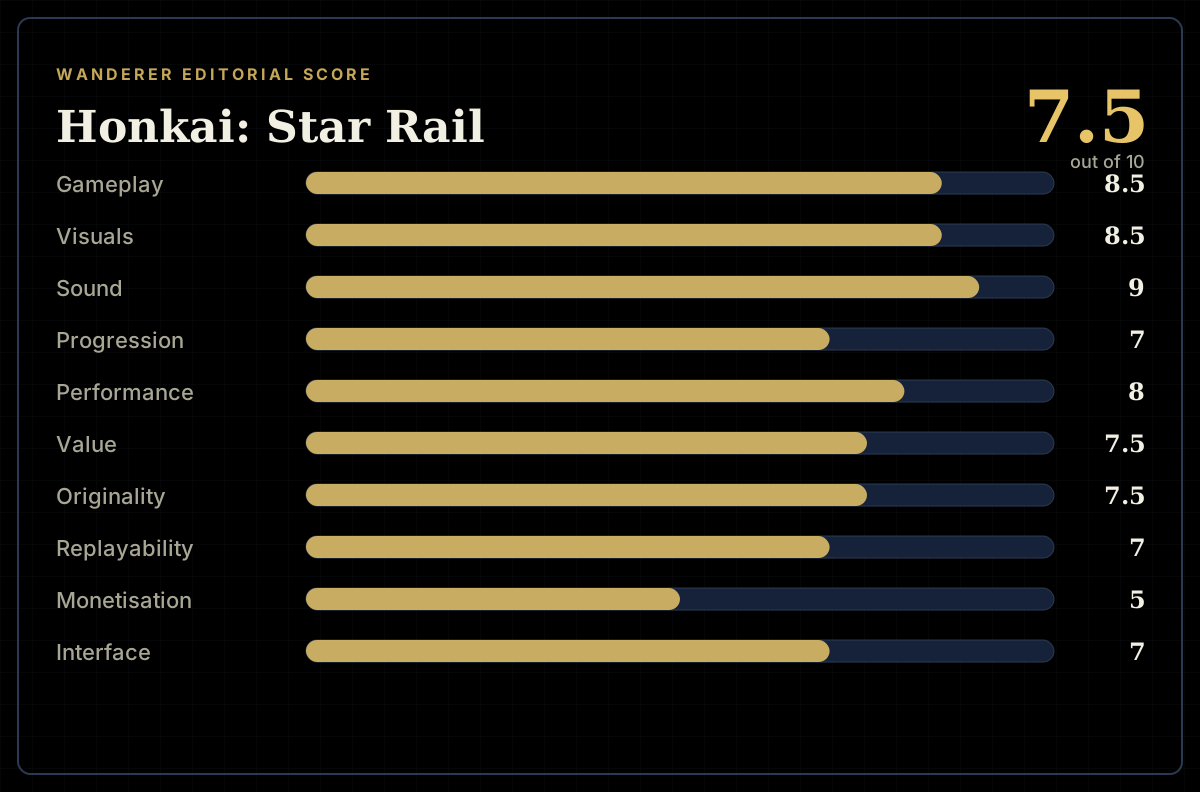
How the review scores each part of the gameWanderer Editorial -
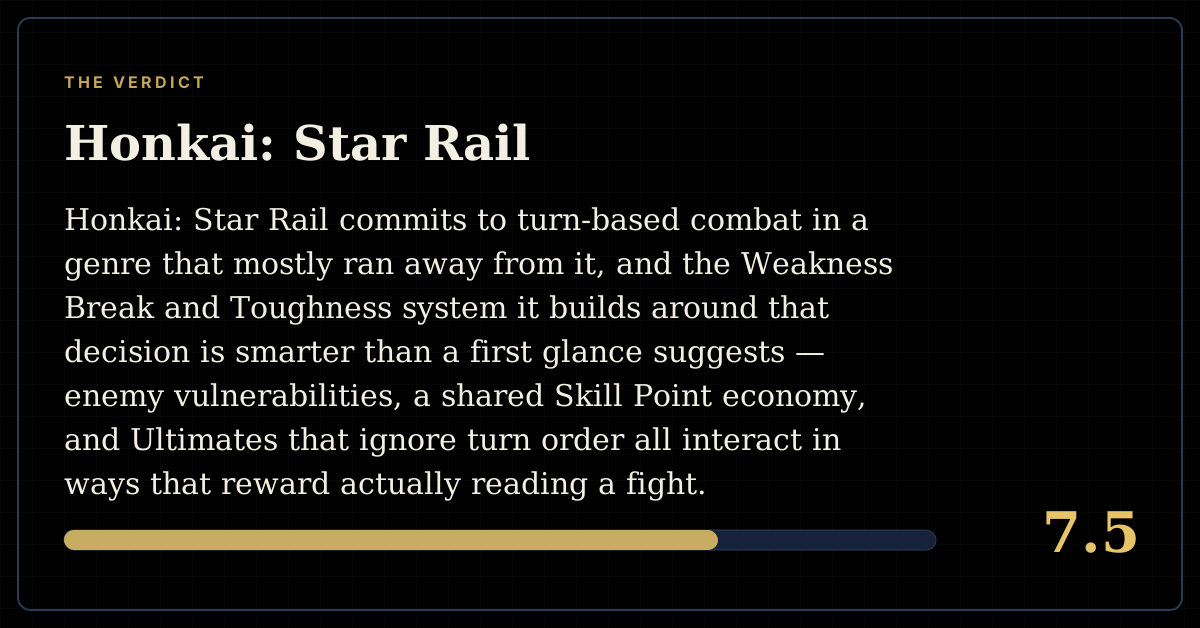
The short versionWanderer Editorial