
Game review
Blue Archive
6.5 / 10
- Developer
- NEXON Games
- Publisher
- NEXON Korea
- Released
- 3 July 2025
- Platforms
- Windows
- Genre
- Gacha RPG / Tactical
- Monetisation
- Free to play with in-app purchases — a gacha model where premium currency buys pulls for characters. Historically regarded as unusually generous to free players; that reputation is the subject of the current dispute. Checked 4 August 2026.
- Players
- Single-player with asynchronous competitive modes
The short version
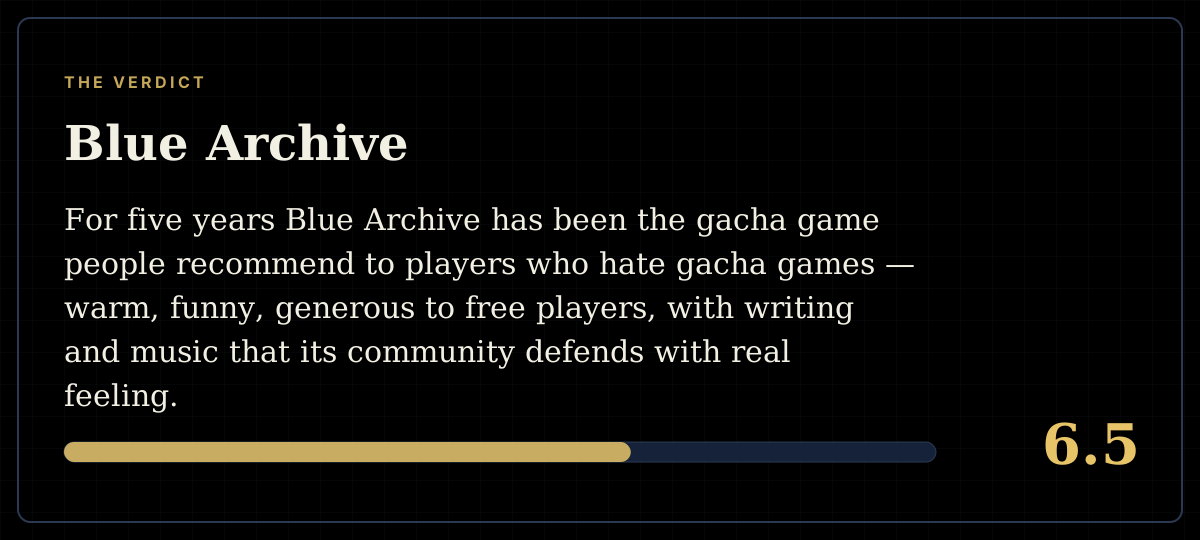
For five years Blue Archive has been the gacha game people recommend to players who hate gacha games — warm, funny, generous to free players, with writing and music that its community defends with real feeling. In late July 2026 NEXON announced changes to its pull system on a Japanese livestream, and the Steam page has been on fire ever since: 91 of the last 100 English reviews are negative, many from players with hundreds of hours and, by their own account, thousands of dollars spent. The complication is that the change has landed on the Japanese server and not yet on global, and players who've actually used it disagree sharply about how bad it is.
Biggest strengths
- Writing and characters that inspire unusual loyalty, with a story players cite as the reason they stay rather than the gacha
- Excellent music, repeatedly singled out even in negative reviews
- Low daily time demands — events and dailies are widely described as quick to clear
Biggest weaknesses
- A late-July 2026 pull-system revision has produced a collapse in sentiment, with 91 of the last 100 English reviews negative
- Critics say the change removes selective acquisition and increases spending pressure; the developer's response is described by players as an apology without a reversal
- Long-term spenders are publicly quitting, including reviewers claiming multi-thousand-dollar histories
Who it's for: Players who want a character-driven anime RPG with a genuinely good story and low daily time demands, and who can tolerate a gacha economy. Not for anyone unwilling to engage with randomised character acquisition, and not for players who need a settled situation before investing.
Our recommendation: It's free, so install it and judge the story and combat for yourself — that part is genuinely good and it costs nothing. Spend nothing for now. The pull-system change is live on the Japanese server and pending on global, players who have used it disagree about its impact, and there is no sensible reason to commit money into an unresolved monetisation dispute. Check the situation again in a couple of months before opening your wallet.
6.5 / 10
A note on timing. This review was written on 4 August 2026, in the middle of an active dispute between Blue Archive's developer and its playerbase. Every one of the hundred most recent English reviews was posted in the last few days, and ninety-one are negative. Anything you read about this game right now — including this — is a snapshot of a moving situation.
What people are angry about
In late July, at a Japanese livestream around the game's 5.5-year anniversary, NEXON announced changes to Blue Archive's pull system. Those changes have since gone live on the Japanese server.
The criticism, as players describe it, is that the revision removes the ability to select what you're pulling for and replaces it with a coin-flip mechanic plus a higher guaranteed threshold — a structure critics say increases both randomness and spending pressure, on banners that frequently feature more than one character. The word that recurs is the loss of the game's free-player-friendly reputation.
The response has been severe and it's coming from the most invested people. A reviewer with 981 hours writes that they have spent thousands of dollars on the game over the years and cannot support it if the new system stays. One with 306 hours logged in daily for two years and describes missing their first day. Another, with 341 hours, thanks the developer for curing an addiction. A review with 1,197 helpful votes says simply that they can no longer recommend the game.
Players also report that the developer took two days to respond and that the response was an apology rather than a reversal.
The complication
Here's what a careless version of this review would miss, and it matters a great deal.
The change is not in the global version most Steam players are running. Several defenders make this point explicitly, and the critics' own reviews confirm it — the phrasing is consistently "we won't get these changes just yet" and "expect it to come soon."
More importantly, players who have actually used the new system on the Japanese server disagree with the characterisation. A free-to-play reviewer of 3.5 years with 622 hours, self-described as an endgame player, says that having seen the real implementation and run the numbers, the new system has genuine benefits and the rebate tickets it introduces allow useful flexibility. Another with 301 hours says the maths circulating in the community shows the new system is better but less convenient, and points readers to the calculations rather than asking to be believed.
I'm not going to adjudicate the pull mathematics. I haven't run them, the numbers differ by server and banner, and anyone who tells you confidently in a review that they've settled it is overreaching. What I can tell you is the shape of the dispute: it is contested, by people with hundreds of hours on both sides, and it concerns a change most Steam players have not yet experienced.
The game underneath
Which brings us to the part the storm is obscuring.
Blue Archive is a character-driven anime RPG set in a city of student militias, and the reason it has the loyalty it does is the writing. Its defenders — including several currently downvoting it — describe staying for the story rather than the gacha, and that distinction shows up again and again. The music draws unprompted praise even in negative reviews. The art is strong.
Combat is a tactical auto-battler: you position a squad, trigger abilities on cooldown, and watch it resolve. One reviewer's description is the most accurate I found — "the gameplay is addictive to watch" — and while it's easy to learn, higher-difficulty raids demand real squad construction.
It's also unusually respectful of your time. Reviewers repeatedly note that events and dailies don't take long to clear, which for a live-service gacha is worth flagging: this is not a game that demands two hours a night.
And it has genuinely supported free players. A 3.5-year free-to-play account reporting endgame completion is not a claim many gacha games can produce.
How to read a review score during a revolt
One broader point, because this situation recurs and readers meet it constantly.
A Steam score is a running average of people who chose to write something. During a controversy, the population writing reviews changes completely: it stops being "players describing a game" and becomes "players registering a position." That's what 91-of-100 means here. It is real, it is sincere, and it is not a measurement of whether the game is fun.
Three checks make it readable. Look at the playtimes — here they run 288, 306, 341, 981, 1,004 hours, which tells you this is invested players protesting rather than a brigade arriving from outside. Look for dissent within the wave — the July positives from players who waited for the new system to go live and then defended it are the most informative reviews on the page, precisely because they cost their authors something socially. And check whether the complaint is about the version you'd install, which here it isn't, yet.
Apply those and the picture resolves: not a bad game, not a manufactured outrage, but a genuine dispute about a business model, being fought by people who care, in the only public venue available to them.
That last part is worth sitting with. Steam reviews have become the customer-relations channel of last resort for live-service games, which is why so many of the most upvoted ones across this whole library — Cyberpunk 2077's licence, XCOM 2's launcher, Helldivers 2's account requirement — aren't about the games at all.
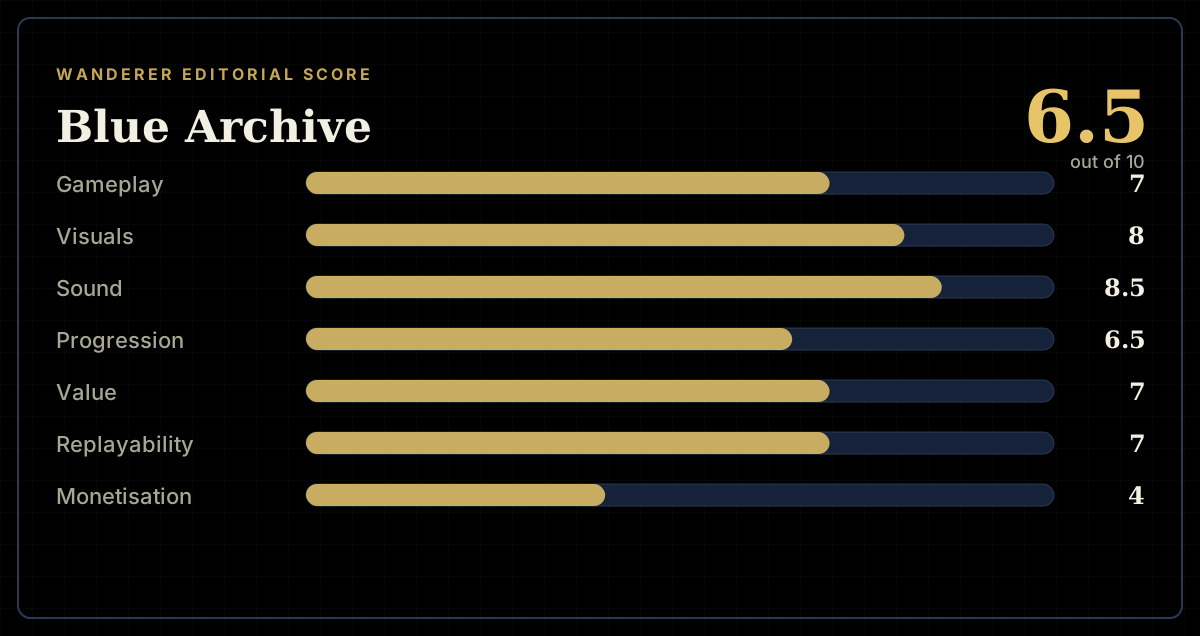
6.5 out of 10. Rated 6.5 out of 10.
That score is a snapshot and I'd expect it to move. The game itself — story, music, characters, time economy — is comfortably worth a 7.5 or better, and the people writing furious reviews this week are furious precisely because they love it.
What holds it here is that a monetisation dispute is unresolved, the developer has apologised without reversing, long-term spenders are publicly leaving, and Steam's own baseline for this port was Mixed before any of it started. None of that makes the game bad. All of it makes committing money to it today a poor decision.
So: install it, it's free, and find out whether the story lands for you. Spend nothing until the dust settles. And if you're reading this months from now, check the recent reviews rather than trusting a number written during a fire.
Pros and cons
Pros
- Writing and characters that inspire unusual loyalty, with a story players cite as the reason they stay rather than the gacha
- Excellent music, repeatedly singled out even in negative reviews
- Low daily time demands — events and dailies are widely described as quick to clear
- Historically generous to free players, with 3.5-year free-to-play accounts reporting endgame completion
- Combat is easy to learn, pleasant to watch and deeper than it looks at higher difficulties
- Free to install with an 88-hour median playtime among recent reviewers
Cons
- A late-July 2026 pull-system revision has produced a collapse in sentiment, with 91 of the last 100 English reviews negative
- Critics say the change removes selective acquisition and increases spending pressure; the developer's response is described by players as an apology without a reversal
- Long-term spenders are publicly quitting, including reviewers claiming multi-thousand-dollar histories
- Steam sentiment sat at Mixed even before this, suggesting the port has had a rougher reception than the mobile original
- It remains a gacha game — character acquisition is randomised and that is the business model
- Regional versions diverge, so advice and calculations you read may not apply to your server
Screenshots
-

Blue ArchiveImage: NEXON Korea via Steam -

Blue ArchiveImage: NEXON Korea via Steam -

Blue ArchiveImage: NEXON Korea via Steam -
How the review scores each part of the gameWanderer Editorial -
The short versionWanderer Editorial