
Game review
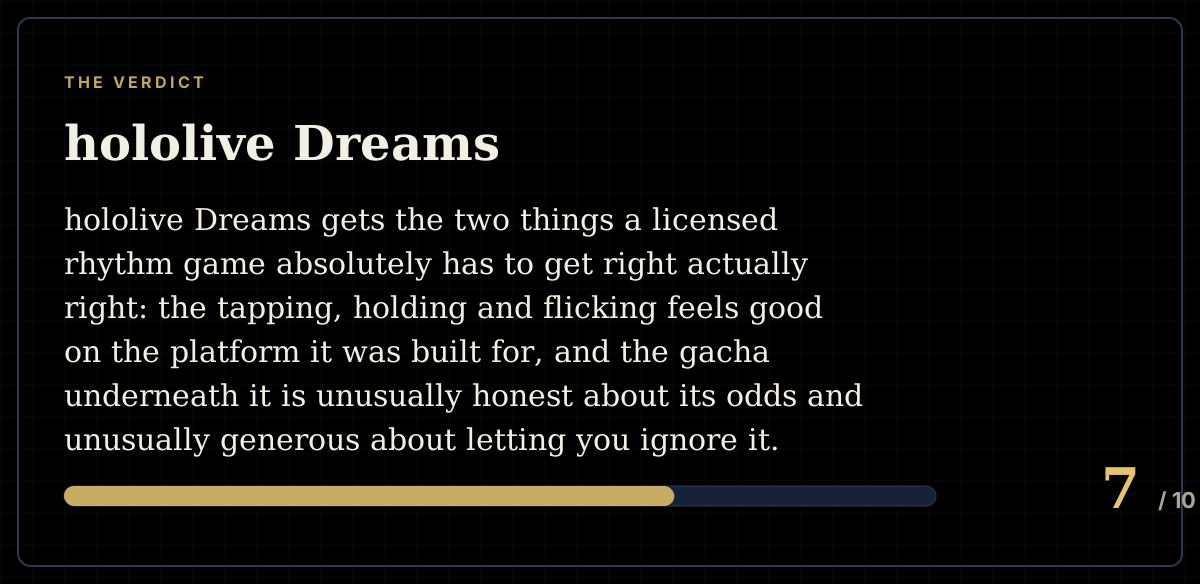
hololive Dreams
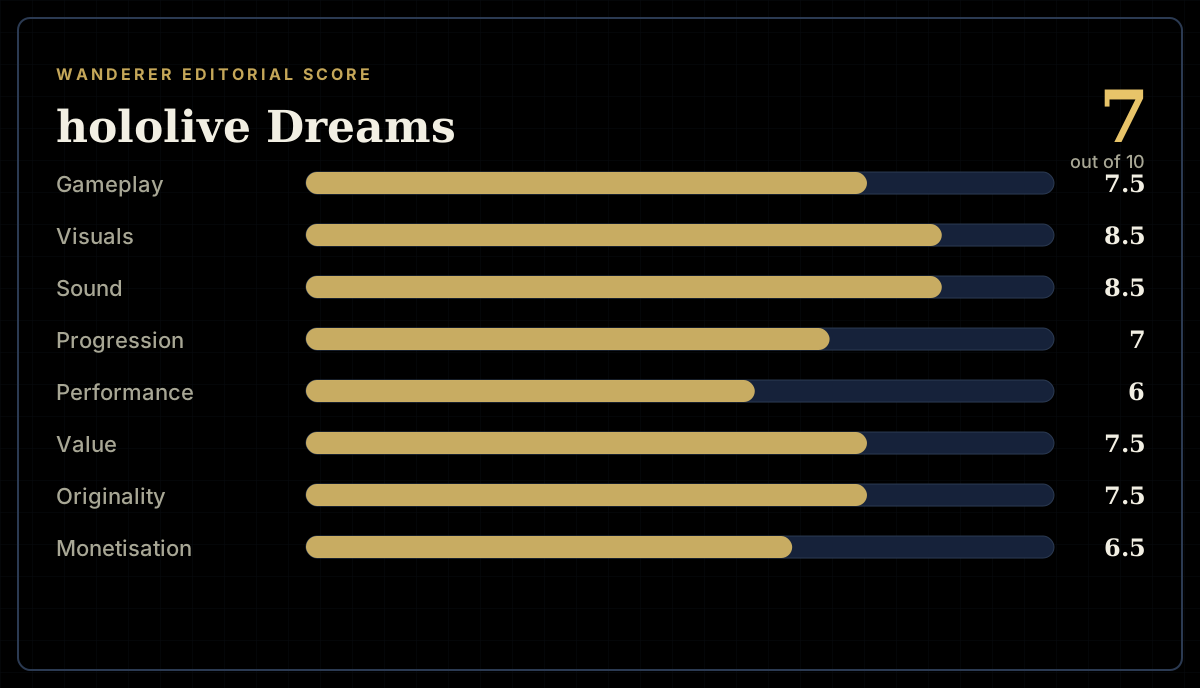
7 / 10
- Developer
- QualiArts, Inc. (jointly developed with COVER Corporation)
- Publisher
- COVER Corporation
- Released
- 23 July 2026
- Platforms
- Android, iOS, Windows
- Genre
- Rhythm RPG and theme-park management sim
- Monetisation
- Free-to-play with a gacha character-recruitment system on three banner types, plus optional cosmetic-only talent memberships
- Players
- Online co-op and competitive mini-games through the in-game Fortune Network facility, including a 16-player race mode; shared rhythm performances
The short version
hololive Dreams gets the two things a licensed rhythm game absolutely has to get right actually right: the tapping, holding and flicking feels good on the platform it was built for, and the gacha underneath it is unusually honest about its odds and unusually generous about letting you ignore it. A 54-character roster, 150-plus songs at launch and a genuine second pillar in Dream Park's facility-building give it more to do than most games in this genre bother with.
It's a very different story the moment you move it off a phone. The Steam release ships with kernel-level anti-cheat that isn't clearly disclosed, refuses to boot on Linux or Steam Deck at all, and hands PC players a rhythm interface designed entirely around a touchscreen. That's a real, specific failure sitting next to a genuinely well-built mobile game, and it's dragged the Steam version's own review score down to Mixed while the mobile build gets treated as the intended experience it clearly is.
Biggest strengths
- Rhythm charts feel responsive and well-tuned on touchscreen, with normal, flick, slide and long-note types across variable-width lanes
- The 200-Gacha-Point exchange system guarantees a chosen character within 200 pulls on top of the standard banners, and a 5% base 5-star rate is well above genre norms
- Dream Park gives the theme-park half genuine weight rather than treating it as a menu between songs — Harmony Island's facilities double as a functional hub and a slow-build management loop
Biggest weaknesses
- The Steam release runs a kernel-level anti-cheat driver disclosed only in a buried "Additional Notes" line, and it blocks Linux and Steam Deck entirely
- PC controls are a six-key layout built for a touchscreen and ported without redesign, and Steam scores from the rhythm mode don't even count toward in-game rankings
- The passive-skill system gives little feedback about what's actually triggering it, and photo mode can't pose more than one character at a time
Who it's for: hololive fans first, rhythm-game players second — anyone who wants a generous, well-designed mobile gacha game built around a big, well-produced song library. Steam players specifically after a keyboard-friendly rhythm game should look elsewhere until the PC port gets real attention.
Our recommendation: Play it on a phone or tablet. The mobile build is the actual game — polished, fair to free players, and packed with more content on day one than most rhythm gachas ship in their first year. Skip the Steam version until the anti-cheat disclosure and control scheme get fixed; right now it's the same game wearing the wrong shoes.
7 / 10
Licensed rhythm games live or die on one question: does the tapping actually feel good, or is the license doing all the work? hololive Dreams answers that question correctly on the platform it was actually designed for, then spends its PC release proving how much the answer depends on which screen you're holding. This is QualiArts and COVER's first official hololive-branded game after years of the brand appearing only in third-party crossovers, and it arrives with the confidence of a studio that knows exactly what its audience wants: a big song library, a generous roster, and a park to build between performances.
What it actually is
hololive Dreams — known in its home market as "holodori" — sets you down on an uninhabited floating island and asks you to build a theme park, Dream Park, one facility at a time, while recruiting hololive talents to staff it. It's a hybrid in the most literal sense: rhythm performances sit at the centre, character collection runs on a gacha system underneath that, and a management layer wraps around both of them. Fifty-four talents are playable at launch, backed by more than 150 songs, with an "Extra Song Campaign" adding twenty-five more across the first fifteen days of service. That's a genuinely large opening library for the genre — most rhythm gachas ship a fraction of that and drip-feed the rest over months.
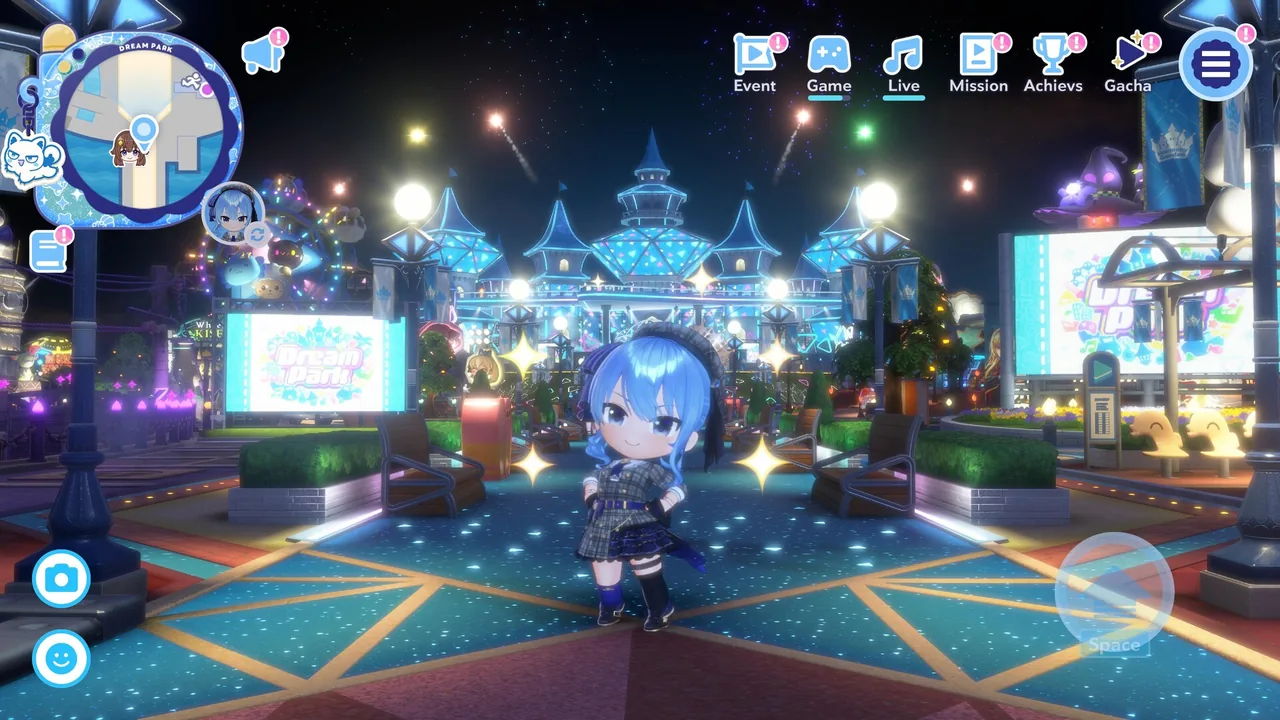
The framing device matters more than it looks. Harmony Island isn't a menu dressed up as a location; it's a real hub you walk around, and the facilities you unlock as Dream Park expands feed back into what songs, characters and mini-games are available. It gives the game a sense of forward motion that a straight song-select screen never manages, even when the underlying loop — perform, earn currency, recruit, build, repeat — is exactly what you'd expect from the genre.
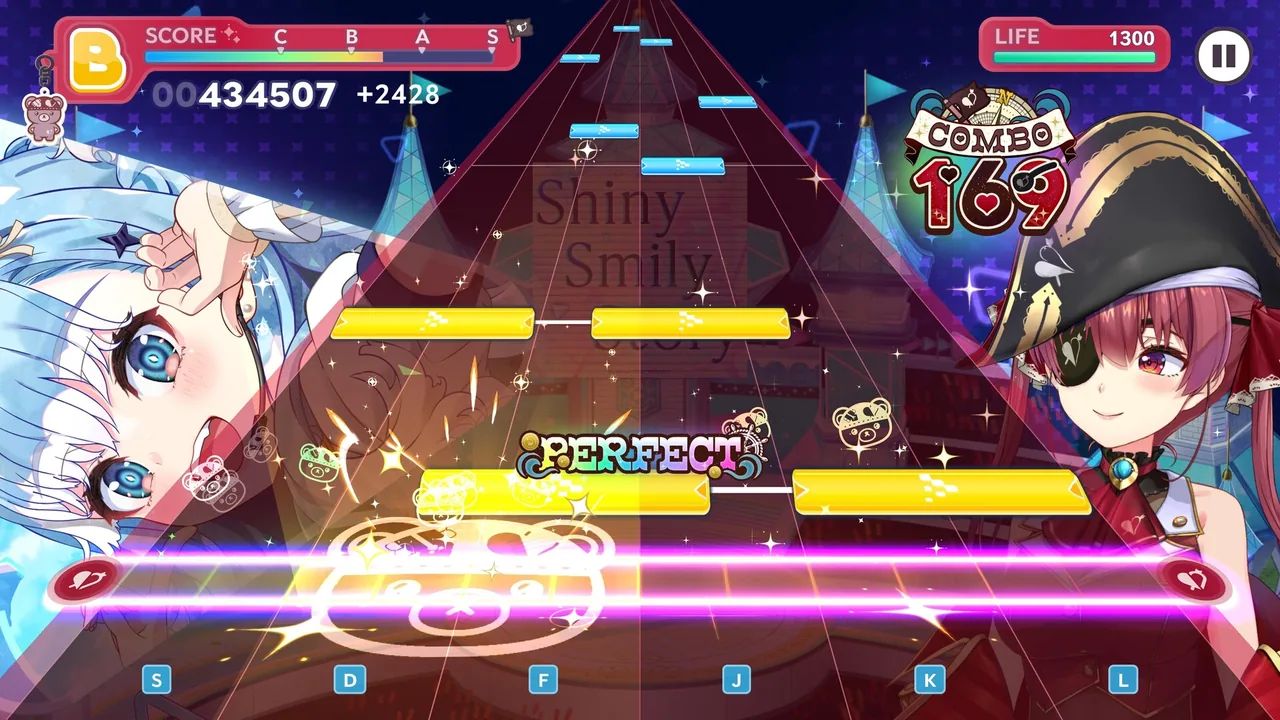
The rhythm game itself
The core mechanic is a six-lane system built around normal taps, flicks, slides and held notes, with lanes that vary in width and angle rather than sitting in a flat, evenly-spaced row. On a touchscreen, this reads as intentional design rather than difficulty for its own sake — charts stay legible even as songs get busier, and the note types are distinct enough that misreads feel like your fault rather than the interface's. A calibration option exists for players whose devices introduce input lag, though it's buried in a menu that needs repeated visits rather than offering a live adjustment while you play, which is a real friction point for anyone whose first few songs feel consistently off.
Difficulty tuning is inconsistent enough to notice: some Hard-tier charts play easier than the Normal charts leading into them, which suggests the launch tracklist wasn't tested end-to-end for a smooth curve. That's a minor complaint next to the bigger structural question the genre always raises — is this built for rhythm purists or for fans who want an easy way into the music — and hololive Dreams answers clearly in favour of the latter. An Auto Mode exists specifically so players who care more about collecting characters than clearing charts can still progress, and the game is honest about that choice rather than pretending otherwise. Players specifically hunting osu!- or Arcaea-level precision will find the ceiling here lower than they want.
Dream Park: more than a lobby
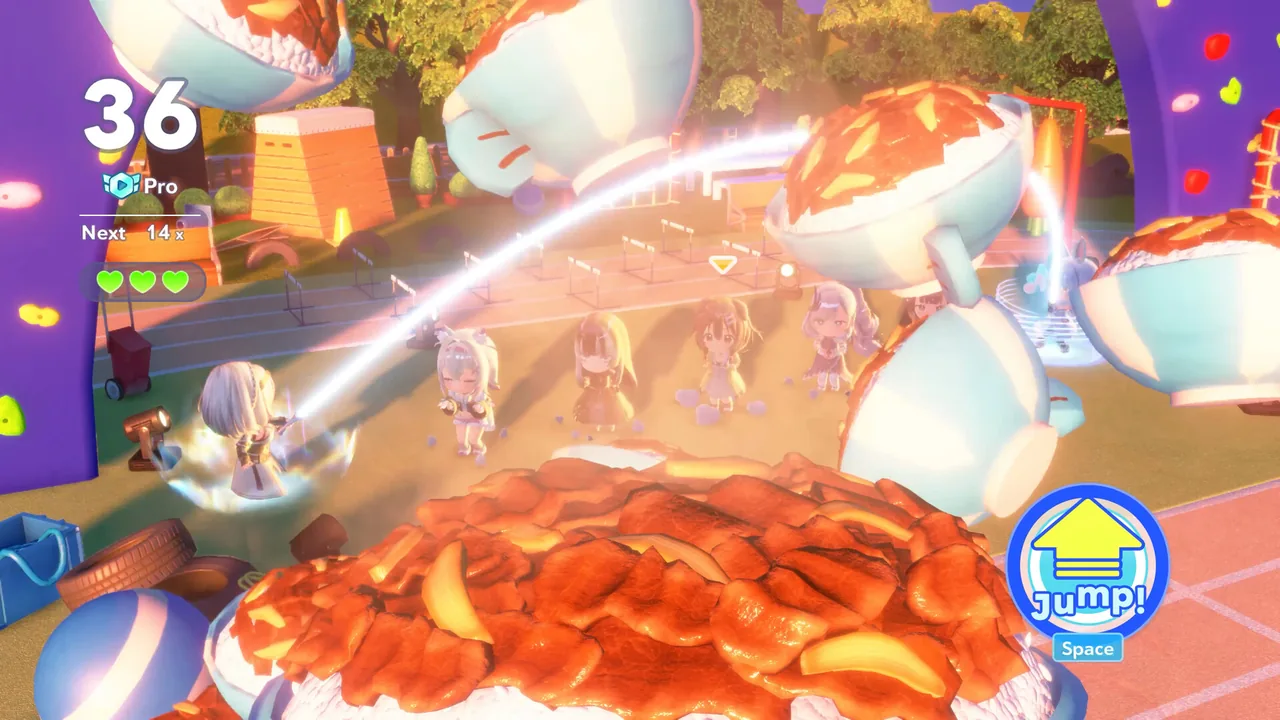
What separates hololive Dreams from a pure song-select rhythm game is how much weight the park-building half is actually given. Facilities you construct on Harmony Island aren't cosmetic set dressing — they gate mini-games, multiplayer modes and progression systems, which means expanding the park is a real decision tree rather than a side activity bolted onto the music. Hoppin' Rope (a jumping survival mode), Mega Circuit (a sixteen-player obstacle race) and Collect Cooking (an ingredient-matching mode) all sit behind specific facilities, giving the builder loop actual teeth instead of being pure decoration between songs.
The tradeoff is a story mode that stays firmly in the back seat. Narrative beats are only partially voiced, and the character interactions clearly exist to support the music and the park rather than the other way around — reasonable for a game built around its song library, but worth knowing if you're expecting anything close to a fully voiced visual novel wrapped around the rhythm sections.
A gacha economy that's actually worth crediting
This is the section most players should read before spending anything. hololive Dreams runs on two currencies — Blue Diamonds, bought with real money, and Red Diamonds, earned entirely through play — plus a ticket system for the game's permanent banner. The standard holodori Gacha runs at 85% for 3-star pulls, 10% for 4-star, and 5% for 5-star, and every pull (successful or not) earns a Gacha Point; hit 200 of those and a separate exchange menu lets you directly recruit any eligible character rather than gambling for it indefinitely. A 5% base rate on the top rarity is meaningfully better than the industry standard set by the genre's biggest names, and a hard point-based guarantee underneath it is the kind of transparency this genre usually treats as a concession rather than a baseline feature.
Two limited banners sit alongside the permanent one at launch: a 48-hour "Running Start" banner that guarantees a 5-star in a single ten-pull using paid currency only, and a seven-day "Beginner Support" banner that lets new players choose up to three 5-star characters outright using earned currency. New players get an unusually generous on-ramp as a result — one that doesn't require a promo code or day-one purchase to make real progress with a roster of strong characters.
Where the money actually goes matters just as much as the rates. Individual talent "memberships" exist as a separate purchase, but they're framed and sold as creator-support cosmetics — profile flair, exclusive interactions — rather than stat increases, which keeps the competitive rhythm charts untouched by spending. Story content, team building and score improvement are all achievable without paying; spending accelerates collection rather than unlocking content that's otherwise walled off. It's the difference between a game that lets you pay to skip and one that requires you to, and hololive Dreams sits clearly in the former category. The one asterisk on all of this: reviewers note that talent memberships aren't purchasable through the Steam version at all, which is a strange gap for a release meant to be the same game on a different platform.
Multiplayer and mini-games
Social features run through Harmony Island's Fortune Network facility, which unlocks co-op rhythm performances and lets Mega Circuit's sixteen-player races run as genuine online multiplayer rather than a solo mode with other players' ghosts pasted in. It's not the main draw — most of the marketing, correctly, sells the song library and the roster — but it gives the park-building half a reason to keep expanding past the point where you've unlocked everything the story needs, and it's a smarter use of a live-service theme-park setting than most games in this space bother building.
The Steam problem
Here's where the review has to split in two. On mobile, by every account available at launch, hololive Dreams is a well-built, generous, technically sound game. On Steam, it's shipping with real, specific problems that have nothing to do with taste. The PC build installs a kernel-level anti-cheat driver that runs at system startup even when the game itself isn't open, and that fact is disclosed only in an "Additional Notes" line buried under the store page's system requirements rather than flagged clearly — a disclosure standard Steam itself has required since 2024 specifically because this kind of software carries real trust implications. The practical consequence is blunt: the game refuses to boot at all on Linux or Steam Deck, on a title that's otherwise available with no such restriction on iOS and Android.
Layered on top of that is a control scheme that was never redesigned for the platform it landed on. The six-lane input system that works well on a touchscreen becomes an awkward keyboard layout on PC, and scores earned through the rhythm mode on Steam don't even count toward the game's own leaderboards or rankings — a strange decision for a version of the game that's meant to be equivalent. Between the two issues, Steam's own review aggregation sits at Mixed, with English-language reviews running roughly 61% positive across about 1,100 reviews at the time of writing, and the wider multi-language sample landing close to 65% positive. That's a meaningfully worse reception than the mobile build appears to be getting, and it's not a subjective quality gap — it's a direct result of a port that wasn't built for the hardware it's running on.
None of that reflects on the actual game underneath it, which is why this review scores the experience it was clearly designed to be rather than penalising the whole package for one platform's rough landing. But anyone reading "also on Steam" as an equivalent way to play should know that's currently not true.
Verdict
hololive Dreams earns its recommendation on the strength of what it gets right where it matters most: a rhythm engine that feels good to actually play, a theme-park builder with real stakes attached to it, and a gacha economy that's unusually willing to let you say no to spending money without falling behind. A fifty-four-character roster and a hundred-and-fifty-song opening library give it more raw content on day one than most of its competitors offer after a year of updates, and the memberships-as-cosmetics approach to monetisation is exactly the kind of restraint this genre needs more of.
The Steam version drags the overall picture down, and it should — kernel-level anti-cheat that isn't clearly disclosed, a total lock-out on Linux and Steam Deck, and a control scheme that was never adapted for a keyboard are the kind of problems that get games reported to storefronts, not just complained about in reviews. Play this one on the device it was built for. On mobile, it's a genuinely strong, fair opening chapter for hololive's first official game. On PC, it's the same game wearing shoes two sizes wrong, and it shows in every review that mentions it.
Players who like the idea of persistent progression systems that respect the time they didn't spend playing — rather than punishing it — might also find something familiar in Wanderer's own approach to offline advancement, even without a single note of music involved.
Pricing, platform and monetisation details checked 4 August 2026.
Pros and cons
Pros
- Rhythm charts feel responsive and well-tuned on touchscreen, with normal, flick, slide and long-note types across variable-width lanes
- The 200-Gacha-Point exchange system guarantees a chosen character within 200 pulls on top of the standard banners, and a 5% base 5-star rate is well above genre norms
- Dream Park gives the theme-park half genuine weight rather than treating it as a menu between songs — Harmony Island's facilities double as a functional hub and a slow-build management loop
- A 54-character roster and 150-plus launch songs, with 25 more added across the first fifteen days, is an unusually large day-one library for the genre
- Talent memberships sell cosmetics and creator support rather than power, keeping the competitive rhythm charts untouched by spending
Cons
- The Steam release runs a kernel-level anti-cheat driver disclosed only in a buried "Additional Notes" line, and it blocks Linux and Steam Deck entirely
- PC controls are a six-key layout built for a touchscreen and ported without redesign, and Steam scores from the rhythm mode don't even count toward in-game rankings
- The passive-skill system gives little feedback about what's actually triggering it, and photo mode can't pose more than one character at a time
- Story content is thin and only partially voiced, clearly positioned behind the music and the park-building as a secondary attraction
Screenshots
-
hololive DreamsImage: QualiArts, Inc. via Steam -
hololive DreamsImage: QualiArts, Inc. via Steam -
hololive DreamsImage: QualiArts, Inc. via Steam -
How the review scores each part of the gameWanderer Editorial -
The short versionWanderer Editorial