
Game review
Golemworks Review
7 / 10
- Developer
- evilalbert
- Publisher
- evilalbert
- Released
- 16 March 2026
- Platforms
- ["Windows", "Mac", "Linux"]
- Genre
- Strategy
A Compass-Rose Automation Roguelike, Not Quite Like Anything Else
Golemworks bolts a factory-automation puzzle onto a wave-defense roguelike, and the hinge between the two is a single elegant idea: every unit you build is defined by which of eight compass directions its modules point in. One reviewer, clearly having spent real time working it out, explained it better than the game's own tutorial does: "Imagine every robot is a compass rose. Modules at N, S, E, and W determine the actual robot you get... These robots are assembled using a node-based system where cores enter a factory, have operations done to them, and then they deploy out of your hanger." Another reviewer summed up the genre-blend appeal more bluntly: "It blends automation-style mechanics with tower defense principles, but instead of separating these into distinct phases, it merges them into a single continuous loop." It's a small, single-developer game with a genuinely uncommon premise, and that premise is doing most of the work.
Cardinal Directions Decide Everything You Build
Molds generate golem cores on a cooldown, catalysts and other components reshape those cores as they pass through your factory, and the finished automaton marches out to fight off waves of "shadows." The appeal, for the reviewers who stuck with it, is that the same eight-directional system that looks simple in the tutorial produces wildly different builds once combined. "Finally a game where bad cable management can get you killed" captures the automation-puzzle side of it in one line, while another reviewer's shorthand, "create golem factory, begin looping golem cores through the factory multiple times, increasing power, begin multiplying, profit," captures the exponential-scaling loop that a lot of players clearly latched onto. It's a legitimately original combination, closer in spirit to a circuit-bending puzzle game than to a conventional tower-defense title, even though the shadows-and-waves dressing on top reads like the latter.
The "Just One More Run" Problem, in a Good Way
A striking number of reviews read less like assessments and more like confessions of how much time got lost to the game, several logged 500 to over 1000 minutes, and one reviewer's Steam profile shows 11,691 minutes, just under 195 hours. "This game is crazy addictive if you love tower defense games, the RNG on buffs, the lil sprites on screen, constantly entertaining every round," they wrote. Another reviewer described the specific hook of the discovery loop: "It hooks you surprisingly quickly. You play one round, you die, you close the game... you open it again (sometimes immediately) and play another... and another." Word of mouth from streamers plays a role too, one reviewer who did not recommend it explained they'd first watched a Let's Play before buying, and found the video had already shown them most of what the game had to offer, a fair complaint about a game whose systems, once understood, don't have a huge amount left to discover.
No Way to Save Mid-Run Is the Loudest Complaint
The single most repeated concrete criticism, showing up across reviews both positive and negative, is that runs cannot be paused and resumed later. One reviewer, otherwise positive on the core idea, put the problem plainly: "This is a singleplayer game with 40-something waves... a run can take a while, and sometimes life happens. You need to step away... I had an amazing run but exited the game because I assumed I could continue later" and lost it. Others echoed the same specific ask, "fun but please make so u can save runs," and "it desperately needs auto-save between waves." Runs comfortably run past the hour mark in the game's normal 40-wave mode, so the lack of any resume option is a real friction point rather than a nitpick, and it's the fix reviewers most consistently asked the solo developer to prioritize.
Success Looks Like a Slideshow: The Late-Game Performance Wall
Reviewers were remarkably consistent about exactly where the game falls apart technically: once a build starts working well, the sheer number of golems and enemies on screen tanks the frame rate. "Made such an efficient factory that made the best robots in such numbers that it lagged the game. 10 out of 10 would lag the game again, its proof im winning," one reviewer joked, but the complaint recurs seriously elsewhere too: "at some point, you will drop to 0 fps... the game tries to render every single individual unit, which is incredibly taxing late game." A third reviewer pinned it to a specific stage: "Tad bit of optimization issues at the end stages where bigger enemies spawn smaller ones when they die, starts to lag the game quite a bit." It's telling that reviewers treat winning too well as the thing that breaks the game, a genuine late-game optimization gap rather than a one-off bug report.
Poorly Explained, But Worth Learning Anyway
Beyond performance, the most common thread is that Golemworks under-explains its own systems. One reviewer put it as a naming problem as much as a tutorial problem: "Names are confusing for directions, units, and enemies. Alien words, they don't help with remembering... why call it catalyst when you can call it modifier?" Several others wanted basic information the game withholds, "hovering over cores in production to see their glyphs and elements would be helpful," and "I wish I knew what the hell any of the elements do." A couple of reviewers also noted the roster feels thinner than the systems suggest, wanting more unlockable content and build variety once the initial tools are in hand rather than most of it being available from the start. None of this stopped reviewers from recommending the game, but it's a real, repeated gap between how interesting the underlying system is and how well the game teaches it.
Verdict
Golemworks earns its Very Positive rating on the strength of a genuinely uncommon idea, an eight-directional, node-based factory that assembles the units defending it, executed by a single developer for $6.99 and clearly capable of eating dozens of hours once it clicks. But the flaws reviewers raise are consistent enough to matter: no way to save and resume a run that can easily run past an hour, a late-game performance wall that turns a well-built factory into a slideshow, and a tutorial that leaves core terminology and mechanics unexplained. Anyone who enjoys puzzling out systems from first principles, and who's willing to treat the current rough edges as a fixable early-life problem rather than a dealbreaker, will likely find the "just one more run" pull as strong as the reviews suggest.
Screenshots
-
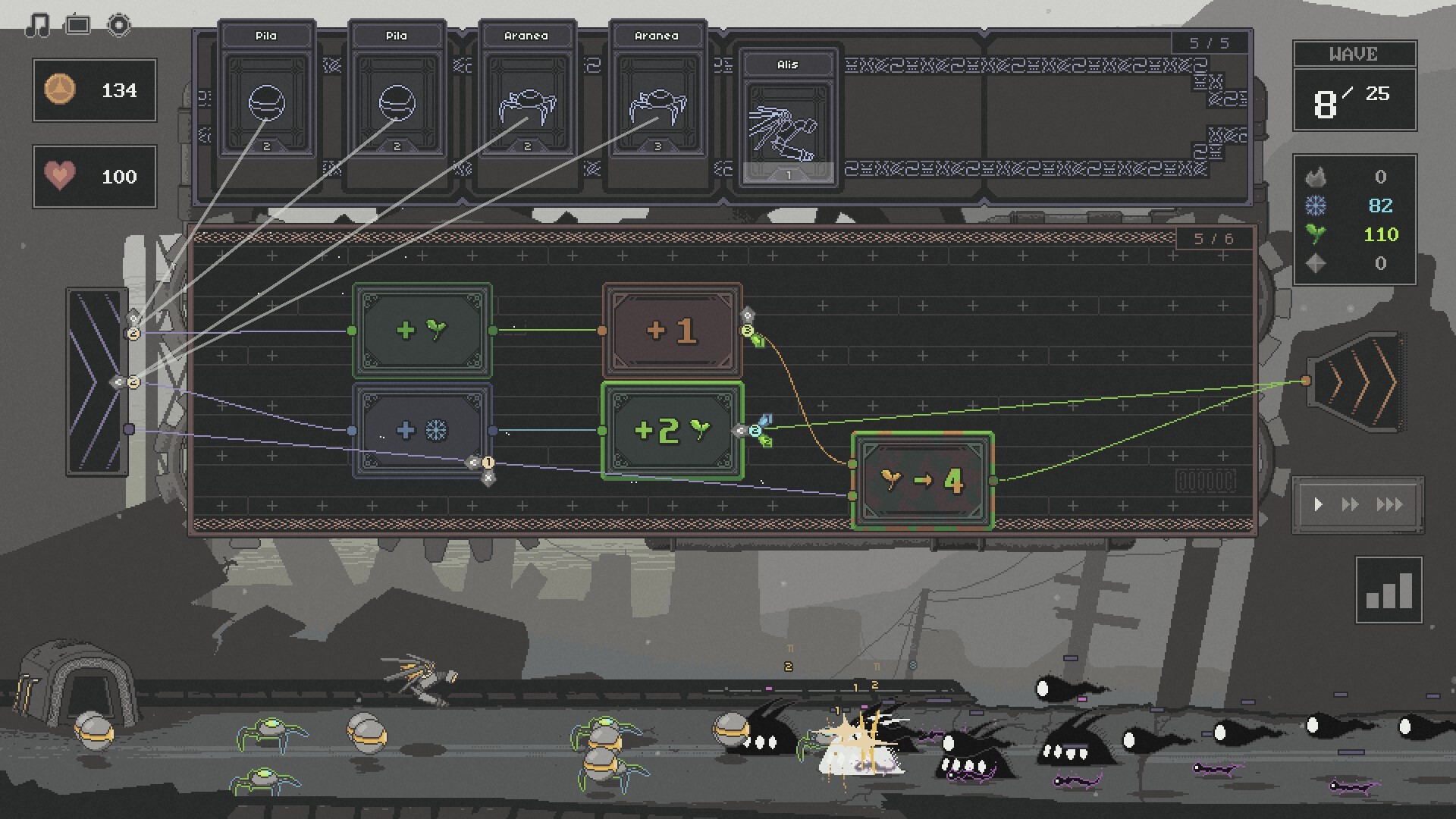
The factory view mid-run, golem cores routed through a chain of catalyst and modifier nodes on wave 8 of 25, with the next wave of shadows already massing below.Image: evilalbert via Steam -
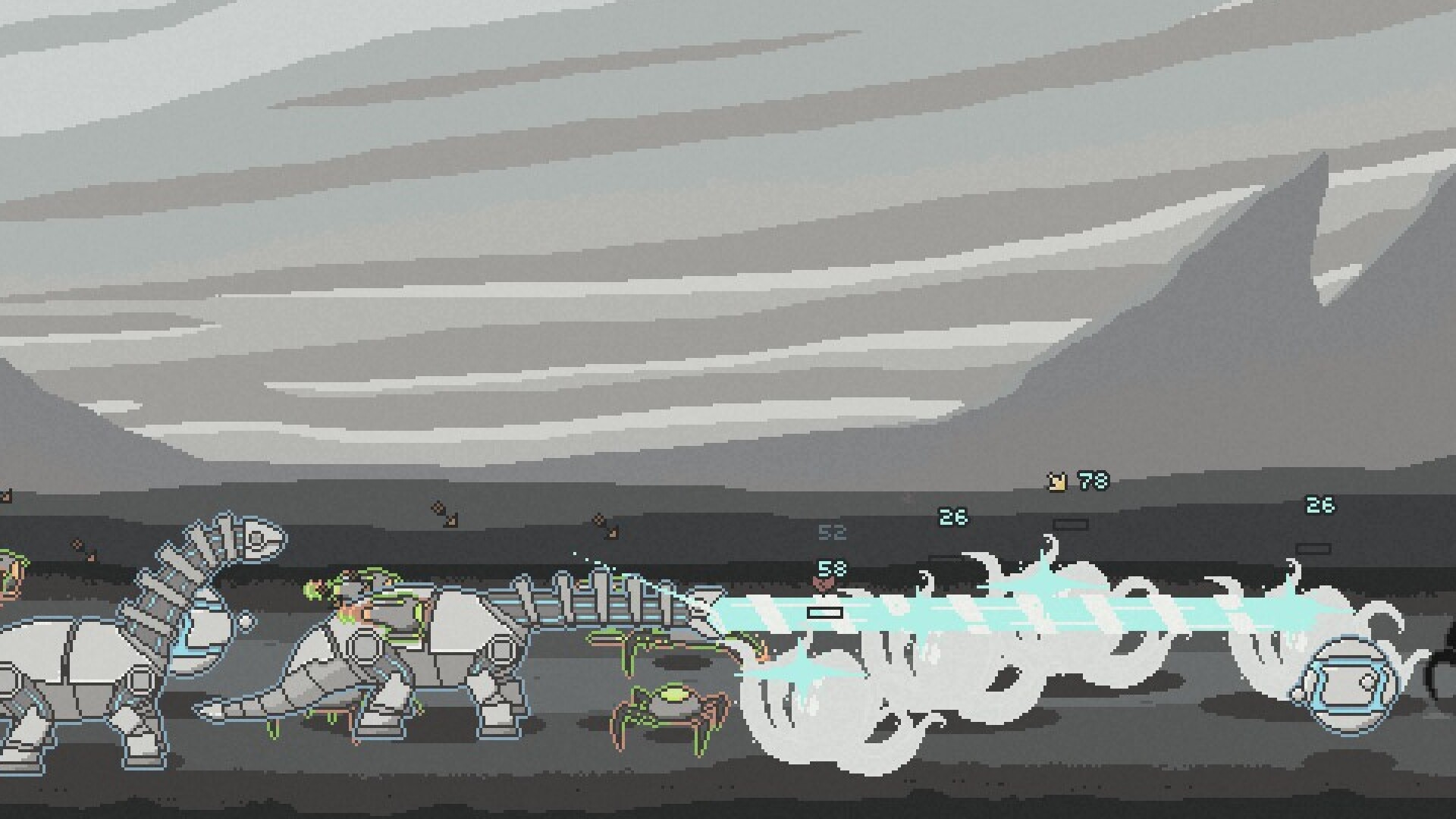
A line of assembled golems unloads a beam attack into an oncoming horde, one of the late-game moments reviewers describe as taxing on performance once enough units are on screen.Image: evilalbert via Steam -
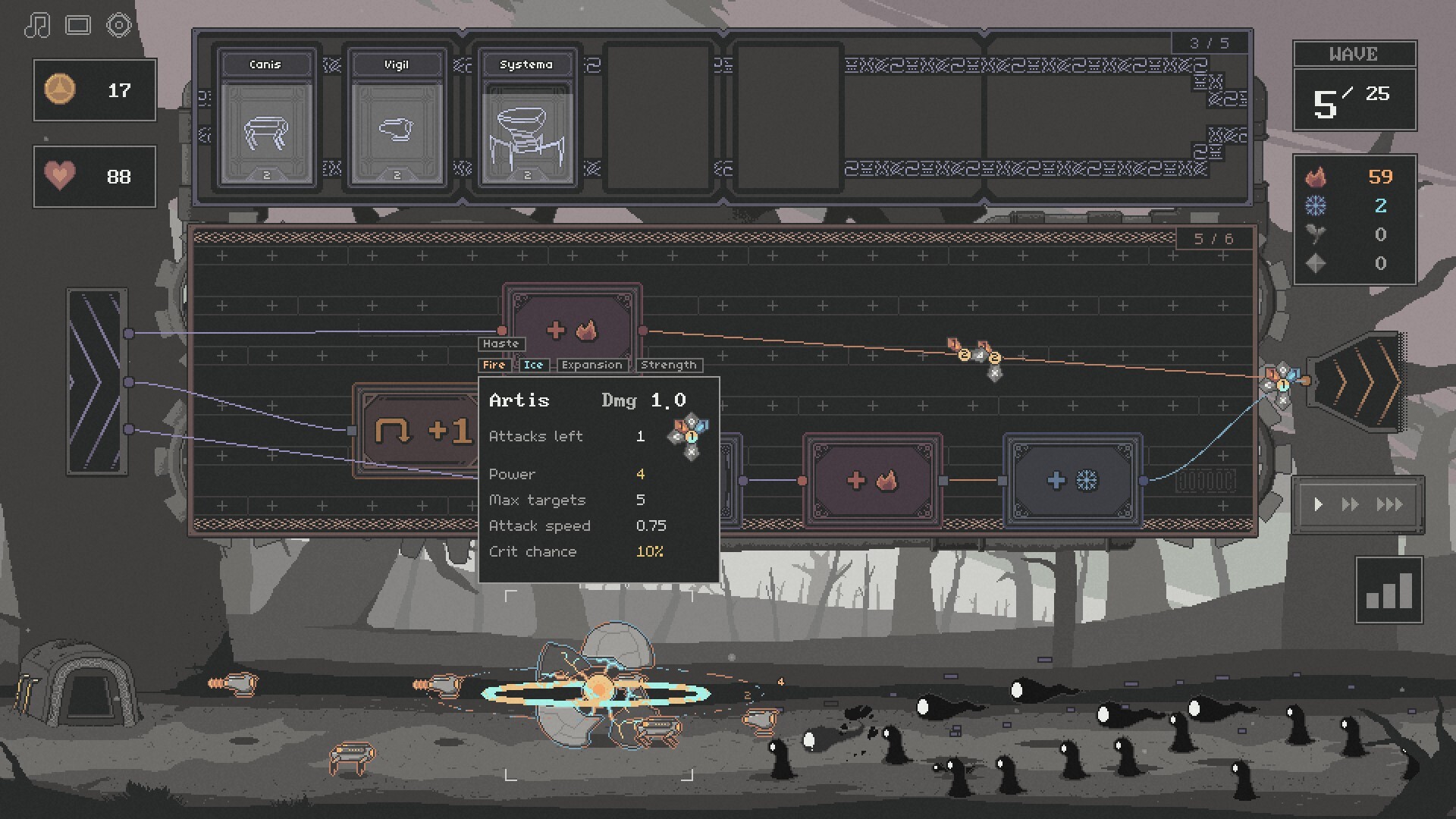
Hovering a unit reveals its underlying stats, part of the detail reviewers said the tutorial itself does a poor job of surfacing.Image: evilalbert via Steam