
Game review
BEACONFALL Review
6.5 / 10
- Developer
- Game Dynasty
- Publisher
- Game Dynasty
- Released
- 16 July 2026
- Platforms
- ["Windows"]
- Genre
- Strategy
A Cheap, Charming Mashup of Tower Defense and Settlement Management
BEACONFALL, from small studio Game Dynasty, launched July 16, 2026 at a budget $4.99 and pitches itself as a fast-paced tower defense game wrapped around a settlement-management layer: send villagers out to harvest resources, feed and house them, and pour whatever's left into towers, units, and traps strong enough to keep a central lighthouse lit against escalating waves. Reviewers consistently zeroed in on the low price as the game's biggest selling point relative to what it delivers. "For the price of basically free, it's a fun little tower defense game that doesn't overstay its welcome," one wrote, while another called it "quite fun and simple mix of tower defence and city builder... a small nice genre-mixing experiment with a charming artstyle." At review time it sat at 37 positive reviews against 3 negative across all languages, a 92 percent "Positive" score.
The Core Loop: Resource Runs, Famine Pressure, and Tower Building
The opening minutes of each run draw particular praise: workers head into a dark forest to gather resources while the player starts laying out defensive infrastructure, and the tension between growing an economy and keeping villagers fed becomes the game's central push-and-pull. One reviewer who put in over six hours described that tension vividly: "I was building - they were destroying. I made a gold farm - the base got destroyed. I built up defenses - a famine started. Built a food farm - didn't have enough resources for towers... the game sucked me in, it's fun to clash." Another reviewer compared the art direction favorably to Don't Starve, "clumsy cartoon vibes" layered over "variative offense gameplay (towers, units, traps etc)" and "variative progression." A Russian-language reviewer summed up the appeal simply as "simple, but fun tower defense with pleasant graphics," a sentiment echoed across nearly every review regardless of language: this is a small, unpretentious game that mostly does what it promises for very little money.
The Recurring Complaint: Performance Breaks Down at Scale, With No Fix Available
The most detailed and specific criticism in the pool comes from a reviewer who logged over 21 hours testing every map and mode, and it centers on a structural problem rather than a matter of taste. "Massive lag and time dilation when too many buildings or units are constructed eventually, in example the game runs at slide-show fps and in-game 30min turn into real life 2 hours, but that's when really pushing the limits," they wrote, adding the detail that makes the problem worse: "no way to destroy buildings though, which means lag is here to stay, and misclicks are also eternal, which frankly sucks." A second, much shorter review flagged the same category of issue from a different angle: "dev isn't motivated to fix anything. There's a bug regarding large resolutions. You can't click where you are pointing and the game is mostly click actions! You cannot manage things well due to this issue." Between the two, a picture emerges of a game whose core click-and-build loop starts to strain, sometimes badly, once a session runs long or a player pushes past the game's comfortable scale, with no in-game tool (like demolishing old buildings) offered to manage the fallout.
A Second Complaint: Once You've Seen the Systems, There Isn't Much Left
Set against the reviewers who came away charmed, one detailed negative review made a specific case that the content underneath the charming presentation runs thin fast. "After two games plus tutorial I feel like I have seen everything. After creating an op economy at minute 10, you mainly build the same unit building over and over again. Units are clunky and boring, towers as well... I do not see how any two rounds would feel much different from each other," they wrote, concluding that at $5 the game "cannot compete to all the free demos out there, that have so much more content and replay value." It's a minority view in the pool, most reviewers who logged only an hour or two came away charmed rather than bored, but it's a pointed one from someone who clearly played enough runs to test whether the loop holds up past a first impression, and it lines up with the game's own modest scope: a handful of maps and modes rather than a deep progression system.
Control Quirks Worth Knowing About Before Buying
Two separate reviewers ran into friction with how BEACONFALL handles input, though they're describing different problems rather than the same bug. Beyond the large-resolution click-precision issue noted above, one reviewer using a laptop reported a more basic access problem: "Unfortunately, I find that I'm unable to interact with the actual buildings because the game is configured for an external mouse. Not for a laptop touchpad. So I was unable to upgrade or repair my towers." Between the two accounts, players on non-standard resolutions or trackpad-only laptops should go in aware that BEACONFALL's mouse-and-click interface isn't as universally comfortable as its low price and casual pitch might suggest, even if most reviewers who used a normal desktop mouse setup didn't report any trouble at all.
Verdict
BEACONFALL is a small, likeable genre mashup that earns its 92 percent approval rating the honest way: a charming art style, a resource-versus-defense tension that several reviewers found genuinely gripping, and a $4.99 price tag that makes its modest scope easy to forgive. It's not a game built for dozens of hours, and reviewers who pushed it that far ran into real problems, mounting lag with no way to demolish old buildings, a shortage of long-term content variety once the initial systems have been seen once or twice, and input quirks that trip up laptop and non-standard-resolution players specifically. Taken for what it is, a cheap, cartoonish afternoon of tower-building and famine management from a small studio, BEACONFALL delivers comfortably. Taken as a game meant to hold up under serious, extended play, its own most dedicated reviewers suggest the seams start to show.
Screenshots
-
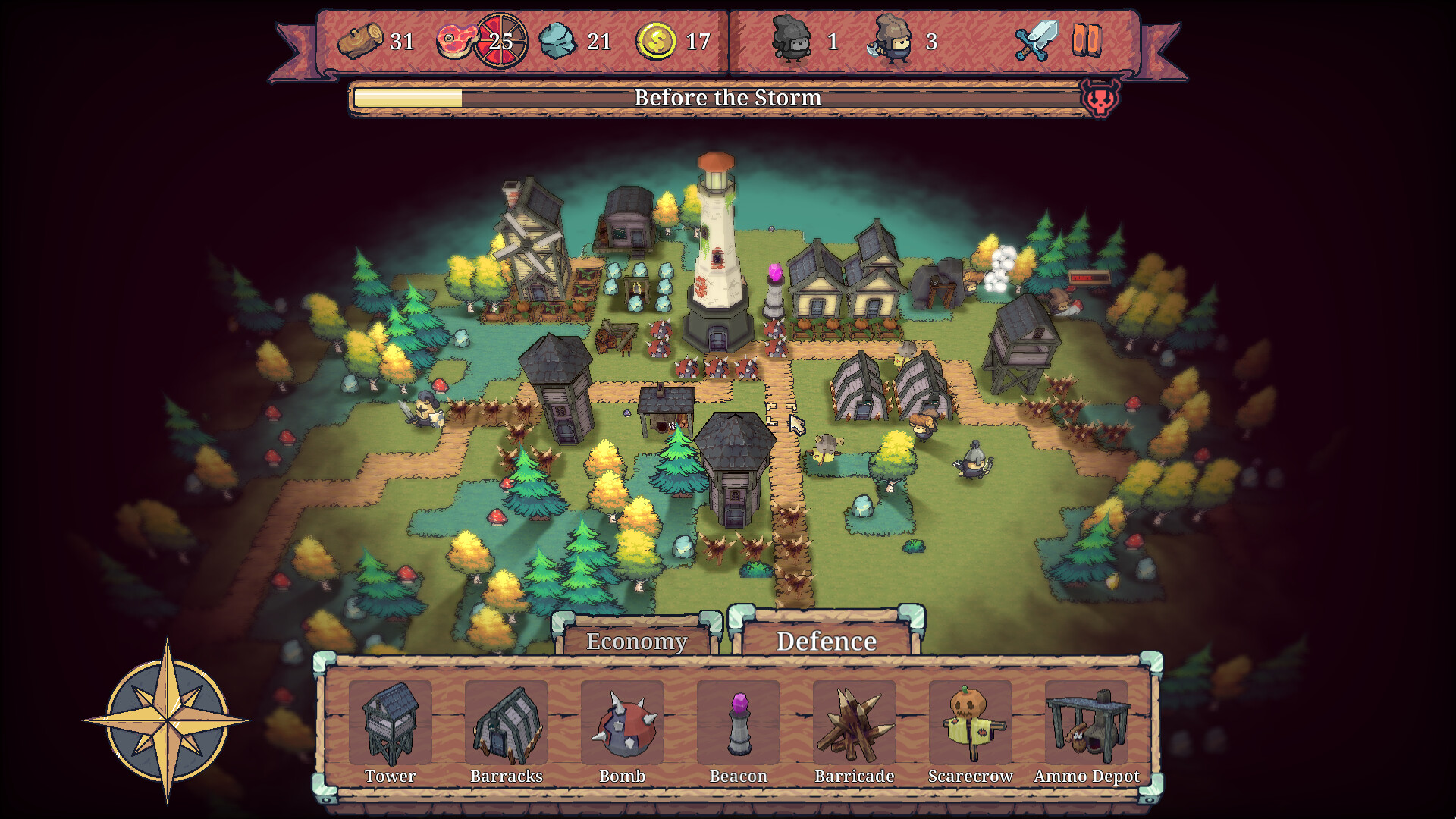
The settlement-management layer, where resources like wood, food, and stone fund new buildings and defenses.Image: Game Dynasty via Steam -
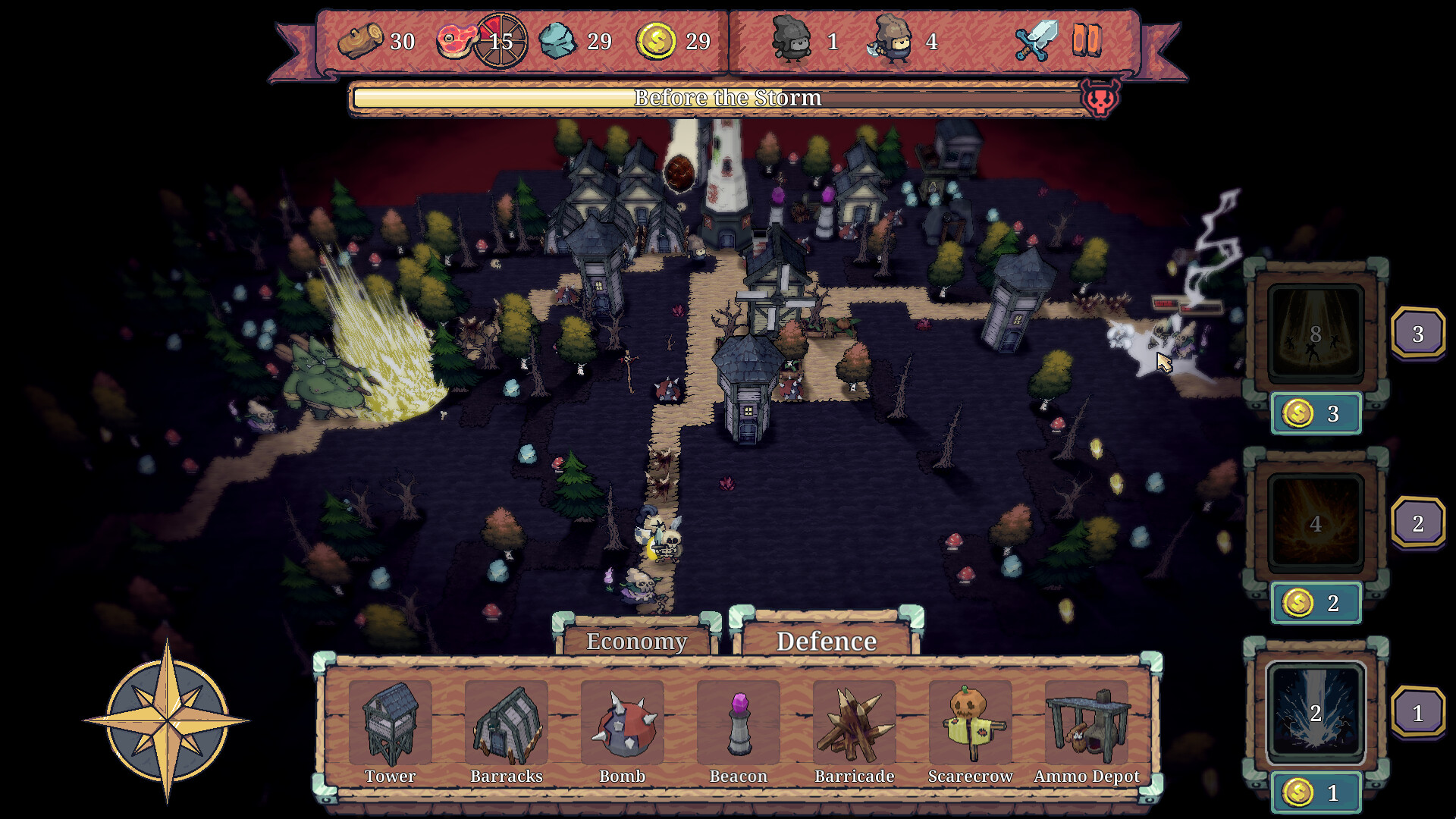
A wave underway after dark, with special abilities queued on the right as enemies close in on the lighthouse.Image: Game Dynasty via Steam -
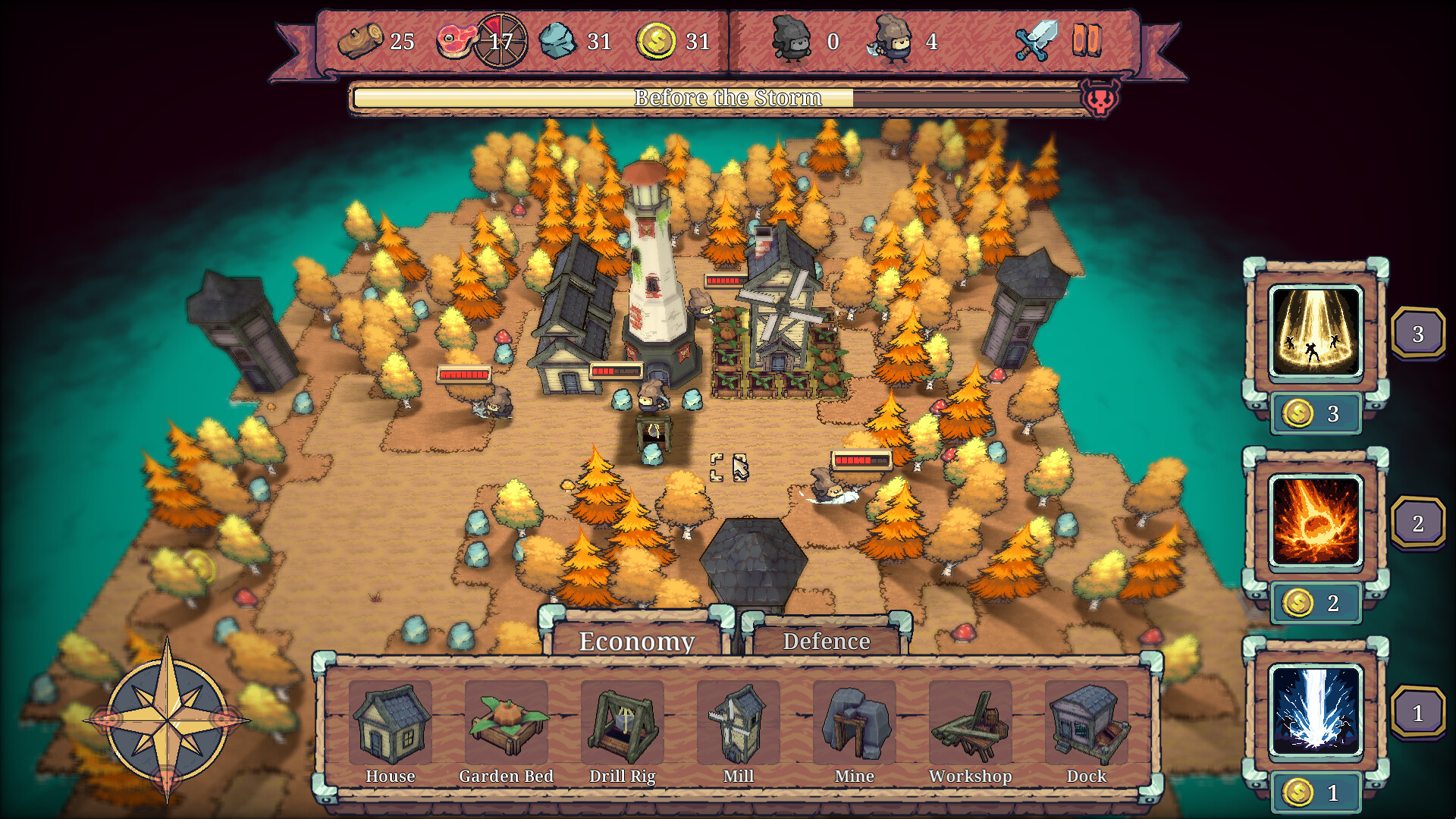
A different island layout, with the economy build menu open to expand housing and resource production.Image: Game Dynasty via Steam