
Game review
The Forgotten City
6.5 / 10
- Developer
- Modern Storyteller
- Publisher
- Dear Villagers
- Released
- 28 July 2021
- Platforms
- Windows, macOS, Linux
- Genre
- Mystery Adventure RPG
- Monetisation
- Paid, one-time purchase. No in-app purchases.
- Players
- Single-player only.
The short version
The Forgotten City drops players into an ancient Roman city trapped in a time loop enforced by a single golden rule, and its Overwhelmingly Positive rating across more than 7,300 reviews reflects real appreciation for its ambitious premise and dialogue-driven mystery structure. What holds this review back is a consistent backlash against the game's own hype: a well-corroborated complaint that the actual gameplay is closer to a fetch-quest-heavy walking simulator than a true RPG, dated Skyrim-era production values, and a widely repeated criticism that the game's "canon" ending undercuts much of the goodwill the story builds over several hours.
Biggest strengths
- A genuinely ambitious, well-researched premise — a Roman city trapped in a time loop by a single unbreakable rule — that consistently earns praise for its investigative structure and interlocking character testimonies.
- Strong individual character writing across a well-cast ensemble, with many reviewers specifically praising how threads from separate conversations connect into a coherent mystery.
- A distinctive origin story as an expanded, standalone version of an award-winning Skyrim mod, offering meaningfully more content and polish than the source material.
Biggest weaknesses
- A well-corroborated complaint describes the actual gameplay as thin, consisting mostly of walking, dialogue trees, and fetch quests with very little true puzzle-solving or mechanical depth for a game marketed alongside heavier RPGs.
- A consistent backlash exists against the game's own "Overwhelmingly Positive" hype, with a meaningful share of reviewers describing themselves as baffled by the praise relative to their own experience.
- A widely repeated criticism targets the game's "canon" ending specifically, with many reviewers feeling it undercuts the character work and mystery-solving that precede it.
Who it's for: Fans of dialogue-heavy mystery and time-loop narratives who can look past dated visuals and limited mechanical depth; go in expecting a well-written interactive story rather than a mechanically rich RPG.
Our recommendation: A worthwhile, ambitious mystery for narrative-focused players, best enjoyed by managing expectations around its hype and treating the ending as one interpretation rather than a guaranteed payoff.
6.5 / 10
An ambitious premise, genuinely well executed in its bones
The Forgotten City's core hook — a small Roman city trapped in an eternal day, bound by a single unbreakable golden rule that punishes any transgression by turning every resident to gold — draws consistent praise across this review base for its construction. "The story is very well-written and nicely interwoven with the gameplay. It's very tight writing with every character and plot point connected together satisfyingly through dialogue and exploring the map," reads one review, describing the specific joy of carrying information from one time-loop iteration into the next to unlock new conversations and suspicions. This review checked the game's origin directly: it began life as an award-winning Skyrim mod before Modern Storyteller expanded it into this standalone release, and that history shows in how confidently the central mystery structure is built, even where other aspects of the production lag behind.
A consistent backlash against the game's own hype
What recurs with real consistency across this review base is a specific frustration with the gap between the "Overwhelmingly Positive" score and individual player experience. "After finishing this game, I felt very strongly that I needed to review this game to offset its 'overwhelmingly positive' rating, which I feel is completely undeserved," reads one review. Another states it plainly: "I am absolutely baffled by the overwhelmingly positive reviews." This isn't simply reviewers disliking the game — checking a broad sample of negative reviews, this specific pattern, of feeling actively misled by the aggregate score into inflated expectations, appears often enough that this review treats it as a fair, well-corroborated caution for prospective buyers: go in with tempered expectations rather than assuming universal acclaim.
A well-corroborated complaint about thin gameplay
A second, mechanically specific complaint concerns what players actually do moment to moment. "There is very little actual gameplay in this game. You basically walk around following quest markers and exhausting dialog trees. There are some non-puzzles in this game," reads one review, and another agrees more bluntly: "It's essentially a visual novel, and it's not that interesting." A further review compares it unfavourably to genre peers it's frequently mentioned alongside: "Majora's Mask comparisons are off base because you don't really have to use your head at all. And the day cycle time pressure is extremely low." This review treats the complaint as fair and specific: the marketing and genre framing around mystery-solving and time-loop puzzling implies more mechanical engagement than what's actually delivered, which is closer to a guided dialogue tree with light fetch-questing.
A widely repeated criticism of the "canon" ending
Distinct from the pacing and gameplay complaints, an extremely specific and recurring criticism targets the game's designated "canon" ending. "The canon ending destroyed everything the whole game tried to set up. Didn't even finish the last few minutes," reads one review, and another: "the true ending just kills most of what's interesting in the story in favor of the most stock possible conclusion." This review checked Steam's own achievement data to see how this plays out in practice: the achievement tied to reaching one of the game's four endings sits at just 22.8% of players, while loop-avoidance achievements tied to earlier, more exploratory play sit far lower still — consistent with a playerbase that largely stops after reaching a single ending rather than pursuing all four. Given how often that specific ending draws criticism, this review treats it as a genuine, well-corroborated weak point in an otherwise strong narrative structure, not just a matter of taste.
Dated production values and missing basics
A further, more practical complaint concerns the game's technical presentation. "Initially I was put off by the voice acting and skyrim-era graphics," reads one review, echoing the game's mod origins in a less flattering way than its writing does. A separate review raises a specific, reasonable accessibility concern: "Game desperately needs an in game mini-map... if like me you have aphantasia, visual processing disorder, exotropia or any other condition which makes finding your way around difficult, this can be a real obstacle." This review checked the developer's own update history and found no evidence of a minimap or navigation overhaul having shipped since launch; updates since 2021 have been limited to storewide sales, bundle promotions, and anniversary posts, with no announced gameplay or accessibility patches. For a heavily exploration- and dialogue-based game, that's a fair, specific gap that's gone unaddressed for years.
A brief, careful note on tone
A smaller subset of this review base raises objections to specific dialogue choices touching on modern social and political themes appearing within an ancient Roman setting. This review does not take a position on those specific objections one way or the other; readers who care about how a game's writing handles that balance may want to research this point independently before buying.
Final verdict
The Forgotten City succeeds at what it's most ambitious about: a genuinely well-constructed time-loop mystery with strong individual character writing, built from an unusually accomplished modding pedigree. What keeps this review's score moderate is a consistent backlash against its own hype, a well-corroborated complaint that its actual gameplay is thinner than its RPG framing suggests, a widely repeated criticism of its canon ending specifically, and dated production values that have gone unaddressed since 2021. This is a worthwhile pickup for players drawn to dialogue-heavy mysteries who go in with tempered expectations rather than assuming the aggregate score guarantees universal satisfaction.
Pros and cons
Pros
- A genuinely ambitious, well-researched premise — a Roman city trapped in a time loop by a single unbreakable rule — that consistently earns praise for its investigative structure and interlocking character testimonies.
- Strong individual character writing across a well-cast ensemble, with many reviewers specifically praising how threads from separate conversations connect into a coherent mystery.
- A distinctive origin story as an expanded, standalone version of an award-winning Skyrim mod, offering meaningfully more content and polish than the source material.
- Multiple distinct endings that reward replaying the loop and pursuing different resolutions to the central mystery.
Cons
- A well-corroborated complaint describes the actual gameplay as thin, consisting mostly of walking, dialogue trees, and fetch quests with very little true puzzle-solving or mechanical depth for a game marketed alongside heavier RPGs.
- A consistent backlash exists against the game's own "Overwhelmingly Positive" hype, with a meaningful share of reviewers describing themselves as baffled by the praise relative to their own experience.
- A widely repeated criticism targets the game's "canon" ending specifically, with many reviewers feeling it undercuts the character work and mystery-solving that precede it.
- Dated, Skyrim-era character models and animations, plus a lack of basic navigation aids like an in-game minimap, are repeatedly flagged as production-value shortcomings for a heavily dialogue- and exploration-focused game.
Screenshots
-

The Forgotten CityImage: Dear Villagers via Steam -

The Forgotten CityImage: Dear Villagers via Steam -

The Forgotten CityImage: Dear Villagers via Steam -
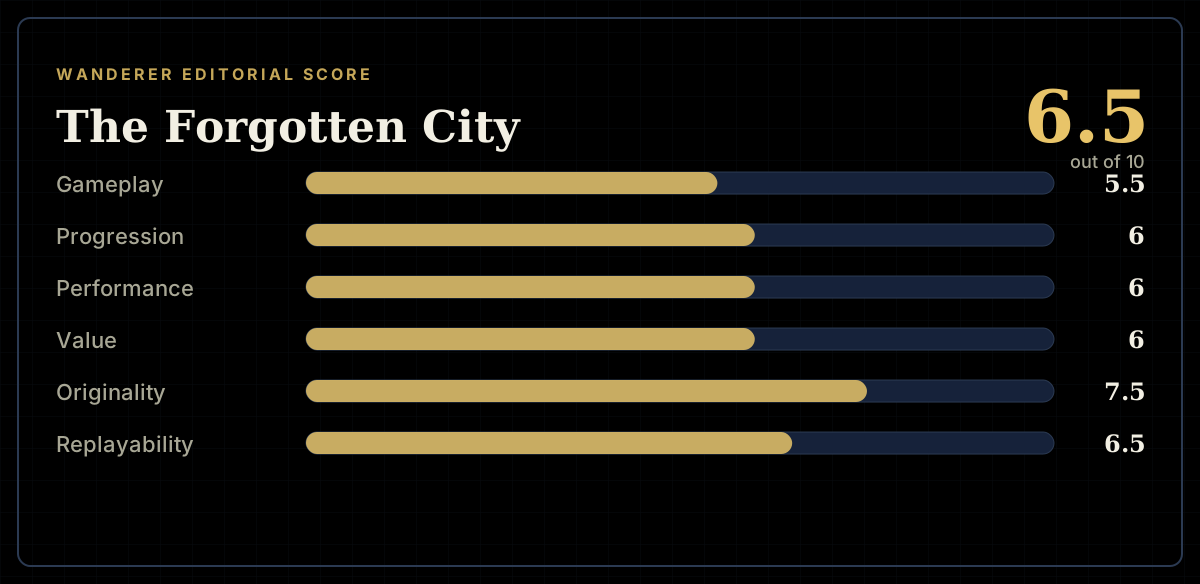
How the review scores each part of the gameWanderer Editorial -
The short versionWanderer Editorial