Game review
Forests, Fields and Fortresses
7.5 / 10
- Developer
- 9 Eyes Game Studio
- Publisher
- 9 Eyes Game Studio, Stately Snail
- Released
- 5 April 2023
- Platforms
- Windows
- Genre
- Puzzle Strategy
- Monetisation
- One-time premium purchase; no ads, DLC or in-game store found
- Players
- Single-player only; no online, co-op or PvP modes
The short version
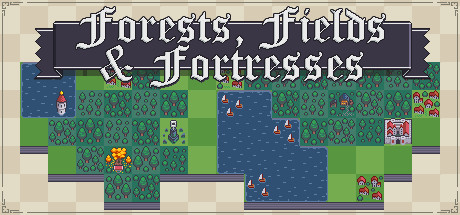
Forests, Fields and Fortresses builds a genuinely clever puzzle out of a simple premise: place medieval structures onto a shared board, where each of seven tile types scores gold by its own distinct rule — a sacred grove by forest size, fishing boats by adjacent water, and so on — and those rules frequently work against each other, forcing real multi-move planning rather than simple pattern-matching. Reviewers draw direct, favourable comparisons to Carcassonne, King Domino and Dorfromantik, and the pixel art and central mechanic earn consistent praise.
It's also a short game, cleanly split into a curated Puzzle mode of around 50-60 levels teaching the rules progressively, and a more randomized Adventure mode layered on top. Reviewers consistently frame the roughly two-to-five-hour runtime as fairly matched to its low price, while flagging specific rough edges: some early puzzle levels solvable by brute force rather than genuine insight, an Adventure mode some feel leans on luck more than skill, and a control scheme that requires both mouse and keyboard with nothing rebindable.
Biggest strengths
- A genuinely clever core mechanic, with each of seven tile types scoring gold by an entirely different rule, and those rules frequently conflicting in ways that force real multi-move planning rather than simple pattern matching
- Direct, favourable comparisons from reviewers to well-regarded board games like Carcassonne, King Domino and Cartographers, and the digital tile-placement game Dorfromantik
- Two distinct modes — a curated, progressively-taught Puzzle mode and a more open-ended Adventure mode — giving the same core rules two different structural contexts to play out in
Biggest weaknesses
- Some early Puzzle mode levels are reported as solvable through brute-force trial and error rather than genuine insight, with at least one reviewer describing several of the game's final levels as a disappointment by comparison to the stronger midgame puzzles
- Adventure mode is described by multiple reviewers as leaning more on random tile draws than skill, in contrast to the tightly curated and teachable Puzzle mode
- Controls require both mouse and keyboard, with the left mouse button unable to activate menu buttons and no option to rebind keys, an unusual and unexplained limitation for a game this otherwise simple
Who it's for: Fans of tile-placement and territory-scoring board games looking for a solo digital equivalent, and puzzle players who want a short, inexpensive, genuinely clever challenge. Less suited to anyone wanting a long campaign or a game built primarily around randomized replay value.
Our recommendation: A well-designed, fairly priced puzzle game worth picking up for board-game fans specifically — just expect a short runtime and a mixed control scheme rather than a deep, long- term time investment.
7.5 / 10
Tile-placement puzzles live or die on whether their individual rules create genuine tension when combined, and Forests, Fields and Fortresses gets that part right. Seven different structures — a sacred grove, fishing boats, a fortress, a tavern, and others — each score gold by a completely different rule: forest size for one, adjacency to water for another, and so on down the list. Reviewers consistently describe the resulting puzzle as smarter than its simple, pixel-art medieval presentation suggests, and the comparisons they reach for — Carcassonne, King Domino, Cartographers, Dorfromantik — put it in genuinely good company for a seven-dollar digital release.
Rules that fight each other on purpose
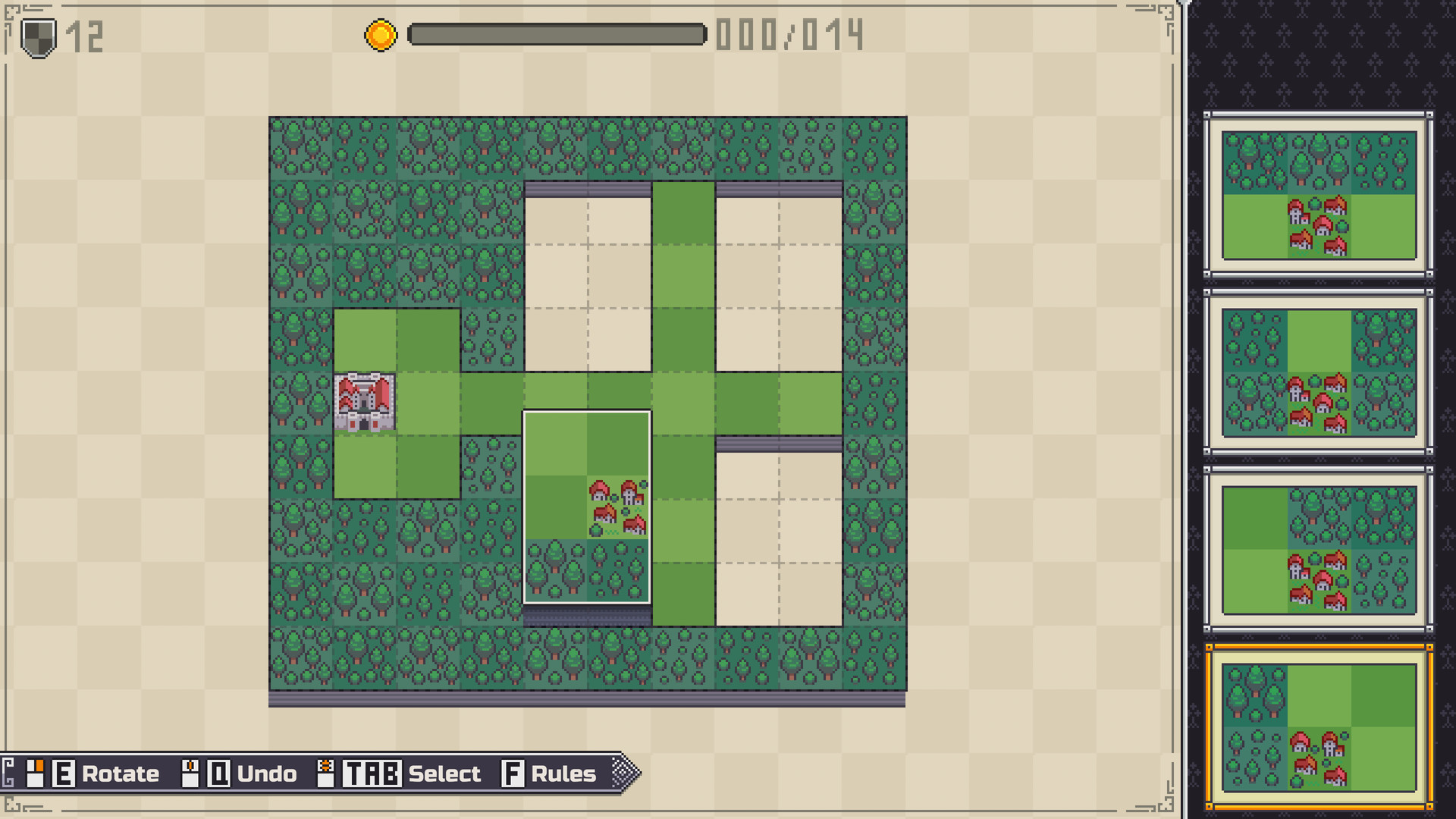
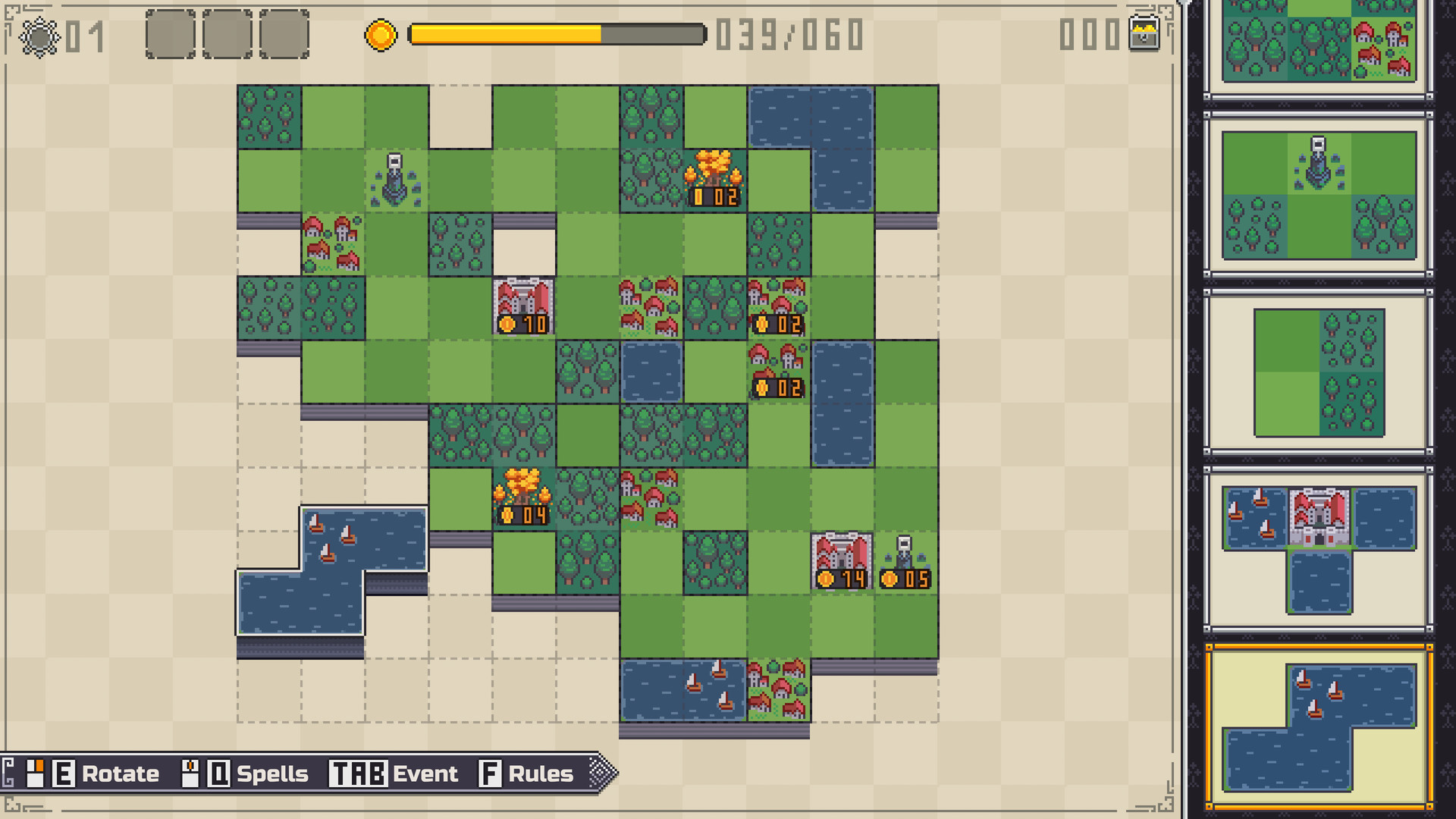
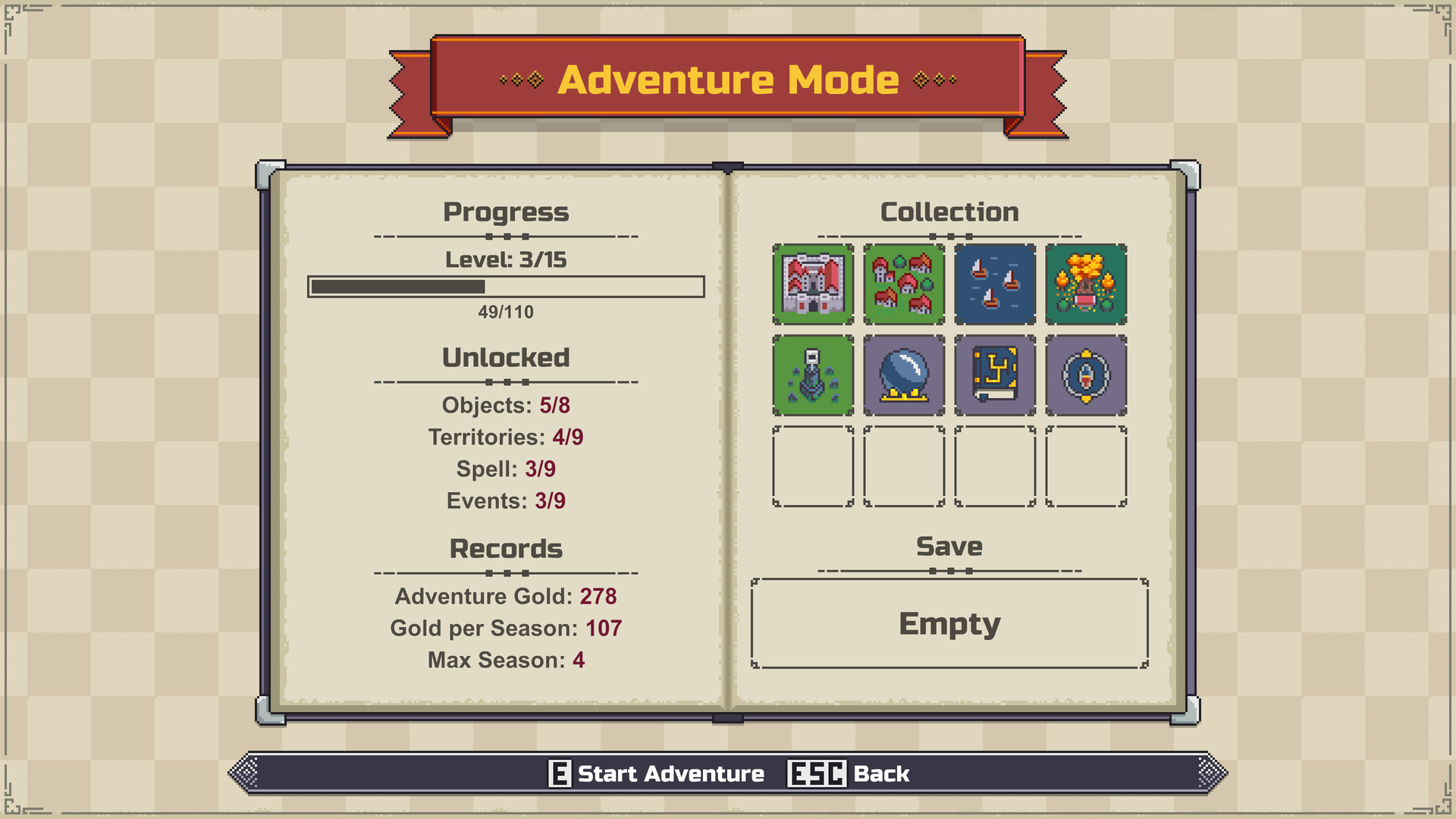
The core design decision that makes this work is that the seven scoring rules aren't independent — placing a tile to maximize one structure's score frequently costs you points from another, forcing exactly the kind of look-two-or-three-moves-ahead planning the best tile-placement games are built around. Puzzle mode introduces this gradually across roughly 50 to 60 curated levels, each teaching a new rule or interaction in isolation before combining it with everything learned so far, and reviewers describe genuine "aha" moments once several rules stack together and a solution that seemed impossible reveals itself. Adventure mode takes the same ruleset and drops the curated structure in favour of randomized tile draws across a longer, roguelite-adjacent "season" structure, giving the same core mechanic a second, looser context to play out in.
One reviewer's list of specific structure interactions gives a useful sense of the design's actual texture: the sacred grove scores by the size of the forest around it, fishing boats reward proximity to water, and other tiles interact with entirely different board conditions again. It's this variety of interpretation — seven pieces of the same board read in seven mutually competing ways — that reviewers repeatedly single out as the game's most distinctive quality, more than any single mechanic taken in isolation.
A short game that mostly earns its length
Reviewers are remarkably consistent about the runtime: most describe finishing the core content in two to five hours, with full completion (all puzzles, achievements included) taking somewhat longer for completionists. Rather than reading this as a flaw, the overwhelming majority explicitly calculate the price against that runtime and come away satisfied — one reviewer's blunt framing, "you're spending about a euro per hour of content if you 100% it," captures the general sentiment well. That said, not every hour is judged equally: a detailed critical review specifically describes several of the puzzle mode's final levels as a letdown relative to the cleverness of the midgame, and notes that a meaningful share of earlier levels can be brute-forced through trial and error rather than solved through genuine insight — a fair critique of a game whose main appeal is supposed to be exactly that insight.
Where the presentation shows its rough edges
Adventure mode draws a more structural complaint: several reviewers feel it leans more on the luck of random tile draws than on the deliberate planning that makes Puzzle mode satisfying, a real tension for a mode explicitly built to extend the game past its curated content. Separately, the control scheme draws specific, repeated criticism — menu buttons can't be activated with the left mouse button alone, requiring a keyboard press as well, and no rebinding option exists for players who'd prefer a different setup. It's a small thing in isolation, but reviewers note it's an unusual and seemingly unnecessary friction point for a game this otherwise streamlined. A single, unvaried background music track rounds out the list of minor but repeated complaints.
What completion data suggests about the difficulty curve
Achievement figures offer a useful, objective read on how the difficulty actually plays out. Early puzzle achievements sit comfortably high — 89.7% and 81.3% for the first tracked milestones — while "AllPuzzles," the achievement for completing every level in Puzzle mode, sits at 27.7%. That's a meaningfully steep drop, but not a cliff: roughly one in four buyers push through the entire curated campaign, a reasonable completion rate for a puzzle game of this length and difficulty, and one that's broadly consistent with reviewer accounts of a game that starts approachable and genuinely tests players by its later levels, even if a specific critical review felt those final levels underdelivered relative to the midgame's cleverness.
A finished package, not an ongoing project
Worth noting plainly: Forests, Fields and Fortresses has no logged post-launch patch history at all, which stands in sharp contrast to several other small releases covered in this lane. That's not necessarily a mark against it — reviewers don't describe game-breaking bugs or missing features that would demand a patch, and a tightly scoped puzzle game arriving essentially complete at launch is a reasonable shape for this kind of release. But it does mean the specific, fixable-sounding complaints raised above — the split mouse-and-keyboard control requirement chief among them — are unlikely to see any further attention, and should be weighed as permanent characteristics of the game rather than early rough edges awaiting a patch.
Where it lands
Forests, Fields and Fortresses succeeds at the thing that actually matters most for a puzzle game: its central mechanic is genuinely clever, and the tension between seven conflicting scoring rules gives it real depth despite a short overall runtime. The brute-forceable early levels, a weaker final stretch, an Adventure mode that leans more on luck than the curated content, and an unnecessarily split keyboard-and-mouse control scheme are all fair, specific complaints — but none of them undo what reviewers consistently describe as a smart, well-priced puzzle experience that stands up well against its board-game inspirations.
Pros and cons
Pros
- A genuinely clever core mechanic, with each of seven tile types scoring gold by an entirely different rule, and those rules frequently conflicting in ways that force real multi-move planning rather than simple pattern matching
- Direct, favourable comparisons from reviewers to well-regarded board games like Carcassonne, King Domino and Cartographers, and the digital tile-placement game Dorfromantik
- Two distinct modes — a curated, progressively-taught Puzzle mode and a more open-ended Adventure mode — giving the same core rules two different structural contexts to play out in
- Runs cleanly on Steam Deck according to reviewers, well suited to short handheld sessions given its puzzle-game pacing
- A price reviewers consistently describe as fairly matched to the roughly two-to-five-hour runtime, with several explicitly calculating cost-per-hour as reasonable
Cons
- Some early Puzzle mode levels are reported as solvable through brute-force trial and error rather than genuine insight, with at least one reviewer describing several of the game's final levels as a disappointment by comparison to the stronger midgame puzzles
- Adventure mode is described by multiple reviewers as leaning more on random tile draws than skill, in contrast to the tightly curated and teachable Puzzle mode
- Controls require both mouse and keyboard, with the left mouse button unable to activate menu buttons and no option to rebind keys, an unusual and unexplained limitation for a game this otherwise simple
- The single background music track plays throughout with no apparent variation, drawing specific complaints from reviewers who otherwise enjoyed the game's atmosphere
- The game received no logged post-launch patches, meaning any of the above complaints are unlikely to see further refinement going forward
Screenshots
-
Forests, Fields and FortressesImage: 9 Eyes Game Studio via Steam -
Forests, Fields and FortressesImage: 9 Eyes Game Studio via Steam -
Forests, Fields and FortressesImage: 9 Eyes Game Studio via Steam -
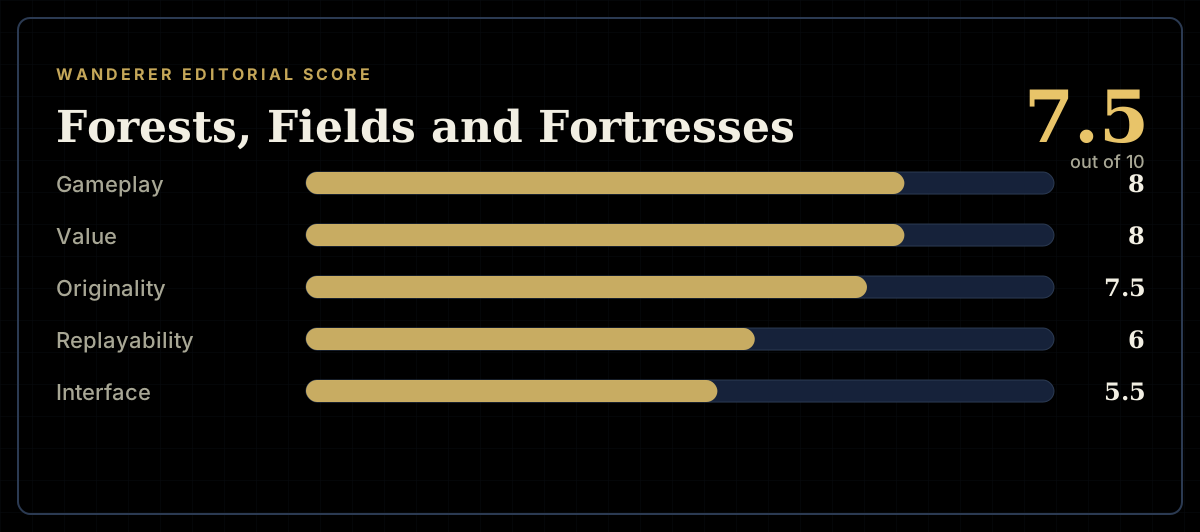
How the review scores each part of the gameWanderer Editorial -
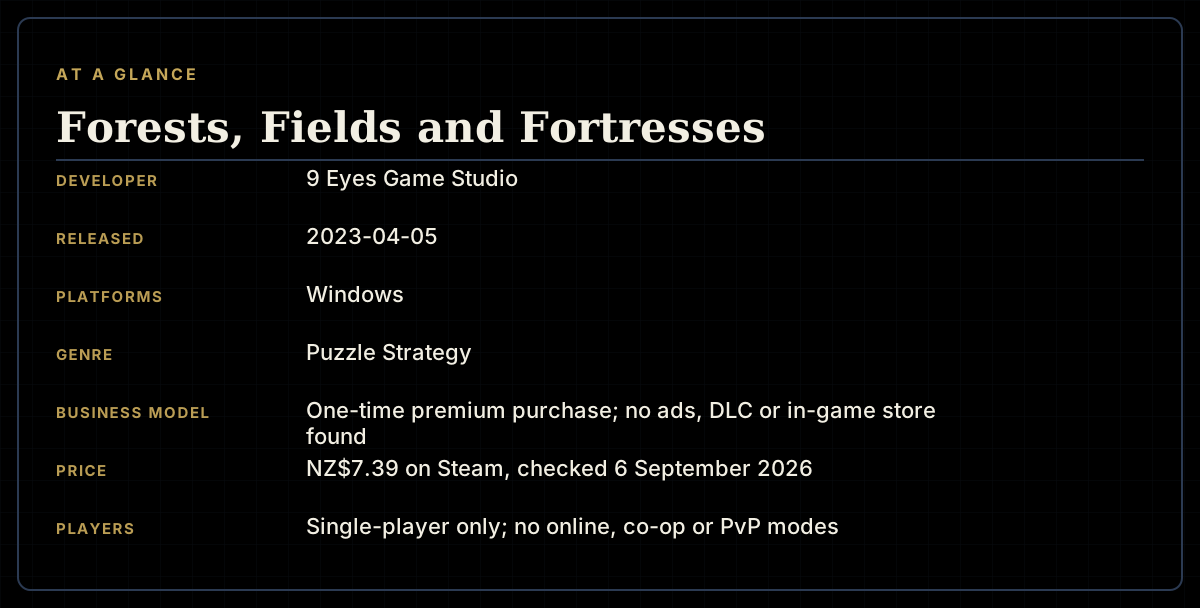
The specsWanderer Editorial -
The short versionWanderer Editorial