Game review
The Chess Variants Club
7.2 / 10
- Developer
- Minimol Games
- Publisher
- Minimol Games
- Released
- 15 December 2020
- Platforms
- Windows, Mac
- Genre
- Chess / Strategy Puzzle
- Monetisation
- One-time purchase, no DLC or in-app purchases
- Players
- Local and Remote Play Together; no online netcode multiplayer
The short version
The Chess Variants Club does exactly what its plain title promises: it hands you regular chess plus eleven-and-a-bit variants — Chess960, Atomic Chess, Circe Chess, Los Alamos Chess and more — dressed in a calm, minimalist club-room aesthetic, backed by an original soundtrack and a bank of more than 400 puzzles. Its 23 English-language Steam reviews are 22 positive and one negative, and I read every negative review this game has; the pattern in the positives is consistent, unprompted praise for the look and feel of the thing rather than for any single killer feature.
What keeps it from being an easy top recommendation is what it doesn't have. Steam's own category tags list PvP and Shared/Split Screen PvP alongside Remote Play Together, but there is no online-multiplayer category at all — you can sit a friend down locally or share your input devices over Steam's remote-play pipe, but you cannot matchmake a stranger over the internet the way you can on chess.com or lichess. And Steam's global achievement stats, the only hard telemetry a game this quiet publishes, show a steep drop-off: the single most-earned achievement sits at 24.2%, and most of the 47 sit under 5%, which reads as a lot of buyers sampling the variants without going deep into any of them. The one negative review on file adds a second, more pointed complaint: the developer reportedly said updates would stop so the studio could work on other titles, leaving some promised features unfinished.
Biggest strengths
- Twelve chess variants in one package — Chess960, Atomic, Circe, Los Alamos, Silverman, Microchess, Demi-Chess, Dunsany's, 3-Checks, Knight Supreme, The Pawns Game and Aleut Chess — several of which reviewers say they'd never heard of before buying
- More than 400 puzzles spread across the variants, not just standard chess
- Consistently praised minimalist presentation and an original soundtrack one reviewer singles out as "lovely"
Biggest weaknesses
- No true online multiplayer — Steam lists PvP and split-screen categories plus Remote Play Together, but nothing for internet matchmaking against a stranger
- Steam's global achievement stats show a steep completion curve (24.2% on the top achievement, most of the other 46 under 5%), suggesting most buyers don't get far into the variant roster
- Multiple reviewers find the piece set hard to read at a glance, specifically the bishop and pawn looking too similar
Who it's for: Chess players who already know the game and want a tidy, good-looking way to sample variants and puzzles they'd otherwise have to hunt down individually, played solo, on the couch, or over Remote Play Together — not players hoping to matchmake online.
Our recommendation: Worth the NZ$7.39 asking price for the breadth of variants and puzzles alone, but go in knowing "multiplayer" means local or Remote Play Together, not internet matchmaking, and that the studio's own update cadence has reportedly slowed.
7.2 / 10
Introduction
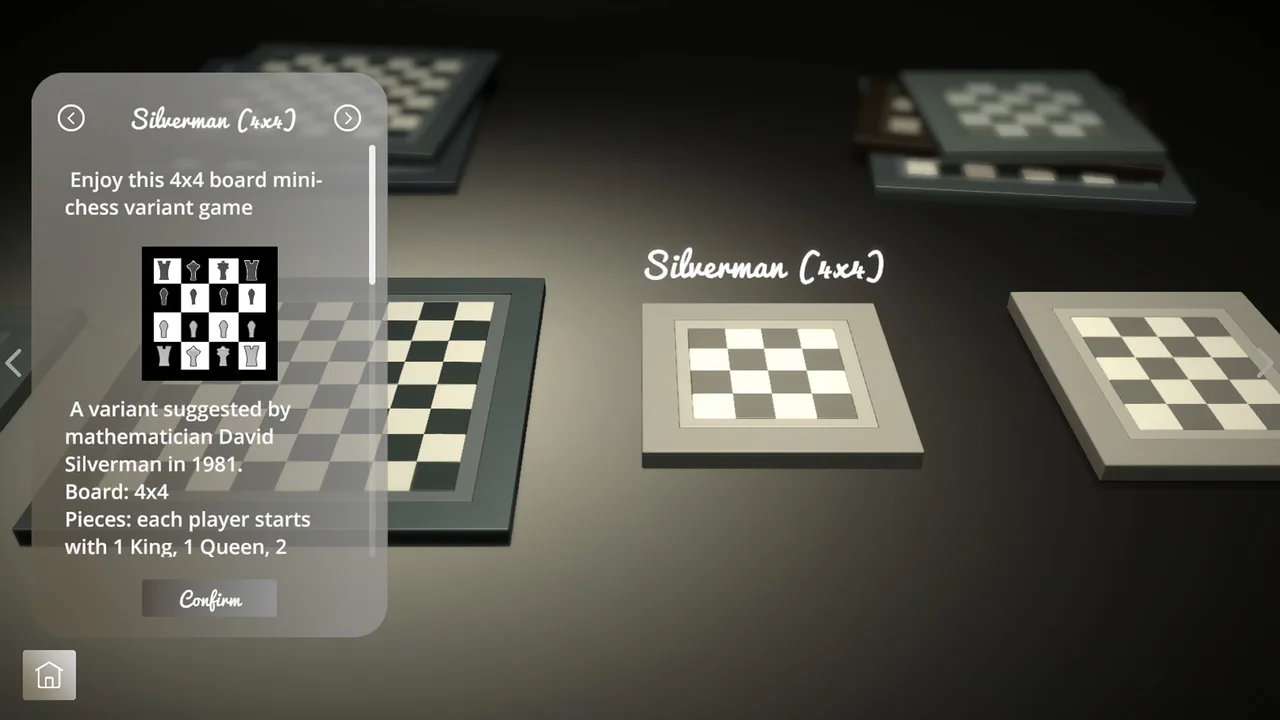
The Chess Variants Club is a small, self-published Steam collection from Minimol Games that does one thing and does it without much fuss: it bundles regular chess with eleven variants and a large puzzle set into a single, calmly designed "club" interface, sorted by piece set or by board size depending on how you like to browse. It released in December 2020 at a budget price, and it has stayed there since — no sequel, no season pass, just the one package.
Gameplay
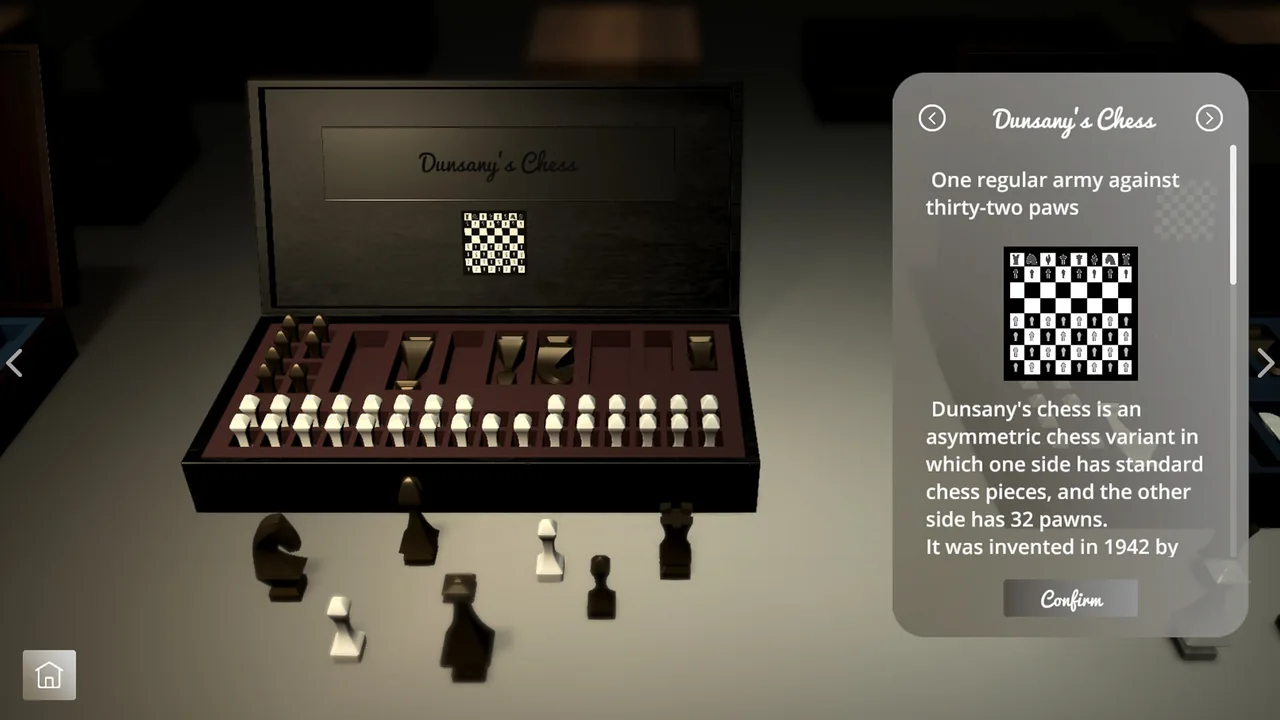
The variant list is the whole pitch: Demi-Chess, Dunsany's Chess, Chess960 (Fischer Random), Los Alamos Chess, Atomic Chess, Silverman Chess, Microchess, Diana Chess, Circe Chess, 3-Checks Chess, Knight Supreme Chess, The Pawns Game and Aleut Chess sit alongside standard chess, each with its own board size, win condition or piece behaviour. Reviewers repeatedly say they'd never heard of half these variants before buying the game, which is a fair description of the appeal — it functions as a browsable catalogue of chess history as much as a game in its own right. On top of the variants sits a bank of more than 400 puzzles spanning classical, Atomic, 3-Checks, Micro and Demi chess among others, plus an AI opponent with adjustable difficulty that more than one reviewer describes as unexpectedly tough even on its easier settings.
The achievement list backs up the breadth: 47 achievements spread thin across the variant roster, one per major mode for both puzzle-solving and match-winning. What the same list also shows, courtesy of Steam's public completion stats, is that hardly anyone finishes the tour. The single most commonly unlocked achievement — a one-move puzzle novice badge — sits at 24.2% of owners, and completion falls off a cliff from there: most of the remaining 46 achievements, tied to individual variants like Los Alamos, Circe or 3-Checks, sit under 5%, several under 2%. Read generously, that's a game people dip into rather than binge. Read less generously, it's a lot of variants that go untouched once the novelty of the piece-set browser wears off.
Visuals and sound
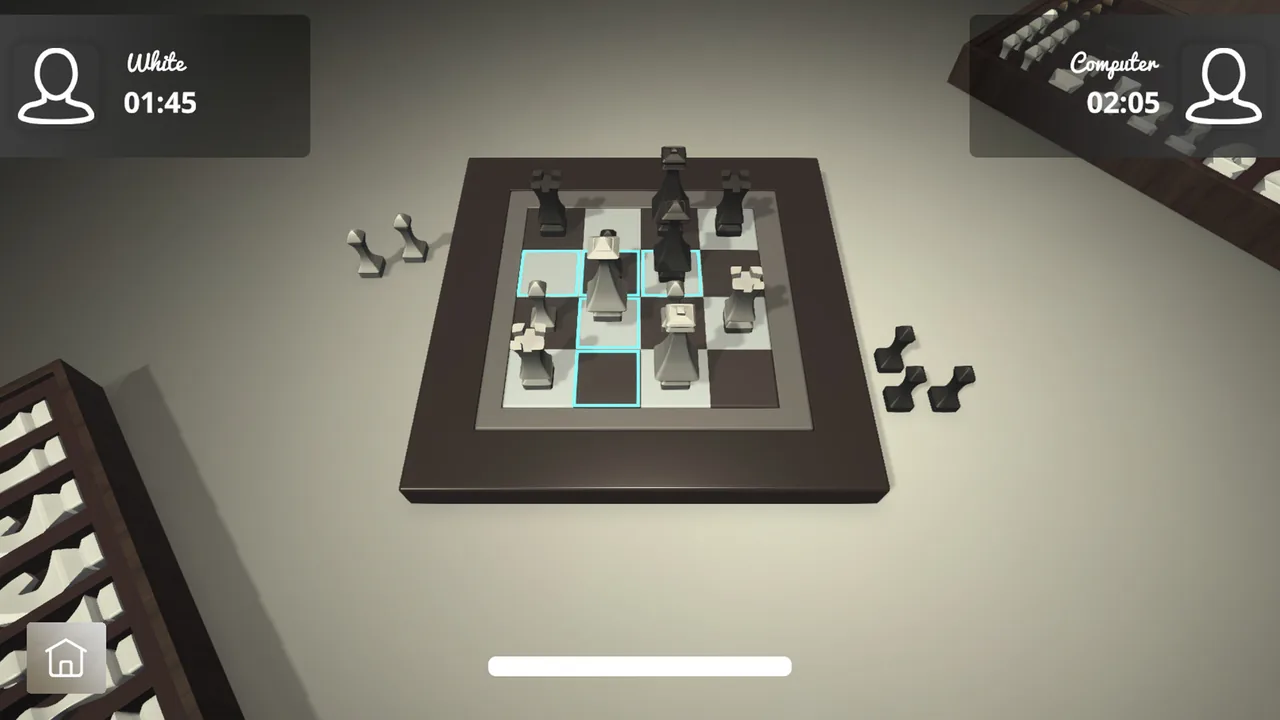
"Minimalist, beautifully designed virtual chess club" is the developer's own description, and it's the one claim every reviewer, positive or not, agrees with. Multiple reviews call the presentation elegant, sophisticated or beautiful without prompting, and one specifically credits it with striking a balance — polished enough to look good, restrained enough not to get in the way of an actual chess game. The soundtrack, described by the developer as originally composed to help players relax and concentrate, gets a direct callout as "lovely" jazz from at least one reviewer. The recurring complaint sits at the piece level rather than the board: a couple of reviewers find the bishop and pawn silhouettes too close to tell apart at a glance, and ask for alternate piece sets — a feature the developer had apparently flagged as planned but which, per the game's one negative review, may not be coming.
Multiplayer
This is the review's biggest caveat. Steam's category tags for the game list Single-player, Multi-player, PvP, Shared/Split Screen PvP, Shared/Split Screen and Remote Play Together — but nothing that indicates online netcode matchmaking against a stranger. In practice, "multiplayer" here means sitting a second player down at the same keyboard, or using Steam's Remote Play Together to share input devices with someone who doesn't even need to own the game or have a Steam account. That's a genuinely nice touch for playing with a friend who doesn't want to buy in, and it's clearly documented up front rather than hidden — but anyone expecting to queue into a match against a stranger the way they would on a dedicated chess platform will be disappointed that the option simply isn't there.
Value
At NZ$7.39 with no DLC, no microtransactions and no subscription hook, this is priced like the minor-key indie title it is, and the reviews largely agree it earns that price. "Reasonable for the price" and "a bargain" both appear verbatim in the review sample, and the sheer count of variants and puzzles per dollar is hard to argue with on paper. The catch is the same one that shows up everywhere else in this review: the one negative review on file — out of only 23 total, 22 of them positive — reports that Minimol Games announced it would stop delivering further updates to focus on other projects, which if accurate means the piece-set customisation and other promised additions several positive reviewers were still hoping for are unlikely to arrive. That doesn't undo the value already on the disc, but it caps how much better this could still get.
Verdict
The Chess Variants Club is a well-liked, keenly priced curiosity for players who already know how to play chess and want an attractive way to sample the game's stranger corners — Atomic Chess, Circe Chess, a chessboard the size of a checkerboard — without hunting down twelve separate implementations. It is not the place to go for online chess against strangers, and its own achievement stats suggest most buyers settle into one or two favourite variants rather than touring the whole roster. For the asking price, that's still a fair trade.
Pros and cons
Pros
- Twelve chess variants in one package — Chess960, Atomic, Circe, Los Alamos, Silverman, Microchess, Demi-Chess, Dunsany's, 3-Checks, Knight Supreme, The Pawns Game and Aleut Chess — several of which reviewers say they'd never heard of before buying
- More than 400 puzzles spread across the variants, not just standard chess
- Consistently praised minimalist presentation and an original soundtrack one reviewer singles out as "lovely"
- Remote Play Together lets a friend join a match without owning the game or a Steam account
- Cheap at NZ$7.39 for the amount of content, and several reviewers call it good value outright
- A reported bug in a puzzle was fixed quickly after being flagged, per one reviewer
Cons
- No true online multiplayer — Steam lists PvP and split-screen categories plus Remote Play Together, but nothing for internet matchmaking against a stranger
- Steam's global achievement stats show a steep completion curve (24.2% on the top achievement, most of the other 46 under 5%), suggesting most buyers don't get far into the variant roster
- Multiple reviewers find the piece set hard to read at a glance, specifically the bishop and pawn looking too similar
- The game's one negative Steam review reports the developer announcing an end to further updates to work on other projects, leaving some promised features (like customisable piece sets, requested by several positive reviewers too) unfinished
- No built-in coaching or move explanation for why a game was lost, a gap one reviewer specifically asks the game to fill for lower-level players
Screenshots
-
The Chess Variants ClubImage: Minimol Games via Steam -
The Chess Variants ClubImage: Minimol Games via Steam -
The Chess Variants ClubImage: Minimol Games via Steam -
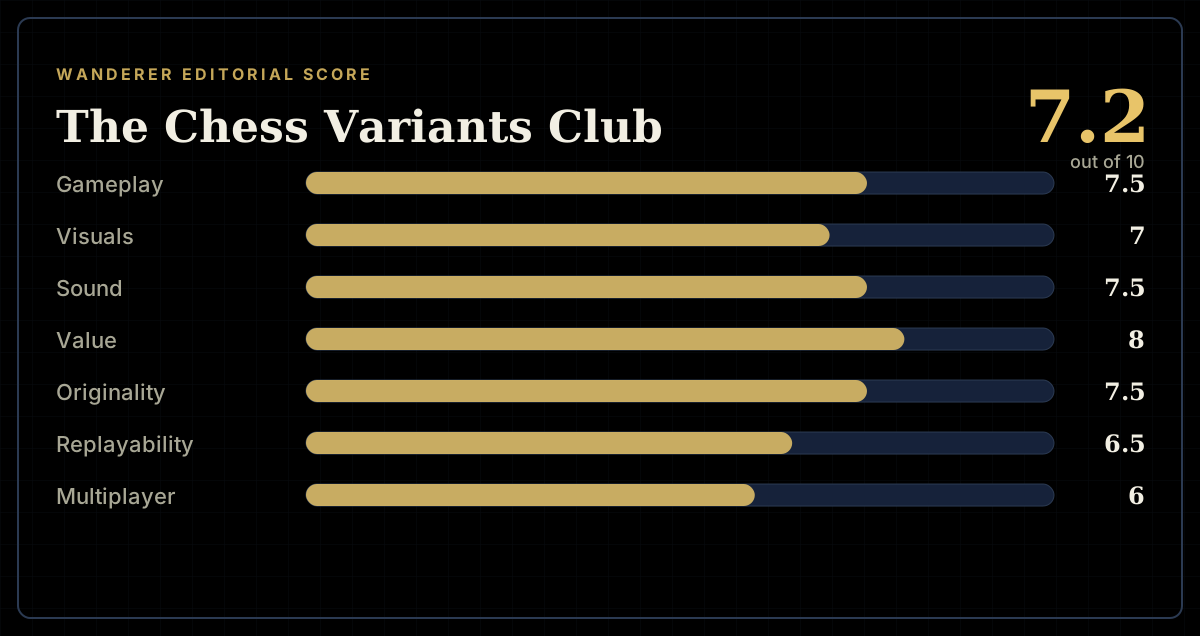
How the review scores each part of the gameWanderer Editorial -
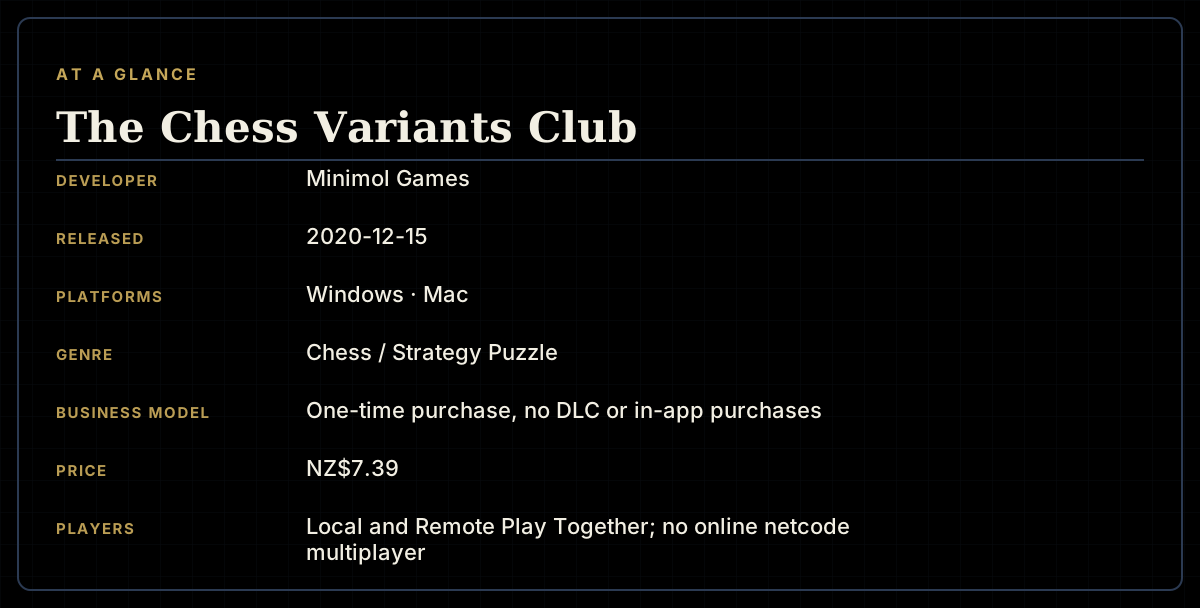
The game at a glanceWanderer Editorial -
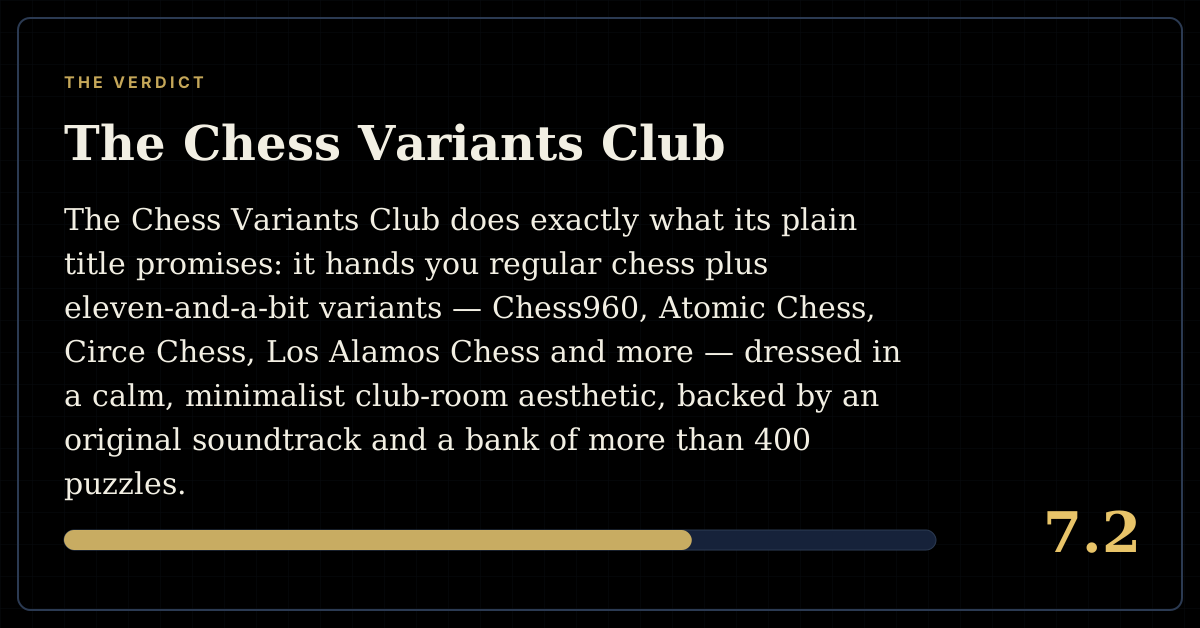
The short versionWanderer Editorial