
Game review
Feudal Alloy
5 / 10
- Developer
- Attu Games
- Publisher
- Attu Games
- Released
- 17 January 2019
- Platforms
- Windows
- Genre
- RPG
- Monetisation
- Paid, no in-app purchases found
- Players
- false
The short version
Feudal Alloy sends Attu, a fish-powered robot knight in a hand-drawn steampunk-medieval world, in search of stolen sunflower oil needed to keep his elderly robot community running. Its distinctive art direction and an unusually interactive health-and-stamina system draw genuine, consistent praise. But a large share of its own review corpus argues the game underneath that presentation is short, repetitive, and undercooked in ways that add up: only two bosses across the entire campaign, a single music track looping for the whole game, visually similar biomes, and a genuinely poor user interface that makes basic tasks like checking equipped gear stats or navigating menus needlessly frustrating.
Biggest strengths
- Genuinely distinctive, well-drawn hand-crafted visual art that draws consistent praise across nearly the entire review corpus regardless of overall verdict
- A creative, unusually interactive health and stamina system that several detailed reviewers specifically call one of the game's most inventive design choices
- Level design with real interconnectivity — shortcuts, loops and backtracking routes that reward exploration in the way a metroidvania should
Biggest weaknesses
- A dominant, repeated complaint that the campaign is short (roughly 7-8 hours per multiple reviewers) and becomes noticeably repetitive after just a few hours, with only two boss fights across the entire game
- A single, repetitive medieval music track plays throughout the entire game with no per-area variation, a specific and widely-cited sound design shortfall
- A genuinely poor user interface, repeatedly criticized in detail: unclear default selections on important prompts (including a progress-wipe confirmation), no way to check equipped gear's stats without repeatedly re-equipping items, and an unwieldy inventory-management system
Who it's for: Metroidvania fans specifically drawn to distinctive hand-drawn art who can tolerate a short, repetitive campaign and rough interface issues.
Our recommendation: Only worth it on a steep discount — the art style and central mechanical idea are genuinely appealing, but a large, consistent share of its own fans say the game doesn't have enough content or polish to justify full price.
5 / 10
What it is
Feudal Alloy follows Attu, a fish-controlled robot knight in a hand-drawn steampunk-medieval world, on a quest to recover stolen sunflower oil — the lubricant keeping his community of elderly robots running — from bandits who raided his village. Developed and published by Czech studio Attu Games, it combines metroidvania-style exploration and gear progression with action combat, all set within a distinctively illustrated 2D world. It released on 17 January 2019 at NZD 20.49.
Its review corpus, 271 in English, sits at a genuinely divided Mixed 63.8% (173 to 98), and reading through it in depth confirms the aggregate score is an honest reflection of real disagreement rather than an aberration — this corpus consistently praises specific, narrow aspects of the game while raising equally specific, repeated concerns about its overall depth and polish.
Art and mechanical creativity that earn genuine praise
Nearly every review in this corpus, positive or negative, credits Feudal Alloy's presentation. "Nice drawn artwork," writes one detailed critical reviewer whose overall verdict is negative. A separate, more positive account highlights a specific mechanical strength: "unique health and stamina system with pretty cool interactivity. Seriously creative on that one," alongside praise for level design that features "inter-connectivity, opening shortcuts, looping, etc" — genuine metroidvania hallmarks executed with real care. Another reviewer frames the whole package charitably: "controls feels good and character almost always does what you expect," alongside a "pretty challenging" difficulty curve that rewards learning enemy patterns.
A short campaign that a large share finds repetitive
Set against that praise, the single most consistent complaint in this corpus concerns content volume and pacing. "Game is pretty short. It will probably take around 7-8h to complete the game while getting some secret rooms here and there," writes one detailed, highly-upvoted reviewer, adding that the "repetitive gameplay... becomes boring after some time." A separate reviewer states the specific content shortfall bluntly: "there are only two bosses" across the entire game, in a genre where boss encounters typically anchor the pacing and provide its most memorable moments. A third reviewer, who put in 22 hours and earned every achievement specifically to give the game a fair shot, still couldn't recommend it: "the story is basically non existent, the world map is absurdly hard to navigate" — a telling account from someone who clearly wanted to like the game more than they ultimately did.
A specifically, repeatedly criticized interface
Beyond content volume, a detailed and pointed critical thread targets the game's user interface directly. "UI is [bad]. Let's list off the MANY ways this fails," writes one reviewer, citing a progress-wipe confirmation prompt where "you have a 50% chance of selecting the one you want" due to unclear default selection, plus no way to check current equipped gear stats "unless you are willing to drop everything in your inventory over a large area" to sort through it manually. That's a specific, checkable set of usability failures rather than a vague complaint, and it's echoed independently by a separate reviewer who calls out the same core problem: being unable to easily verify what a piece of gear actually does compared to what's currently equipped.
Sound and biome variety criticized specifically
A separate, detailed negative review raises two more specific complaints worth naming directly: "excruciatingly repetitive generic medieval music track (that's track, singular, not plural) that plays the entire game; there's no different music for different areas," and "all the areas are basically completely identical looking." Both are concrete, verifiable claims about content variety rather than subjective taste, and together they reinforce the broader "short and repetitive" critique running through this corpus — a game whose central visual style is well-liked in isolation but applied without enough variation across its full runtime to sustain a longer playthrough.
A contested case for combat and movement feel
Unlike the interface and content-volume complaints, this corpus genuinely splits on how the actual moment-to-moment combat and platforming feel. Some reviewers, quoted above, call the controls tight and responsive. Others disagree sharply: "movement is floaty and overall poor... combat is really boring and at times non-responsive," writes one detailed reviewer, while a separate, especially blunt account calls the controls "absolutely insane" and cites "inadequate enemy hitboxes." That's worth naming as a genuine, unresolved disagreement rather than a clear consensus either way — control feel appears to be one of the more subjective, player-dependent aspects of this particular game.
What the achievement data confirms
Feudal Alloy's achievement curve shows a notably low ceiling even at its most basic milestone — the most-earned achievement sits at just 47%, a comparatively weak figure for a "did anything at all" achievement compared to other games this lane has covered, before falling into the teens and single digits for exploration and full-collection achievements. That's consistent with a game a substantial share of buyers don't engage with deeply, corroborating the "short and repetitive" pattern running through the negative reviews — many players appear to bounce off well before reaching the game's back half.
Verdict
Feudal Alloy's hand-drawn art style and its inventive health-and-stamina mechanic represent real, specific design achievements, and the metroidvania interconnectivity of its level layout shows genuine care. But a large, consistent share of its own reviewers argue those strengths sit inside a shorter, more repetitive package than its asking price justifies, compounded by a genuinely poor interface that makes basic tasks needlessly frustrating. Worth a look only on a steep discount, with modest expectations for content depth and interface polish.
Pros and cons
Pros
- Genuinely distinctive, well-drawn hand-crafted visual art that draws consistent praise across nearly the entire review corpus regardless of overall verdict
- A creative, unusually interactive health and stamina system that several detailed reviewers specifically call one of the game's most inventive design choices
- Level design with real interconnectivity — shortcuts, loops and backtracking routes that reward exploration in the way a metroidvania should
- A charming, simple children's-story framing (rescuing stolen sunflower oil for elderly robots) that lands well for players looking for a gentler tone
Cons
- A dominant, repeated complaint that the campaign is short (roughly 7-8 hours per multiple reviewers) and becomes noticeably repetitive after just a few hours, with only two boss fights across the entire game
- A single, repetitive medieval music track plays throughout the entire game with no per-area variation, a specific and widely-cited sound design shortfall
- A genuinely poor user interface, repeatedly criticized in detail: unclear default selections on important prompts (including a progress-wipe confirmation), no way to check equipped gear's stats without repeatedly re-equipping items, and an unwieldy inventory-management system
- Split, contested combat and movement feel — while some reviewers call the controls tight and responsive, an equally substantial share describes them as floaty, unresponsive and hampered by inconsistent hitboxes
- Visually similar, largely undifferentiated biomes that make navigation and full exploration for collectibles and secret rooms feel tedious rather than rewarding
Screenshots
-

Feudal AlloyImage: Attu Games via Steam -

Feudal AlloyImage: Attu Games via Steam -

Feudal AlloyImage: Attu Games via Steam -
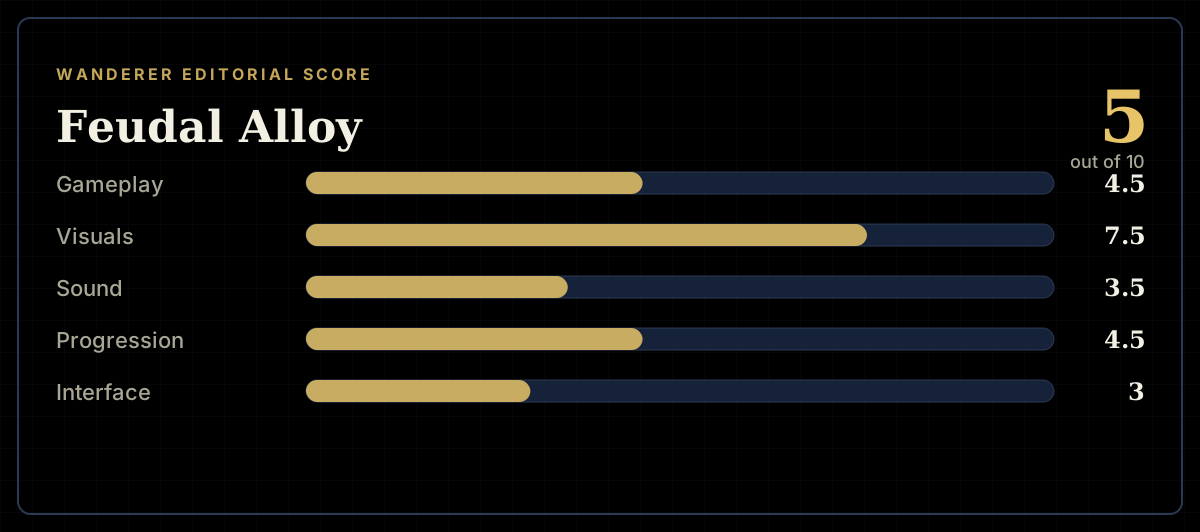
How the review scores each part of the gameWanderer Editorial -
The short versionWanderer Editorial