
Game review
Indivisible
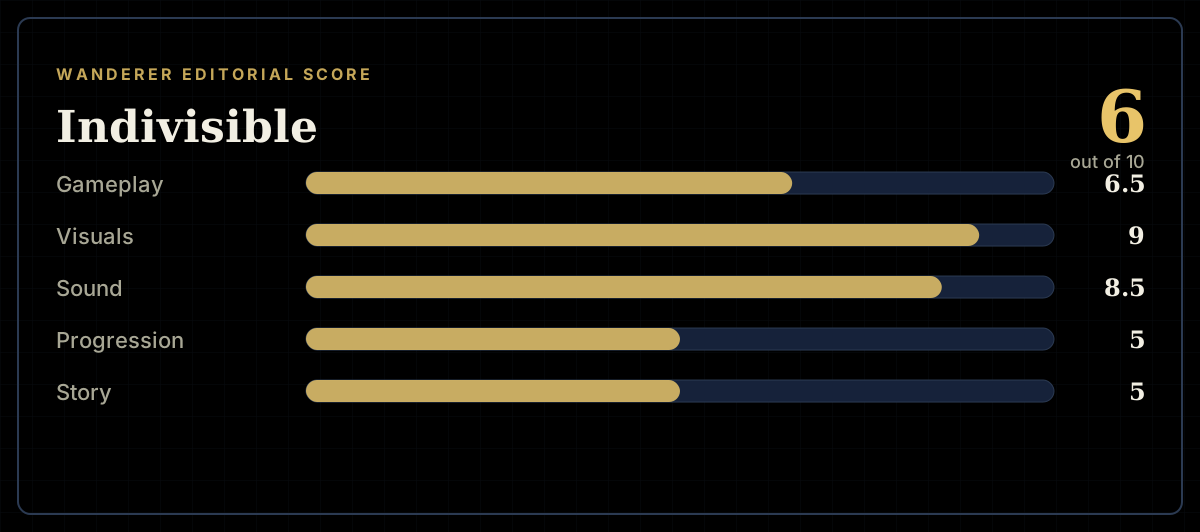
6 / 10
- Developer
- Lab Zero Games
- Publisher
- 505 Games
- Released
- 8 October 2019
- Platforms
- Windows, Mac, Linux
- Genre
- RPG
- Monetisation
- Paid, with cosmetic/challenge DLC
- Players
- false
The short version
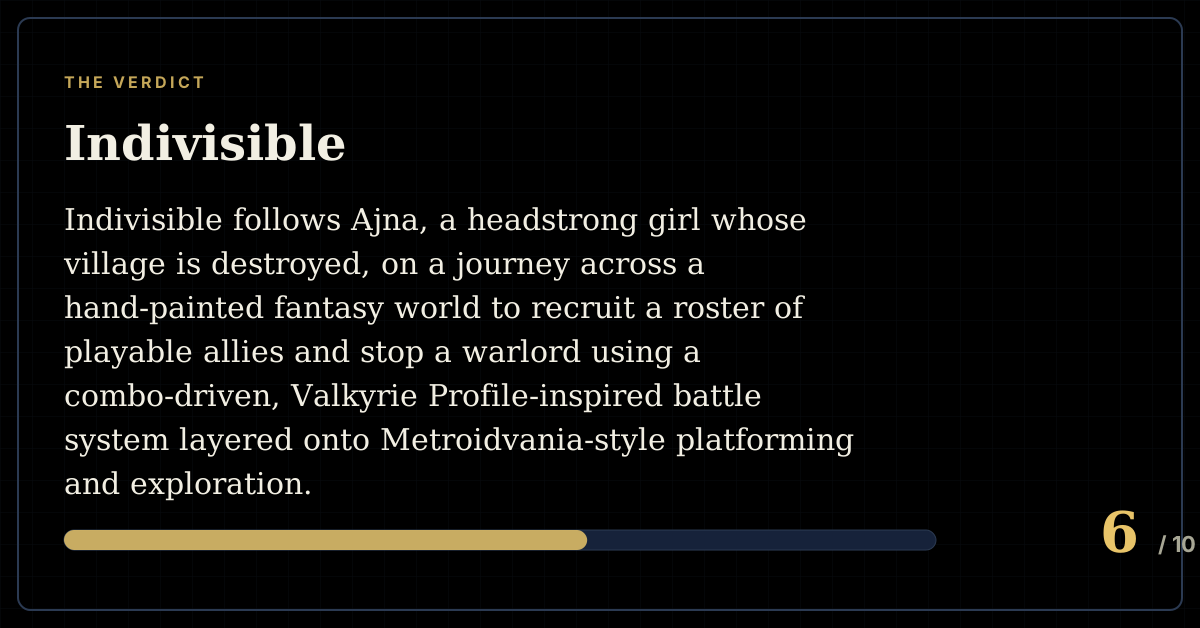
Indivisible follows Ajna, a headstrong girl whose village is destroyed, on a journey across a hand-painted fantasy world to recruit a roster of playable allies and stop a warlord using a combo-driven, Valkyrie Profile-inspired battle system layered onto Metroidvania-style platforming and exploration. Its art, music and voice acting draw close to unanimous praise, and its combat is widely called genuinely inventive. But Lab Zero Games closed its doors after launch, leaving Kickstarter-promised characters, content and polish permanently unfinished — a fact the review corpus treats not as an asterisk but as central to any honest verdict on the finished product.
Biggest strengths
- Gorgeous, distinctive hand-drawn art direction and animation from the Skullgirls team, drawing close to universal praise even from the game's harshest critics
- A genuinely inventive combo-based combat system explicitly compared to Valkyrie Profile, requiring real thought about which party members to field together
- A large, memorable cast of recruitable characters with strong voice acting and distinct personalities, frequently cited as a highlight independent of the gameplay debate
Biggest weaknesses
- A specific, extensively documented incompleteness: Lab Zero Games closed after launch, permanently cancelling promised crossover characters, unfinished character abilities, and further post-launch content backers were told to expect
- Widely and independently criticised writing and pacing, particularly in the back half of the story, described by multiple detailed reviewers as rushed and unpolished
- Real, specific balance complaints — some party members are dramatically weaker than others, and at least one character reportedly cannot use a core ability (self-healing) due to what reviewers describe as a bug rather than a design choice
Who it's for: Fans of 2D hand-drawn RPGs and unconventional turn-based combat systems who can accept a game that's visibly, permanently unfinished in places.
Our recommendation: Worth playing for the art, music and combat ideas on a discount, but go in knowing the game was never completed as originally promised, and that this shapes the experience throughout, not just at the margins.
6 / 10
What it is
Indivisible casts players as Ajna, a fearless, rebellious young woman whose home village is destroyed in the opening minutes, sending her on a globe-spanning journey to recruit a growing roster of playable allies and confront the warlord responsible. Developed by Lab Zero Games — the studio behind the fighting game Skullgirls — and published by 505 Games, it blends hand-drawn 2D platforming and Metroidvania-style exploration with a distinctive, combo-driven battle system explicitly modeled on Valkyrie Profile, where each party member is mapped to a different face button and timing their attacks together builds toward devastating combination moves. It released on 8 October 2019 after a famously long, crowdfunded development, at NZD 29.95.
Its review corpus, 1,272 in English, sits at a genuine Mostly Positive 72.4% (921 to 351) — not the overwhelming acclaim its art and combat ideas alone might suggest, and reading through both sides reveals exactly why: this is a game whose real, well-earned strengths sit uneasily alongside a specific, well-documented story of unfinished ambition.
Art, combat and cast that earn near-universal praise
Whatever else divides this corpus, the presentation and combat design largely don't. "It's beautiful visually, its characters are fun and memorable," writes one of the most-upvoted reviews, a sentiment echoed constantly even by reviewers who go on to deliver harsh overall verdicts. The combat draws specific, repeated comparisons to a beloved genre touchstone: "combat puts me in mind of more evolved Valkyrie profile with some fighting game influence," writes one detailed reviewer, praising how different party members bring genuinely distinct mechanics — a fire mage, a melee bruiser, a support healer — that reward thoughtful team composition rather than simply fielding whoever hits hardest. The soundtrack and voice acting draw their own independent praise across nearly every review regardless of overall verdict, and the platforming — including a forgiving, no-direction-required wall jump — is repeatedly called satisfying enough to please both newcomers and secret-hunting completionists.
A specific, well-documented incompleteness
Where this corpus turns sharply critical is a factual, checkable event rather than a matter of taste: Lab Zero Games closed its doors after Indivisible's launch, permanently cancelling content the studio had promised to Kickstarter backers and players. "The game is literally unfinished and the studio was usurped," writes one of the most-upvoted reviews in the entire corpus, a framing echoed independently across dozens of others. A separate, especially detailed account is more specific still: "there are characters that were promised and will never be in the game, and there are aspects of the gameplay that just don't work, (for example Thorani literally can't heal herself for some reason.)" Another reviewer closes their account bluntly: "Lab Zero closed, all DLC and updates for this game got cancelled, so don't expect to play the complete version of this game (the one promised to backers and supporters)." This isn't a single disappointed voice — it's a specific, checkable, repeatedly corroborated fact about the game's development history that shapes how nearly every critical review in this corpus frames its complaints.
Writing, pacing and balance complaints layered on top
Beyond the unfinished-content issue, a substantial share of critical reviews raise more conventional complaints that stand on their own. "Everything the negative reviews say about atrocious writing, bad balance, annoying platforming and meaningless rpg elements is true," writes one reviewer who nonetheless spent most of a year hoping to like the game. A separate, lengthy review that explicitly completed the game before writing their verdict argues the second half of the story rushes badly compared to the first, while another flags a specific balance problem: "some characters are extremely weak while others are insanely strong," undermining the tactical promise of the combat system once players settle into a small set of reliably powerful party members rather than experimenting broadly.
The progression system's hollow core
One particularly specific, mechanically literate complaint concerns the game's collectible-driven stat progression. "There's a cap on the max shards you need to get for the highest attack and def stats," one reviewer explains, "so there was no need to find all of the shards" despite exploration being ostensibly incentivized throughout the map. That's a concrete design flaw distinct from the studio-closure controversy — a Metroidvania built around rewarding thorough exploration undercuts its own hook when the exploration stops meaningfully paying off partway through, and it's a fair, specific point for players who value that particular genre's traditional completionist pull.
What the achievement data suggests about engagement
Indivisible's achievement completion curve shows a notably healthy, gradual decline rather than an early cliff — 92.3% and 82.5% for the top achievements, descending smoothly through a real mid-tier (58.3%, 50.6%, 42.0%) before settling at 7.6% for the hardest. That's a meaningfully more gradual slope than many of this lane's more divisive titles, and it corroborates something several critical reviewers state directly: many of them did finish the game, sometimes explicitly to ensure a fair basis for their negative reviews, rather than bouncing off early in frustration. The base combat and platforming clearly hold enough of the playerbase's attention to see the story through, even when the writing, balance and content gaps draw real criticism along the way.
A minority pushing back on the harshest reviews
It's worth including the corpus's counterweight directly: "some of the negative reviews that this game has are really harsh and mostly unwarranted," writes one reviewer, arguing that a game with "charming characters, beautiful visuals and an engaging combat system" doesn't need to be a perfect 10/10 to be worth recommending. That's a fair, honest position too — the studio-closure controversy and its resulting content gaps are real and worth knowing before buying, but they coexist with genuine design achievements that a meaningful share of this corpus still finds worth the price of admission, particularly at a discount.
Verdict
Indivisible pairs genuinely striking hand-drawn art and an inventive, Valkyrie Profile-inspired combat system with a permanently, specifically unfinished game underneath — Lab Zero Games' post-launch closure isn't background trivia here, it's the central fact shaping how this corpus reads its own experience. The combat and presentation are real achievements worth experiencing, particularly at a discount, but buyers should go in knowing exactly what was promised and never delivered rather than discovering it mid-playthrough.
Pros and cons
Pros
- Gorgeous, distinctive hand-drawn art direction and animation from the Skullgirls team, drawing close to universal praise even from the game's harshest critics
- A genuinely inventive combo-based combat system explicitly compared to Valkyrie Profile, requiring real thought about which party members to field together
- A large, memorable cast of recruitable characters with strong voice acting and distinct personalities, frequently cited as a highlight independent of the gameplay debate
- Satisfying Metroidvania-style platforming and traversal, including a well-liked no-direction-required wall-jump that keeps movement approachable for newcomers
Cons
- A specific, extensively documented incompleteness: Lab Zero Games closed after launch, permanently cancelling promised crossover characters, unfinished character abilities, and further post-launch content backers were told to expect
- Widely and independently criticised writing and pacing, particularly in the back half of the story, described by multiple detailed reviewers as rushed and unpolished
- Real, specific balance complaints — some party members are dramatically weaker than others, and at least one character reportedly cannot use a core ability (self-healing) due to what reviewers describe as a bug rather than a design choice
- A progression system reviewers call hollow in practice: a hard cap on stat-boosting collectibles removes any real incentive to fully explore the map for them
- Combat that a substantial critical contingent says degenerates into repetitive button-mashing over a long playthrough, undermining the early-game praise for its complexity
Screenshots
-

IndivisibleImage: 505 Games via Steam -

IndivisibleImage: 505 Games via Steam -

IndivisibleImage: 505 Games via Steam -
How the review scores each part of the gameWanderer Editorial -
The short versionWanderer Editorial