
Game review
Endgame of Devil
7 / 10
- Developer
- MiniWhale
- Publisher
- Anotherindie
- Released
- 8 April 2023
- Platforms
- Windows, macOS
- Genre
- Auto-Battler Roguelike
- Monetisation
- One-time premium purchase; no ads, DLC or in-game store found
- Players
- Single-player only; no online, co-op or PvP modes
The short version
Endgame of Devil takes the addictive drafting-and-synergy formula popularized by Luck be a Landlord and flips its premise: you play as the Devil, recruiting minions and treasures to automatically repel waves of treasure-hunting adventurers rather than spinning a slot machine for gold. Genre fans consistently rank it among the strongest entries since its inspiration, praising genuine build variety and satisfying synergy discovery, and reviewers unfamiliar with the source material describe it as an easy, addictive game to pick up.
Set against that praise, a substantial and consistent share of reviewers describe real launch-era friction: an English translation reviewers repeatedly call awkward, uneven power balance where some units and treasures are described as near-useless while others dominate every run, and a base game many reviewers found too easy to fully master within just a few hours. The developer has responded with an unusually sustained multi-year stream of content and balance updates, including a specifically named harder mode directly targeting the difficulty complaint.
Biggest strengths
- Genuine, satisfying build variety and synergy discovery that reviewers consistently rank among the best in the Luck be a Landlord-inspired genre, with more than one reviewer calling it the strongest entry since the original
- A clever, well-realized thematic reversal — playing as the besieged Devil rather than the adventurer — that gives familiar mechanics genuine new flavor
- Charming, stylized pixel art that reviewers consistently praise across an otherwise divided review base
Biggest weaknesses
- The English translation is widely and consistently described as awkward, compounding genuine difficulty understanding unit and mechanic descriptions independent of the translation issue itself
- Power balance is reported as uneven by multiple reviewers, with some minions and treasures described as near-useless and others as dominant "instant winners," narrowing genuinely viable strategies more than the large content roster suggests
- A substantial number of reviewers found the base game's difficulty too easy, with several reporting they'd cleared its highest standard tier or seen most of its content within just a few hours of play
Who it's for: Fans of Luck be a Landlord and similar slot-machine roguelikes looking for a genuinely strong entry in that specific niche, with tolerance for rough English localization. Less suited to anyone who needs precise mechanical clarity or wants the game's base difficulty to provide a sustained challenge on its own.
Our recommendation: A strong pickup for genre fans at a low price, especially now that years of balance patches and a dedicated harder mode have addressed much of the "too easy" complaint from launch.
7 / 10
Luck be a Landlord's slot-machine roguelike formula has inspired plenty of imitators, but Endgame of Devil finds a genuinely clever angle on the genre: instead of spinning reels for gold, you play as the Devil, drafting minions and treasures to automatically repel wave after wave of greedy adventurers coming to loot your dungeon. Reviewers well-versed in the genre consistently rank it among the strongest entries to follow its inspiration, and the thematic reversal gives familiar drafting-and-synergy mechanics a genuinely fresh flavor.
A worthy successor to its inspiration
The core praise centers on build variety and synergy discovery, with reviewers describing genuinely satisfying moments piecing together unexpected minion and treasure combinations across a run. More than one reviewer states plainly that this is the best game in its specific niche since Luck be a Landlord itself, and reviewers new to the genre describe it as an easy, addictive game to pick up without prior knowledge of its inspiration. Charming, stylized pixel art draws consistent praise across an otherwise divided review base, and the low asking price earns near-universal approval even from reviewers critical of other aspects of the game.
Real friction reviewers consistently describe
Set against that praise, this review's research turned up a consistent, specific set of complaints. The English translation is widely described as awkward, and reviewers report this compounds a separate, deeper problem: basic mechanical information about how specific units and effects actually function is often difficult to find or unclear even after parsing the translation itself. Balance draws an equally consistent complaint, with multiple reviewers describing power distributed unevenly across the game's roster — some minions and treasures functionally useless, others dominant enough to guarantee a win on their own, without much viable middle ground. One particularly detailed reviewer identifies a related structural issue: many thematically-linked synergy pieces, like specific monster types tied to a themed build, only appear in single copies per run, making several of the game's advertised build archetypes mathematically difficult or impossible to complete depending on what a given run offers.
A base difficulty many reviewers found too easy
A separate, widely-reported complaint concerns challenge: despite offering 20 distinct difficulty tiers, several reviewers describe reaching the highest standard tier after only a handful of attempts, with at least one detailed reviewer reporting a win with only five total deaths across the entire climb. Another reviewer reports beating the game twice within their first hour of play, describing feeling they'd already seen most of what the base game had to offer. That's a real concern for a genre built around replayability, though multiple reviewers note the game's separate Endless mode offers meaningfully more sustained challenge than the standard difficulty ladder.
A sustained response, confirmed by dated patches
To the developer's credit, the public patch record backs up reviewer accounts of continued, substantive investment well past launch. A dedicated Bloody Battle mode, introduced roughly a year after release, directly targets the difficulty complaint by making adventurers actively fight back rather than passively absorbing damage — exactly the kind of harder, more dynamic challenge reviewers who found the base game too easy were asking for. Named balance patches followed regularly, including specific buffs to underperforming minions and treasures and, in at least one update, direct fixes to "the English description text of some Minions" — a concrete, if partial, response to the translation complaints above. New playable Devil Lord characters, additional content updates, and even a full companion game in the same universe have continued arriving years after the original April 2023 launch.
What the achievement data suggests
Global achievement figures show a comparatively gradual decline across the game's difficulty ladder, from 84.1% of the playerbase clearing the earliest tier down to 26.8% reaching the twentieth and highest standard tier — a real drop-off, but a more forgiving curve than several other games this lane has tracked, broadly consistent with reviewer accounts that a meaningful share of players can climb quite far into the standard difficulty ladder without excessive friction.
Pace and progression complaints beyond balance
A separate cluster of complaints concerns how the game presents information moment to moment. Multiple reviewers report that even the slowest available game speed moves fast enough to make it difficult to observe and understand exactly which part of a build is contributing to a given result, undercutting the genre's usual appeal of watching a carefully assembled combo play out clearly. Meta-progression between runs draws a related, smaller complaint, with at least one reviewer describing the currency and unlock systems as underdeveloped and poorly explained relative to what a genre veteran would expect from a game built around repeated attempts. Neither complaint is as severe as the translation or balance issues above, but both compound the sense that some systems needed more polish before launch, even if the core drafting loop underneath works well.
Where it lands
Endgame of Devil earns its strong reception through genuinely satisfying build variety and a clever thematic twist on a proven roguelike formula, and its low price makes the real, consistently reported translation and balance rough edges easier to forgive than they might be at full retail elsewhere. The developer's sustained, multi-year response — including a difficulty mode built specifically to answer the "too easy" complaint — reflects well on a small studio genuinely invested in the project. For fans of the genre specifically, this remains a strong, worthwhile pickup years past its rockier launch-era reception.
Pros and cons
Pros
- Genuine, satisfying build variety and synergy discovery that reviewers consistently rank among the best in the Luck be a Landlord-inspired genre, with more than one reviewer calling it the strongest entry since the original
- A clever, well-realized thematic reversal — playing as the besieged Devil rather than the adventurer — that gives familiar mechanics genuine new flavor
- Charming, stylized pixel art that reviewers consistently praise across an otherwise divided review base
- An exceptionally sustained, multi-year post-launch content record, including new playable Devil Lords, a dedicated harder game mode, and continued balance patches years after launch
- A low asking price that most reviewers, even critical ones, describe as fair for the genre and the amount of content on offer
Cons
- The English translation is widely and consistently described as awkward, compounding genuine difficulty understanding unit and mechanic descriptions independent of the translation issue itself
- Power balance is reported as uneven by multiple reviewers, with some minions and treasures described as near-useless and others as dominant "instant winners," narrowing genuinely viable strategies more than the large content roster suggests
- A substantial number of reviewers found the base game's difficulty too easy, with several reporting they'd cleared its highest standard tier or seen most of its content within just a few hours of play
- At least one detailed reviewer describes the game's synergy system as working against itself, since many thematically-linked units and treasures only appear in single copies per run, making several advertised build archetypes mathematically difficult to complete
- The fastest game speed setting is reported by multiple reviewers as too fast to clearly follow what's happening on screen, undercutting the moment-to-moment clarity the genre depends on
Screenshots
-

Endgame of DevilImage: Anotherindie via Steam -

Endgame of DevilImage: Anotherindie via Steam -

Endgame of DevilImage: Anotherindie via Steam -
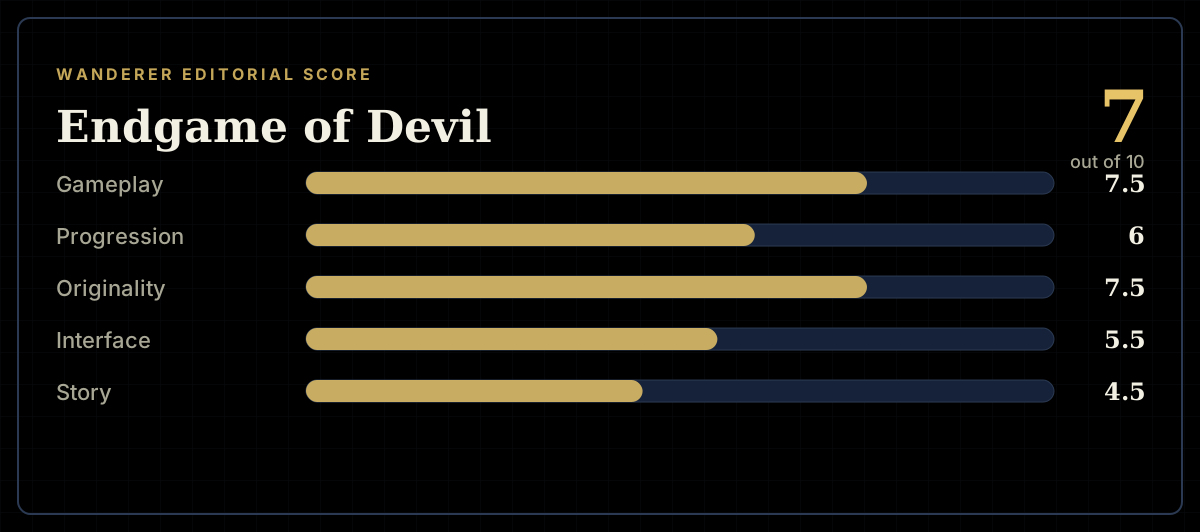
How the review scores each part of the gameWanderer Editorial -
The short versionWanderer Editorial