Game review
Dungeon 100
6 / 10
- Developer
- Kebuhe Changchang'ei
- Publisher
- Kebuhe Changchang'ei
- Released
- 25 November 2022
- Platforms
- Windows
- Genre
- Auto Battler Roguelike RPG
- Monetisation
- One-time premium purchase; no ads, DLC or in-game store found
- Players
- Single-player only; no online, co-op or PvP modes despite auto-chess-style comparisons
The short version
Dungeon 100 builds its entire identity around one idea: defeat a dungeon's boss, and your own character becomes the boss the next contender has to beat instead. It's a genuinely clever twist on the "beat your own ghost" roguelike structure, and reviewers across the review sample — supportive and critical alike — agree it's unlike anything else in the genre.
What very few of them agree is a good idea is what that mechanic does in practice: build a character too well, and you've just created an opponent your next run may never be able to beat, actively discouraging the optimal play the rest of the systems reward. Layered on top of that central tension are real translation and UI clarity problems, a specific and repeated allegation that some card art was lifted from another game, and a development pace that went quiet not long after its August 2023 full release following a genuinely dense Early Access support period.
Biggest strengths
- A genuinely novel structural hook — becoming the boss your own next character must defeat — that reviewers across the spectrum agree is unlike anything else in the roguelike or auto-battler genres
- A real, dense Early Access support cadence, with near-daily update logs for weeks at a time across late 2022 and much of 2023, including two additional game modes added post-launch
- Achievement data confirms multiple distinct modes (normal, "demonizing," fast, and challenge) genuinely exist and see real play, not just a single core loop dressed up differently
Biggest weaknesses
- The core "become the next boss" mechanic actively punishes strong, well-optimized builds by turning them into a wall the player's own next attempt may never get past, a contradiction multiple reviewers call the single biggest problem with an otherwise interesting idea
- Translation quality is repeatedly cited as poor enough to obscure what individual card abilities and synergies actually do, undermining a system whose entire appeal is build experimentation
- At least two independent reviewers allege specific card artwork was reused from other games without proper attribution, including one review naming Across the Obelisk directly as a source — a serious claim this review can't independently verify but is documented here as reported by reviewers rather than confirmed fact
Who it's for: Roguelike and deckbuilder fans drawn specifically to the "beat your own past success" structural hook, who can tolerate rough translation and are prepared to deliberately hold back from building the strongest possible character.
Our recommendation: Worth trying at a discount for a genuinely novel idea executed with real jank — go in prepared to actively avoid making your best possible build, since the game punishes you for it rather than rewarding you.
6 / 10
Every so often a roguelike finds a genuinely new twist on the "beat your own ghost" structure that underpins the genre. Dungeon 100 found one: clear a dungeon's boss, and rather than simply progressing, your current character becomes that boss — the exact opponent the next run has to get past. It's a clean, clever idea, and reviewers across this review's positive and negative samples converge on the same read: nobody else is doing quite this. What almost as many of them agree on, often in the same review, is that the idea works against itself in a very specific and repeatable way.
A build system that punishes success
The autobattler layer underneath that hook is a fairly standard card-and-synergy structure: buy cards each round, place them to trigger automatically in combat, and chase set bonuses and build-defining synergies as a run progresses. What sets the tone of nearly every review in this sample, whether recommending the game or not, is what happens once a build actually works. One detailed critical review lays it out precisely: "if you make a really strong build it's just super difficult or next to impossible to proceed with the other characters afterwards. It also incentivises you to not make good builds, but just kinda ok, barely good enough builds." A separate reviewer frames the same problem as a design contradiction at the system's core — a min-maxer's instinct to build the strongest possible character is directly punished by a mechanic that turns that exact success into an obstacle. Several reviewers describe genuinely bricking their own save this way, creating a boss they can't beat with any subsequent character and effectively ending their ability to progress further.
Not every reviewer treats this as a flaw. A vocal minority describes the tension as the entire appeal — deliberately calibrating a build to be just strong enough without becoming an insurmountable wall, and returning across multiple sessions specifically to finally crack a boss of their own making. That split is real and worth taking seriously in either direction: this is a mechanic some players find is the smartest thing about the game, and others find is the single design decision undermining everything else it does well.
Translation and interface friction
A second, more universally negative thread concerns how clearly the game actually communicates its own systems. Card abilities and synergy text are repeatedly described as poorly translated to the point of obscuring what a given ability actually does — a serious problem in a game whose stated appeal is deep, experimental build-crafting. Reviewers separately note missing basic combat information (damage-per-minute, crit chance) and UI elements like card text overlapping their own frames, compounding the clarity problem rather than easing it. One specific reported bug goes further than cosmetic friction: a UI-breaking issue that prevents cards from being unequipped once placed, despite the game's own tutorial explicitly describing that as a normal, expected action. Another reviewer notes the game's speed-up feature comes with its own in-game warning that using it will miscalculate combat damage against the player — an unusual thing for a shipped feature to openly admit rather than fix.
A serious allegation worth flagging carefully
At least two independent reviewers raise a more serious concern: that some of the game's card artwork was reused from other commercial games without proper credit, with one review specifically naming Across the Obelisk as a source. This is a specific, attributed claim rather than vague speculation, and it recurs independently across more than one review, which raises it above the level of a single disgruntled account — but it's also not something this review is able to verify directly through official sources, and the developer's own response to the allegation, if any, isn't part of the public record reviewed here. It's reported as exactly what it is: a serious, repeated reviewer accusation, not a confirmed fact.
A dense Early Access, then quiet
Dungeon 100's actual original release was its 25 November 2022 Early Access launch — the visible "release date" of 10 August 2023 on its store page marks the 1.0 exit, not the game's origin. The Early Access period itself was genuinely active: near-daily update logs through December 2022 and a steady cadence through most of 2023, including two additional modes added via dedicated updates in April and June 2023, which achievement data confirms are real and played rather than announced and abandoned. Public development activity appears to have gone quiet not long after the August 2023 full release, based on the available patch record, which lines up with reviewer complaints that translation, UI clarity and the reported bugs above remain unresolved as of this review.
Depth that doesn't always match the pitch
A separate thread of criticism concerns whether the promised build variety actually holds up under scrutiny. The game's own marketing leans on "unlimited character customization," but several reviewers push back on that framing directly, noting the absence of common RPG defensive tools — no reflect, no armor mitigation, no crowd control, no spell-shield equivalents — that would normally round out a build-crafting system's toolkit. Without those pieces, a meaningful number of reviewers describe build variety as shallower in practice than the marketing suggests, with combat resolving almost entirely on offensive synergy stacking rather than genuine tactical variety. That critique sits somewhat uneasily alongside the reviewers who praise the game's build-crafting depth directly, and the honest read is that the ceiling on offensive combo-building is real and often satisfying, while the promised breadth of playstyles is thinner than advertised.
Where it lands
Dungeon 100 is a genuinely hard game to score cleanly, because its most interesting idea and its biggest flaw are the same mechanic, and reasonable, engaged players land on opposite sides of whether that's a feature or a failure. Layer real translation problems, specific reported bugs and an unverified but repeated art-reuse allegation on top of that central tension, and what's left is a game worth recommending specifically to players drawn to its structural novelty and willing to work around its rough edges — not a confident recommendation for anyone looking for a polished autobattler experience first.
Pros and cons
Pros
- A genuinely novel structural hook — becoming the boss your own next character must defeat — that reviewers across the spectrum agree is unlike anything else in the roguelike or auto-battler genres
- A real, dense Early Access support cadence, with near-daily update logs for weeks at a time across late 2022 and much of 2023, including two additional game modes added post-launch
- Achievement data confirms multiple distinct modes (normal, "demonizing," fast, and challenge) genuinely exist and see real play, not just a single core loop dressed up differently
- A satisfying moment-to-moment power fantasy that several reviewers compare favourably to the escalating build-power feeling of looter ARPGs, delivered in minutes rather than hours
- Priced to reflect its rough edges, with several critical reviewers still recommending it specifically as a discounted curiosity rather than writing it off entirely
Cons
- The core "become the next boss" mechanic actively punishes strong, well-optimized builds by turning them into a wall the player's own next attempt may never get past, a contradiction multiple reviewers call the single biggest problem with an otherwise interesting idea
- Translation quality is repeatedly cited as poor enough to obscure what individual card abilities and synergies actually do, undermining a system whose entire appeal is build experimentation
- At least two independent reviewers allege specific card artwork was reused from other games without proper attribution, including one review naming Across the Obelisk directly as a source — a serious claim this review can't independently verify but is documented here as reported by reviewers rather than confirmed fact
- Specific reported bugs include a UI-breaking issue preventing cards from being unequipped once placed despite the tutorial explicitly describing that as possible, and a speed-up feature the game itself warns will miscalculate damage against the player
- Public development activity appears to have gone quiet not long after the August 2023 full release, following a genuinely active Early Access period, leaving several of the above-mentioned issues unresolved as far as the public patch record shows
Screenshots
-
Dungeon 100Image: 可布和常常诶 via Steam -
Dungeon 100Image: 可布和常常诶 via Steam -
Dungeon 100Image: 可布和常常诶 via Steam -
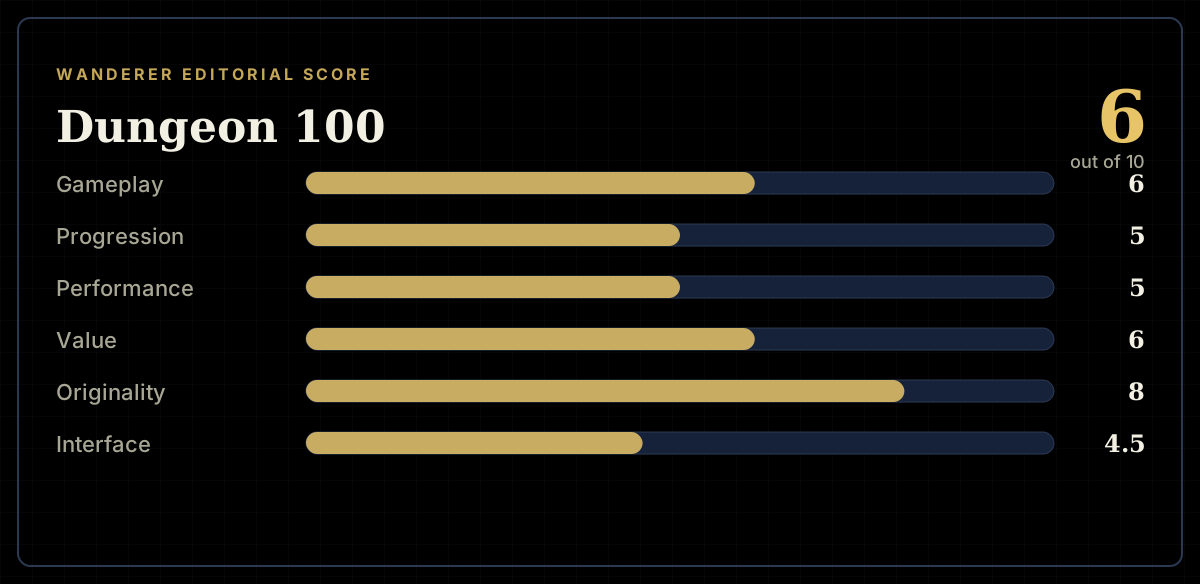
How the review scores each part of the gameWanderer Editorial -
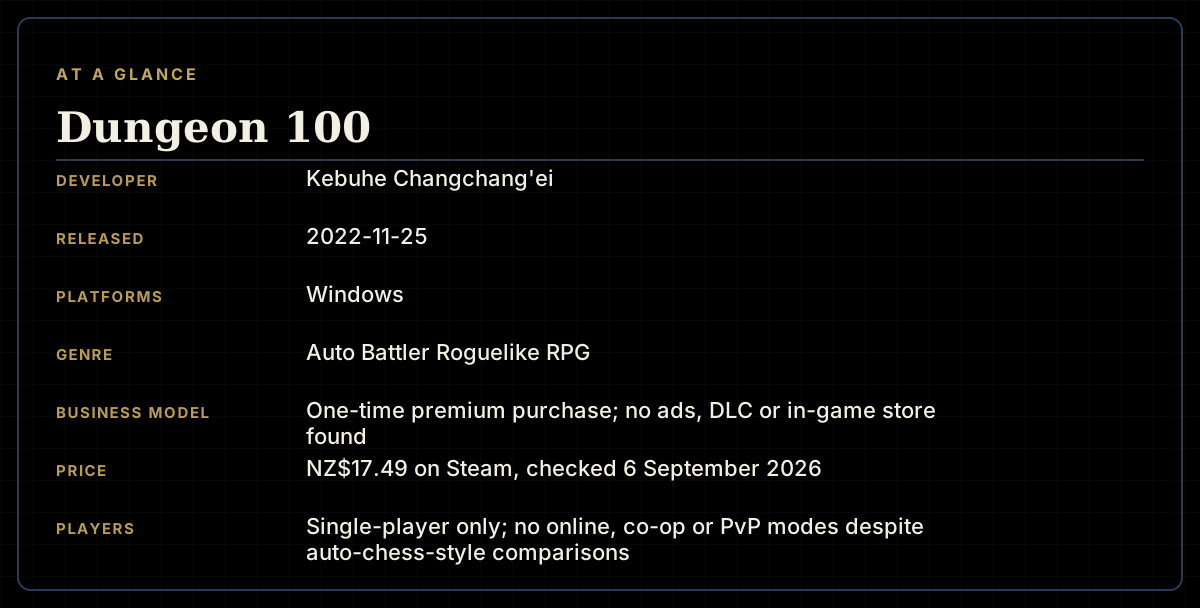
The specsWanderer Editorial -
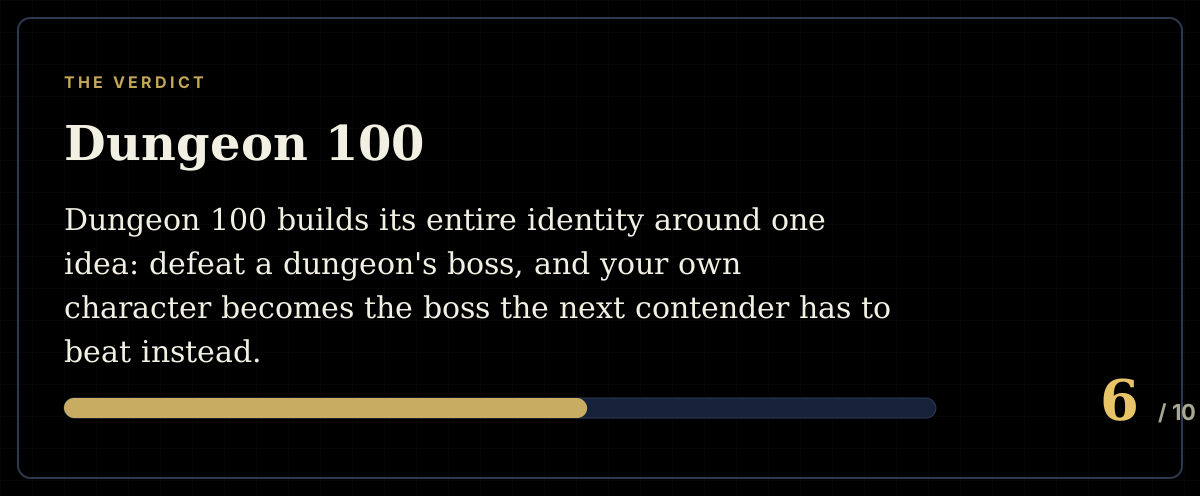
The short versionWanderer Editorial