
Game review
Dungeon Defenders
6.5 / 10
- Developer
- Chromatic Games
- Publisher
- Chromatic Games
- Released
- 18 October 2011
- Platforms
- Windows
- Genre
- Tower Defense Action RPG
- Monetisation
- Paid base game plus 40 separate DLC items, including a recent wave of cosmetic hero skins the developer has explicitly said fund new hires.
- Players
- Four-player online co-op tower defense is the game's central pillar.
The short version
Dungeon Defenders' fusion of tower-defense strategy with real class-based RPG progression has held up well enough to earn Very Positive status across more than 12,000 reviews, and its official screenshot still shows the loop working as designed: four defenders holding a wave against a horde of orcs with towers, spells and gear all visibly mattering at once. What makes 2026 an unusually interesting time to review this fifteen-year-old game is a story this review can verify directly from the developer's own words: a small team has spent the past year turning a wave of paid cosmetic DLC into a real hiring push, confirmed in an August 2026 developer diary, while a share of the game's original community reacts to that same wave of paid content as a jarring departure from what they remember the game standing for.
Biggest strengths
- Genuine class-building depth across four hero types, with real strategic decisions about tower placement, stat allocation and gear that reward experimentation.
- Four-player co-op tower defense remains a strong, distinctive hook, visible directly in the game's own promotional screenshots showing towers, spells and coordinated defense working together.
- Real, current, transparent developer investment: an August 2026 dev diary explains, in detail, how recent DLC revenue directly funded new coding, art and design hires.
Biggest weaknesses
- A meaningful share of reviewers in mid-to-late 2026 describe a sudden, unexplained-feeling wave of paid cosmetic DLC as jarring relative to the goodwill the original 2011 release built.
- One reviewer speculates, without offered evidence, that a specific recent skin may use AI-generated art; this review treats that as unverified speculation, not confirmed fact, and notes the developer's own account describes hiring a real artist.
- Long-standing complaints about post-launch itemisation dating to 2012-2013 describe DLC power creep repeatedly invalidating players' previously-earned gear.
Who it's for: Tower-defense and co-op action RPG fans who want genuine class-building depth, and who are comfortable with an actively monetising, actively revived older game rather than a static classic.
Our recommendation: The core game remains genuinely good; go in aware it's mid-transition into a new commercial phase, and judge the recent cosmetic DLC wave on its own terms rather than assuming it matches the base game's original spirit.
6.5 / 10
A tower-defense RPG that still holds up mechanically
Dungeon Defenders' pitch — "create a hero from one of four classes to save Etheria in this 4-player coop Tower Defense Action-RPG" — undersells how much genuine RPG structure sits underneath the tower-placement strategy. The official screenshot shows the loop at full tilt: a wave counter reading "8," a defense-unit tally at "54/100," and two heroes actively fighting alongside a field of towers and traps against a wave of charging orcs, with individual stat panels for health, mana and equipped gear visible in the corner. That density — strategy, stats and real-time combat all happening simultaneously — is what earned the game its lasting reputation, and reviewers across its entire history consistently credit the class-building systems specifically as the game's strongest, most enduring element.
A revival this review can verify from the source
What makes this a genuinely unusual game to review in September 2026 is a story with an unusually solid paper trail. Multiple reviews from June through August 2026 describe the same specific observation, independently: a fifteen-year-old game suddenly "pumping out a bunch of random DLCs." One July 2026 review is blunt: "So I'm not exactly saying the recent cosmetic DLC has an AI picture used to promote it... Buuuuut the style doesn't match any previous pictures used for the game, uses a very common anime style." This review has no way to verify that specific accusation, and treats it as unconfirmed speculation rather than fact. What this review can verify directly is the developer's own account of the same period: an August 2026 developer diary, posted under the byline of Thales, the lead developer at Chromatic Games since 2023, explains plainly that recent paid skins — including the same "Magical Academy Adept" and forthcoming "Academy Huntress" skins reviewers were reacting to — directly funded hiring "a new full time team" of coders, designers and artists. The diary lists concrete, checkable outputs from that investment: new hero skins, new maps including "Etheria's Primordial Palm," new weapon and pet models, ongoing bug fixes, and work toward a fully-supported 64-bit executable. Checking the game's public DLC listing confirms the scale independently: 40 separate DLC items now exist for this release, with the most recent cosmetic skin priced at roughly NZ$7.89 as of this review.
That combination — verified, transparent developer investment on one side, and a share of the original community reacting to the same funding mechanism as a departure from the game's original character on the other — is a genuinely different shape of story than most legacy-game coverage in this outlet's back catalogue, where the more common pattern is quiet abandonment rather than active, well-documented reinvestment. Both things are true simultaneously here: the developer's account of what the money is funding checks out against the visible patch history, and the community reaction to how that money is being raised is real and worth taking seriously on its own terms, independent of whether the underlying investment itself is a good thing for the game.
Older complaints that predate the current story
Two separate, longer-standing threads round out the picture, unconnected to the current DLC controversy. A 2012-2013 pattern describes itemisation power creep specifically: "every update DLC invalidates all of your previous work instantly," reads one 2013 review, describing gear a player worked to earn becoming obsolete with each new content drop — a genuine, historically documented balance problem distinct from anything happening in 2026. Separately, a 2012 review recommends the game "on one condition: that you do not play it past completing Insane difficulty," describing a steep, sudden difficulty escalation beyond that point. A 2021 review reports a more serious and unresolved account: being banned shortly after purchasing multiple DLC packs, with several attempts to contact support going unanswered. This review has no way to independently verify the circumstances of that ban, and reports it as a specific, if isolated and dated, account rather than a confirmed pattern.
Why disclosure doesn't automatically resolve the complaint
It's worth being precise about what the developer's transparency does and doesn't settle. Publishing a detailed dev diary explaining exactly what DLC revenue funds is a genuinely uncommon level of openness, and it's fair to credit Chromatic Games for it rather than assuming bad faith by default. But transparency about a business model is a separate question from whether that business model is the right fit for this specific game's community and history. A player who bought Dungeon Defenders in 2011 as a complete, premium-priced game, before free-to-play-style cosmetic monetisation was as culturally normalised as it is today, can honestly feel that a new anime-skin economy sits oddly against that original purchase, even while accepting every word of the developer's explanation as sincere. Both positions — "the funding model is honestly disclosed and clearly effective" and "this still doesn't feel like the game I remember" — can be true for the same reader at once, and this review doesn't think crediting the developer's honesty requires dismissing the community's discomfort as unreasonable.
What a returning player should actually expect
For a lapsed player specifically deciding whether to reinstall in 2026, the practical takeaway from all of the above is fairly concrete: the core tower-defense-and-class-building loop that earned the game its reputation is intact and, per the patch notes, actively receiving bug fixes and new content for the first time in years. The visual identity of new cosmetic content leans further toward anime aesthetics than the original 2011 art direction did, which will read as either a welcome refresh or a mismatch depending on taste. And the game's monetisation, while cosmetic rather than pay-to-win by every account in this review's research, is now a more active and visible part of the experience than it was during the years of relative dormancy many returning players will remember. None of that changes the underlying verdict on the base game's design, but it's the honest picture of what reinstalling today actually looks like.
Final verdict
Dungeon Defenders' core tower-defense-meets-RPG design remains genuinely strong, and this review's score reflects real respect for both that design and for a documented, transparent revival effort that's rare to see explained this plainly by a developer. Where the score reflects real caution is in taking the community's monetisation concerns seriously rather than dismissing them just because the developer's own explanation checks out — a funding model can be honestly disclosed and still feel, to longtime players, like a meaningful shift in what the game is selling and to whom. This is a strong game worth playing for the core loop, mid-transition into a new commercial chapter that longtime fans should judge with open eyes rather than assumed continuity with 2011.
Pros and cons
Pros
- Genuine class-building depth across four hero types, with real strategic decisions about tower placement, stat allocation and gear that reward experimentation.
- Four-player co-op tower defense remains a strong, distinctive hook, visible directly in the game's own promotional screenshots showing towers, spells and coordinated defense working together.
- Real, current, transparent developer investment: an August 2026 dev diary explains, in detail, how recent DLC revenue directly funded new coding, art and design hires.
- An extremely active current patch cadence, with multiple updates per week through September 2026, addressing bugs the community has flagged for years.
Cons
- A meaningful share of reviewers in mid-to-late 2026 describe a sudden, unexplained-feeling wave of paid cosmetic DLC as jarring relative to the goodwill the original 2011 release built.
- One reviewer speculates, without offered evidence, that a specific recent skin may use AI-generated art; this review treats that as unverified speculation, not confirmed fact, and notes the developer's own account describes hiring a real artist.
- Long-standing complaints about post-launch itemisation dating to 2012-2013 describe DLC power creep repeatedly invalidating players' previously-earned gear.
- A 2021 review reports being banned shortly after purchasing DLC, with no response from support after multiple contact attempts — an old, unresolved account this review cannot verify further.
Screenshots
-

Dungeon DefendersImage: Chromatic Games via Steam -

Dungeon DefendersImage: Chromatic Games via Steam -

Dungeon DefendersImage: Chromatic Games via Steam -
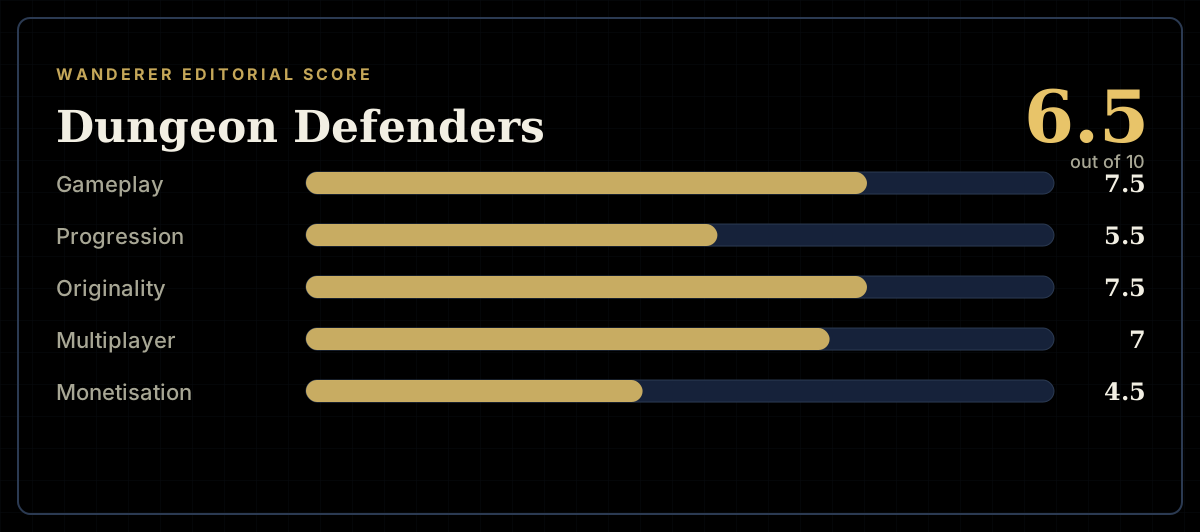
How the review scores each part of the gameWanderer Editorial -
The short versionWanderer Editorial