
Game review
Disc Room
6 / 10
- Developer
- Terri, Dose, Kitty, JW
- Publisher
- Devolver Digital
- Released
- 22 October 2020
- Platforms
- Windows, macOS
- Genre
- Precision Dodge-and-Survive
- Monetisation
- Paid, one-time purchase. No in-app purchases.
- Players
- Single-player only.
The short version
Disc Room sends players into a grid of small, timed challenge rooms, each filled with a distinct type of deadly, disc-shaped hazard to survive or exploit, and its Very Positive rating across 577 reviews reflects real appreciation for its creative premise and confident presentation. What holds this review back is an extremely consistent complaint, raised specifically and repeatedly by reviewers with bullet-hell genre experience, that disc movement is randomised rather than built on learnable patterns — undermining the sense of skill mastery the genre traditionally rewards. A separate, well-corroborated complaint concerns the game's short overall length relative to its asking price, and several reviewers raise a specific, concrete concern about flashing-light rooms designed as intentional challenges.
Biggest strengths
- A genuinely creative core premise, reframing bullet-hell-style dodging as a grid of short, distinct puzzle-challenge rooms rather than one continuous encounter.
- Confident, appealing pixel art and a well-regarded soundtrack that reviewers consistently credit as elevating the experience.
- A flexible in-game difficulty adjustment option that lets frustrated players scale down individual room challenges.
Biggest weaknesses
- An extremely consistent complaint from reviewers with bullet-hell genre experience describes disc movement as randomised rather than pattern-based, undermining the skill-mastery loop the genre is traditionally built around.
- A well-corroborated complaint describes the game as short relative to its price, with several reviewers estimating completion in one to two hours before repetition sets in.
- Specific rooms built around flashing or strobing lights are raised repeatedly as a concrete discomfort concern, distinct from the game's general difficulty.
Who it's for: Fans of short, creative arcade challenges who don't need the pattern-mastery depth of dedicated bullet-hell games; players prone to discomfort from flashing lights should be aware of specific rooms built around that mechanic.
Our recommendation: A creative, short arcade experience worth trying on sale; bullet-hell genre veterans specifically expecting pattern-based mastery should temper expectations.
6 / 10
A genuinely creative reframing of a familiar genre
Disc Room's core idea is specific and, by wide consensus, genuinely inventive: rather than one continuous bullet-hell encounter, the game breaks its challenge into a grid of small, distinct rooms, each built around a single type of disc-shaped hazard to survive, avoid, or turn to the player's advantage. "Really solid visuals and music, the art is fantastic and the setting is creative enough to support it," reads a 2021 review, one of many that credits the presentation and structural creativity even while raising more substantial reservations about the underlying mechanics. A 2022 review captures the appeal of the format specifically: the room-by-room structure gives each hazard type room to be explored in isolation, a distinctive approach relative to more continuous genre peers.
An extremely consistent complaint from genre veterans about randomisation
What dominates the critical portion of this review base is a specific, technically precise complaint about how the discs actually move. "The point of bullet hell games is that there are patterns to learn and master weaving through. this game doesnt have that, it just throws a bunch of discs at you moving in random directions until theres practically nowhe[re safe to stand]," reads a 2021 review. A 2021 review, from a reviewer who explicitly identifies as a developer of a similarly bullet-pattern-based game, states the criticism even more precisely: "this is a well-made game that fundamentally disregards any respect for or knowledge of what it means to make bullet patterns." A 2023 review describes the practical consequence: "An unrewarding, grueling slog in which your performance is dependent on RNG instead of mastery of patterns and your abilities." Checking a broad sample of negative reviews, this exact complaint — not that the game is too hard, but specifically that success depends on randomised luck rather than learnable, repeatable pattern recognition — recurs with striking consistency, particularly from reviewers who bring direct genre expertise to their assessment. That consistency is meaningful: it suggests a genuine, deliberate design choice that lands very differently depending on what a player expects a bullet-hell-adjacent game to reward.
A related, more specific complaint concerns a single room in particular: "this game would be good without the lobotomy room," reads a 2026 review, a sentiment echoed by several other reviewers who single out that specific room as disproportionately frustrating relative to the rest of the game, particularly for players pursuing full achievement completion. Naming a single specific room this consistently across independent reviews is a notable pattern in its own right — it suggests one particular design outlier drawing outsized frustration relative to the game's generally well-received broader structure, rather than uniform dissatisfaction across every room.
A well-corroborated length and value complaint
Separate from the design-philosophy debate, a consistent complaint concerns how much content the game offers relative to its price. "Shamefully Short... Especially for its price. While there are different types of discs and different room challenges, they're too few, it gets repetitive," reads a 2021 review. A 2020 review reaches a similar conclusion: "1 hour of story mode and then bonus difficulty in the same levels as an addition is not $15 of value in this case." This review takes the complaint seriously as a value consideration rather than dismissing it — several reviewers report finishing the core content in one to two hours, which is a reasonable, specific piece of information for a prospective buyer weighing the asking price against expected playtime.
A specific, concrete discomfort concern about flashing-light rooms
A further, more specific complaint concerns particular rooms built explicitly around flashing or strobing visual effects as part of their challenge design. "Once you get to the area where the lights flash on and off, you realize that the developers don't actually want you to enjoy this game," reads a 2021 review. A 2023 review reports the effect directly: "what sent it from 'not for me but seems like a solid little game' to 'not recommended' were the flashing levels — just miserable on the eyes." This review did not find explicit references to seizure risk in this review sample, but the consistency of reviewers describing genuine visual discomfort from these specific, intentionally designed rooms is worth flagging directly for any player who knows flashing lights affect them, distinct from the game's broader difficulty.
Weighing the randomisation complaint fairly
It's worth noting that not every reviewer treats the randomised disc movement as an outright flaw. Several describe genuine enjoyment specifically because each room functions more like a short, chaotic puzzle to read and react to in the moment rather than a pattern to memorise and repeat — a legitimately different design philosophy from traditional bullet-hell games rather than simply an unpolished attempt at one. The complaint from more critical reviewers isn't that this approach is inherently invalid, but that it sits uncomfortably within a genre whose most dedicated fans specifically come in expecting pattern-based mastery, and Disc Room's marketing and visual language draw heavily enough on that genre's conventions to set expectations the actual design doesn't fully deliver on for that specific audience.
Final verdict
Disc Room offers a genuinely creative, well-presented take on dodge-and-survive gameplay, and this review credits its structural inventiveness honestly. What keeps the score moderate is an extremely consistent complaint from bullet-hell genre veterans about randomised, rather than pattern-based, disc movement, compounded by a well-corroborated length-versus-price concern and a specific, concrete discomfort complaint about flashing-light rooms. This is a reasonable pick on sale for players drawn to its short, creative structure; genre veterans specifically expecting learnable bullet patterns should temper their expectations accordingly.
Pros and cons
Pros
- A genuinely creative core premise, reframing bullet-hell-style dodging as a grid of short, distinct puzzle-challenge rooms rather than one continuous encounter.
- Confident, appealing pixel art and a well-regarded soundtrack that reviewers consistently credit as elevating the experience.
- A flexible in-game difficulty adjustment option that lets frustrated players scale down individual room challenges.
- Backing from Devolver Digital, a publisher reviewers consistently associate with high creative and design standards, reflected in the game's distinctive presentation.
Cons
- An extremely consistent complaint from reviewers with bullet-hell genre experience describes disc movement as randomised rather than pattern-based, undermining the skill-mastery loop the genre is traditionally built around.
- A well-corroborated complaint describes the game as short relative to its price, with several reviewers estimating completion in one to two hours before repetition sets in.
- Specific rooms built around flashing or strobing lights are raised repeatedly as a concrete discomfort concern, distinct from the game's general difficulty.
- A minority of reviewers report a save-data loss bug and Mac-specific compatibility problems preventing the game from launching at all.
Screenshots
-

Disc RoomImage: Devolver Digital via Steam -

Disc RoomImage: Devolver Digital via Steam -

Disc RoomImage: Devolver Digital via Steam -
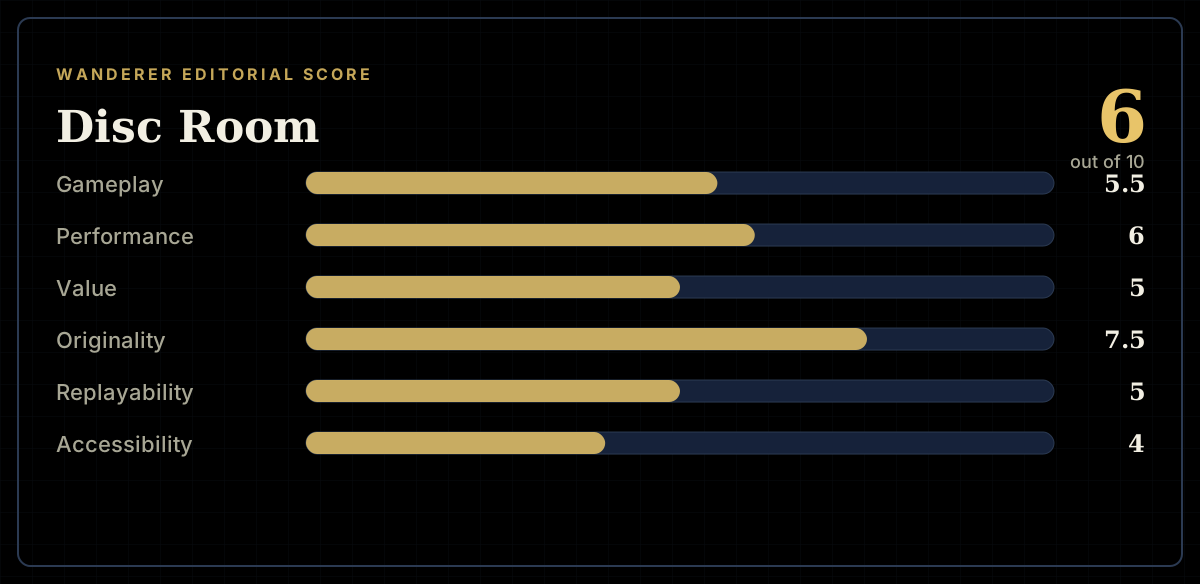
How the review scores each part of the gameWanderer Editorial -
The short versionWanderer Editorial