Game review
Gravitron
6 / 10
- Developer
- JOZGameru
- Publisher
- JOZGames
- Released
- 6 August 2026
- Platforms
- Windows
- Genre
- Action
- Monetisation
- One-time purchase, no in-game store, no IAP, no DLC
- Players
- Single-player only; no online or local multiplayer modes are listed
The short version
Gravitron strips platforming down to one input: which way is down right now. The character can't run or jump, only fall, so every level becomes a sequence of gravity flips threaded between spike-edged hazards toward a portal, with a draining energy meter forcing speed over caution. Underneath that single mechanic is a genuinely substantial completion ladder — 78 Steam achievements split across roughly two dozen levels, tracking deaths, coin collection and bonus objectives separately for each one — which is a clearer sign of the design's ambitions than any single screenshot. It launched a day before this review with zero user reviews, no press coverage and no demo, so none of that ambition has been tested by an outside audience yet.
Biggest strengths
- The single-input premise is genuinely distinctive — removing run and jump entirely and reducing control to "which way is down" is a real design commitment, not a gimmick bolted onto a normal platformer
- Achievements are split into three separate tracks per level (avoiding deaths, collecting coins, hitting a bonus objective), giving the completion ladder real depth rather than one flat "beat the level" checkbox — 78 achievements across roughly 26 levels
- Full controller support including DualSense, on top of keyboard/mouse, for a genre where input feel matters more than in most
Biggest weaknesses
- No demo, so there is no way to test whether the gravity-flip controls feel precise before paying for a genre where control feel is the entire product
- Windows only, with no Mac or Linux build listed
- The store page carries zero user reviews and no press coverage at the time of writing, so nothing about difficulty balance, level count accuracy or bugs has been independently confirmed yet
Who it's for: Arcade and precision-platformer players who already like trial-and-error "one more try" games such as Super Meat Boy or VVVVVV and don't mind a short, mechanically narrow game built around mastering a single control idea rather than expanding it.
Our recommendation: The core idea is sound on paper and the achievement structure gives it real score-chasing depth, but a Windows-only release with no demo, no reviews and a $9.99 asking price (currently discounted to $5.99) is a harder sell than a shorter or cheaper game would be. Worth watching for early user reviews before buying at full price.
6 / 10
Gravitron makes one decision for the player before the game even starts: there is no jump button. The character, described in the store listing simply as Gravitron, doesn't run and doesn't leap — it only falls, and the only input available is which direction "down" currently points. Every level becomes a sequence of gravity flips threaded between hazards toward a portal, with an on-screen energy counter draining the whole time to keep the player from creeping through carefully. That's the entire pitch, stated almost defiantly plainly in the store description: "the character does not run, jump, or move like in a traditional platformer." The more interesting part of the release, though, isn't the mechanic itself — gravity-direction control has shown up in plenty of games before it — but what's built on top of it. The Steam achievement list runs to 78 entries, and decoding the internal names shows they split into three separate tracks repeated across roughly two dozen levels: one for finishing without dying, one for collecting every coin, and one for a bonus objective, tracked individually per level rather than folded into a single "complete the level" checkbox. That's a real completionist ladder sitting underneath a very small surface-level pitch, and it tells you more about what this game wants from a player than any one level does.
One input, and what it's asking of the player
Removing running and jumping from a platformer isn't a new idea by itself — VVVVVV built an entire game around gravity flips in 2010, and Gravity Ghost and And Yet It Moves both explored variations on "you don't control momentum directly, you control the world around it." What Gravitron seems to be doing differently, based on the store description and the level layouts visible in its own screenshots, is refusing every other input alongside the flip. There's no horizontal run speed to manage, no jump arc to time — just fall, flip, fall again, and thread the resulting diagonal path between obstacles. The store page frames this as being "for players who enjoy trial and error, precise control, and that 'one more try' feeling," which puts it firmly in Super Meat Boy territory: short levels, high attempt counts, and a design that expects failure as the normal state rather than the exception. The energy meter reinforces that — it drains constantly rather than only on damage, so hesitating to plan a route costs the same as making a wrong move, which should push levels toward being read and executed quickly rather than solved slowly.
Whether the flip controls actually feel good under that pressure is the one thing no amount of store-page research can answer, and it's also the single most important fact about a game like this. Precision platformers live or die on input feel in a way few other genres do, and Gravitron ships with no demo to test that before buying. That's the biggest structural risk in this release, independent of whatever the level design turns out to be like.
The completion ladder is the real pitch
The achievement list is the most concrete evidence available about the shape of the game, and it's more substantial than the two-sentence store pitch suggests. Rather than one achievement per level for simply reaching the portal, the list tracks three separate outcomes per level — a clean run, a full coin collection, and a bonus condition — which means a level isn't "done" once but potentially three times over. That structure matches the store description's claim that "reaching the portal is the main goal, but finishing with more energy, dying less, and mastering each level are all part of the challenge," and it's a meaningfully deeper design decision than it first looks: it turns roughly two dozen short levels into closer to eighty distinct challenges for anyone chasing full completion, without needing to add any new levels to do it. For a genre built on replaying short segments until they're perfect, that's exactly the right kind of depth to add, and it's the clearest sign in the whole package that more design thought went into Gravitron than the one-line pitch communicates.
Visual language and presentation
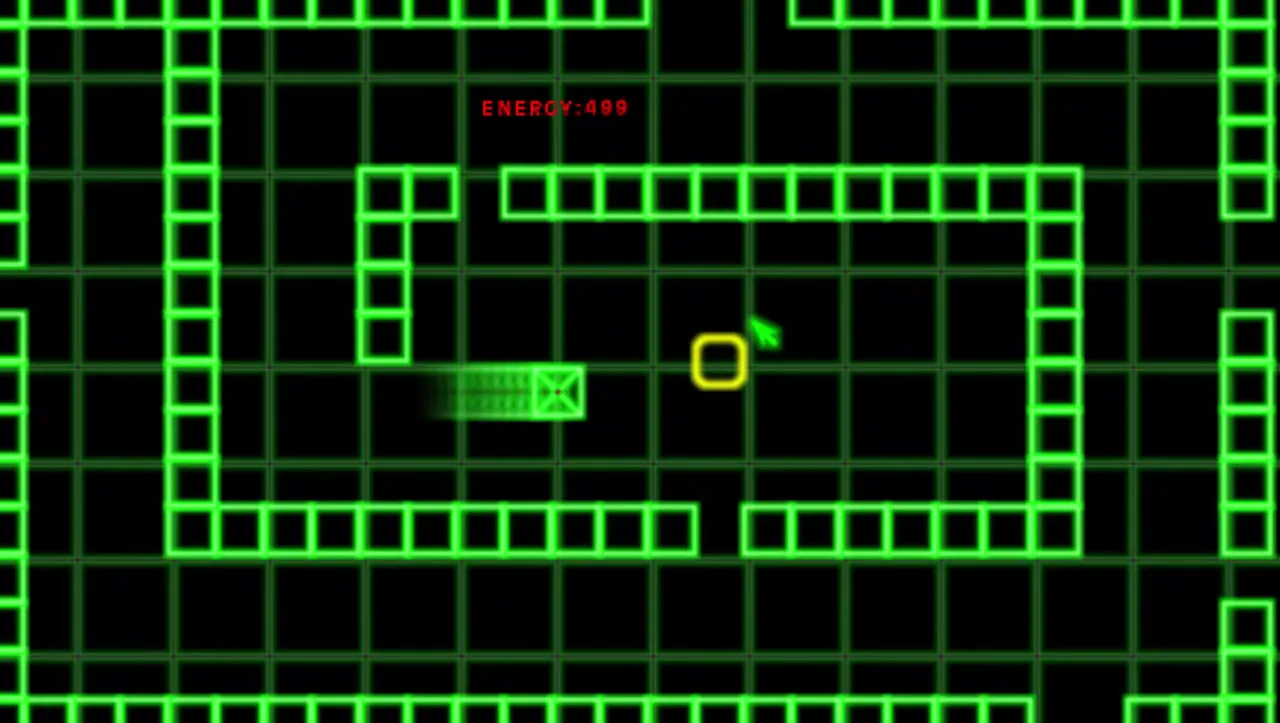
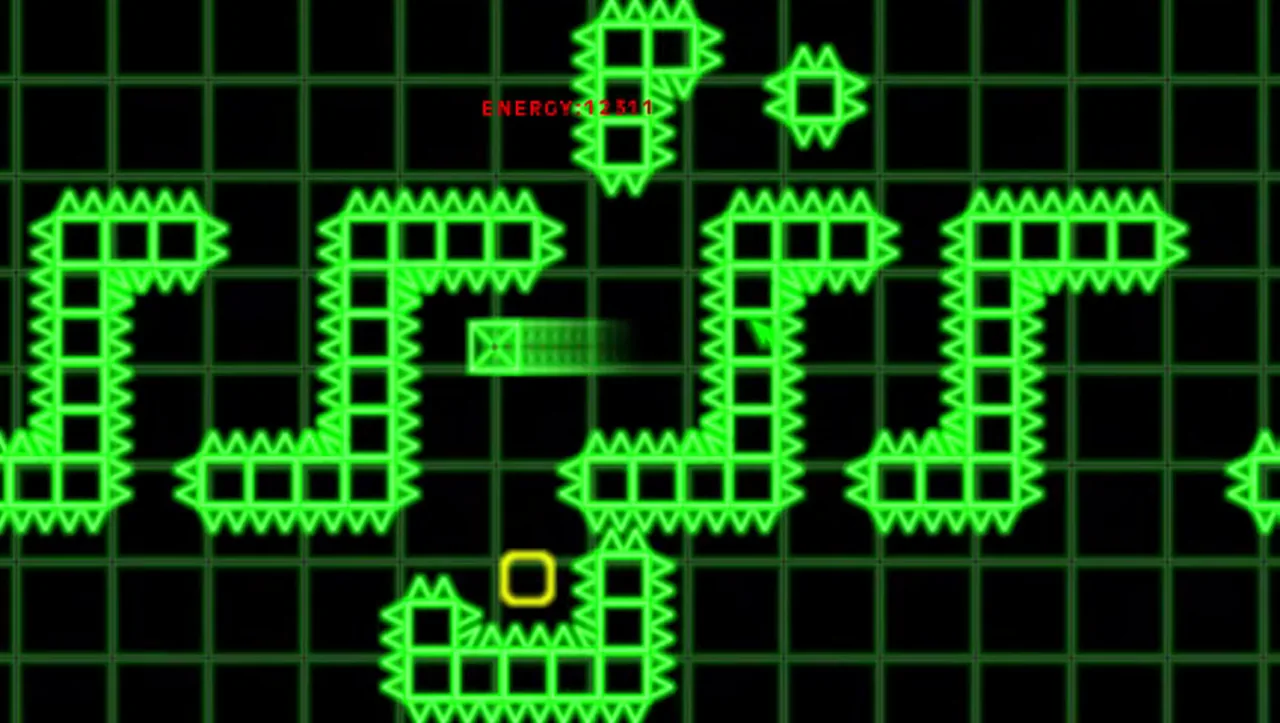
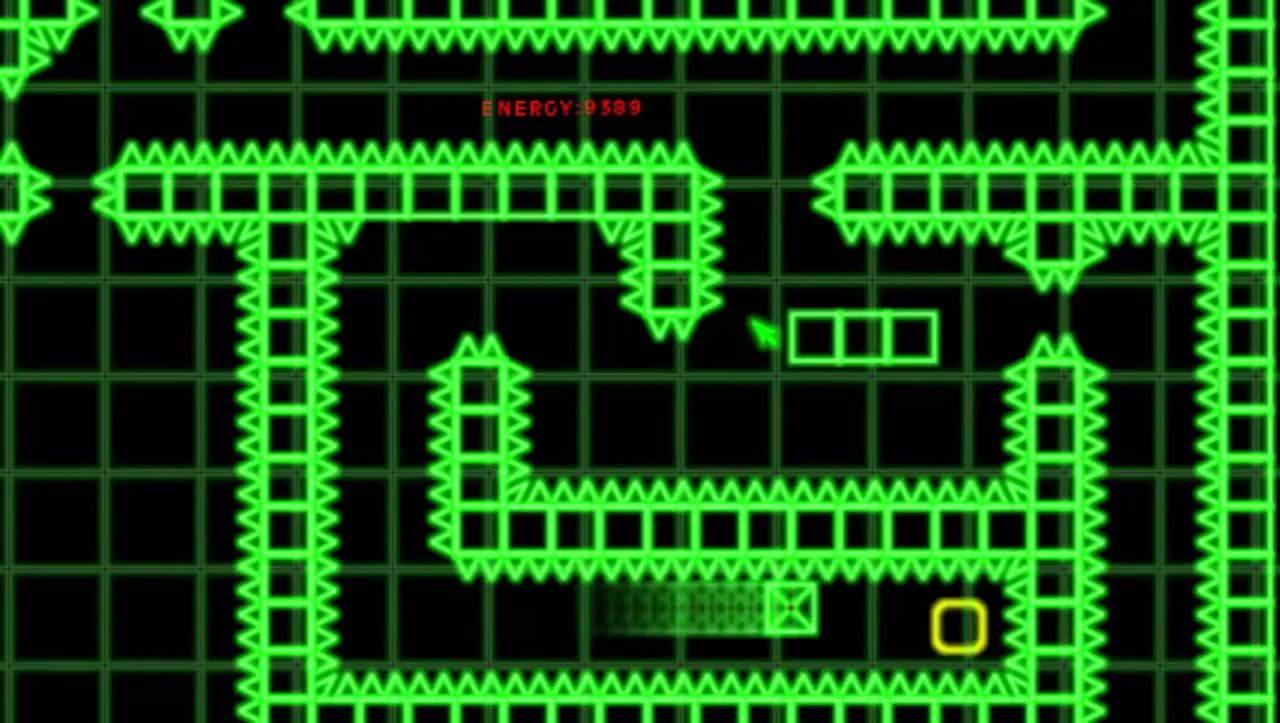
The five screenshots on the store page all show the same look: a black background overlaid with a faint square grid, rendered entirely in a single bright green line-art style with no fill colors and no background art beyond the grid itself. Terrain reads in two distinct silhouettes — smooth square-edged blocks for safe platforms and walls, and the same blocks outlined in jagged spikes for hazards — which is a legible piece of visual grammar for a game where reading a level correctly in the half-second before committing to a fall is the whole challenge. A red "ENERGY" counter sits fixed at the top of the screen, and the numbers visible across the five screenshots — ranging from under 500 up into the thousands — suggest each level hands the player a large starting energy pool that ticks down steadily rather than a tight, seconds-based timer. Collectible coins appear as small rounded yellow squares scattered through the level geometry, distinct enough from the green terrain and hazards not to be confused with either. It's a minimal, almost vector-graphics look that won't be for everyone, but it's consistent and functional rather than merely cheap-looking, and functional is what a hazard-reading game actually needs from its art.
Price, platform and the evidence gap
At $9.99, discounted to $5.99 for what the store page doesn't specify as a time-limited launch window, Gravitron sits in ordinary small-indie pricing territory, and the monetisation itself is about as clean as it gets — one purchase, no DLC, no in-app store, no live-service layer of any kind. What's harder to weigh is whether that price is earned by the amount of content on offer. The store page doesn't state a total level count anywhere in its own description, and the achievement data implies roughly 26 levels rather than confirming it outright. Windows is the only supported platform; there's no Mac or Linux build listed, and no demo to let a buyer test the control feel before paying. Full controller support, including specifically-listed DualSense support, is a genuine plus for a game this input-sensitive, and it suggests some care went into that part of the build even without outside confirmation.
The single fact that shapes this review more than any other is that Gravitron launched with zero Steam user reviews and no press coverage of any kind at the time of writing. That's expected for a release barely a day old, not a mark against the game, but it does mean nothing here — difficulty balance, bug count, whether the flip controls feel precise or floaty — has been checked by anyone outside the developer yet. A buyer today is trusting the store page and nothing else.
Final verdict
Gravitron's core idea — cut a platformer down to a single input and build hazard-reading levels around it — is a real design commitment, and the 78-achievement, three-track-per-level structure underneath it shows more ambition than the one-paragraph store pitch lets on. That's enough to clear a straightforwardly mediocre score. What keeps it from climbing higher is everything the release doesn't yet offer a buyer: no demo to test the one thing that will make or break a game like this, a single supported platform, no stated level count, and a launch-day silence where a review corpus should be. None of that is a mark against the design itself, but it is a mark against how much a buyer can verify before spending on it today.
Worth tracking for players who already know they like trial-and-error precision platformers and are comfortable buying on a clear, well-executed pitch alone. Everyone else should wait for the first wave of user reviews to confirm the controls hold up before paying full price for a game built entirely around getting one control scheme exactly right.
Pros and cons
Pros
- The single-input premise is genuinely distinctive — removing run and jump entirely and reducing control to "which way is down" is a real design commitment, not a gimmick bolted onto a normal platformer
- Achievements are split into three separate tracks per level (avoiding deaths, collecting coins, hitting a bonus objective), giving the completion ladder real depth rather than one flat "beat the level" checkbox — 78 achievements across roughly 26 levels
- Full controller support including DualSense, on top of keyboard/mouse, for a genre where input feel matters more than in most
- Clean one-time purchase with no DLC, no in-app purchases and no live-service layer of any kind
- Storefront screenshots show a consistent, legible visual language — smooth green blocks read as safe terrain, spike-edged green blocks read as hazards — which matters in a game whose whole challenge is reading the level fast enough to react
Cons
- No demo, so there is no way to test whether the gravity-flip controls feel precise before paying for a genre where control feel is the entire product
- Windows only, with no Mac or Linux build listed
- The store page carries zero user reviews and no press coverage at the time of writing, so nothing about difficulty balance, level count accuracy or bugs has been independently confirmed yet
- A gravity-direction platforming hook has appeared in various forms before (Gravity Ghost, And Yet It Moves, VVVVVV's flip rooms among others), so the pitch reads as a focused execution of a known idea rather than something unprecedented
- $9.99 is a firm ask for a short, single-mechanic arcade game with no stated total level count on the store page itself
Screenshots
-
GravitronImage: JOZGames via Steam -
GravitronImage: JOZGames via Steam -
GravitronImage: JOZGames via Steam -
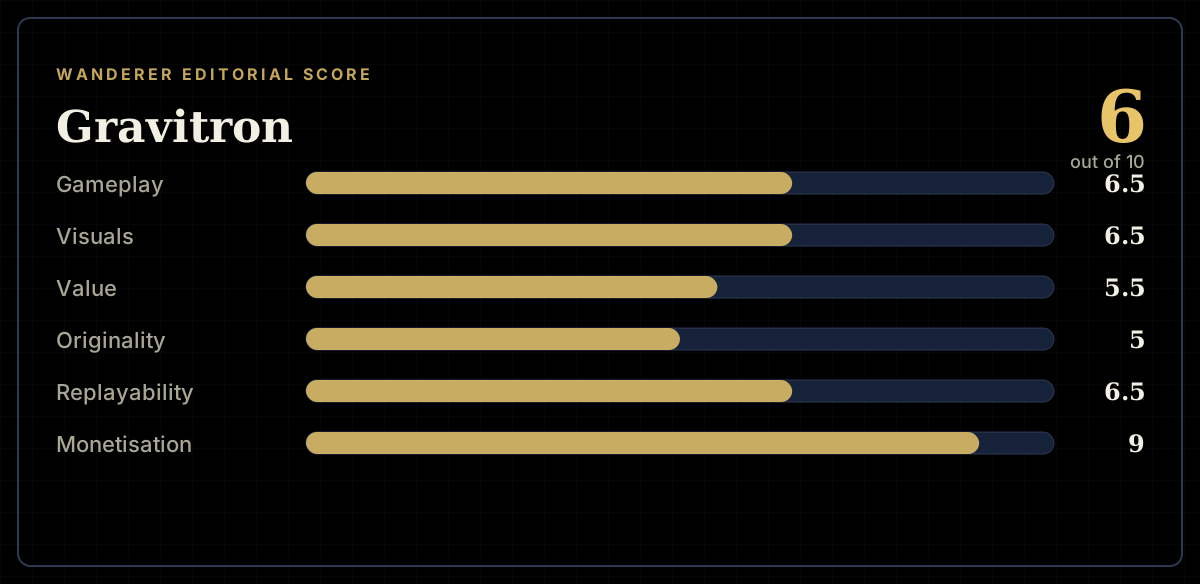
How the review scores each part of the gameWanderer Editorial -
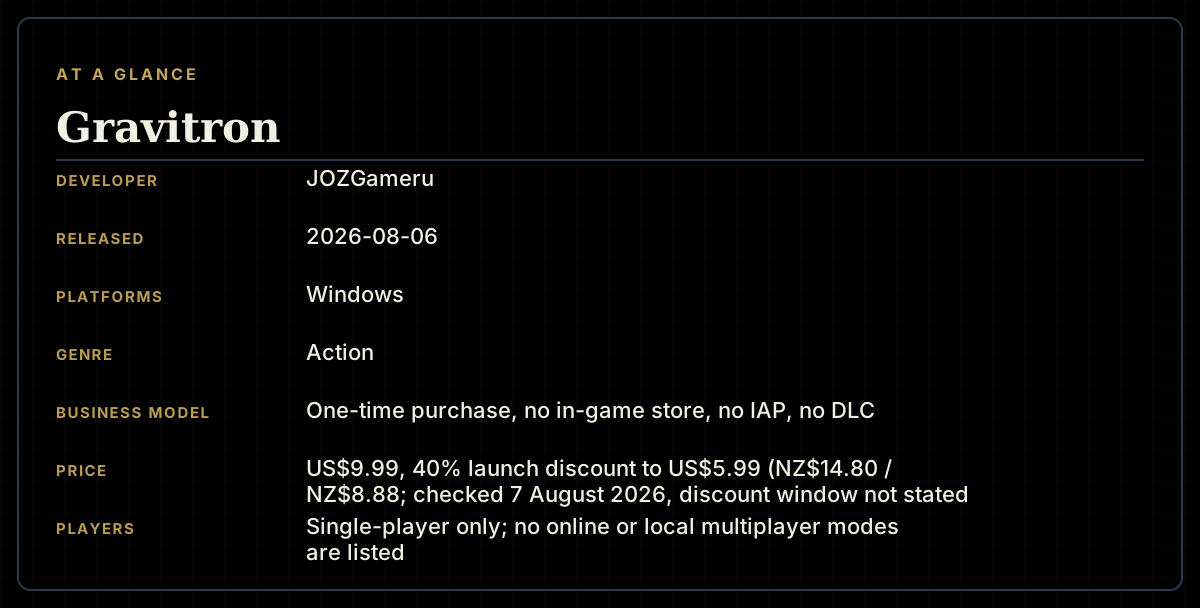
The game at a glanceWanderer Editorial -
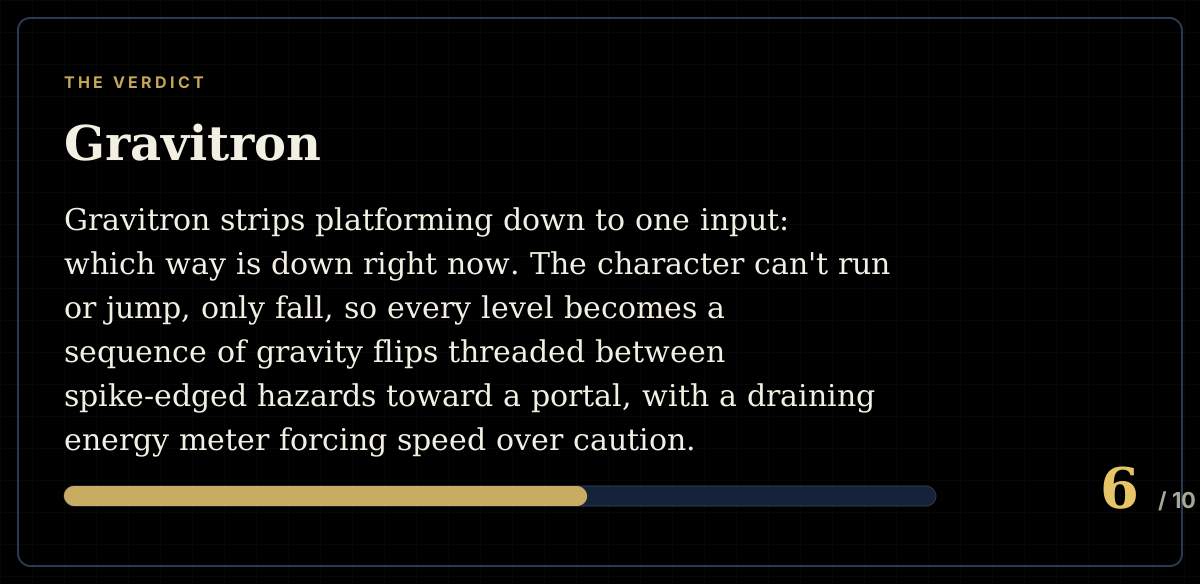
The short versionWanderer Editorial