Game review
Deep Rock Galactic
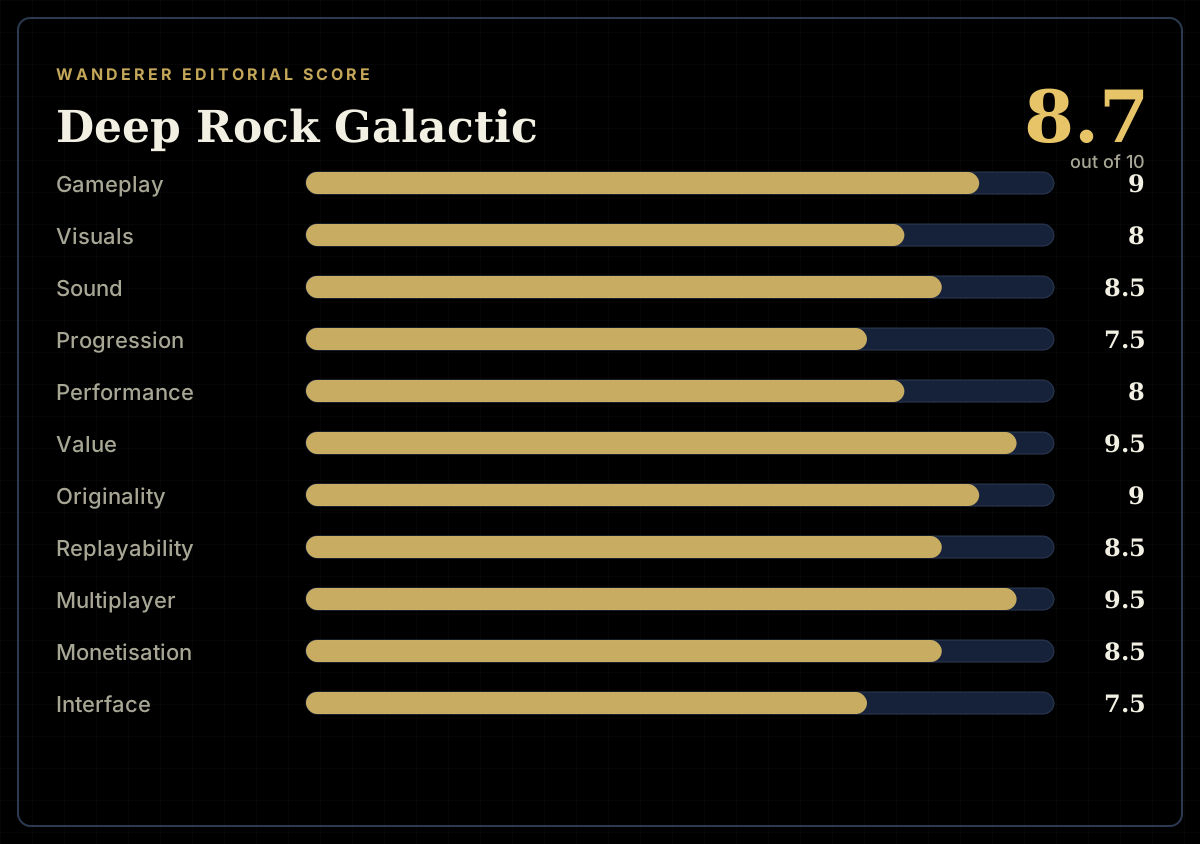
8.7 / 10
- Developer
- Ghost Ship Games
- Publisher
- Coffee Stain Publishing
- Released
- 13 May 2020
- Platforms
- Windows, PlayStation 4, PlayStation 5, Xbox One, Xbox Series X|S
- Genre
- Co-op Sci-Fi FPS
- Monetisation
- Premium one-off purchase; the seasonal Performance Pass is entirely free with no paid tier, alongside more than a dozen optional cosmetic-only DLC packs and a soundtrack bundle
- Players
- 1-4 player online co-op with drop-in matchmaking or private lobbies; full solo support via the Bosco companion drone
The short version
Deep Rock Galactic's cave systems are fully destructible, which sounds like a tech demo bullet point until you realise what it does to level design: there is no critical path, only a rock face and a decision about which direction costs you the least time and oxygen. Everything else the game does well — the four interlocking classes, the mission structure, even the tone — is built to make that one mechanic matter every few seconds instead of once per level.
It backs that up with one of the most player-friendly live-service models in this library: the seasonal content is free, the battle pass has no paid tier, and old seasons don't vanish, they fold into the general loot pool. What keeps it from a higher score is a mix of the familiar and the current: the gunplay itself is solid rather than exceptional, the overclock grind for the best gear runs long, and — a real, live thread in 2026's reviews — some of the game's most invested players report the last two seasons have delivered noticeably less content than the cadence that built this reputation in the first place.
Biggest strengths
- Fully destructible caves make traversal itself a skill and guarantee no two dives share the same layout
- Driller's drills, Scout's grapple, Engineer's platforms and Gunner's zipline are genuinely complementary tools, not four skins on one shooter
- The seasonal Performance Pass is completely free with no paid tier, and retired seasons fold into the general loot pool instead of vanishing
Biggest weaknesses
- A real, specific accessibility gap: the single most-upvoted negative review in this game's history describes the tutorial as unplayable for a colourblind player unable to distinguish gold ore from cave walls, and a separate 255-hour reviewer asks for better global brightness controls due to genuine eye strain
- A live, current thread in 2026's reviews from some of the game's highest-playtime veterans (1,500+ hours) reporting Season 5 and Season 6 delivered markedly less content than earlier seasons, with long gaps and few new overclocks or balance changes
- No in-game system to report players who intentionally sabotage or team-kill during missions, a complaint raised by a reviewer with over 1,300 hours
Who it's for: Co-op shooter fans who want a squad game that rewards planning and terrain-reading over twitch aim, and solo players who want a real support option rather than a difficulty slider. Less suited to players chasing the tightest, most precise gunplay a shooter can offer.
Our recommendation: Worth the full price on any platform, and an easy buy at the current discount. The cosmetic DLC packs are entirely optional — the base game and its free seasonal content are the whole experience, not a demo for the storefront.
8.7 / 10
Most co-op shooters build a level once and let every squad walk the same corridor. Deep Rock Galactic doesn't have corridors. Every cave on Hoxxes is generated fresh and can be dug through in any direction the moment your Driller decides the wall between you and the objective is slower to walk around than it is to erase. That single design decision — terrain as a resource you spend rather than scenery you navigate — is the reason this still reads as a genre of one nearly six years after its 1.0 launch, and it's the lens the rest of this review runs through.
Destructible terrain is the whole argument
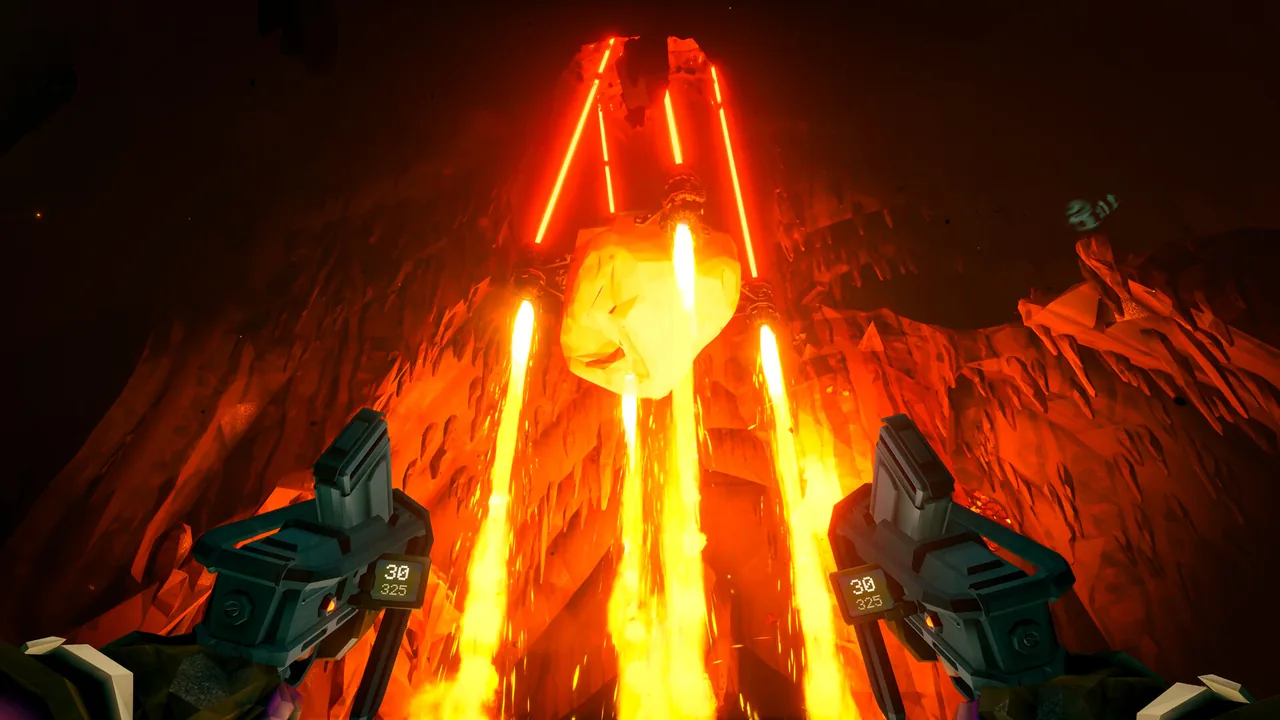
Strip away the dwarves, the sci-fi voice acting and the mining fantasy, and Deep Rock Galactic is still doing something almost no other shooter attempts at this scale: the map is not a fixed asset, it's a volume that responds to what you do to it. Fall into a chasm and you can dig your way back up instead of respawning at a checkpoint. Get swarmed in a dead end and a Driller can carve a new exit through solid rock in seconds. A Salvage Operation that looks impossible from the drop pod might have a shorter route two floors down that nobody would find without cutting straight through the wall.
That changes what "level design" even means here. There's no critical path to memorise, no optimal route a wiki can hand you, because the cave a wiki describes will never generate again. What the game hands you instead is a resource-management puzzle layered on top of the shooting: oxygen and time are finite, tunnelling is fast but not free, and every decision to go around instead of through is really a bet about which costs less. It's a smarter kind of traversal challenge than most shooters bother with, because it turns navigation from a solved problem into a live one.
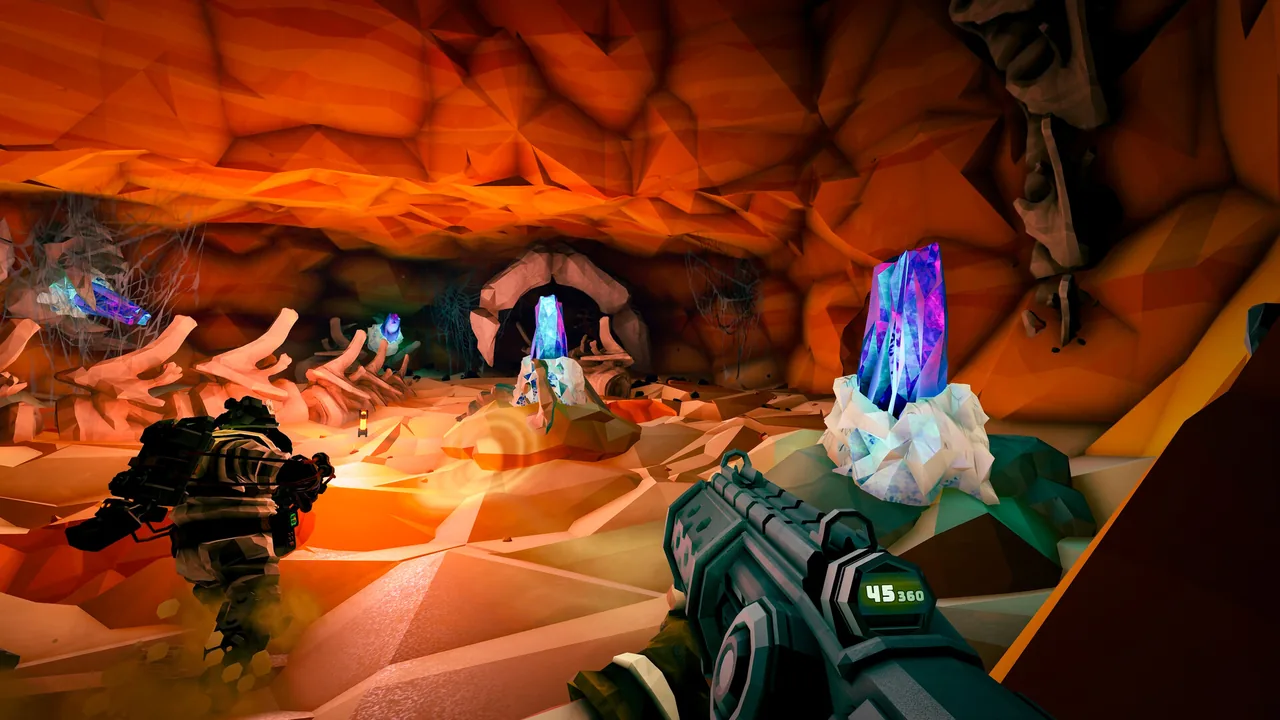
The honest trade-off is that procedural caves are very good at generating a shape and very bad at generating a place. Hollowbrook or Standing Watch, to borrow language from a different genre entirely, aren't things Deep Rock Galactic can produce — nobody remembers a specific cave from a specific run six months later the way they'd remember a hand-built dungeon. What you remember instead are moments: the drill that opened up at exactly the wrong time, the tunnel that dead-ended into a swarm, the extraction shaft your Gunner zipped a rope across with three seconds on the clock. That's a different kind of memorable, and whether it's a worse one depends entirely on what you go into a co-op shooter wanting.
Four classes that need each other
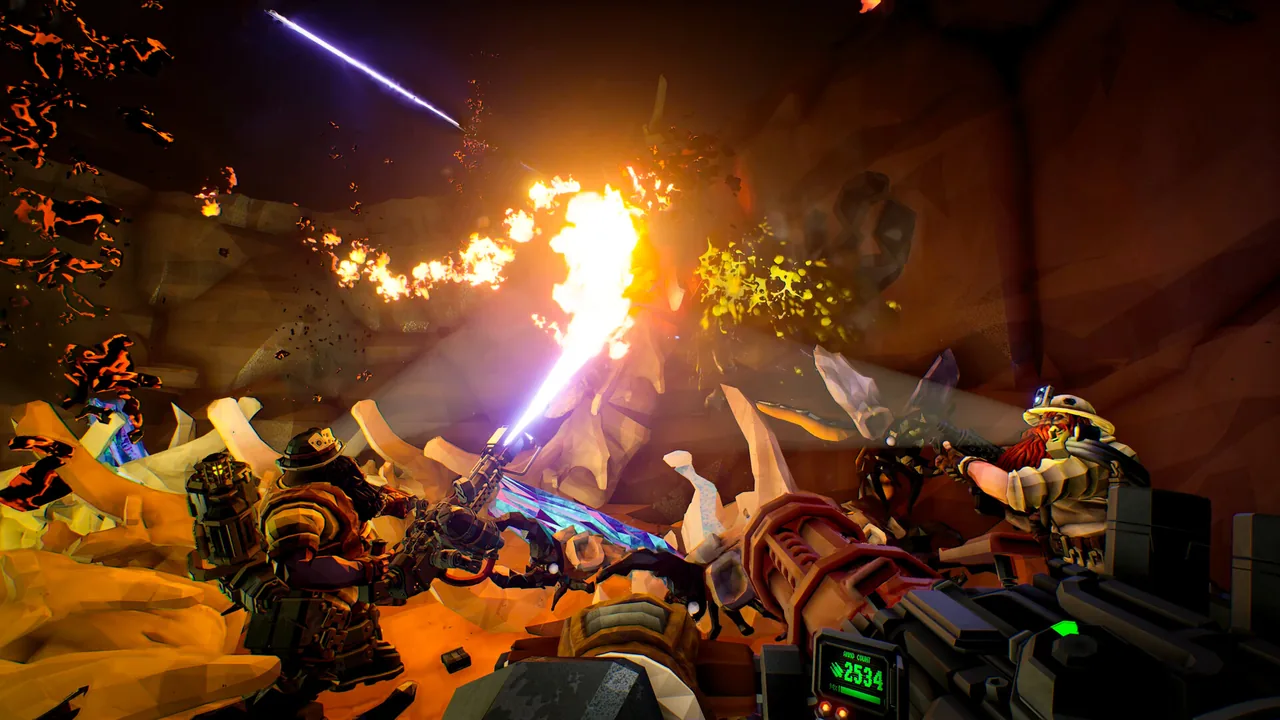
The class kit is where the destructible-terrain idea earns its keep, and it's the single best piece of systems design in the game. Each of the four dwarves owns a traversal tool that solves a different version of the same problem — getting somewhere the cave doesn't obviously let you go — and none of them substitute for each other cleanly. The Driller's twin drills cut straight lines through rock, the fastest way to make a new path but a poor one for reaching height. The Scout's grappling hook and flare gun solve verticality and visibility, letting a squad see and reach ledges nothing else can. The Engineer's platform gun drops solid ground anywhere, turning an unreachable ledge into a five-second detour. The Gunner's zipline gun does the same job across horizontal gaps, letting an entire team cross a chasm in one motion instead of finding a route around it.
Take any one of those tools out of a four-player squad and the mission changes shape, not just difficulty. A team without a Scout loses fast access to high ground and has to path around it. A team without a Driller solves cave-ins the slow way, walking instead of cutting through. That's a harder thing to design than it sounds — plenty of games hand each class a gimmick and call it variety, but Deep Rock Galactic's traversal tools are genuinely load-bearing, which is exactly why a mid-mission dropout stings more here than in most co-op shooters. The squad doesn't just lose a gun, it loses a capability.
Progression, overclocks and the grind underneath it
Long-term progression runs through Assignments and class Promotions, which gate cosmetic prestige and account-wide perks behind repeated play rather than raw hours, and through weapon and armour modification trees that open up as you level each class. The real depth — and the real grind — sits in Overclocks: rare, weapon-specific modifications, some clean upgrades and some deliberately double-edged, that can turn a serviceable gun into a build-defining one. Getting them means farming specific crafting materials and matrix cores that show up more reliably in Deep Dives and Elite Deep Dives, the game's toughest, time-limited mission chains.
That's the fair trade the game asks: the build-altering choices exist and they're genuinely interesting, but reaching them takes a long, repetitive climb through missions you've already mastered mechanically. It's a familiar shape to anyone who's played Deep Rock Galactic: Survivor, the auto-shooter spin-off that shares this game's mining hook and DNA but almost none of its mechanics — Survivor gates its best overclocks behind a similarly slow meta-progression climb, and the base game's community has the same love-it-or-tolerate-it relationship with the grind. The difference is that in the base game, a Deep Dive without the ideal loadout is still a complete, winnable mission built around skill and communication rather than a run cut short by an unlucky draft.
The season structure Wanderer's readers should actually envy
This is the part of the picture that stands out hardest against the rest of this review library. Deep Rock Galactic's live content runs on the Performance Pass, a themed seasonal track that is, by design, entirely free — there is no paid tier, no currency purchase that skips levels, nothing behind a wall except playing missions and completing challenges. Season 06, "Relics of Hoxxes," has been the live season since late January 2026, adding a new tomb-like biome, the Ossuary Depths, and its own enemy roster and mission variants, with lighter seasonal events (a Lunar Festival, an eight-year anniversary celebration, an Egg Hunt event) layered on top through the months since.
What makes this genuinely notable rather than just pleasant is what happens when a season ends: its unlocks don't get retired to a vault or a rotating shop. They fold into the general cosmetic pool, so a player who starts today isn't locked out of two years of past seasonal content the way they would be in almost any battle-pass game built around FOMO. Compare that to the live-service norm this library has spent months documenting, where seasonal content routinely expires, resets, or gets repackaged for a second sale — Deep Rock Galactic's approach is closer to how a paid expansion should behave than how a free-to-play season usually does, and it's a big part of why the community trusts the studio as much as it does.
That trust is exactly what's being tested in 2026, and it's worth reporting plainly rather than leaving the picture one-sided. Several reviewers with extraordinary playtime — 1,517 hours, 1,880 hours, 698 hours — say the pace behind Season 06 and its predecessor broke from the cadence that built this reputation. One counts 597 days since Season 5 launched and calls its content "fun for like a week at most." Another, at nearly 700 hours, describes Season 06 shipping "half the content" of the season before it, with no new overclocks or balance changes. These aren't reviews from players bouncing off the core loop — they're from the same profile of thousand-plus-hour player whose praise built the reputation this section just described, now asking whether the studio is keeping pace with its own standard. The existing content library — years of it, still included at the base price — remains excellent regardless of how any one season lands, but a prospective buyer deserves to know this conversation is live and current, not settled history.
Solo play and the robot who covers for a squad
Wanderer's readers often play alone, and Deep Rock Galactic is one of the rare co-op-first shooters that takes solo play seriously rather than treating it as the multiplayer mode with the difficulty turned down. Bosco, a small drone companion, is available exclusively in solo missions: it mines alongside you, fights, carries extra ore, and can revive you if you go down instead of ending the run. It doesn't replace a four-dwarf squad's tool synergy — there's no substitute for a Scout's grapple or a Gunner's zipline when you're the only one on the ground — but it means solo missions are a designed, supported way to play rather than an unofficial workaround, which is more than most squad-built shooters offer.
What money actually buys
The core game is a straightforward premium purchase, and everything that matters — every class, weapon, biome, mission type and the entire live seasonal track — ships in that base price with no gate behind a second purchase. Beyond it sits a long list of optional DLC, all of it cosmetic: character skins, weapon paint jobs, a soundtrack bundle and a couple of "Supporter" packs that fund the studio in exchange for cosmetic flair. None of it changes what a dwarf can do underground. That puts Deep Rock Galactic's monetisation close to best-in-class for this library — a fair comparison point is Warframe, another squad-shooter with a genuinely generous free-to-play model, except Deep Rock Galactic doesn't even ask for the free-to-play trade-off in the first place. You pay once, and the studio keeps building.
An accessibility gap worth naming directly
One thing this game's overwhelmingly positive reputation shouldn't paper over: the single most-upvoted negative review in Deep Rock Galactic's entire history is not a design complaint at all. A player with protanopia colourblindness describes being stuck in the tutorial itself, unable to tell gold ore apart from cave walls, while a friend playing the same section had no trouble. Separately, a reviewer with 255 hours logged asks for better global brightness controls outside of sandbox mode, citing genuine eye strain. Both are specific, well-founded and worth knowing about before buying if visual accessibility affects how you play — they sit oddly against a game otherwise built with obvious care for its players.
Where "Rock and Stone" doesn't cover for the game
The community's catchphrase culture is real, and it shapes how the game feels to play — greeting another player's "Rock and Stone" mid-mission is a genuine, low-stakes bonding ritual that plenty of shooters would kill for. But goodwill isn't a substitute for auditing the mechanics, and two weaknesses hold up under scrutiny. First, the gunplay itself is solid rather than special: weapons feel purposeful and modding them is satisfying, but next to a dedicated shooter's recoil patterns and hit feedback, the shooting here is clearly built to serve the mining and the terrain rather than to be the main event on its own. Second, despite a genuinely wide mission-type roster — salvage runs, escort duty, elimination, egg collection, on-site refining and more — the underlying job across most of them still resolves to the same three verbs: clear the bugs, grab the resource, reach extraction. Across hundreds of hours, especially once the overclock chase flattens out, that similarity becomes the more noticeable pattern, even with a new biome or mode dropped in every season.
Set next to something like Risk of Rain 2, where a run's identity resets completely every time you die, Deep Rock Galactic's missions are deliberately more stable and less chaotic — that's a legitimate design choice, not a flaw, but it does mean the game's long-term hook is squad chemistry and terrain-reading skill rather than build variety.
Verdict
8.7 out of 10. Deep Rock Galactic earns its reputation on the strength of one genuinely rare idea executed with real discipline: a cave that isn't scenery, four classes built to need each other inside it, and a live-service model that treats "free" as an actual promise instead of a funnel. Nearly six years after 1.0, that combination still hasn't been matched by anything wearing similar sci-fi trappings.
It's held below the top tier by a mix of the familiar and the current — a genuine grind behind the best overclocks, gunplay that's good but not the reason to play, a documented colourblind accessibility gap in its own tutorial, and a real 2026 conversation among the game's most invested players about whether recent seasons have kept pace with the standard the studio itself set. None of that undercuts what the existing game does better than almost anything else on the market. If you want a co-op shooter that rewards reading a space instead of just clearing it, and you're tired of live-service games that treat "free content" as a marketing term rather than a description, this remains one of the clearest recommendations this library can make — bought with clear eyes about where its momentum currently stands.
Price, season and review data checked 5 August 2026.
Pros and cons
Pros
- Fully destructible caves make traversal itself a skill and guarantee no two dives share the same layout
- Driller's drills, Scout's grapple, Engineer's platforms and Gunner's zipline are genuinely complementary tools, not four skins on one shooter
- The seasonal Performance Pass is completely free with no paid tier, and retired seasons fold into the general loot pool instead of vanishing
- The base price buys the finished game outright, and every one of the DLC packs is cosmetic only
- Bosco gives solo missions a real support option instead of just thinning out the enemy count
- Close to six years of consistent free content updates back up the community's reputation for good faith
Cons
- A real, specific accessibility gap: the single most-upvoted negative review in this game's history describes the tutorial as unplayable for a colourblind player unable to distinguish gold ore from cave walls, and a separate 255-hour reviewer asks for better global brightness controls due to genuine eye strain
- A live, current thread in 2026's reviews from some of the game's highest-playtime veterans (1,500+ hours) reporting Season 5 and Season 6 delivered markedly less content than earlier seasons, with long gaps and few new overclocks or balance changes
- No in-game system to report players who intentionally sabotage or team-kill during missions, a complaint raised by a reviewer with over 1,300 hours
- The underlying job across most mission types still resolves to clear the bugs, grab the resource, reach extraction, and that similarity shows after a few hundred hours
- Chasing specific Overclock blueprints and matrix cores for the build-defining unlocks is a genuine long grind gated behind repeated Deep Dives
- The gunplay is competent but doesn't have the weight or precision of a dedicated shooter, and it knows it is in service of the mining rather than the main event
- Menus, loadout comparisons and the equipment terminal still show the game's 2018 Early Access bones
- Procedurally generated caves rarely produce a place worth remembering by name, only a shape worth surviving
- Losing a class from a four-player squad is felt immediately, which makes a mid-mission dropout more painful than in most co-op shooters
Screenshots
-
Deep Rock GalacticImage: Coffee Stain Publishing via Steam -
Deep Rock GalacticImage: Coffee Stain Publishing via Steam -
Deep Rock GalacticImage: Coffee Stain Publishing via Steam -
How the review scores each part of the gameWanderer Editorial -
The short versionWanderer Editorial