
Game review
Dicey Dungeons
7.5 / 10
- Developer
- Terry Cavanagh
- Publisher
- Terry Cavanagh
- Released
- 13 August 2019
- Platforms
- Windows, Mac, Linux
- Genre
- RPG
- Monetisation
- Paid, with free content DLC (Reunion)
- Players
- false
The short version
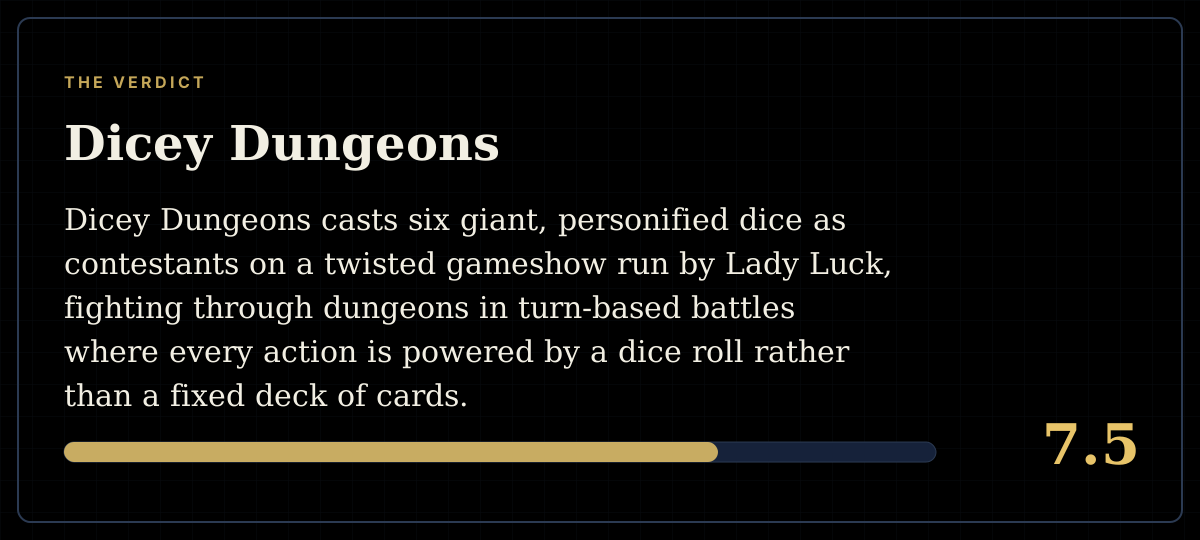
Dicey Dungeons casts six giant, personified dice as contestants on a twisted gameshow run by Lady Luck, fighting through dungeons in turn-based battles where every action is powered by a dice roll rather than a fixed deck of cards. Terry Cavanagh's distinctive presentation, humor and genuinely varied per-character mechanics earn broad, enthusiastic praise. But a detailed, unusually well-articulated critical minority argues the game's central promise — that skilled play can meaningfully mitigate its randomness — doesn't hold up as well as genre favourites like Slay the Spire, with runs often converging on the same obvious choices and late-game difficulty spikes that can feel like pure bad luck rather than a fair test of skill.
Biggest strengths
- Genuinely inventive core mechanic: replacing cards with dice, where different equipment wants high rolls, low rolls, odd, even or specific numbers, creates constant, distinctive tactical puzzles each turn
- Six mechanically distinct playable characters (plus a hidden seventh), each restructuring the core dice-combat loop in a meaningfully different way rather than reskinning the same system
- Charming, funny writing and presentation, with a memorable framing device (a rigged gameshow hosted by a mischievous, morally ambiguous host) that reviewers consistently enjoy
Biggest weaknesses
- A detailed, well-organized critical minority argues the game lacks real player agency — "in 95% of your runs they will be exactly the same," writes one reviewer, describing meager variety in early-game choices compared to genre benchmarks like Slay the Spire or Enter the Gungeon
- A specific, repeated complaint that later episodes introduce "Killer Levels" — sudden, severe difficulty spikes that reviewers describe as feeling less like fair challenge and more like a different, harder game bolted onto the earlier content
- No fast-retry option after a loss, according to at least one detailed reviewer, meaning failed high-difficulty runs require re-selecting character, episode and dialogue every single time
Who it's for: Fans of roguelike deckbuilders looking for something genuinely different in presentation and mechanics, who don't mind randomness playing a larger role than in genre benchmarks like Slay the Spire.
Our recommendation: A confident recommendation for the presentation, humor and inventive dice-based mechanics alone — just go in aware that a detailed contingent finds the actual strategic depth thinner than it first appears, especially in the later, harder episodes.
7.5 / 10
What it is
Dicey Dungeons drops six giant, personified dice into a rigged gameshow hosted by the capricious Lady Luck, sending each through a series of dungeon episodes where turn-based combat runs entirely on dice rolls rather than a conventional deck of cards. Developed and published solo by Terry Cavanagh — the creator of VVVVVV and Super Hexagon — it released on 13 August 2019 at NZD 21.99, later adding a free "Reunion" expansion with six additional episodes. Its review corpus, 6,281 in English, sits at a strong Very Positive 89.7% (5,637 to 644), and reading through it in depth reveals both a genuinely inventive core mechanic and a specific, detailed disagreement about whether that mechanic delivers real strategic depth or mostly the appearance of it.
A distinctive dice-combat system that earns real praise
Reviewers consistently single out the game's central hook as a genuine innovation within the crowded roguelike deckbuilder space. "This is a fantastic game," writes one detailed reviewer, describing it as effectively "13 variant games smashed into 1" across its six playable characters and hidden seventh. Another reviewer highlights the specific tactical texture the dice system creates: "when playing the Thief, for example, you don't actually want to roll 6s. You're much better off with 2s or 3s," describing how different equipment demands high rolls, low rolls, odd numbers, even numbers or exact values, forcing constant recalculation rather than a simple "biggest number wins" approach. Presentation draws its own independent, consistent praise — "this game is incredibly fun and the soundtrack is amazing," writes one reviewer, a sentiment echoed across dozens of others regardless of their overall verdict on the gameplay itself.
A detailed, specific case that the choices don't really matter
Set against that enthusiasm, this corpus contains an unusually well-articulated critical thread making a precise, mechanically literate argument rather than a vague complaint about difficulty. "The decisions are not interesting," writes one detailed, highly-upvoted review. "There's too much uncertainty for your choices to have much meaning... the game happens at you." A separate reviewer makes the comparison to genre benchmarks explicit: "it's not like Slay the Spire or Enter the Gungeon where a run can turn out all sorts of different ways. In 95% of your runs they will be exactly the same. Same starting equipment, meager variety in choices." A third, particularly thorough review frames the core failing as "a gaunt strategic horizon," noting that "most of my runs end with a character who battles the boss in the exact same way that they battled" earlier fights — a specific, structural critique of build variety rather than a complaint about losing to bad luck.
The "Killer Level" difficulty-spike complaint
A separate, more specific thread targets pacing rather than the core combat system. "It's a good, fun game until you hit a couple of Killer Levels, which basically turn it into a different game entirely, an exercise in frustration," writes one reviewer, describing "50 times repeating" a level as part of the resulting grind. Another reviewer raises a specific quality-of-life gap that compounds this frustration: "there's no fast retry option, you have to select your character, select the episode, skip through dialogue, and then you can start your next doomed run," turning each failed attempt at a hard level into a longer time investment than the actual combat itself. That's a fair, specific complaint distinct from the broader agency debate — even reviewers who enjoy the core dice mechanics describe these spikes as testing patience with menu navigation as much as skill.
Reconciling the disagreement fairly
It's worth noting this corpus contains its own internal rebuttal to the "no agency" critique. "Don't believe anyone who says it's a dice game and therefore not strategic," writes one reviewer. "This is a strategy game that encourages thinking about probabilities and how to mitigate randomness." Another puts it more bluntly: "anyone who says this game is bad is cringe and unironically whining about RNG in a game with 'Dicey' in its title." That's a reasonable framing worth taking seriously alongside the critical case — much of the disagreement in this corpus traces back to differing expectations about how much a roguelike deckbuilder should let skilled play override randomness, rather than a factual dispute about what the game actually does. Players who go in expecting Slay the Spire-level build determinism seem more likely to end up in the critical camp; those who embrace genuine chance as part of the challenge report a much more positive experience.
What the achievement data adds to the difficulty-spike debate
Dicey Dungeons's achievement curve offers a useful, concrete data point for the "Killer Level" complaints. Early challenge and episode achievements sit reasonably high (69.4%, 66.7%, 45.5%), but the curve drops sharply and steadily from there — later per-character episodes fall into the 10-20% range, and the hardest "bonus hard mode" achievements for each character bottom out at just 2.2-4.9%. That's a notably steep decline for a roguelike deckbuilder, and it corroborates the reviewer pattern directly: a meaningful share of the playerbase engages happily with the early-to-mid content, but the game's harder late-game and post-launch bonus material retains only a small, especially dedicated fraction of players — consistent with both the "Killer Level" frustration and the broader agency debate above.
Verdict
Dicey Dungeons succeeds at something genuinely rare — building a roguelike deckbuilder around a mechanic (dice rather than cards) that changes the texture of nearly every decision, wrapped in distinctive, funny presentation and a genuinely excellent soundtrack. Whether that mechanic delivers Slay the Spire-level strategic depth is a real, detailed point of disagreement within its own review corpus, and prospective buyers who prize build determinism over embracing chance should weigh that critical case carefully. For players willing to meet the game on its own terms, though, it remains a distinctive, well-crafted entry in a crowded genre.
Pros and cons
Pros
- Genuinely inventive core mechanic: replacing cards with dice, where different equipment wants high rolls, low rolls, odd, even or specific numbers, creates constant, distinctive tactical puzzles each turn
- Six mechanically distinct playable characters (plus a hidden seventh), each restructuring the core dice-combat loop in a meaningfully different way rather than reskinning the same system
- Charming, funny writing and presentation, with a memorable framing device (a rigged gameshow hosted by a mischievous, morally ambiguous host) that reviewers consistently enjoy
- A widely and specifically praised soundtrack that multiple reviewers call a highlight independent of the gameplay debate
Cons
- A detailed, well-organized critical minority argues the game lacks real player agency — "in 95% of your runs they will be exactly the same," writes one reviewer, describing meager variety in early-game choices compared to genre benchmarks like Slay the Spire or Enter the Gungeon
- A specific, repeated complaint that later episodes introduce "Killer Levels" — sudden, severe difficulty spikes that reviewers describe as feeling less like fair challenge and more like a different, harder game bolted onto the earlier content
- No fast-retry option after a loss, according to at least one detailed reviewer, meaning failed high-difficulty runs require re-selecting character, episode and dialogue every single time
- A recurring complaint that the game's meta-progression is thin, with runs feeling structurally similar to each other over a long play session despite surface-level character variety
- At least one reviewer specifically notes that mitigating the dice results through skill is harder in practice than the game's design promises, undercutting its core pitch as a strategic rather than purely luck-based experience
Screenshots
-

Dicey DungeonsImage: Terry Cavanagh via Steam -

Dicey DungeonsImage: Terry Cavanagh via Steam -

Dicey DungeonsImage: Terry Cavanagh via Steam -
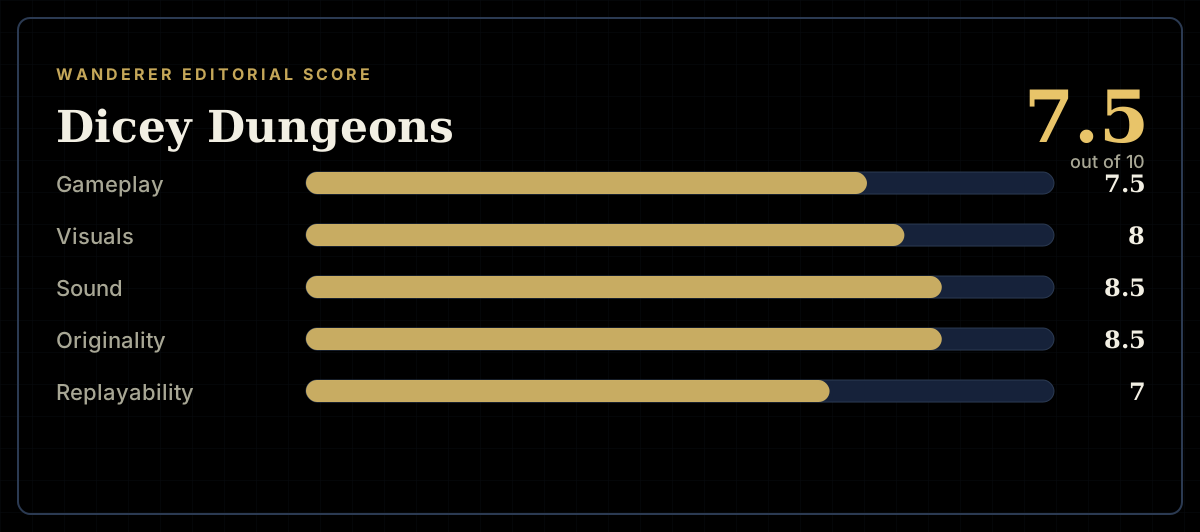
How the review scores each part of the gameWanderer Editorial -
The short versionWanderer Editorial