
Game review
Demon Queen's Hero Act
5 / 10
- Developer
- Zect Lab (ゼクトラボ) Lv10.jp
- Publisher
- Zect Lab (ゼクトラボ) Lv10.jp
- Released
- 13 August 2026
- Platforms
- PC
- Genre
- Idle Action-RPG
A demon queen cosplaying as the hero who's supposed to kill her
Demon Queen's Hero Act is a free-to-play idle action-RPG built around a genuinely fun premise: after generations of humans forging "heroes" to assassinate her, an exhausted demon queen casts a time-reversal spell, hands off her throne, and travels back to quietly talk would-be heroes out of the job before they ever pick up a sword. Released 13 August 2026 by Japanese solo-adjacent studio Zect Lab, the game delivers that story in short chapters between long stretches of auto-battling, gear-gacha pulls, and stat investment that keeps climbing whether or not you're at the keyboard. It's built entirely around Steam's Idler/Incremental/Action RPG/Auto Battler tag cluster, and it earns all four: the demon-queen framing is charming, but the actual minute-to-minute loop is standard idle-RPG stat-snowballing underneath it.
The core progression loop mixes gacha gear pulls, a gear-fusion upgrade system, and respec-able talent trees (with separate builds recommended for grinding stages versus fighting bosses), on top of manual stat purchases available at x1/x5/x10 multipliers. Numbers scale far enough that the late game literally runs out of digits — past a certain point the interface just displays "Immeasurable" instead of a number (the Japanese version uses an actual, if absurd, numeral name equivalent to 10^68 for the same milestone). After the main story ends, a Prestige system resets gear and talents for a New Game+ loop that keeps an online leaderboard of prestige counts and layers in a post-ending "Epilogue" story arc, so there's a defined structure to keep progression from just petering out.
Free to finish, and it means it
The most credible claim on the store page is the monetisation pitch: the base game is $0 forever, and every piece of DLC (growth-speed boosts, drop-rate boosts, talent coins, starter packs) is explicitly time-savers only, not gated content — the store page states plainly that the ending is reachable without spending. That's backed up indirectly by one of the more engaged Steam reviews, a Japanese player who logged over 480 hours (28,877 minutes) and reported the game opening up into "an absurd-numbers world" past the first few weeks of what plays like tutorial pacing, with no complaint about being blocked behind a paywall. For a genre that's frequently built to squeeze players, an explicit no-content-paywall pledge from the developer is worth crediting, even though it can't be independently confirmed how the optional DLC actually feels to skip once the numbers get punishing.
The interface has real, independently confirmed rough edges
Where this review can be more confident is in what the screenshots themselves show. The main combat screen keeps a permanently open bulk-purchase panel (x1/x5/x10 stat buys) sitting directly beside the fight, a scrolling combat log stacking skill triggers and reward text on top of a boss health bar, and currency counters in the tens of millions — a dense, text-heavy layout that leans hard on the player already knowing what everything means. One negative Japanese review, playing at 120 minutes, backs this up with a specific and checkable interface complaint: the x10 bulk-purchase buttons don't actually require affording all ten copies to activate — they only grey out once you can't afford a single one, silently processing a partial purchase (e.g. one or two copies) instead, which makes it hard to keep multiple stats level with each other on purpose. That's a concrete, mechanically specific bug report rather than a vague complaint, and it lines up with what the screenshot shows: a UI built for speed-clicking through purchases, not for careful build-planning.
A second negative review (Simplified Chinese, 1383 minutes played — a substantial time investment before writing a negative review) reported the game becoming very slow when minimized and generally sluggish during normal play, and separately reported a lost save file after reopening the game following a short break. Neither claim can be independently verified with the tools available here, but a detailed, specific bug report from a player who stuck around for over 23 hours is a stronger signal than a one-line complaint, and it's reflected in a conservative performance score.
An art-style mismatch worth flagging plainly
One of the negative Japanese reviews makes a serious allegation: that the game's promotional key art and character portraits are AI-generated, paired with "makeshift" pixel-art sprites that don't match the polish of the portraits, and that the trailer includes visible AI-art artifacts (mismatched finger counts, anatomically odd poses) that went unreviewed before release. This review is treating that specific claim — AI involvement in the art pipeline — as an allegation from one reviewer, not an established fact, since there's no official statement from the developer either way. What can be independently confirmed by looking at the screenshots directly: the dialogue-scene character portraits (the demon queen, her aide Nox) are rendered in a glossy, high-detail anime style that's visually inconsistent with the simple, blocky pixel-art sprites used in the actual combat screens — a real and visible split between the two art styles used in the same game, regardless of how either was produced. The same reviewer also raised more granular design complaints about the skill system (common skills sharing gacha-ticket pools across characters in a way that discourages using extra party members) and a gear "possession" stat that's tracked as a one-time unlock flag rather than a live count — plausible but not independently checkable claims, so they're noted here as the reviewer's account rather than confirmed fact.
A separate, unrelated observation that is independently verifiable: the store page lists English as a fully supported interface and audio language, but all three of the promotional screenshots on the store page — including the two combat screens — show exclusively Japanese UI text throughout, with no English visible anywhere. That's the same kind of store-claim-versus-screenshot mismatch this outlet has flagged in other Steam idle RPGs recently, and it's worth being aware of for anyone relying on the store's language claim before downloading.
Where this lands
Demon Queen's Hero Act has a better hook than most idle RPGs bother writing, a credible free-to-finish monetisation pledge, and a numbers-go-up structure that clearly holds at least one player's attention for hundreds of hours. Against that: a genuinely mixed review base (3 positive, 3 negative out of only 6 total), a bulk-purchase interface bug that's specific enough to trust, unverified but plausible performance complaints from a long-session player, and a real visual mismatch between its two art styles that's worth going in aware of. This is a fine pick for genre fans who want the demon-queen framing and don't mind rough UI edges on a free download, but it's not a game whose current small review pool gives much confidence about how it holds up over the very long haul the genre demands.
Screenshots
-
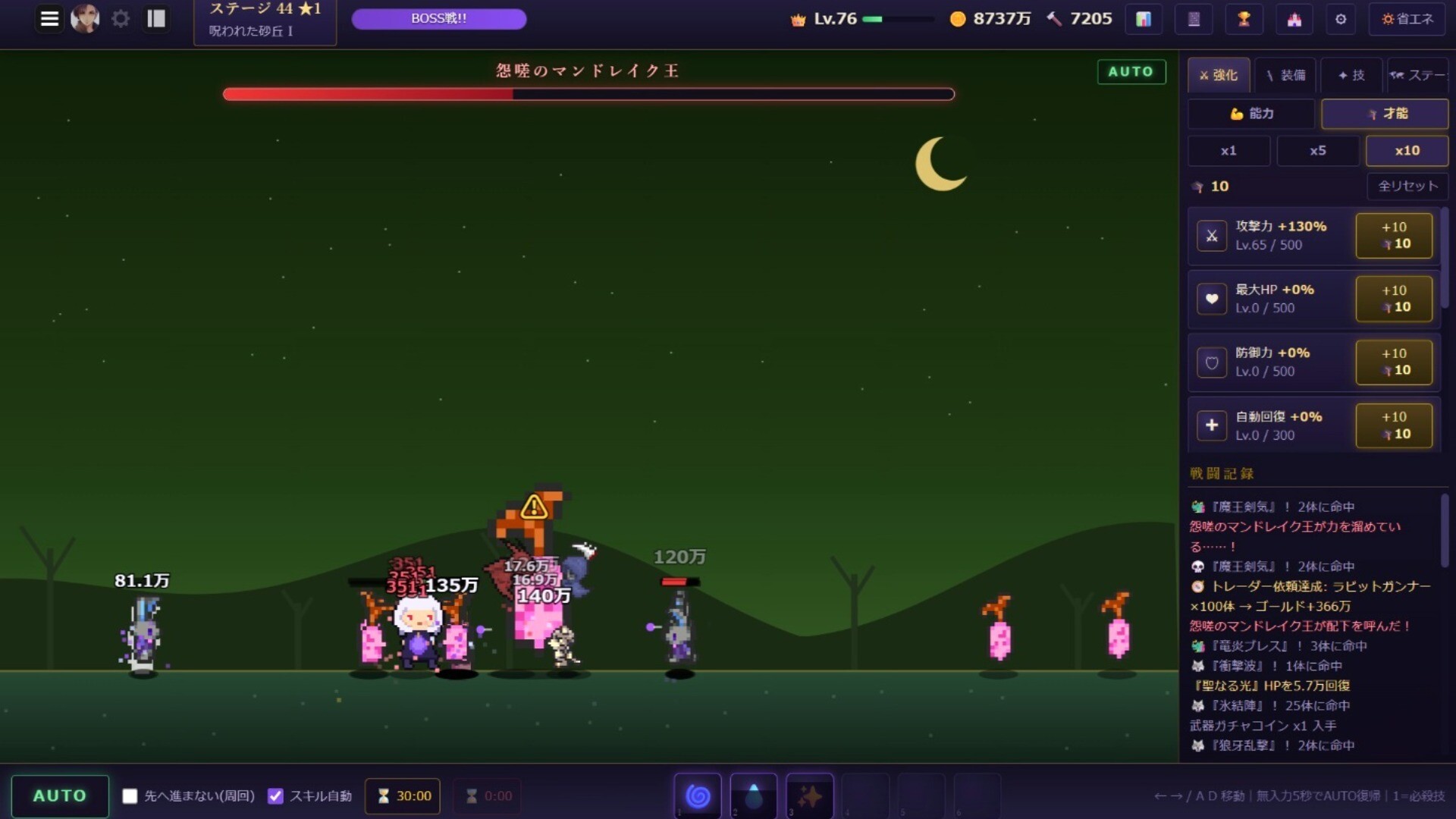
The main combat screen defaults to auto-battle against a scrolling gallery of named bosses, with bulk-purchase upgrade buttons (x1/x5/x10) sitting permanently open on the right.Steam store page -
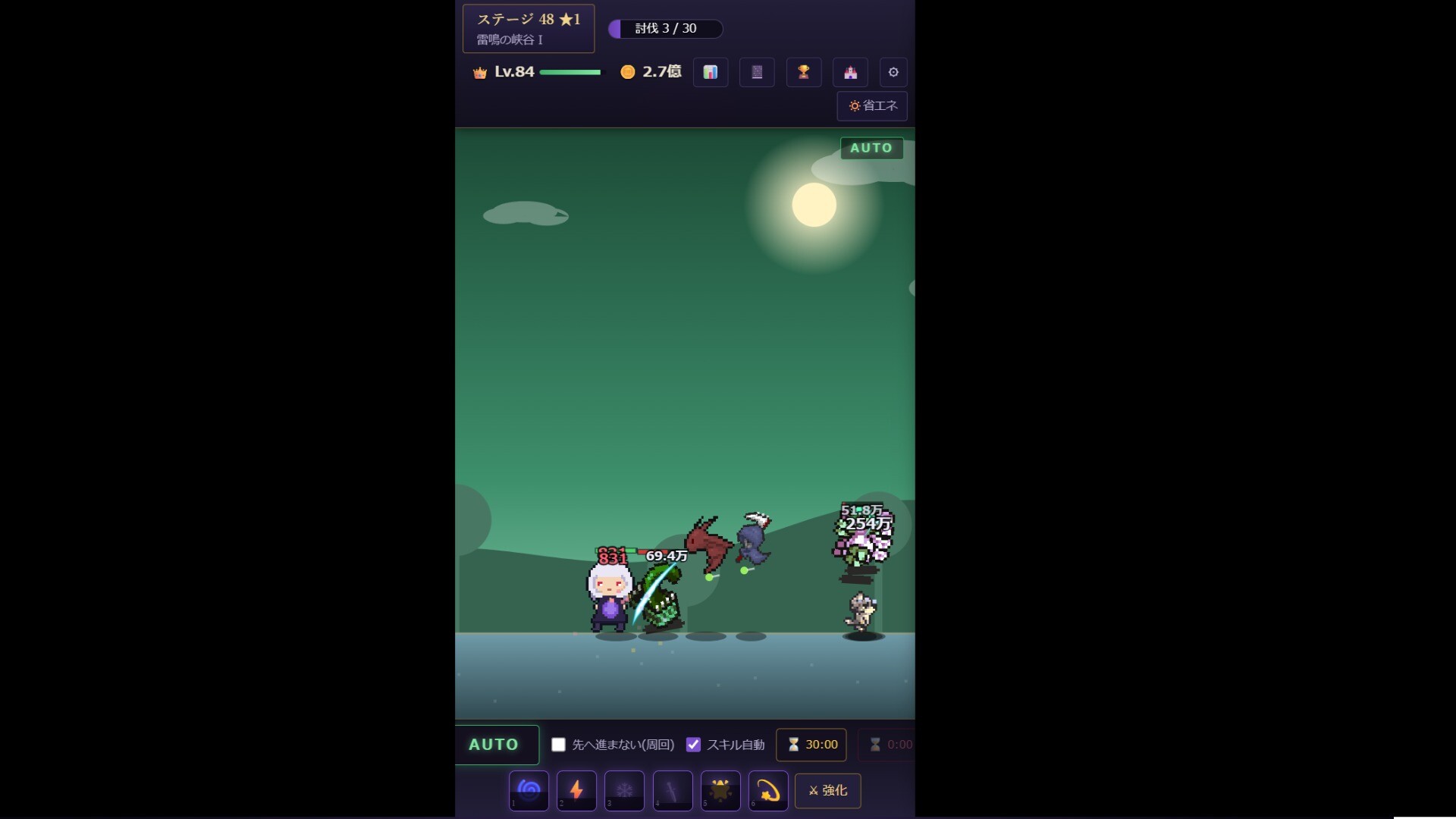
Stages track both a raw stage number and a kill-count objective per stage, feeding into a numbers-go-up structure the store page says is theoretically endless.Steam store page -
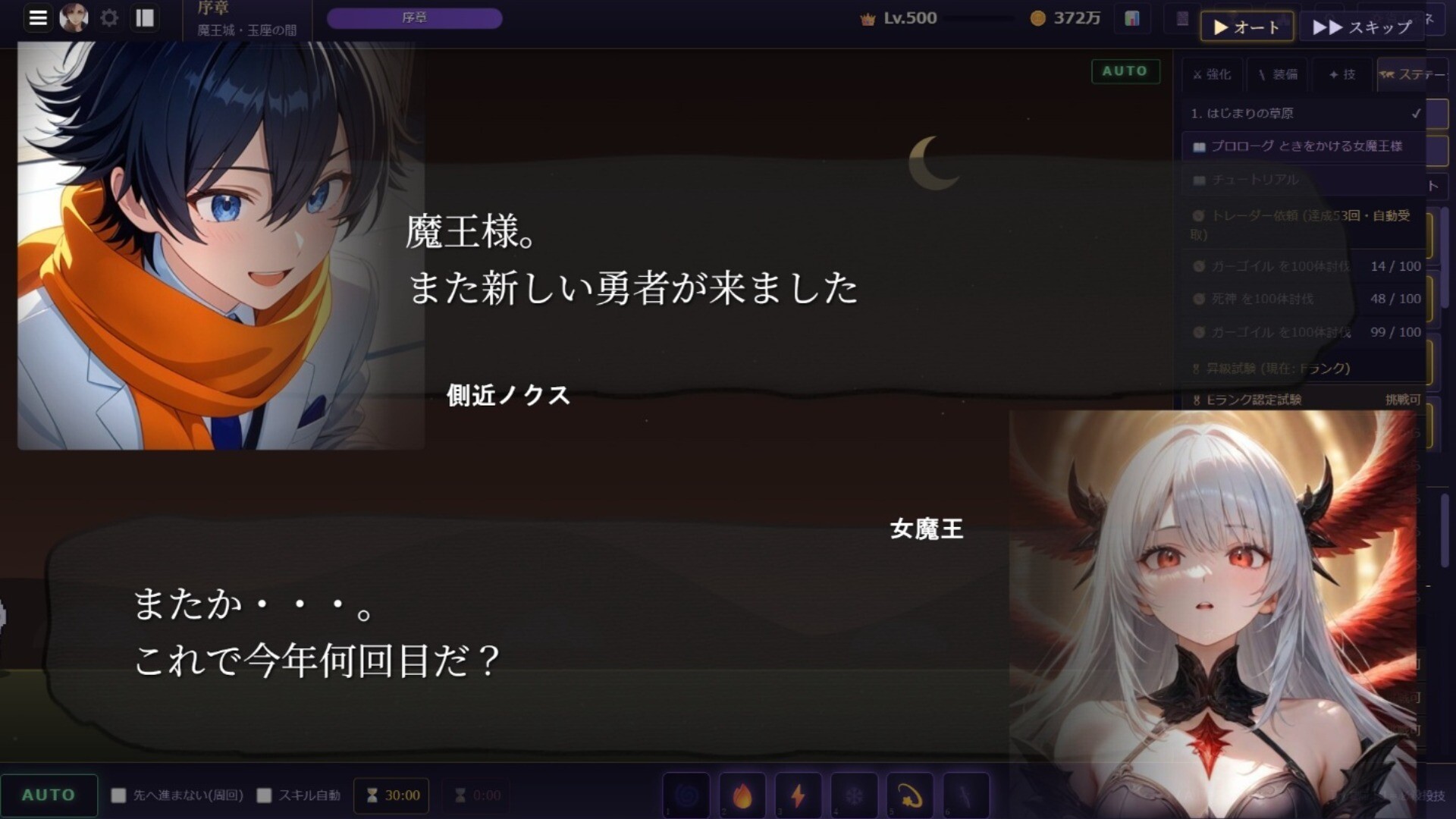
Story scenes swap the pixel-art combat view for full anime character portraits, delivered as short visual-novel exchanges between the demon queen and her court.Steam store page