
Game review
Dark Gnome
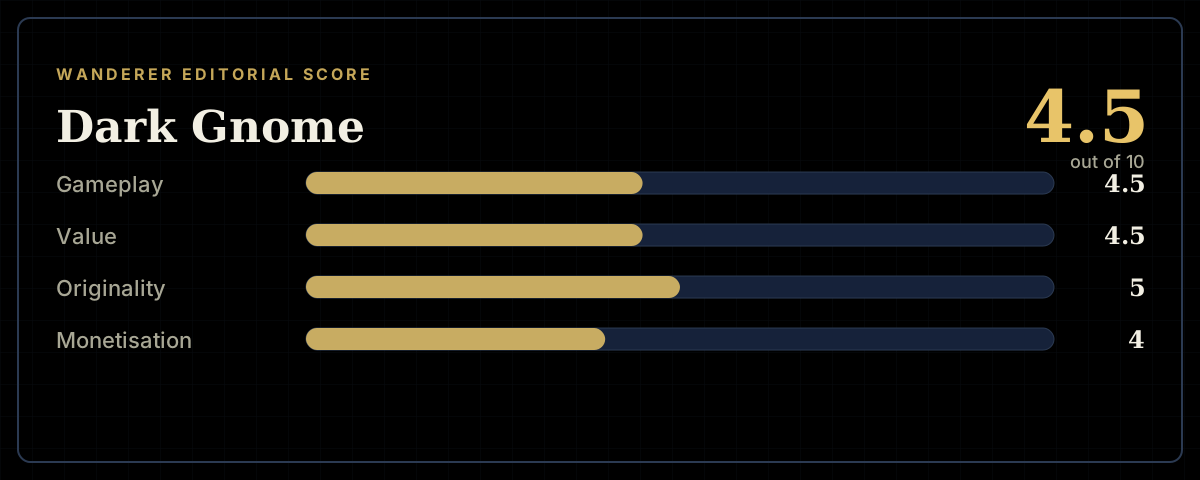
4.5 / 10
- Developer
- upjers
- Publisher
- upjers
- Released
- 18 March 2019
- Platforms
- Windows
- Genre
- RPG
- Monetisation
- Free-to-play with in-app purchases
- Players
- true
The short version
Dark Gnome dressed up a fairly standard free-to-play resource-and-combat loop — send a squad of dwarves out on missions, manage support roles back at base, fight PvE and PvP battles — in a genuinely distinctive dark-comedy pixel-art skin, from a studio with a long track record of shipping exactly this kind of browser game. It shut down for good in November 2024 having accumulated not a single written Steam review, leaving this review to work almost entirely from the game's own documented systems rather than any player's independent account.
Biggest strengths
- A distinctive dark-comedy pixel-art presentation built around a cast of specifically characterised support roles (a doctor, a cook, a blacksmith, a trainer) rather than generic town-hub NPCs
- Real role variety in its combat design, with rogues disarming traps, thugs dealing heavy damage, and medics healing mid-battle, requiring squad composition to be considered rather than a single dominant strategy
- Both PvE missions and a PvP mode offered, giving the game two distinct play patterns rather than one
Biggest weaknesses
- Zero written Steam reviews accumulated across the game's entire five-and-a-half-year lifespan, leaving no independent player account to verify how well any of its systems actually worked in practice
- Officially shut down: the game's own store description carries a direct announcement that service ended on 25 November 2024, with players told to spend remaining in-game currency before that date
- In-app purchases were present in a completely unreviewed free-to-play game, meaning there is no external account of how fair or aggressive that monetisation was
Who it's for: Retro strategy-RPG fans who specifically enjoyed upjers' other browser titles and want a similarly styled dwarf-themed take.
Our recommendation: No longer playable — reviewed here for the record rather than as a live recommendation.
4.5 / 10
What it is
Dark Gnome cast the player as the leader of a small horde of dwarves whose grudge against a rival tribe of rats — who stole a prized cooking pot — escalates into a full campaign of missions, resource-gathering, and both PvE and PvP combat. The pitch leans hard into a specific tone: "black humor" and a cast of deliberately quirky characters populating the player's home base, including a doctor who heals wounded dwarves, a cook who provides rations and potions, a blacksmith who crafts gear, and a trainer who teaches special attacks. That's a more characterised support-role setup than most free browser RPGs bother building, and it's the clearest evidence in the game's own marketing copy of real design intent behind the presentation rather than a generic reskin.
Combat draws on a familiar but reasonably deep role structure for the genre: rogues who disarm traps, thugs who deal heavy damage, and medics who heal on the battlefield, explicitly requiring the player to "assemble the right squad for the job" against different enemy types — rats, packs of dogs, cats and bandits are all named specifically as distinct threats. It released free-to-play on 18 March 2019 from upjers, a German developer and publisher with a long history of browser and mobile games brought to Steam, with in-app purchases as its stated monetisation model.
A review built almost entirely from documented systems
This review differs from most in a way worth stating plainly up front: across its entire five and a half years of availability, Dark Gnome accumulated zero written Steam reviews. There is no player account anywhere in the usual sources to independently confirm whether the squad-composition combat actually delivered meaningful tactical decisions, whether the resource-gathering missions felt rewarding or grindy, or how the in-app purchases were priced and structured relative to free progression. What follows leans on the game's own store description and its achievement-completion data, both of which are real, checkable facts, but neither of which can substitute for a player's lived account of the moment-to-moment experience.
The achievement data available is worth reporting carefully because its shape is genuinely unusual compared to other 2019 titles checked this lane. Eleven tracked achievements correspond to defeating eleven sequential bosses. The first shows 31.2% completion, dropping sharply to 15.6% for the second — a steep early falloff consistent with many free games losing a large share of their audience quickly. But rather than continuing a smooth decline, completion rates for bosses three through eleven cluster tightly in a narrow 5.5% to 7.2% band, essentially flat rather than gradually decreasing. That shape suggests something specific: whatever the game's real difficulty or content wall was, it seems to sit somewhere around the third boss fight, after which the players who push past it tend to see most or all of the remaining content through to the end, rather than dropping off gradually one boss at a time. That's a genuinely different completion pattern from the smooth, gradual decay curves this lane has found in most other achievement-tracked idle and RPG titles, and it's worth flagging as a real, if inconclusive, data point rather than reading too much into it without a player account to explain why.
What can't be verified here
It would be dishonest to write around the central limitation of this review a second time: nothing here can confirm whether Dark Gnome's monetisation was fair or predatory, whether the promised squad-tactics depth held up over dozens of missions, or whether the "dark humor" tone the marketing leans on actually landed with the players who tried it. The 24-screenshot gallery on the store page does suggest a reasonably developed game with real content variety rather than a barebones shovelware release, and upjers' long track record as an established studio (rather than a fly-by-night developer) is a modest point in the game's favour when weighing how seriously to take its own description. But modest circumstantial signals are not the same as verified quality, and this review should be read with that gap clearly in mind.
What the shutdown notice itself reveals
The shutdown announcement is worth reading closely for what it does and doesn't say. It's notably practical rather than apologetic in tone: players are told plainly to "spend your in-game currency until then if you wish to do so," a direct acknowledgment that whatever premium or earned currency existed would simply become worthless afterward, with no compensation, refund process, or migration path mentioned. That's a fairly standard way for a small free-to-play title to wind down, but it's worth naming plainly for what it is: any player who had spent real money on in-app purchases close to the shutdown date got no stated recourse for unspent currency. This isn't unusual for the genre — upjers runs a portfolio of similar free browser-to-Steam titles, and quietly retiring the lowest-performing ones while support continues elsewhere in the catalogue is standard practice for a studio operating at that scale — but it's a meaningfully different outcome for a player than the kind of full-refund wind-downs some larger publishers have offered for shuttered live-service games.
Reading the achievement plateau against the game's own structure
It's worth returning to that unusual achievement plateau — bosses three through eleven all clustering within a couple of percentage points of each other — because the game's own described structure offers one plausible, if unconfirmed, explanation worth naming even without a player account to verify it. If progression past an early wall depends heavily on properly building a squad around the rogue/thug/medic role split the store description emphasises, then players who never grasp or invest in that system would predictably stall around boss two or three regardless of how much further content exists, while players who do commit to proper squad-building would be equipped to carry that investment through most or all of the remaining bosses in a single continued push. That reading is speculative rather than confirmed — this review has no player testimony to check it against — but it's offered as a coherent hypothesis consistent with both the achievement data and the game's own stated design emphasis on squad composition, rather than treated as settled fact.
Verdict
Dark Gnome presented a genuinely distinctive dark-comedy take on the free-to-play squad RPG formula, with real characterised support roles and a combat system built around meaningful role variety on paper. Its complete absence of player reviews across more than five years of availability, now compounded by its formal shutdown in November 2024, means this can only be judged on its own documentation rather than on how it actually played for the people who tried it — a real gap this review is stating outright rather than papering over with confident-sounding guesses.
Pros and cons
Pros
- A distinctive dark-comedy pixel-art presentation built around a cast of specifically characterised support roles (a doctor, a cook, a blacksmith, a trainer) rather than generic town-hub NPCs
- Real role variety in its combat design, with rogues disarming traps, thugs dealing heavy damage, and medics healing mid-battle, requiring squad composition to be considered rather than a single dominant strategy
- Both PvE missions and a PvP mode offered, giving the game two distinct play patterns rather than one
- A substantial 24-screenshot gallery on its store page suggests a genuinely developed, content-rich game rather than a shovelware reskin
Cons
- Zero written Steam reviews accumulated across the game's entire five-and-a-half-year lifespan, leaving no independent player account to verify how well any of its systems actually worked in practice
- Officially shut down: the game's own store description carries a direct announcement that service ended on 25 November 2024, with players told to spend remaining in-game currency before that date
- In-app purchases were present in a completely unreviewed free-to-play game, meaning there is no external account of how fair or aggressive that monetisation was
- The achievement-completion curve is unusually shaped for this lane — a steep initial drop from 31.2% to 15.6% between the first two boss fights, then an odd flattening around 5.5-7.2% for the next eight, rather than the smooth gradual decay this lane's better-documented games typically show
Screenshots
-

Dark GnomeImage: upjers via Steam -

Dark GnomeImage: upjers via Steam -

Dark GnomeImage: upjers via Steam -
How the review scores each part of the gameWanderer Editorial -
The short versionWanderer Editorial