
Game review
Vagrus - The Riven Realms
7 / 10
- Developer
- Lost Pilgrims Studio
- Publisher
- Lost Pilgrims Studios
- Released
- 22 July 2020
- Platforms
- Windows, macOS, Linux
- Genre
- Turn-Based Fantasy RPG
- Monetisation
- One-time purchase, several paid story/cosmetic DLC packs
- Players
- Single-player
The short version
Vagrus - The Riven Realms is what happens when a tabletop RPG's worldbuilding instincts get poured into a Sunless Sea-shaped caravan-management game rather than a combat-first fantasy RPG, and its 85% Very Positive rating across 1,275 reviews reflects genuine devotion to that worldbuilding — reviewers compare the writing to reading an "epic mature fantasy novel" and the setting to Dark Sun. What keeps a large minority from recommending it is the systems the writing is wrapped around: an economy and combat balance several detailed reviews describe as so punishing without save-scumming that the resulting stress outweighs the reward, one calling the overall experience "like a toxic relationship" — a phrase that recurs, independently, more than once in the corpus.
Biggest strengths
- Writing and worldbuilding draw some of the most specific, personal praise in this library's coverage — multiple reviewers compare it directly to reading a fantasy novel, and to formative RPG touchstones like Dark Sun: Shattered Lands
- A genuinely rare genre combination — caravan/trading-company management crossed with tabletop-rooted narrative choice — that several reviewers say has almost no direct competitors currently on Steam
- Extensive accessibility options, including adjustable text size, a mouse-only control scheme, a touch-only option and play without timed input, go further than most narrative RPGs bother to offer
Biggest weaknesses
- Combat and economic balance are the corpus's dominant complaint — multiple detailed reviews describe RNG-driven encounters and a fragile economy that together make save-scumming feel less like a strategy and more like a requirement
- Several reviewers report the playable map area as a small fraction of the visible world, describing the eventual exploration ceiling as a disappointment relative to the demo's promise of scale
- Time and resource pressure runs continuously through the game by design, and more than one review argues this removes any real "downtime" to simply enjoy the writing without a looming failure state attached
Who it's for: Readers first, players second — anyone who wants a genuinely literary, unusually dark fantasy setting delivered through dense text and meaningful choices, and who can tolerate real narrative and economic risk without needing every system to feel fair, will find something few other games offer. Players who want their RPG's difficulty to come from skill expression rather than resource-attrition RNG should read the specific complaints below closely before buying.
Our recommendation: Recommended specifically for the audience it's built for — fans of Sunless Sea, Thea and text-heavy, mechanically harsh trading RPGs — with a clear warning that its economy and combat balance draw real, repeated, detailed complaints from players who otherwise loved everything around them. Try the free prologue demo before buying at full price; several reviewers specifically credit it with setting honest expectations.
7 / 10
A trading company built out of tabletop lore
Vagrus - The Riven Realms puts the player at the head of a small trading caravan crossing a continent devastated by an arcane cataclysm — cities barely function, monsters roam the wilderness, and the company's survival depends on managing food, morale, cargo and coin across a genuinely hostile map. Its roots in Lost Pilgrims Studio's own tabletop RPG show clearly in the density of the writing: reviewers describe reading through lore entries and event text at a volume closer to a novel than a typical RPG's flavour text, and the comparisons the corpus reaches for are specific and telling — Dark Sun: Shattered Lands' oppressive desert setting, Sunless Sea's mercantile dread, and George R. R. Martin-style "mature" fantasy prose come up independently across multiple reviews rather than as a single outlier's comparison.
That density is clearly the game's core appeal, and the players it wins over describe genuine, personal attachment to it. One reviewer frames evaluating Vagrus like reviewing "an epic mature fantasy novel," warning that the amount of reading required is itself a filter for the right audience. Another explicitly credits the world's atmosphere with hooking them despite going in expecting nothing more than "a little merchant caravan simulator." For players willing to meet the game on its own dense, literary terms, this is a genuinely distinctive experience in a genre where most competitors lean on combat or exploration spectacle instead of prose.
The systems underneath the prose
The recurring, specific complaint in this corpus isn't about the writing at all — it's about what happens when the writing's choices meet the game's economic and combat systems. Multiple detailed reviews describe RNG swings severe enough that a string of unlucky rolls can undo a well-managed run, with more than one reviewer explicitly stating the game feels "unplayable without save-scumming" in its current balance. Combat draws a specific complaint about evasion streaks turning fights into repeated whiffed attacks against an enemy at critically low health, a frustration distinct from the broader difficulty conversation and referenced by name in more than one review. Layered onto a design where time and resources are under near-constant pressure — food, money and morale all draining continuously rather than in discrete, manageable phases — several reviewers argue there's no real space left to simply enjoy the writing without an active failure state bearing down.
What makes this worth taking seriously rather than dismissing as one-off frustration is how the corpus's language converges. Two separate reviewers, writing independently, reach for the exact same word to describe their overall relationship with the game: "toxic." That's an unusually strong, specific characterisation for players who are simultaneously praising the writing in the same review — it isn't "the game is too hard," it's "the game's core loop makes me feel bad in a way I keep coming back for anyway," which is a genuinely different and more serious kind of critical signal.
What the demo actually tells you
Several reviewers specifically praise the existence and accuracy of Vagrus's free prologue demo — a rarer courtesy than it should be in a genre this niche, and one that several buyers credit directly with letting them opt out before spending money on a game whose difficulty philosophy clearly isn't for everyone. That's worth stating plainly as its own point in the game's favour: a studio confident enough in its own identity to let players test the exact tone and pacing they'll be signing up for, rather than leading with a curated highlight reel, is doing right by a buyer even when what that demo reveals is "this will frustrate you."
One recurring, more specific disappointment tied to that demo is scale. More than one reviewer who loved the prologue describes the eventual playable area of the full game as a small fraction of the visible world map, expecting a scope the release doesn't fully deliver on. That's a fair expectation-management complaint distinct from the balance conversation above — it's not that the world feels wrong, it's that reviewers who fell for the demo's sense of possibility found the actual campaign's geography more contained than they'd hoped.
Accessibility and value
Vagrus's accessibility feature list is unusually thorough for a text-dense RPG: adjustable text size, a mouse-only control option, a touch-only option for tablet play, and the ability to play without any timed input at all — a meaningful accommodation given how much of the game's tension elsewhere comes from resource pressure rather than reflexes. Combined with Steam Cloud saves and Remote Play across phone, tablet and TV, it's a genuinely well-considered accessibility package that doesn't get much attention in the review corpus simply because it works quietly rather than drawing complaints.
At NZ$44.99 before its several story and cosmetic DLC packs, the base game sits at a real but not unreasonable price for the genre, and reviewers weighing cost against the hundred-plus hours several report sinking into it generally don't list price as a primary complaint — the corpus's frustration is almost entirely about how those hours feel moment to moment, not about what they cost.
Verdict
Vagrus - The Riven Realms occupies a rare space: a caravan-management RPG built by writers first, with a setting and prose several reviewers rank among the best they've read in the medium, wrapped around economic and combat systems that a large, detailed minority say actively work against enjoying that writing. Its 85% Very Positive score is earned rather than inflated — the fans this game has made are genuinely devoted — but the balance complaints are specific, repeated, and come from players who otherwise loved everything else on offer, which makes them harder to dismiss than an ordinary "too hard" grumble. Try the free demo, know what kind of frustration you're signing up for, and this is one of the more distinctive fantasy RPGs on Steam. Go in expecting a purely comfortable reading experience and the corpus's harshest reviews will likely become your own.
Pros and cons
Pros
- Writing and worldbuilding draw some of the most specific, personal praise in this library's coverage — multiple reviewers compare it directly to reading a fantasy novel, and to formative RPG touchstones like Dark Sun: Shattered Lands
- A genuinely rare genre combination — caravan/trading-company management crossed with tabletop-rooted narrative choice — that several reviewers say has almost no direct competitors currently on Steam
- Extensive accessibility options, including adjustable text size, a mouse-only control scheme, a touch-only option and play without timed input, go further than most narrative RPGs bother to offer
- A free prologue demo lets players test the tone and difficulty before committing to the full NZ$44.99 price, and several reviews specifically credit it with managing their expectations honestly
Cons
- Combat and economic balance are the corpus's dominant complaint — multiple detailed reviews describe RNG-driven encounters and a fragile economy that together make save-scumming feel less like a strategy and more like a requirement
- Several reviewers report the playable map area as a small fraction of the visible world, describing the eventual exploration ceiling as a disappointment relative to the demo's promise of scale
- Time and resource pressure runs continuously through the game by design, and more than one review argues this removes any real "downtime" to simply enjoy the writing without a looming failure state attached
- At least two independent reviews use the same specific phrase — describing their relationship with the game as "toxic" — a striking, repeated framing for a game whose writing and setting they otherwise praise highly
- The learning curve is steep enough that several reviewers who ultimately recommend the game still describe an initial run or two ending in a slow, frustrating collapse before the systems click
Screenshots
-

Vagrus - The Riven RealmsImage: Lost Pilgrims Studios via Steam -

Vagrus - The Riven RealmsImage: Lost Pilgrims Studios via Steam -

Vagrus - The Riven RealmsImage: Lost Pilgrims Studios via Steam -
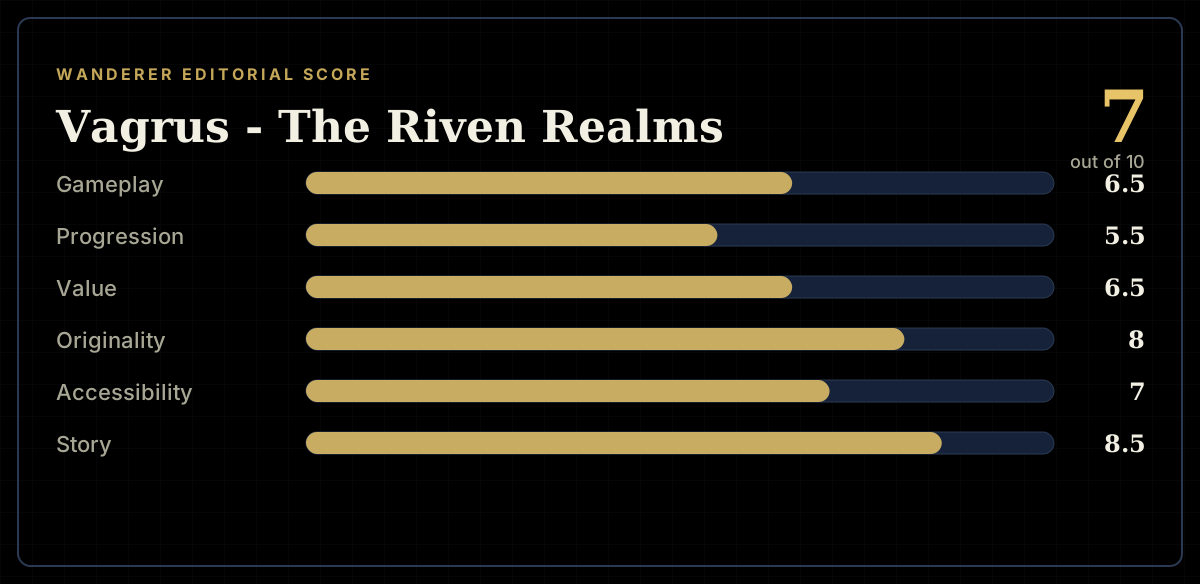
How the review scores each part of the gameWanderer Editorial -
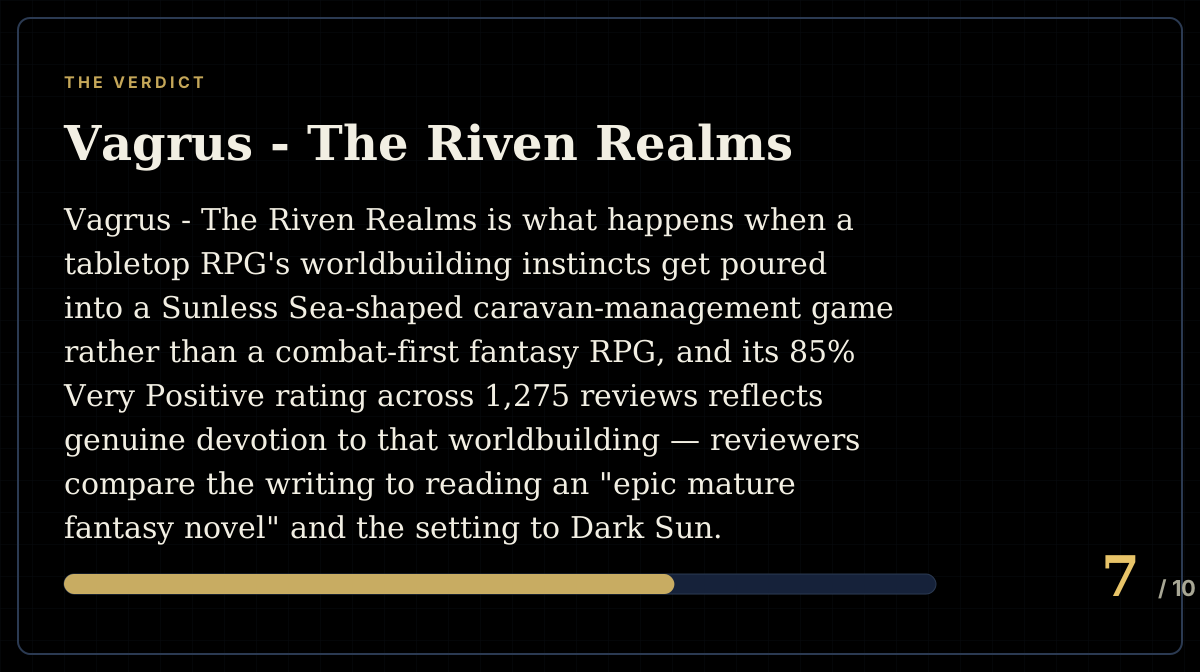
The short versionWanderer Editorial