
Game review
Fell Seal: Arbiter's Mark
7 / 10
- Developer
- 6 Eyes Studio
- Publisher
- Fulqrum Publishing
- Released
- 30 April 2019
- Platforms
- Windows, macOS, Linux
- Genre
- Tactical RPG
- Monetisation
- One-time purchase, one paid DLC expansion
- Players
- Single-player
The short version
Fell Seal: Arbiter's Mark set out to be the Final Fantasy Tactics successor a generation of players has wanted for decades, and on the specific promise of a deep, freely mixed class and ability system, its 89% positive rating across 3,426 reviews says it largely delivered. What keeps that same review corpus from unreserved praise is remarkably consistent: a story reviewers repeatedly call flat or poorly written, and a difficulty curve that several detailed accounts describe tipping from genuinely tactical to a grinding chore in the second half, as enemies scale with the player and healing-heavy fights stretch into attrition wars.
Biggest strengths
- The class system lets any character freely mix a main class's abilities with a secondary class's, plus a reactive skill and equipment slot, producing genuinely deep build variety that multiple reviewers rank above Final Fantasy Tactics' own system
- Missions are built around distinct win conditions and terrain rather than simple "kill everything," and several detailed reviews credit specific encounter design for forcing real tactical adaptation rather than repeating one dominant strategy
- A two-person core team (with contracted support) delivering a 30-50 hour campaign at this level of systemic depth draws genuine, specific respect even from reviewers who ultimately can't recommend the full package
Biggest weaknesses
- Writing and story are the single most consistent complaint in the review corpus, described across dozens of reviews as flat, cliché-driven or simply uninteresting compared to the mechanical depth surrounding it
- Multiple detailed reviews describe the difficulty curve inverting in the second half — enemies that scale alongside the player make grinding feel pointless, and healing-heavy late-game encounters stretch fights into slow wars of attrition rather than sharp tactical puzzles
- The class-mastery system, which rewards switching a character's main class once it's mastered to avoid "wasting" ability points, is called an artificial, unwelcome pressure by several reviewers who'd rather commit to a build than be nudged away from it
Who it's for: Players specifically chasing the Final Fantasy Tactics or Tactics Ogre itch, who care more about building an army of freely customised classes than about the story carrying them there, are exactly who this was made for and who its own reviewers say it serves best. Anyone who needs a tactics game's narrative to hold up alongside its combat, or who bounces off pacing that slows rather than accelerates in its second half, should read the specific complaints below before buying at full price.
Our recommendation: Recommended for tactical RPG fans on the strength of its class system alone, with a clear caveat: go in for the strategic sandbox, not the story, and be aware more than one detailed review describes losing steam specifically in the second half rather than at launch.
7 / 10
A crowdfunded promise, kept on its central premise
It's worth stating plainly what 6 Eyes Studio was competing against: a decades-long, still-unmet fan wish for a proper Final Fantasy Tactics sequel, one strong enough that reviewers here openly frame their expectations against a game that doesn't exist rather than against Fell Seal on its own terms. That's a difficult bar to be measured against, and the review corpus is unusually self-aware about it — several reviewers explicitly caveat their score with some version of "you're only here because you played Final Fantasy Tactics," treating that inherited context as part of the review rather than pretending Fell Seal exists in a vacuum. Judged that way, the honest answer the corpus arrives at isn't "better than FFT" or "a disappointing imitation" — it's closer to "the mechanics genuinely improve on the formula, the story and pacing genuinely don't," which is a more useful verdict for a buyer than either extreme would be.
Building the army Final Fantasy Tactics never let you build
Fell Seal: Arbiter's Mark is upfront about its influences — a grid-based tactical RPG about a squad of Arbiters enforcing order across a fantasy realm, built by a team that has said outright it wanted to succeed where it felt Final Fantasy Tactics Advance's structure held players back. The part of that ambition the review corpus credits without much argument is the class system: every character can hold a main class's full skill set alongside a secondary class's abilities, plus a reactive "counter" skill and an equipment loadout, and multiple long-time genre veterans specifically rank the resulting build flexibility above the games it's imitating. One reviewer who has spent two decades chasing "FFT2" calls the combination of classes here more freely mixable and more rewarding to theorycraft than anything the genre's most famous entry ever offered. That's a real, earned distinction, not faint praise — it's the single thing the negative reviews concede even while criticising everything around it.
Mission design backs that system up more often than not. Reviewers repeatedly point to specific encounters built around distinct win conditions and terrain hazards rather than simple attrition, arguing that Fell Seal is at its best when a fight forces you to actually use the sandbox rather than repeat a solved formula. For a two-person core studio supported by two dozen contractors, delivering that level of systemic ambition across a 30-to-50-hour campaign is a genuine achievement, and several reviews who ultimately can't recommend the whole package still say so plainly before explaining why.
Where the second half loses the room
The complaint that shows up with the most consistency, across reviews otherwise disagreeing on almost everything else, is the writing. "The writing is astonishingly bad" is one reviewer's blunt summary; others are gentler but land in the same place, describing the story as flat, cliché-heavy, or simply an afterthought next to the combat systems it's wrapped around. For a genre where Tactics Ogre and Final Fantasy Tactics are remembered as much for morally complicated storytelling as for combat, several reviewers frame this as the one area where Fell Seal doesn't even attempt to compete with its inspirations, rather than falling short while trying.
The more mechanically specific complaint concerns pacing, and it's detailed enough across independent reviews to treat as a real pattern rather than a handful of players hitting a difficulty wall. As the campaign progresses, enemies scale alongside the player's level, which more than one reviewer says makes the genre's usual grinding-for-safety strategy pointless — you can't out-level a fight that levels with you. Combined with healing-heavy late-game enemy compositions, several detailed accounts describe fights stretching into long wars of attrition rather than the sharp, decisive tactical puzzles the earlier campaign delivers, with more than one reviewer specifically calling the late game's pacing "glacial." A smaller but pointed complaint singles out the class-mastery system for the same reason: once a class is mastered, the game nudges players to switch mains to avoid "wasting" ability points, which several reviewers describe as an artificial pressure against just committing to a build they enjoy.
Value against the campaign length
At NZ$46.49, Fell Seal sits at the pricier end of the indie tactics shelf, but reviewers weighing cost against runtime generally land somewhere between fair and generous — a 30-to-50-hour main campaign, before touching the single paid DLC expansion (Missions and Monsters, which adds extra scenarios and challenges rather than gating core content behind a paywall), is a genuinely substantial amount of tactics-game content for the price by most reviewers' own accounting. The achievement data supports a campaign most owners genuinely engage with rather than bounce off immediately: completion percentages decline gradually rather than falling off a cliff after the first few hours, consistent with a game whose main criticisms are about the back half of a long campaign rather than an early-game barrier to entry.
It's also worth crediting the accessibility choices that don't show up in any review headline but matter to players evaluating the purchase: full DualSense and DualShock controller support, Steam Cloud saves and Remote Play on TV all suggest a studio thinking about how the game gets played beyond a desktop mouse-and-keyboard session, which is a genuinely useful, unglamorous piece of craft for a genre that traditionally assumes PC-only play.
Verdict
Fell Seal: Arbiter's Mark earns its Very Positive rating on the strength of a genuinely deep, freely combinable class system and encounter design that rewards real tactical thinking more often than it doesn't — exactly the itch its intended audience came looking for, and its own reviewers confirm it scratches that itch better than most of the genre's recent entries. But the story is close to universally called the weak link, and a specific, well-documented pacing problem in the second half means the campaign's back stretch asks for more patience than its front half earns. For tactics fans who came for the class system and don't need a great story alongside it, that's an easy trade. For anyone hoping the whole 30-to-50-hour package holds together evenly from start to finish, the reviews that describe losing steam partway through are worth taking seriously before buying at full price.
Pros and cons
Pros
- The class system lets any character freely mix a main class's abilities with a secondary class's, plus a reactive skill and equipment slot, producing genuinely deep build variety that multiple reviewers rank above Final Fantasy Tactics' own system
- Missions are built around distinct win conditions and terrain rather than simple "kill everything," and several detailed reviews credit specific encounter design for forcing real tactical adaptation rather than repeating one dominant strategy
- A two-person core team (with contracted support) delivering a 30-50 hour campaign at this level of systemic depth draws genuine, specific respect even from reviewers who ultimately can't recommend the full package
- Full controller support including DualSense and DualShock input, alongside Steam Cloud and Remote Play on TV, make it comfortable outside a mouse-and-keyboard setup
Cons
- Writing and story are the single most consistent complaint in the review corpus, described across dozens of reviews as flat, cliché-driven or simply uninteresting compared to the mechanical depth surrounding it
- Multiple detailed reviews describe the difficulty curve inverting in the second half — enemies that scale alongside the player make grinding feel pointless, and healing-heavy late-game encounters stretch fights into slow wars of attrition rather than sharp tactical puzzles
- The class-mastery system, which rewards switching a character's main class once it's mastered to avoid "wasting" ability points, is called an artificial, unwelcome pressure by several reviewers who'd rather commit to a build than be nudged away from it
- At least one detailed review argues the tactical depth is more surface-level than it first appears, once a small number of dominant ability combinations are discovered
- Enemy AI is repeatedly accused of favouring the most frustrating available option — stacking haste and double-cast abilities in particular — rather than behaving in a way several reviewers call genuinely intelligent
Screenshots
-

Fell Seal: Arbiter's MarkImage: Fulqrum Publishing via Steam -

Fell Seal: Arbiter's MarkImage: Fulqrum Publishing via Steam -

Fell Seal: Arbiter's MarkImage: Fulqrum Publishing via Steam -
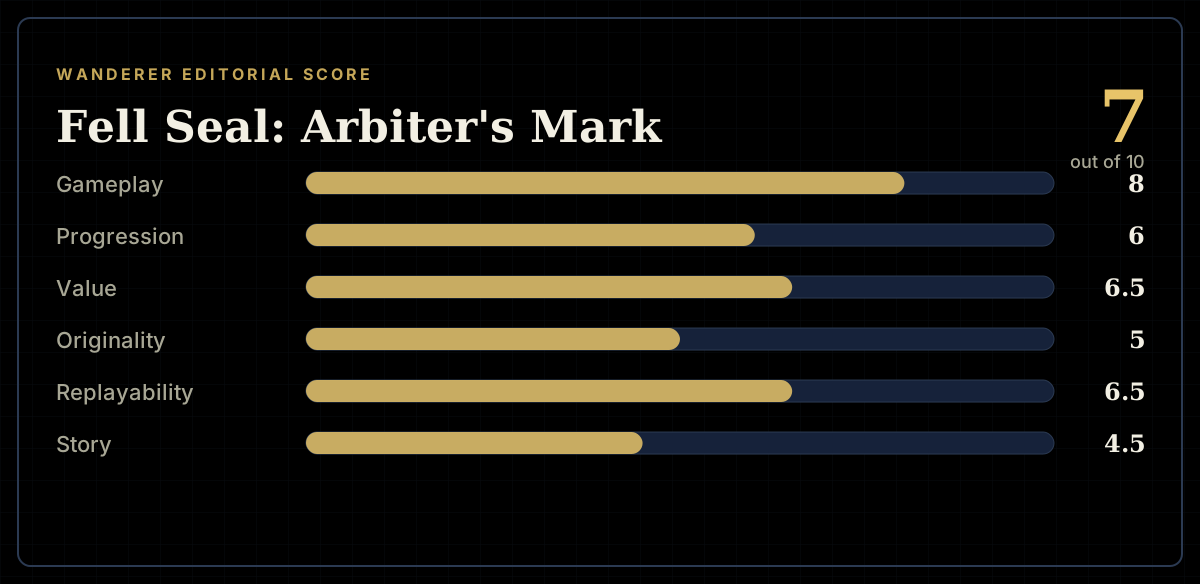
How the review scores each part of the gameWanderer Editorial -
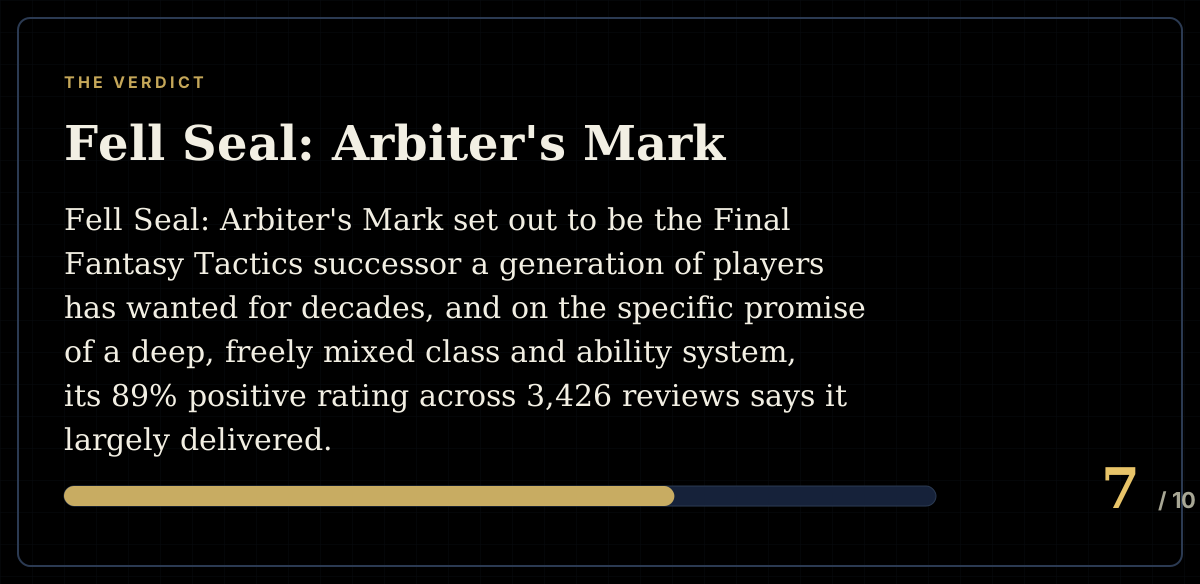
The short versionWanderer Editorial