
Game review
Crusader Kings II
6.5 / 10
- Developer
- Paradox Development Studio
- Publisher
- Paradox Interactive
- Released
- 14 February 2012
- Platforms
- Windows, macOS, Linux
- Genre
- Grand Strategy RPG
- Monetisation
- Free-to-play base game funded by 32 separate paid DLC packs, several of which unlock entire playable regions, cultures or religions rather than optional extras.
- Players
- Multiplayer is supported, though the review sample and this outlet's coverage focus overwhelmingly on the single-player dynasty campaign.
The short version
Crusader Kings II plays a character-driven medieval succession game that almost nothing else on Steam has replicated — you don't control a kingdom so much as a bloodline, scheming, marrying and murdering your way through generations of nobles each with their own agenda. Free-to-play pricing makes the core experience trivially easy to try. The catch, documented in remarkably consistent detail across a decade of reviews, is that the free base game is a fraction of what the design intends, and reviewers who clearly love the game keep giving it thumbs-down anyway over a DLC structure that gates entire cultures, regions and mechanics behind purchases reviewers independently price at well over a hundred dollars to complete.
Biggest strengths
- A genuinely unique format among strategy games — a chain of individually mortal, flawed characters across generations rather than one persistent, ageless empire.
- Deep systems for scheming, diplomacy, succession law, religion and vassal management that reward long, patient engagement.
- Completely free to install and try, with no paywall blocking access to the core game loop entirely.
Biggest weaknesses
- 32 separate paid DLC packs, several of which are reported to gate entire playable regions, cultures or religions rather than cosmetic or minor content.
- Reviewers across nearly a decade independently cite very similar total costs to complete the DLC catalog, in the rough USD130-238 range depending on when they checked.
- At least one reviewer describes the free base game as deliberately reduced to the point of being "basically the diet demo version" without several key expansions.
Who it's for: History and strategy fans who want the deepest character-driven dynasty simulation available, and who are prepared to either budget carefully for DLC or accept a meaningfully reduced experience on the free base game alone.
Our recommendation: Try the free base game to see if the format clicks, then budget deliberately for DLC rather than assuming the full experience is close to free — reviewers are unusually unanimous that it isn't.
6.5 / 10
A format nothing else has quite matched
Crusader Kings II's central idea remains distinctive even now, over a decade after release and several years after its own sequel arrived: you don't play a kingdom, you play a family. Start as a single Christian lord anywhere between 1066 and 1337, and when your character dies — of age, disease, assassination or the battlefield — you continue as their heir, carrying forward accumulated prestige, alliances and enemies rather than restarting. The store page's own feature list captures the texture of that format well: "unravel the plots of your courtiers and vassals, each with their own opinions and agendas," alongside the frank acknowledgement that "loyal vassals can quickly turn to bitter rivals." Official screenshots show the mechanical backbone behind that pitch — a detailed 1066 historical map with named duchies and kingdoms, a vassal list with individual character portraits tracked by name and title, and a difficulty meter alongside diplomacy tools that treat every noble on the map as a distinct, trackable actor rather than a faceless AI player. Few strategy games commit this fully to individual mortality and generational continuity as the actual core loop rather than a flavour layer on top of empire management, and it's the reason this format still has few true successors outside Paradox's own later Crusader Kings III.
What "Very Positive" is actually built on
Nearly 30,500 reviews rate the game Very Positive, and reading a wide sample of the negative ones is more informative here than usual, because the pattern is unusually specific and consistent rather than scattered across unrelated complaints. Reviewer after reviewer, across years, opens by praising the game itself in strong terms before explaining the thumbs-down: "I play Crusader Kings 2 currently, I have a blast while doing so" starts one 2022 review before it turns to DLC pricing. "This game is amazing. It's fun, interesting, educational... and it's so much fun. I love it," reads another from March 2021, immediately followed by the same pivot. A 650-hour player writes plainly that the game "is fantastic" and still can't recommend it, "the pure [expletive] of Paradox's business model" being the sole stated reason. This isn't a case of disappointed players padding out complaints about a mediocre game — it's specifically, repeatedly, players who by their own account love what they're playing declining to endorse how it's sold.
The DLC math, cited independently across a decade
What separates this from a generic "DLC bad" complaint is how specific and how consistent the actual figures are across reviewers who clearly didn't coordinate with each other. A 2018 review titles itself "One of the greatest games ever made… after $200 of DLC." A 2022 review cites "US$164" to get "the proper game." A 2021 review, with 650 hours logged, states the full package runs "well over 130 dollars even on sale." Most tellingly, a review dated 27 May 2026 — the most recent in the sample — puts the number at "$237.77 to complete my collection for a game made IN 2012," explicitly noting the irony of a fourteen-year-old game's DLC catalog still growing in price. A December 2025 review adds a structural point rather than just a price tag: the free base game "requires around 3 to 4 DLCs to actually enjoy," calling it "basically the diet demo version" of the intended experience. Another review raises a more specific access complaint — that DLC gates the ability to play as cultures and regions "anywhere besides western Europe," meaning a free player's historical map is meaningfully smaller than the one shown in the game's own promotional screenshots. Given that these figures and complaints recur independently across at least eight separate years of reviews rather than clustering around one bad sale or one controversial expansion, this reads as a stable, long-term business practice rather than a temporary pricing misstep.
Why "just play the free version" undersells the problem
It would be easy to read all of this and conclude the solution is simple: play the free base game, skip the DLC, and judge the design on its own merits without worrying about Paradox's pricing at all. The reviewers cited above make clear why that doesn't fully work as advice. Grand strategy games like this one are explicitly designed around breadth — more playable starting positions, more cultures with distinct mechanics, more religious and legal systems to interact with — and a base game that several long-term players describe as deliberately reduced to push DLC purchases isn't really the same designed experience running at a smaller scale. It's closer to a demo shaped like a full game, which is precisely the distinction the December 2025 review draws when it calls the free version "the diet demo version" rather than simply "a smaller version." A reader taking this review's recommendation to "try the free version" should understand they may be evaluating a meaningfully different, narrower design than the one nearly 30,500 reviews are actually rating, not a fair, if smaller, sample of the same game.
Final verdict
Crusader Kings II deserves its reputation as one of the most distinctive, deeply systemic strategy games ever released, and nothing in this review disputes that the core design — mortal, flawed characters carrying a dynasty's fortunes across generations — is genuinely excellent. What keeps the score from reflecting that achievement alone is that the score has to account for what actually reaches a player who installs the free base game, and reviewer after reviewer, independently and across a decade, describes that as a meaningfully incomplete slice of the design gated behind a DLC catalog now approaching or exceeding the cost of several full-price AAA games. Try it for free to see if the format grabs you the way it's grabbed tens of thousands of players before you — just go in with a clear-eyed budget for what the full experience will actually cost, rather than assuming "free" means what it usually means.
Pros and cons
Pros
- A genuinely unique format among strategy games — a chain of individually mortal, flawed characters across generations rather than one persistent, ageless empire.
- Deep systems for scheming, diplomacy, succession law, religion and vassal management that reward long, patient engagement.
- Completely free to install and try, with no paywall blocking access to the core game loop entirely.
- A specific, respected place in strategy-gaming history as the game that established the template Crusader Kings III later refined.
Cons
- 32 separate paid DLC packs, several of which are reported to gate entire playable regions, cultures or religions rather than cosmetic or minor content.
- Reviewers across nearly a decade independently cite very similar total costs to complete the DLC catalog, in the rough USD130-238 range depending on when they checked.
- At least one reviewer describes the free base game as deliberately reduced to the point of being "basically the diet demo version" without several key expansions.
- A specific complaint recurs about DLC-gating access to non-Western-European regions and cultures, limiting where in the game's own historical map a free player can actually rule.
Screenshots
-

Crusader Kings IIImage: Paradox Interactive via Steam -

Crusader Kings IIImage: Paradox Interactive via Steam -

Crusader Kings IIImage: Paradox Interactive via Steam -
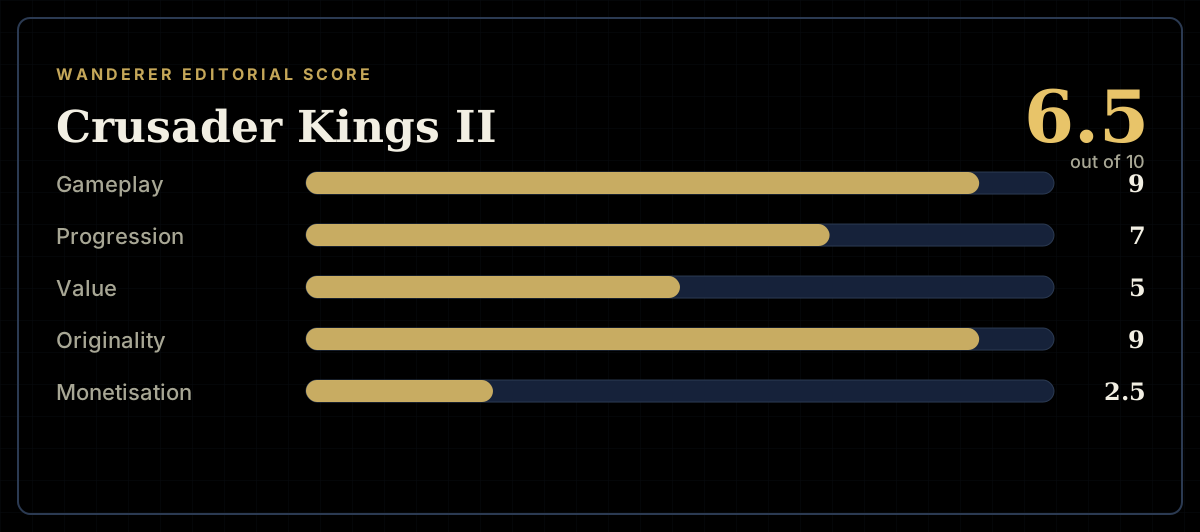
How the review scores each part of the gameWanderer Editorial -
The short versionWanderer Editorial