
Game review
Fantasy World Online Tycoon
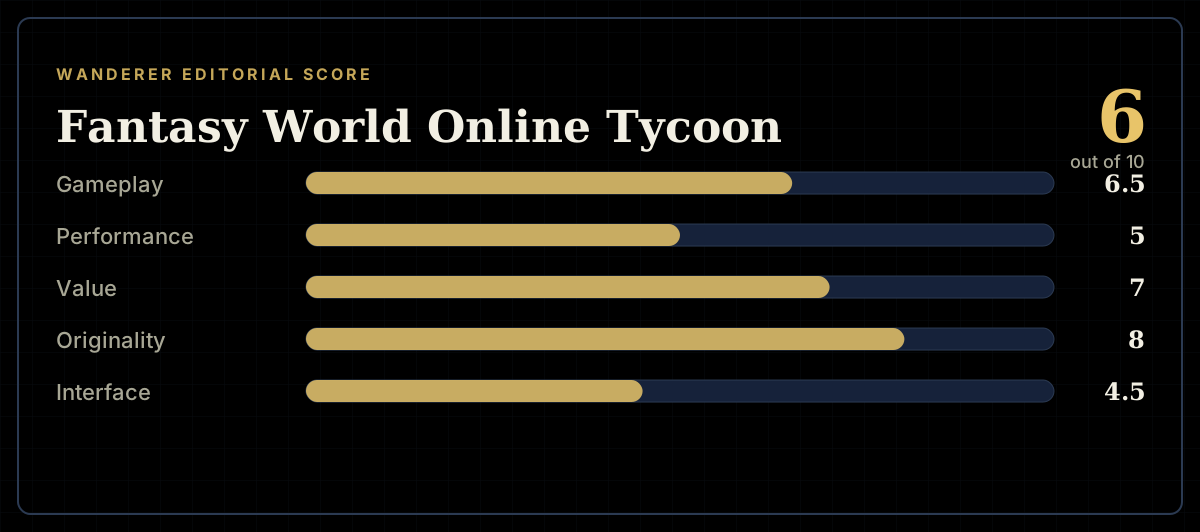
6 / 10
- Developer
- Roberto Trasarti
- Publisher
- Roberto Trasarti
- Released
- 20 April 2020
- Platforms
- Windows
- Genre
- Tycoon Management
- Monetisation
- Paid, one-time purchase. No in-app purchases or subscriptions found on the store page; NZ$12.39 base price, frequently discounted as steeply as 75%.
- Players
- Single-player. The "players" populating your MMORPG are AI, not other people.
The short version
Fantasy World Online Tycoon's premise is genuinely clever: you're not the hero exploring a fantasy MMORPG, you're the studio CEO who built it, setting monster spawns and potion prices while hired specialists fight off bugs, cyberattacks and server failures to keep your subscriber count climbing. A five-year, 49-review record backs up that the idea works well enough to hold a Mostly Positive rating from a genuinely engaged small audience. The same record just as consistently flags a missing tutorial, thin tooltips and bugs that never fully went away, and the most recent review on file — over a year after the last substantive patch — calls it barely functional.
Biggest strengths
- The core hook — running the business behind an MMORPG rather than a character inside one — is a genuinely distinctive angle the tycoon genre rarely attempts.
- Systems stretch beyond simple building placement into pricing potions and trainers, hiring R&D/tech/support/marketing specialists, and managing subscriber-facing crises like bugs and server failures.
- Several years of reviews credit the solo developer with fast, responsive bug fixes and steady content updates through most of the game's life.
Biggest weaknesses
- A recurring complaint across multiple years of reviews: no real tutorial and thin or absent tooltips, leaving core systems like pricing hard to discover.
- At least one specific, reproducible complaint describes a UI softlock when trying to set prices without a numeric keypad.
- Development has visibly slowed: the last substantive update landed in October 2024, and the most recent review on file, from February 2026, calls the game "barely functional."
Who it's for: Tycoon and management-sim players curious about an angle the genre rarely takes, who are willing to tolerate a rough, occasionally cryptic interface and the fact that a solo developer's updates have slowed to a stop since late 2024.
Our recommendation: A worthwhile discount purchase for tycoon fans who want something distinct from the genre's usual theme parks and hospitals, with realistic expectations about its rough edges and its now-quiet development.
6 / 10
Managing the game instead of playing it
Most tycoon games ask you to run a theme park, a hospital or a small business. Fantasy World Online Tycoon asks you to run an MMORPG studio, and the distinction shapes almost everything about it. You don't control a hero wandering an isometric fantasy map — you place the monster spawns your AI subscribers will fight, set the level and rewards on the quests they'll complete, design the dungeons they'll explore, and adjust the prices on the potions, trainers and equipment upgrades that keep your in-game economy balanced. A visible subscriber count in the corner of the interface functions as the game's real scorecard, standing in for the box-office or guest-satisfaction numbers a normal tycoon game would track, and a four-segment mood meter tracks how happy your simulated playerbase currently is with what you've built for them.
The studio-management layer runs in parallel with the world-building one. The store description is specific about it: you hire specialists across research and development, technology, client support and marketing, and you have to weather "crisis" events — bugs, cyberattacks, server failures — that threaten to make your simulated users "run away," in the same language any real live-service operator would use. It's a smart piece of thematic framing: the game is honest that running an online game is partly a content problem and partly an uptime-and-support problem, and it makes you manage both.
A genuinely engaged small audience, with the same complaints recurring for years
Steam's review data for this game is worth reading in full rather than trusting the badge alone. Forty-nine reviews spanning April 2020 through February 2026 average out to "Mostly Positive" (37 positive, 12 negative), and unlike a lot of small, quiet Steam releases this one is a real, continuously-refreshed sample rather than a launch-week fossil — reviews land in nearly every year from 2020 to 2026, not just clustered at release. The praise is consistent and specific: reviewers repeatedly credit the developer's responsiveness to bug reports and community suggestions, several explicitly compare the concept favourably to Roller Coaster Tycoon and Theme Park for capturing that same "build something and watch it work" satisfaction, and more than one says outright that managing this fictional MMORPG is more fun than playing an actual one.
The criticism is just as consistent, and just as specific, which matters more than the star split itself. From a 2020 review to a 2022 one to a 2023 one, the same two complaints keep resurfacing almost word for word: no real tutorial, and tooltips too thin to explain what half the interface is doing. One 2023 review describes a specific, reproducible failure rather than a vague gripe — being unable to set prices at all because the input requires a numeric keypad the reviewer's setup didn't have, effectively soft-locking basic economy management five minutes in. Multiple reviewers across different years independently use the same framing: that a game sold as a finished 1.0 release still plays like it's in Early Access.
Depth versus difficulty are two different complaints, and reviewers separate them
It's worth distinguishing two criticisms that could easily blur into one another. Several reviewers describe the actual economic simulation as thin once you've learned it — one 2022 review calls the game "not very challenging" while still recommending it for the creative building it allows, and another from the same year separately flags the management layer as "very limited... almost non-existent" once the novelty of the concept wears off. That's a different complaint from the tutorial and interface gap covered above: it isn't that the systems are hard to find, it's that once found, several of them don't have much depth to reward mastering. A tycoon game can survive either complaint in isolation — Roller Coaster Tycoon veterans happily play shallow scenarios for the building alone — but having a confusing frontend on top of a simulation multiple reviewers already consider mechanically light is a harder combination for a new player to push through.
The most recent signal is the least encouraging one
Separating launch-era grumbling from current conditions is usually the point of checking review timestamps, and here it cuts against the game rather than for it. The developer's own update history shows a real, sustained patch cadence from mid-2020 through most of 2024 — bug fixes, a "New Engine" update in January 2023, new bosses and a dungeon system added in March 2022 — before going quiet after an "Avatar Fix" posted in October 2024. The single most recent review on file, from February 2026, is a one-line pan: "Barely functional, I'm not sure I'd call this a game." That's one data point and shouldn't be read as a verdict on its own, but its timing lines up exactly with what over sixteen months of silence from the developer would predict — a game whose rough edges were previously being sanded down in real time is no longer being actively maintained, and the most recent piece of evidence available says that's starting to show.
Final verdict
Judged purely on its central idea, Fantasy World Online Tycoon deserves real credit: putting the player behind the curtain of an MMORPG's business, rather than inside its fantasy, is a distinctive enough angle that it's easy to see why a small but genuine audience stuck with it for five years. Judged as a piece of software to install today, it's harder to recommend without real caveats — the tutorial and tooltip gaps reviewers flagged in 2020 were apparently never fully solved, at least one concrete usability bug can lock a new player out of core mechanics, and the developer's own update pace has slowed to nothing over the past year and a half. At its steep, frequent discount price it's a reasonable gamble for tycoon fans specifically drawn to the concept. It is not, on the current evidence, a game anyone should expect continued support for.
Pros and cons
Pros
- The core hook — running the business behind an MMORPG rather than a character inside one — is a genuinely distinctive angle the tycoon genre rarely attempts.
- Systems stretch beyond simple building placement into pricing potions and trainers, hiring R&D/tech/support/marketing specialists, and managing subscriber-facing crises like bugs and server failures.
- Several years of reviews credit the solo developer with fast, responsive bug fixes and steady content updates through most of the game's life.
Cons
- A recurring complaint across multiple years of reviews: no real tutorial and thin or absent tooltips, leaving core systems like pricing hard to discover.
- At least one specific, reproducible complaint describes a UI softlock when trying to set prices without a numeric keypad.
- Development has visibly slowed: the last substantive update landed in October 2024, and the most recent review on file, from February 2026, calls the game "barely functional."
- Several reviewers independently describe the finished 1.0 release as still feeling like an Early Access build.
Screenshots
-

Fantasy World Online TycoonImage: Roberto Trasarti via Steam -

Fantasy World Online TycoonImage: Roberto Trasarti via Steam -

Fantasy World Online TycoonImage: Roberto Trasarti via Steam -
How the review scores each part of the gameWanderer Editorial -
The short versionWanderer Editorial